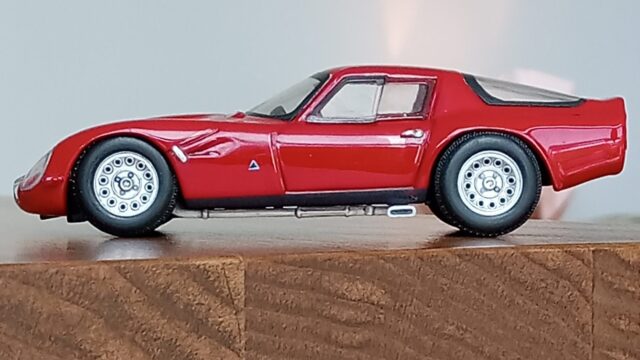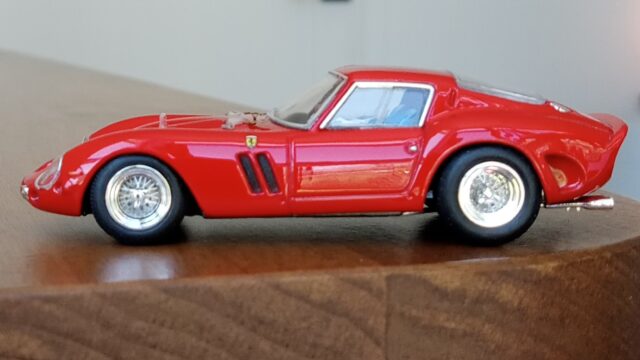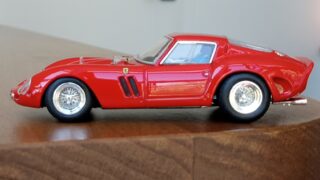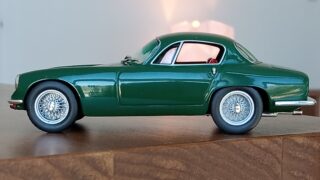
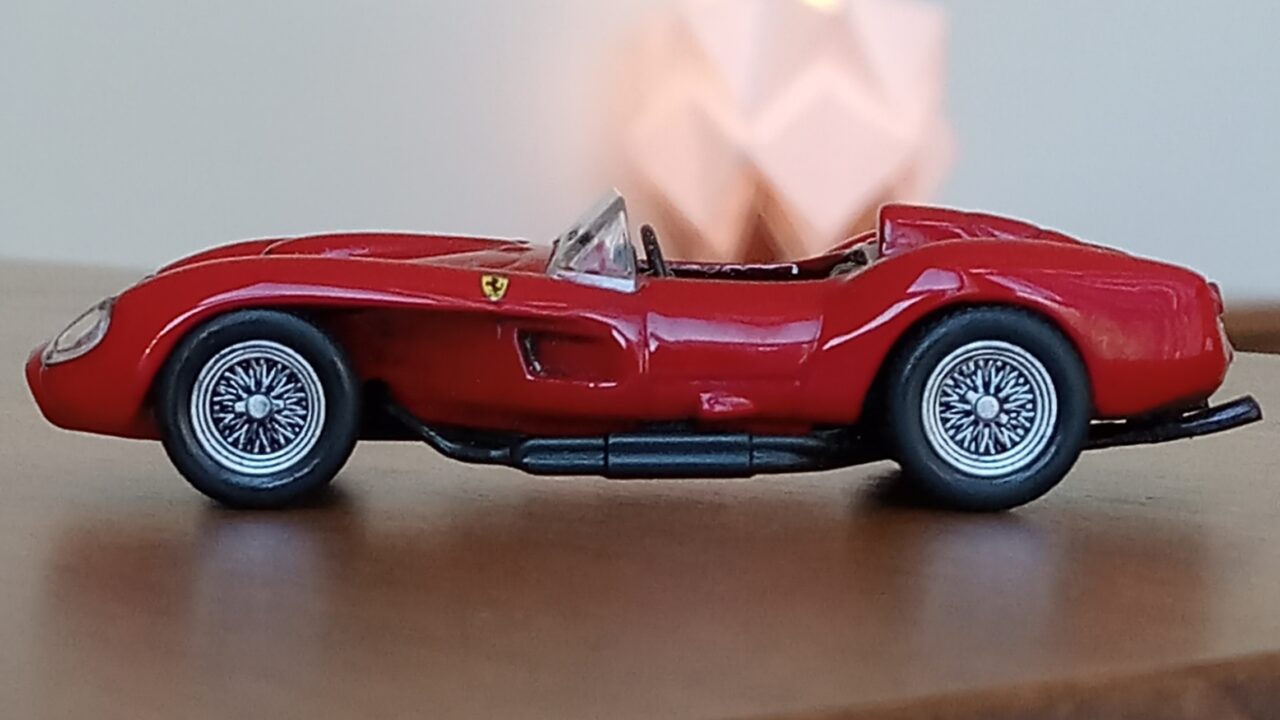
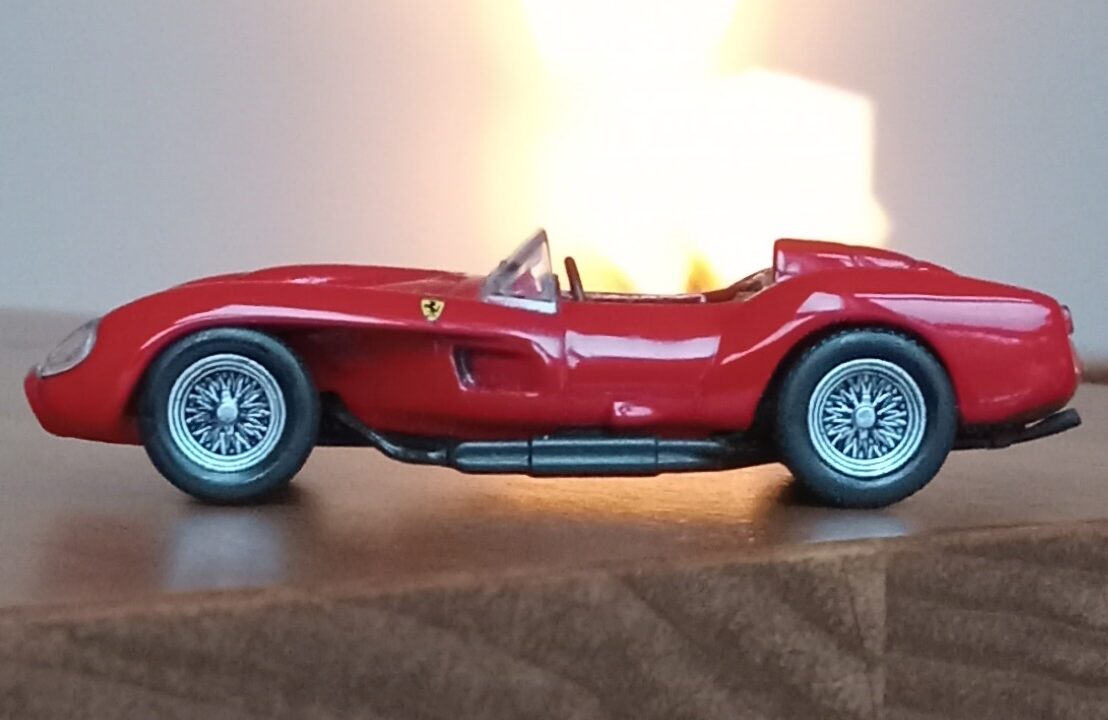
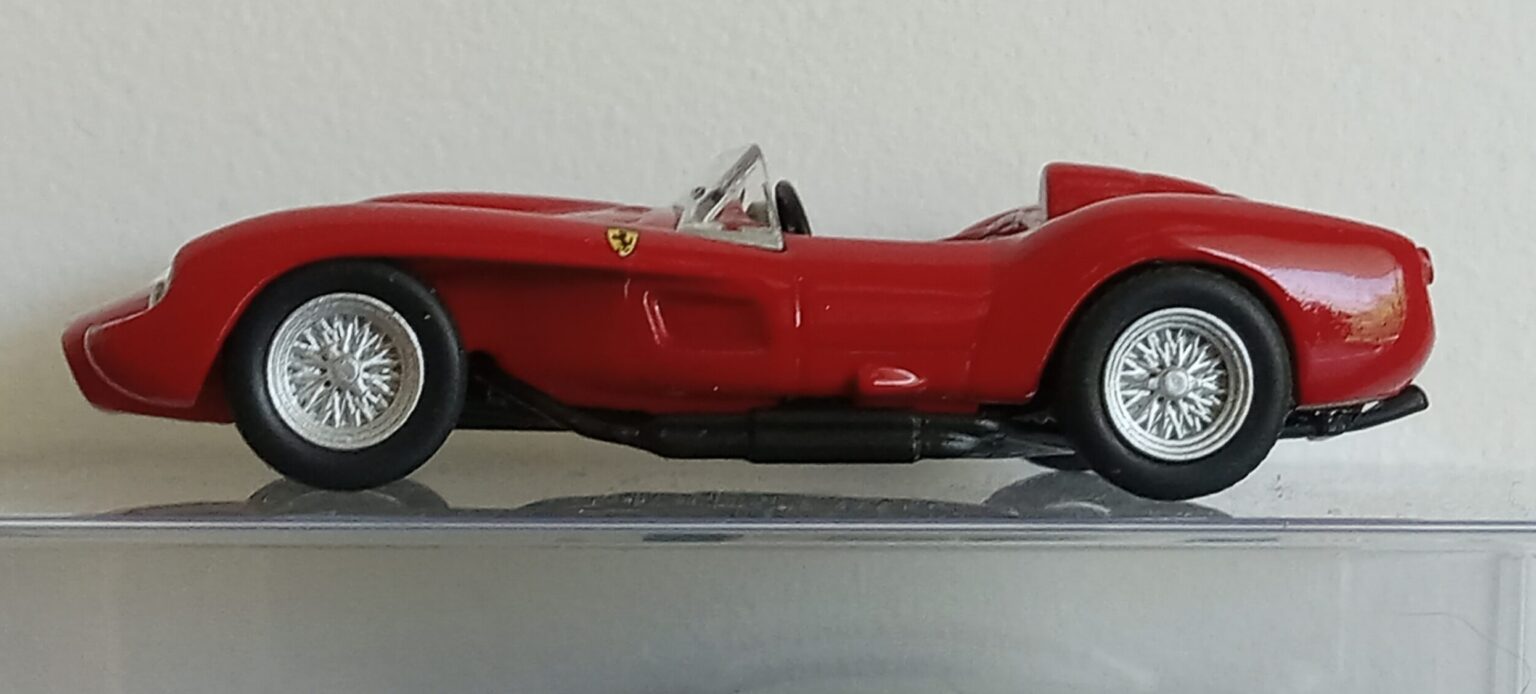
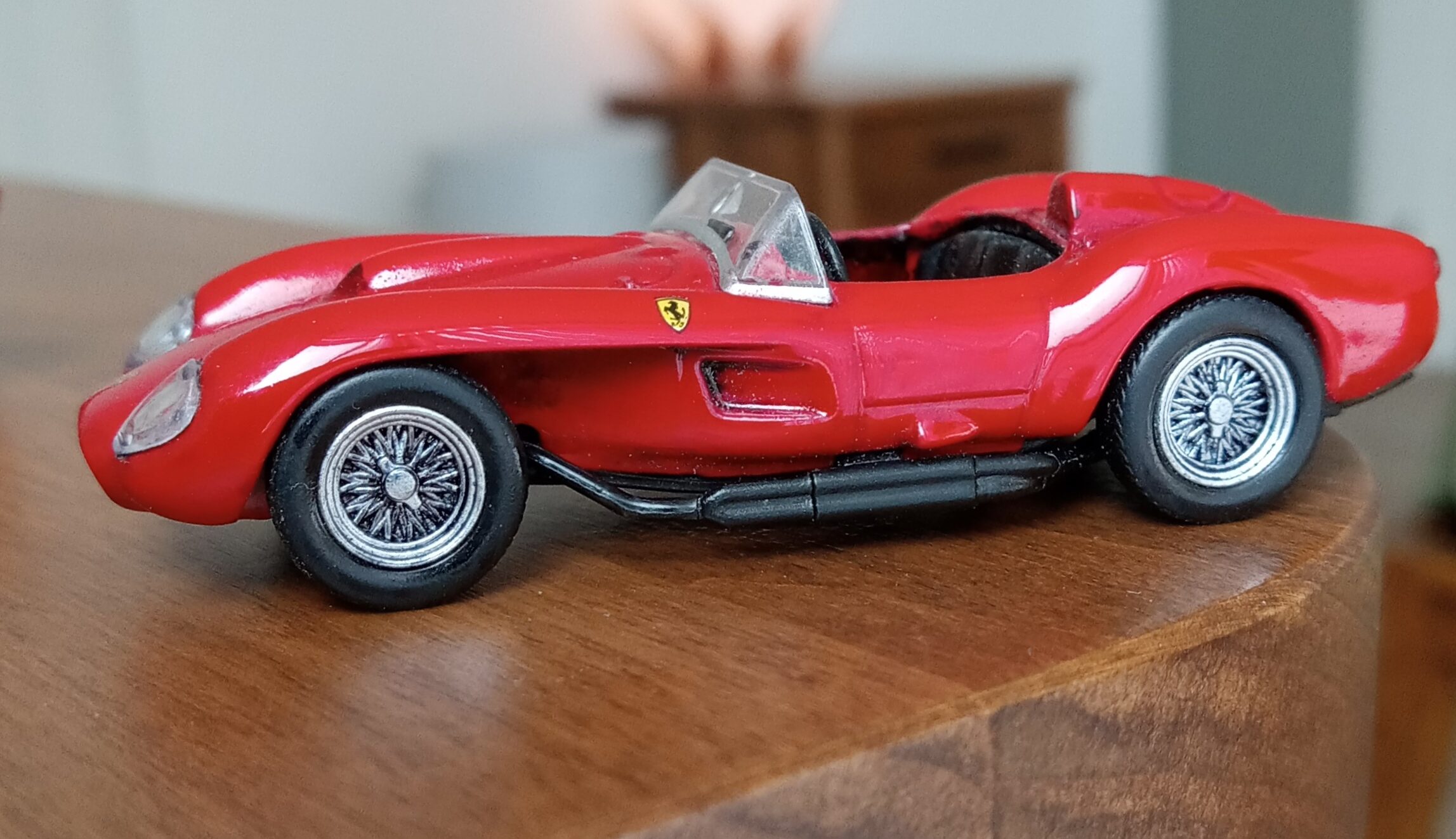
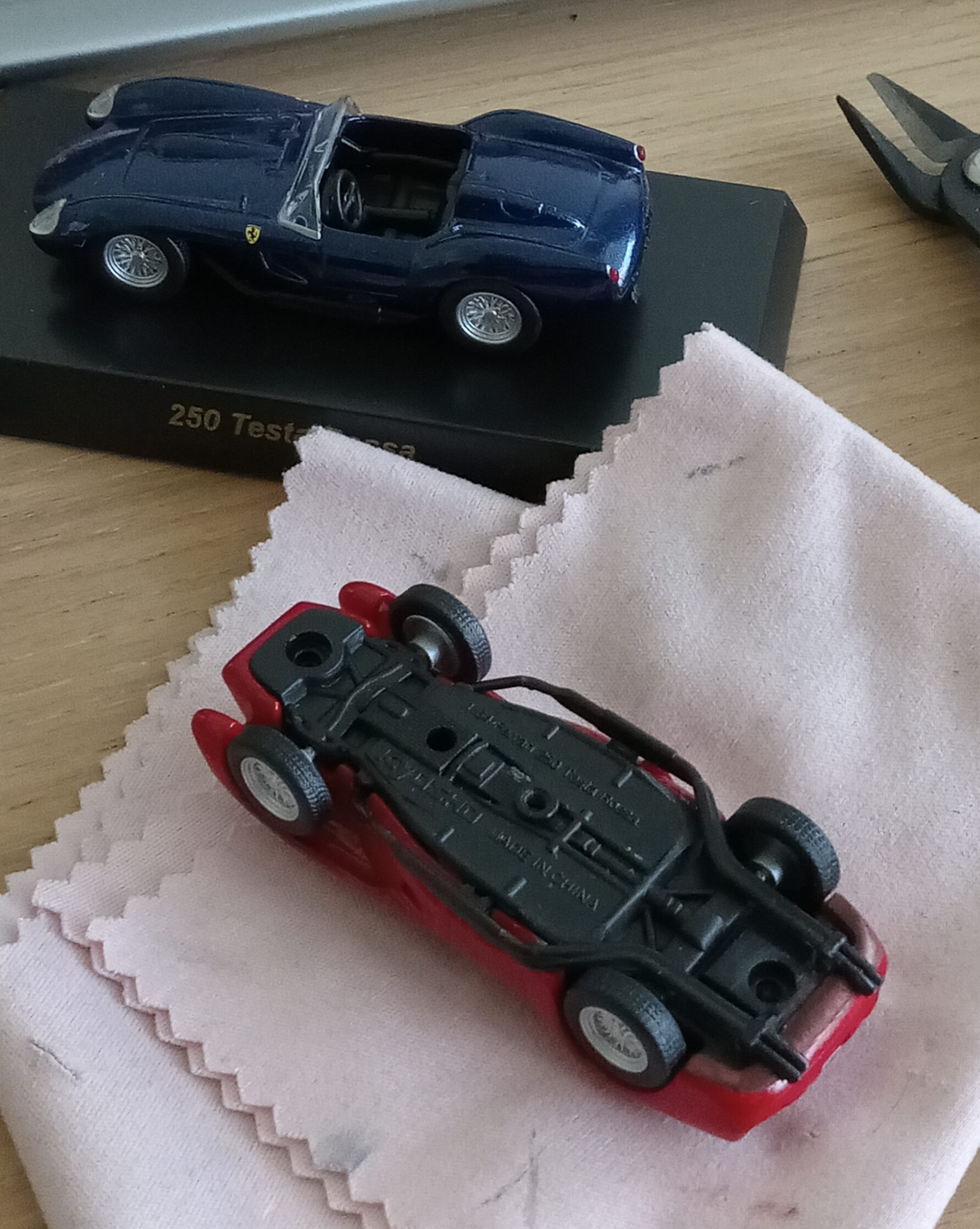
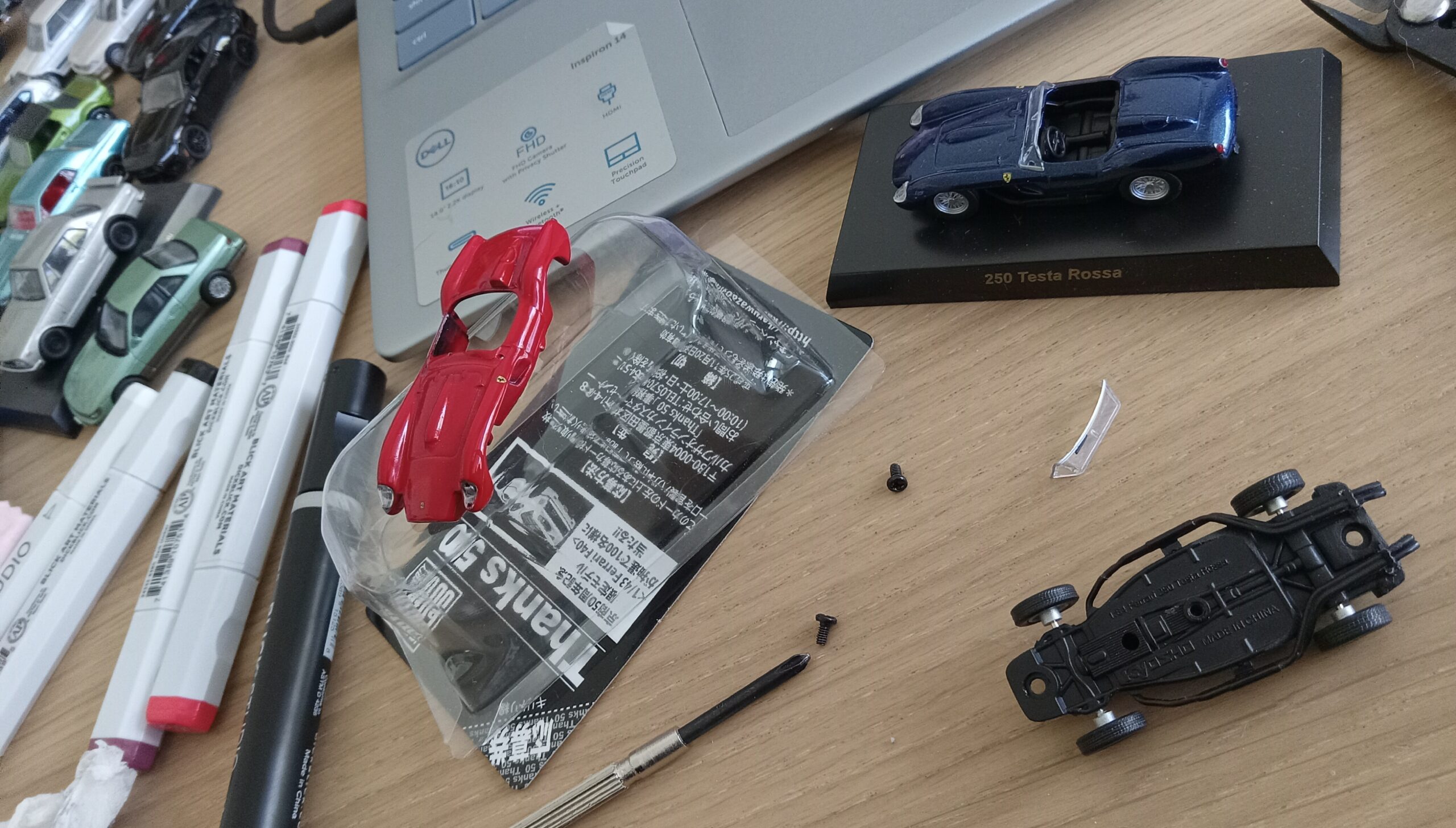
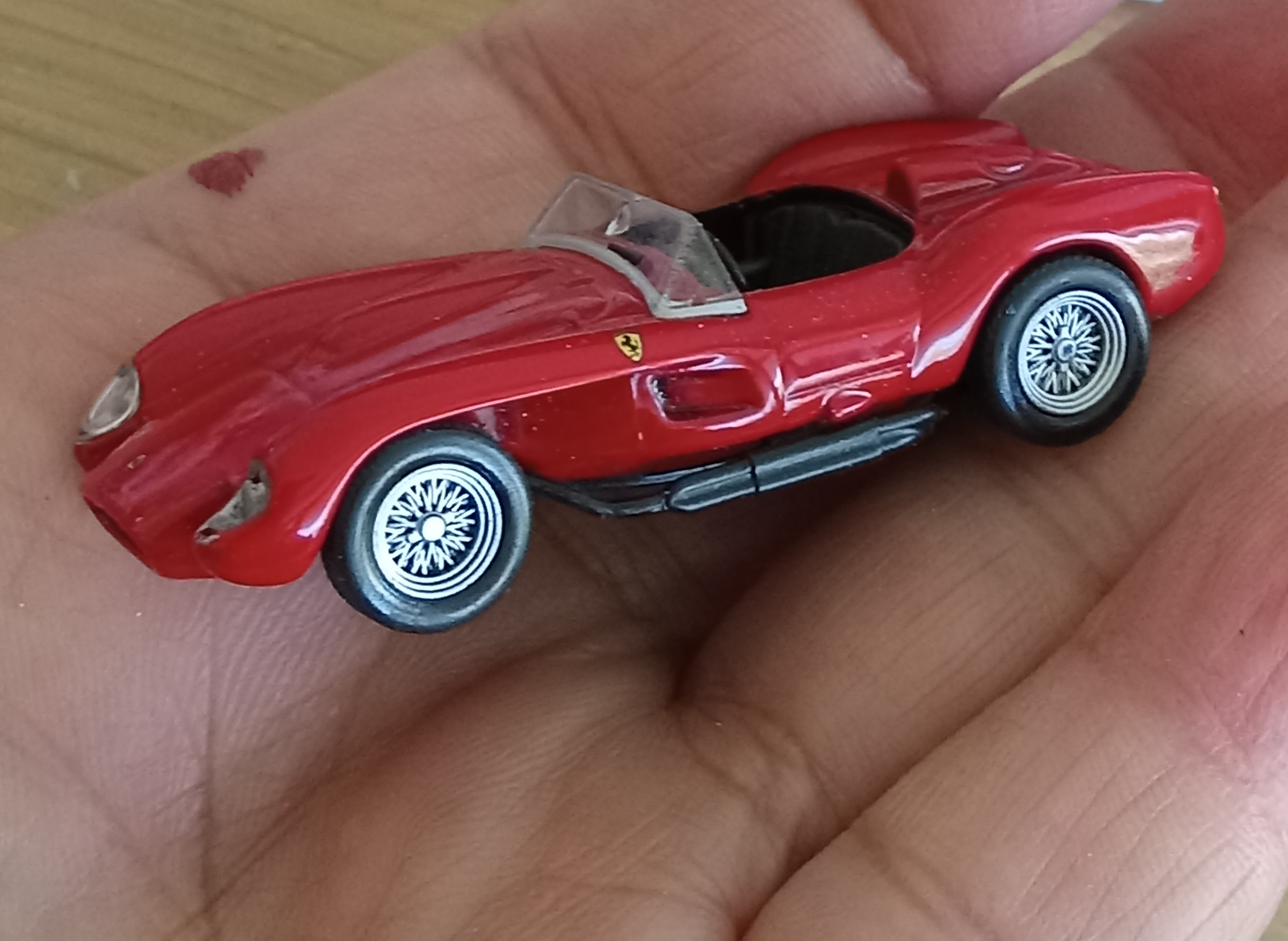
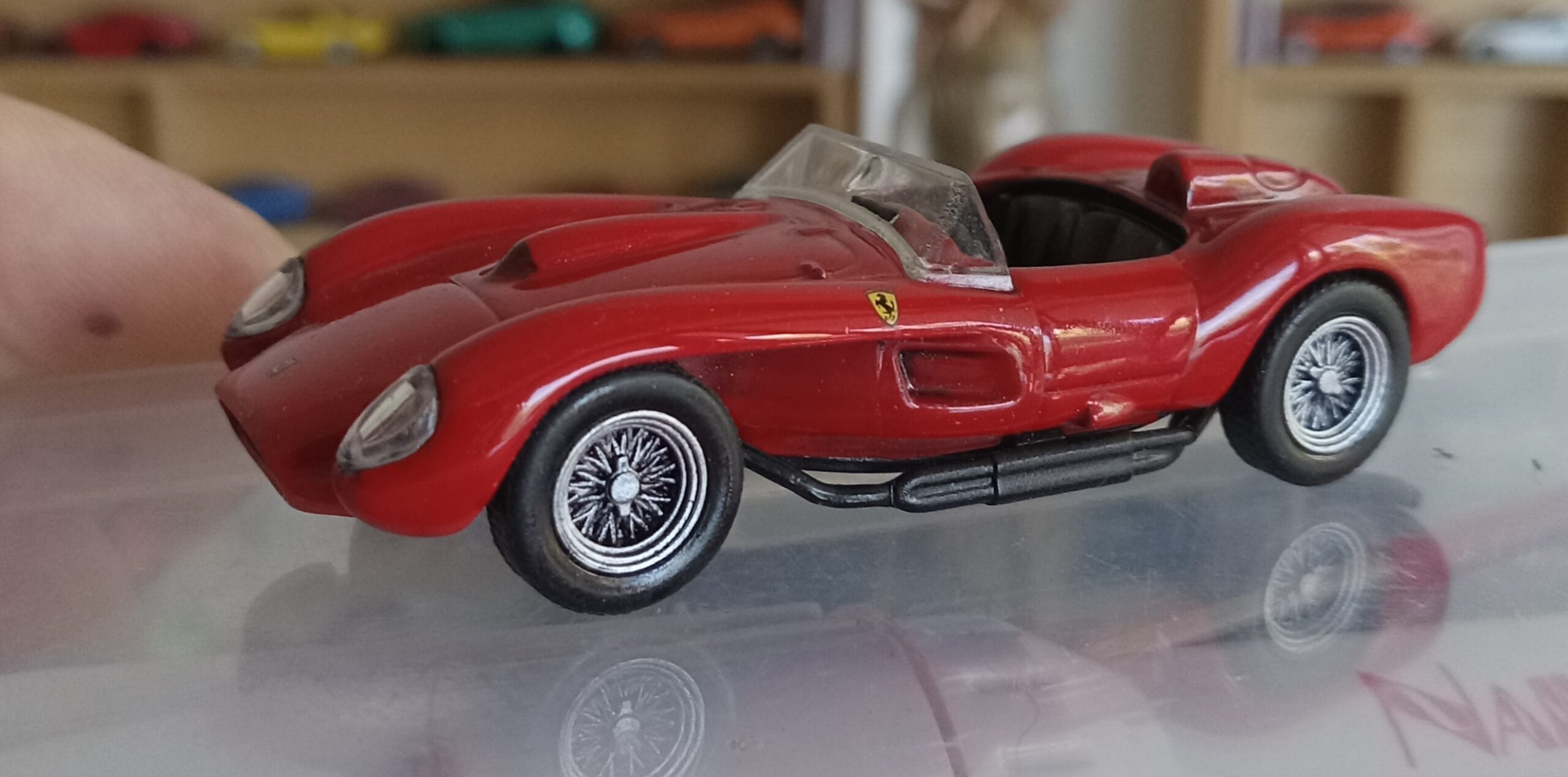
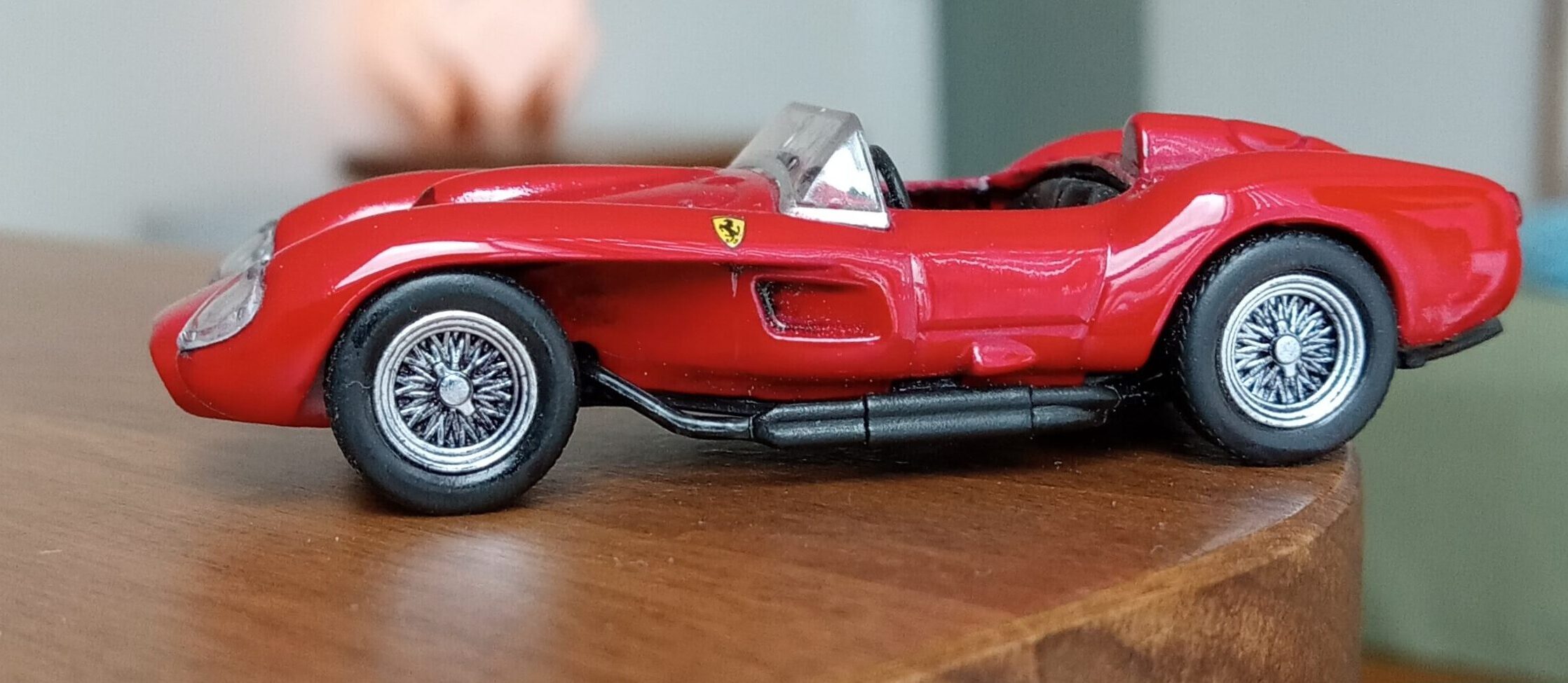
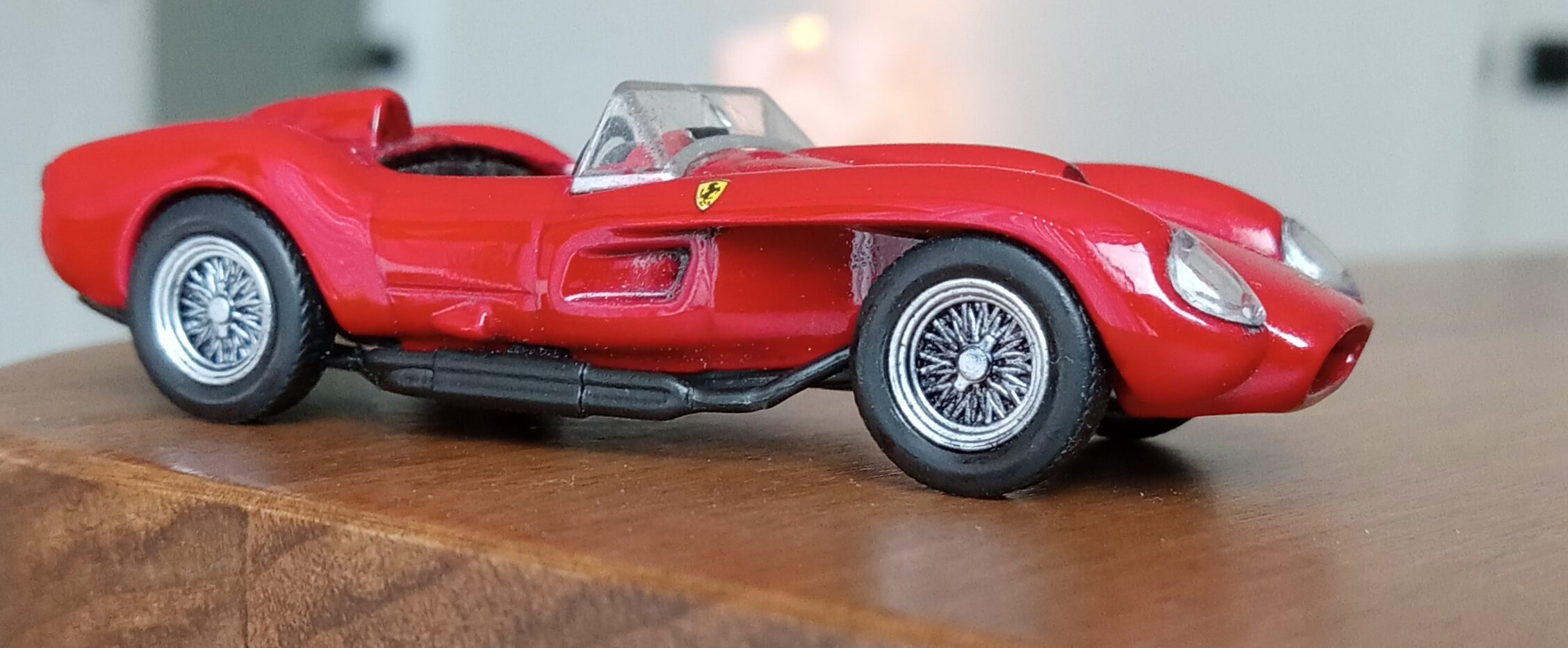
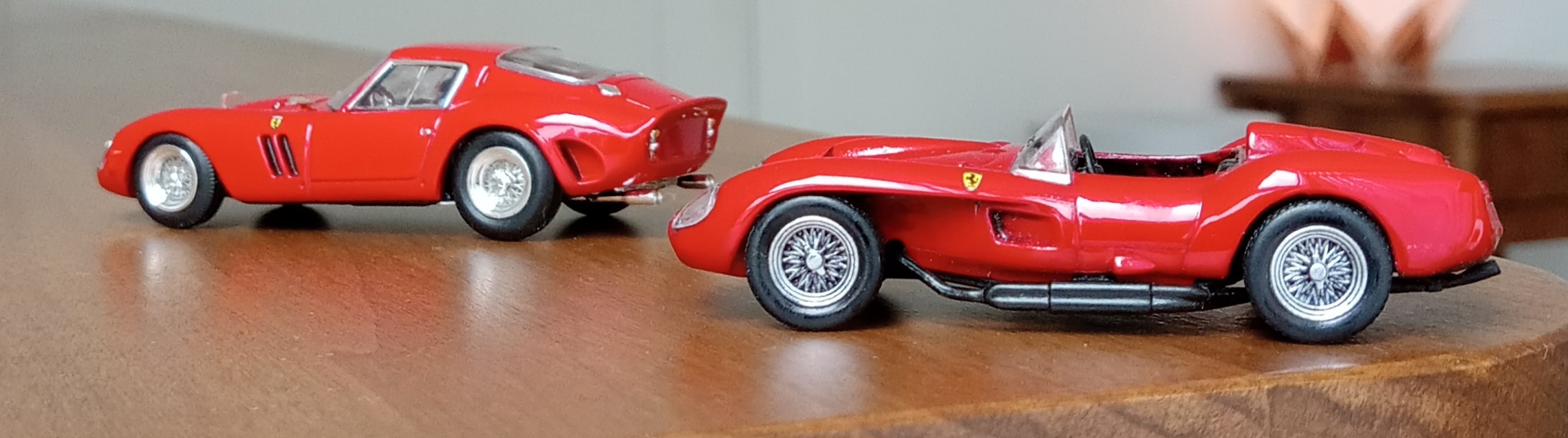
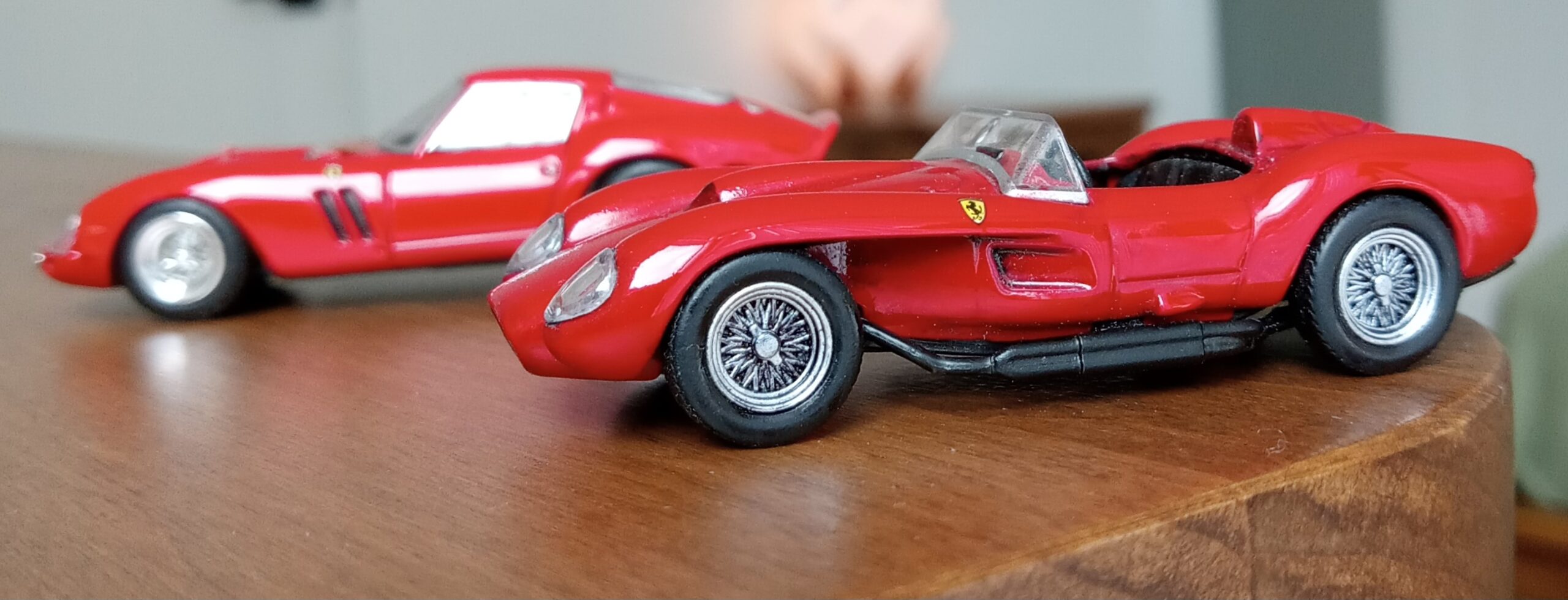
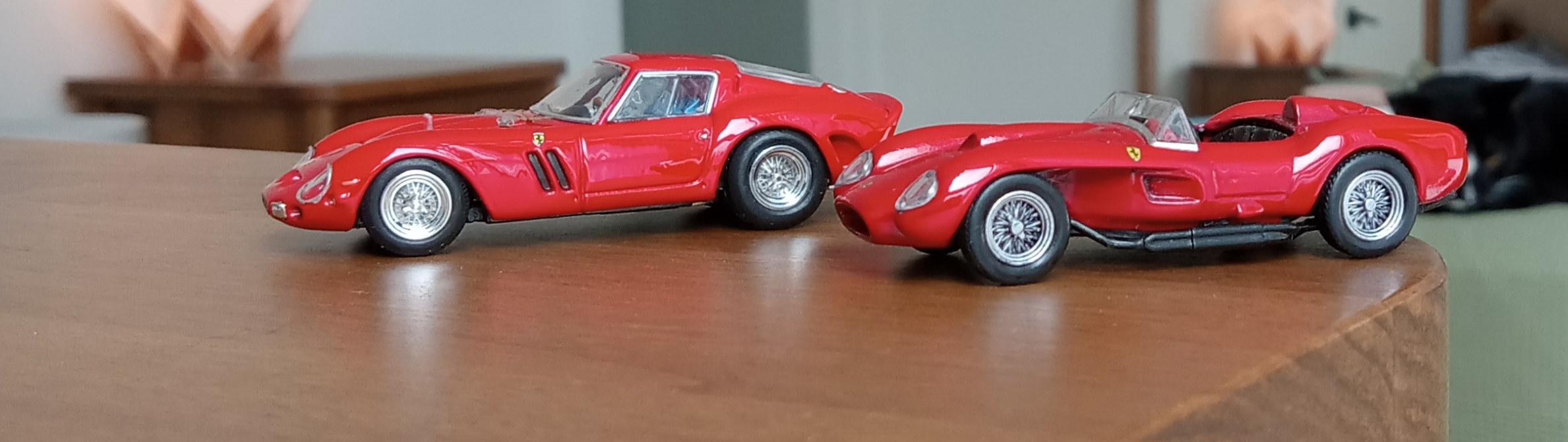
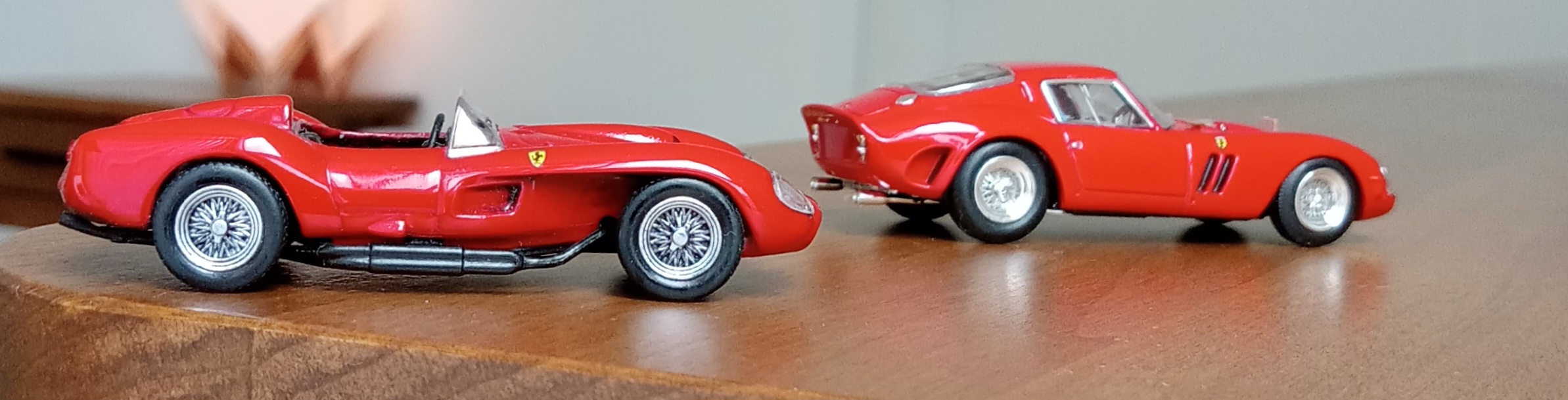
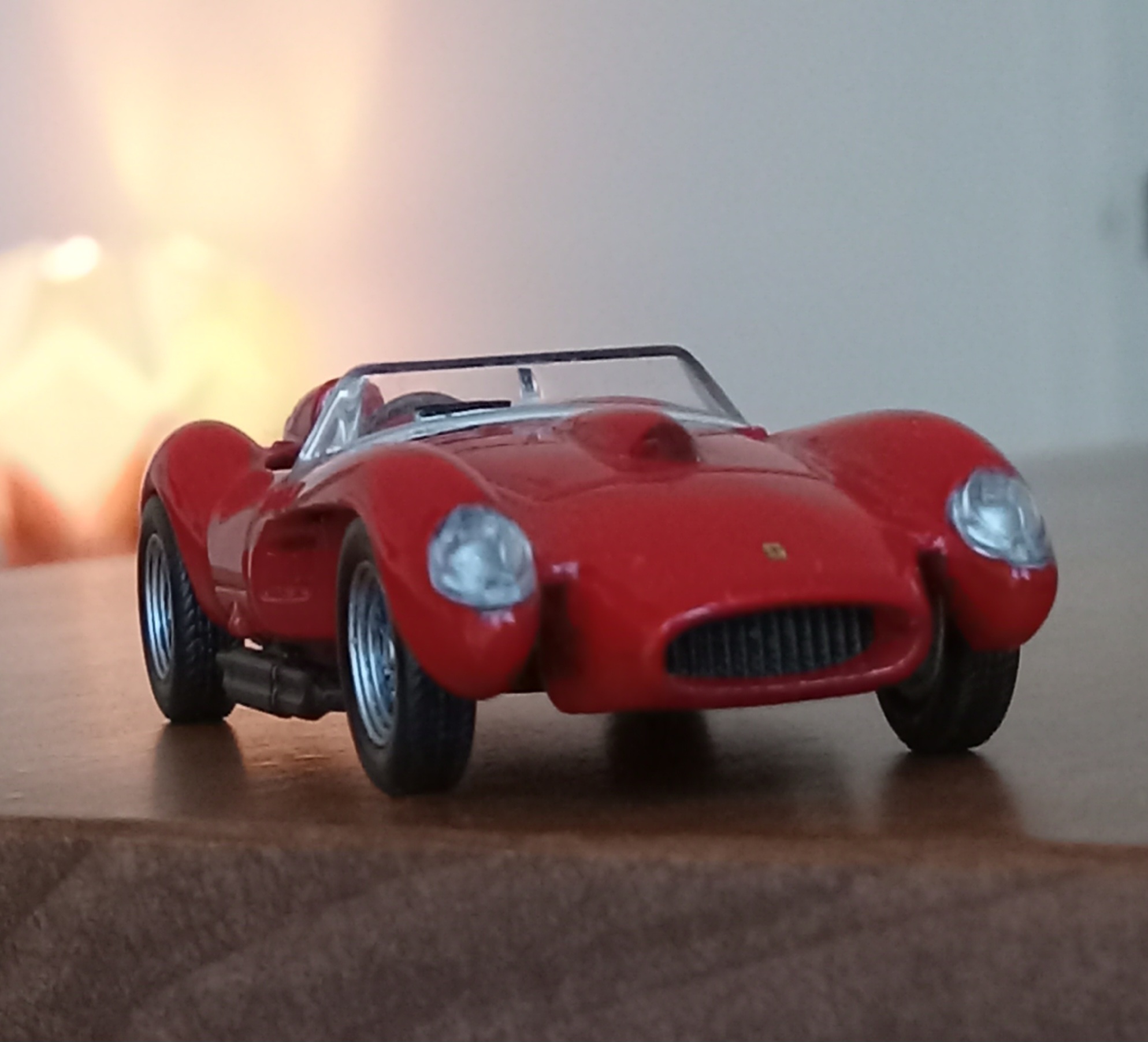
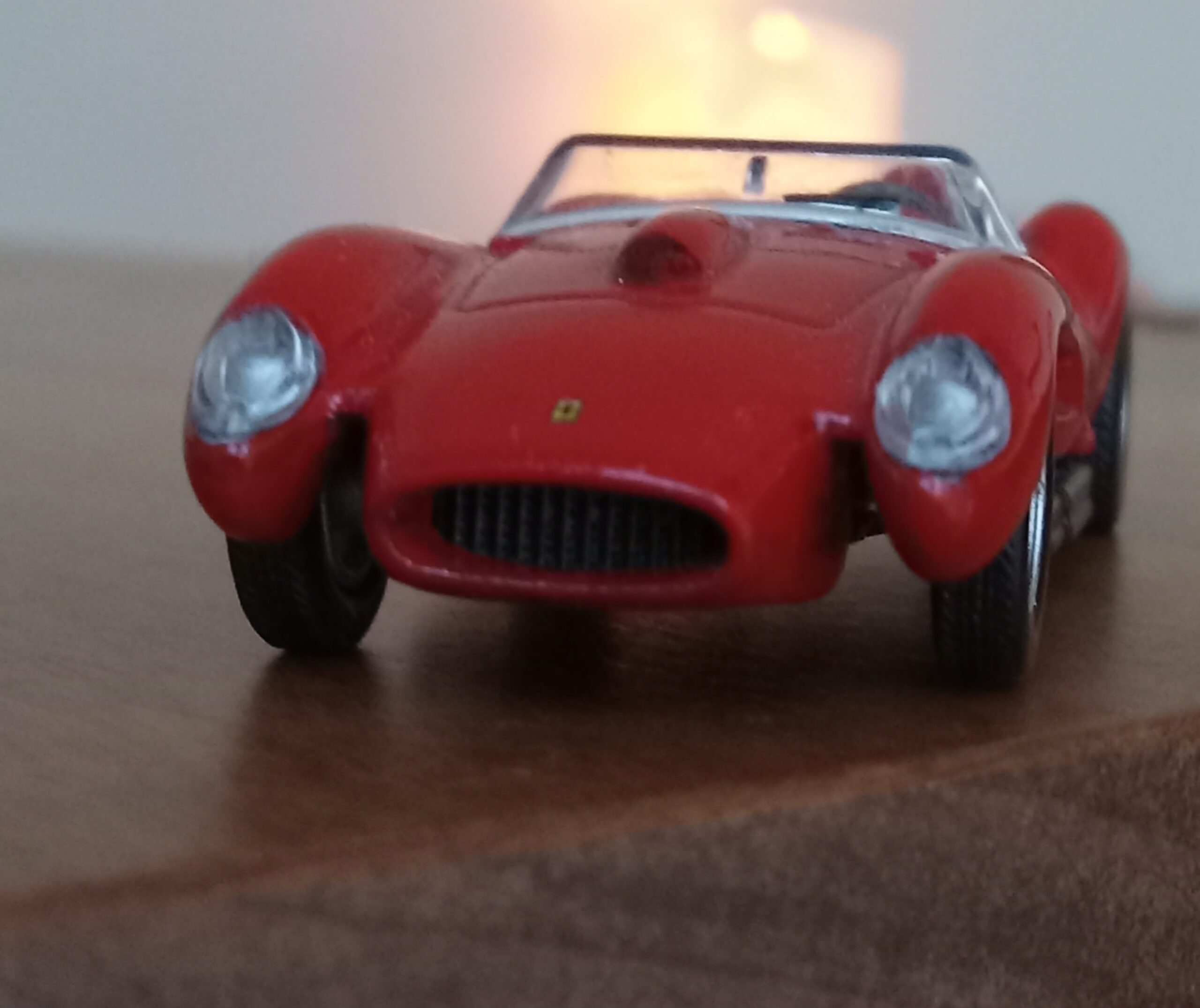
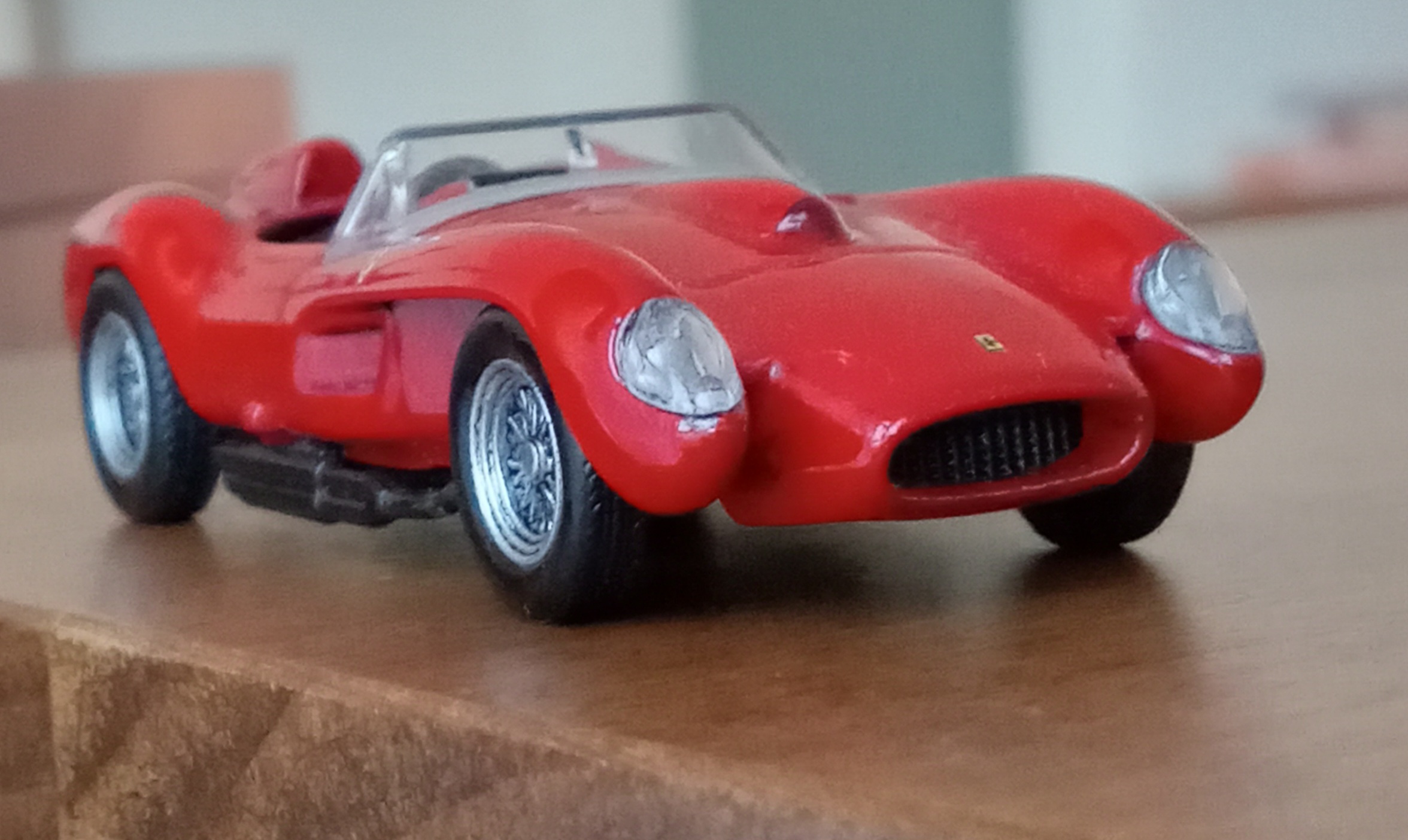
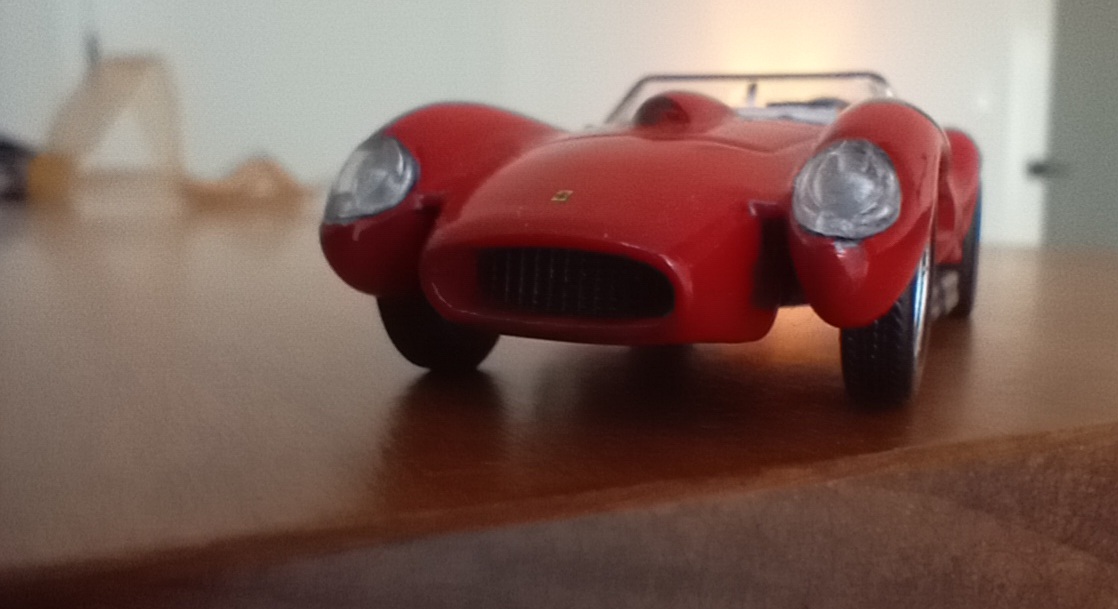
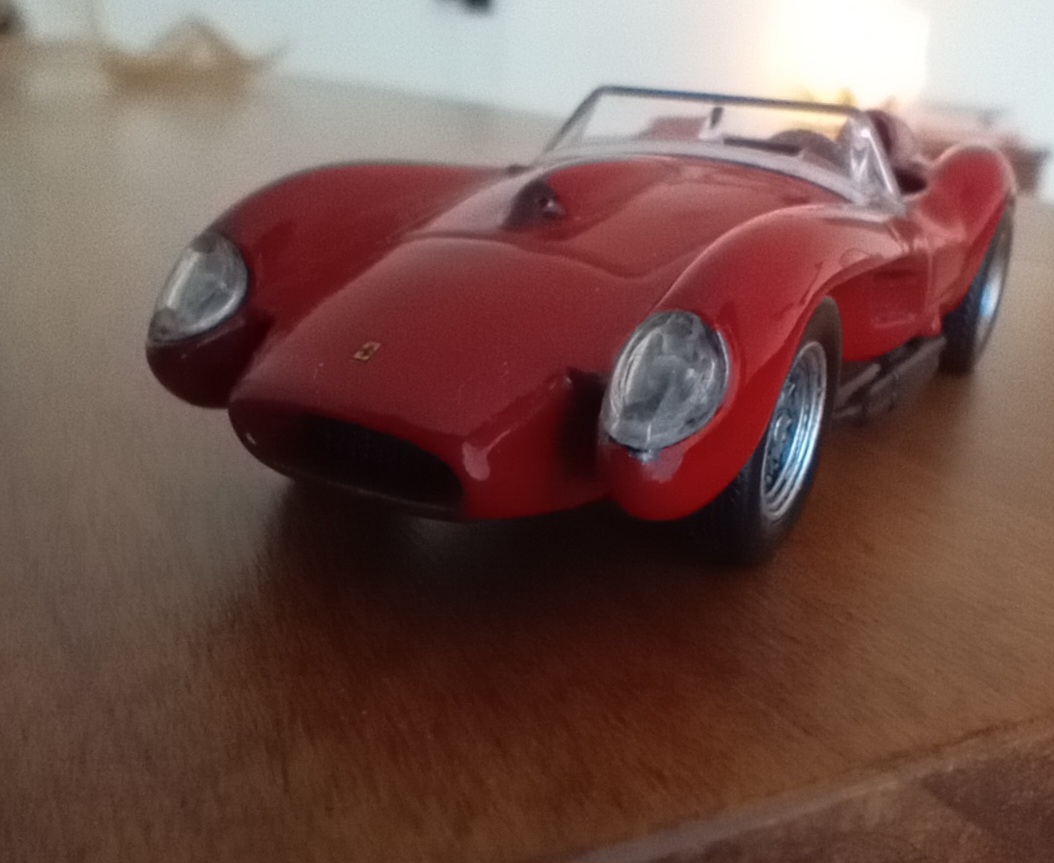
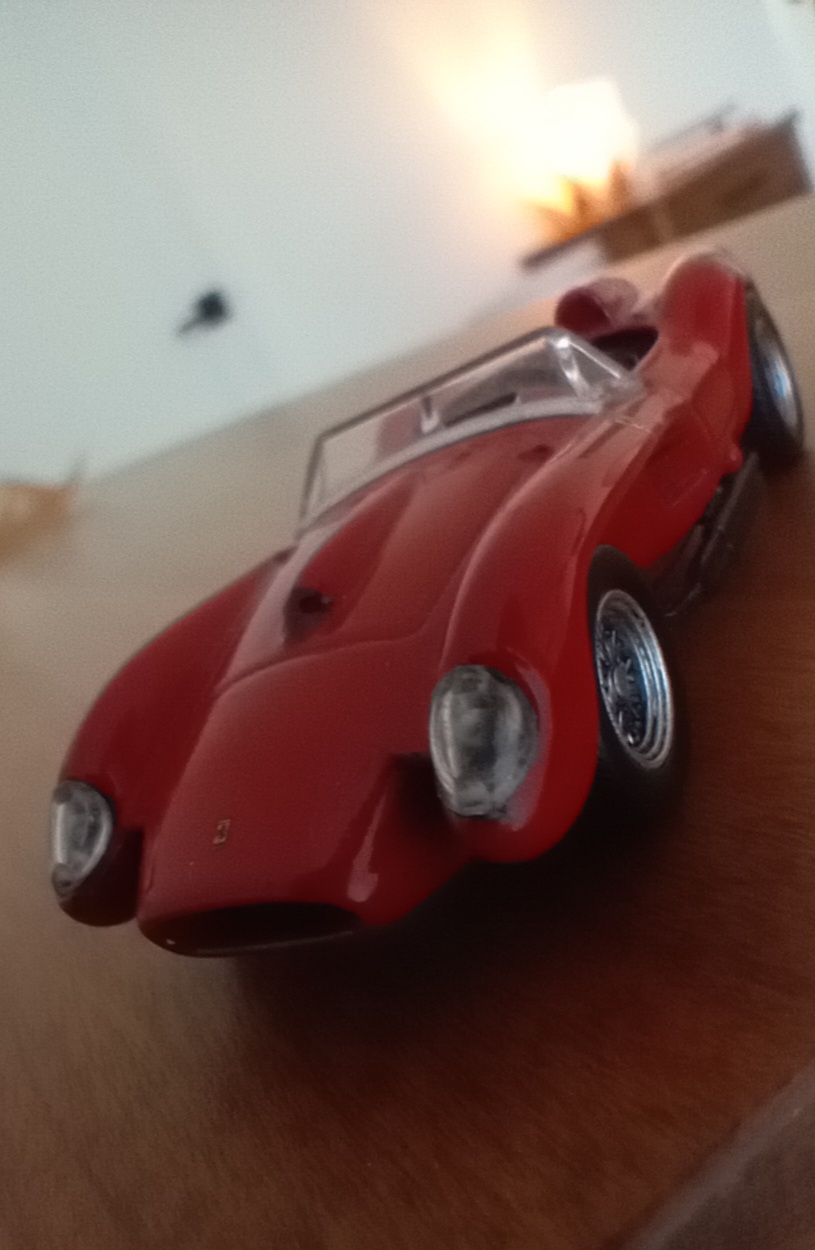
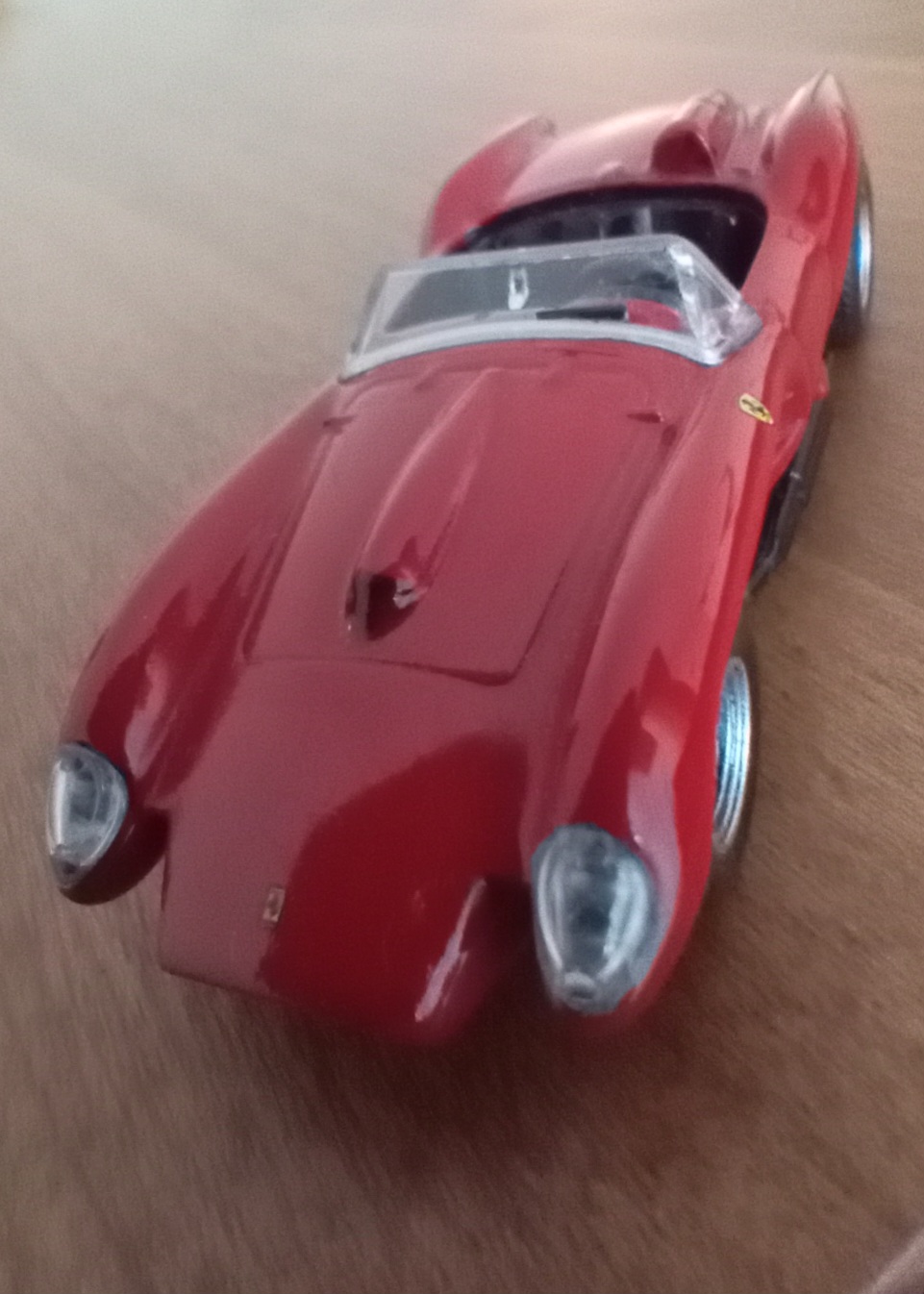
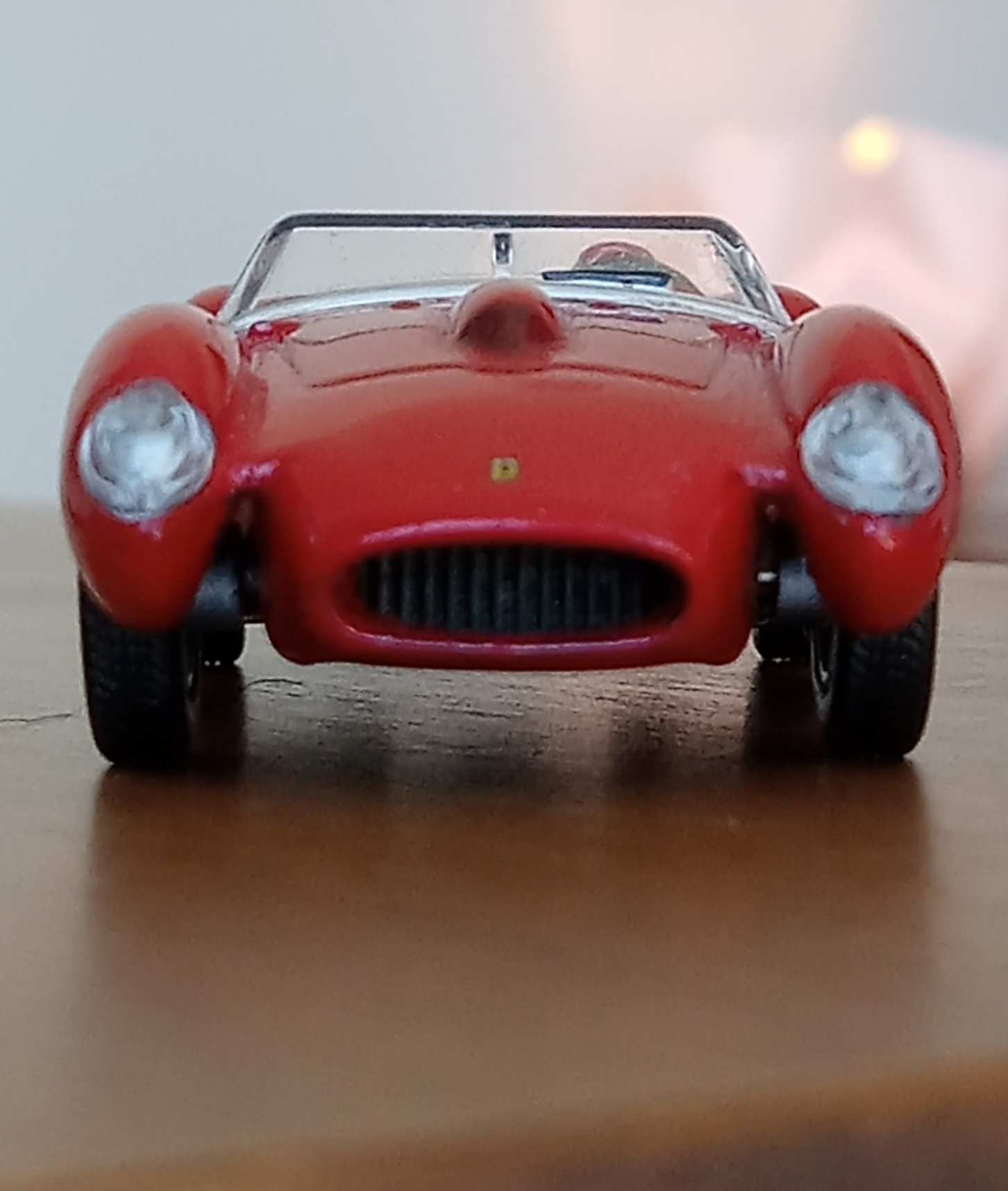
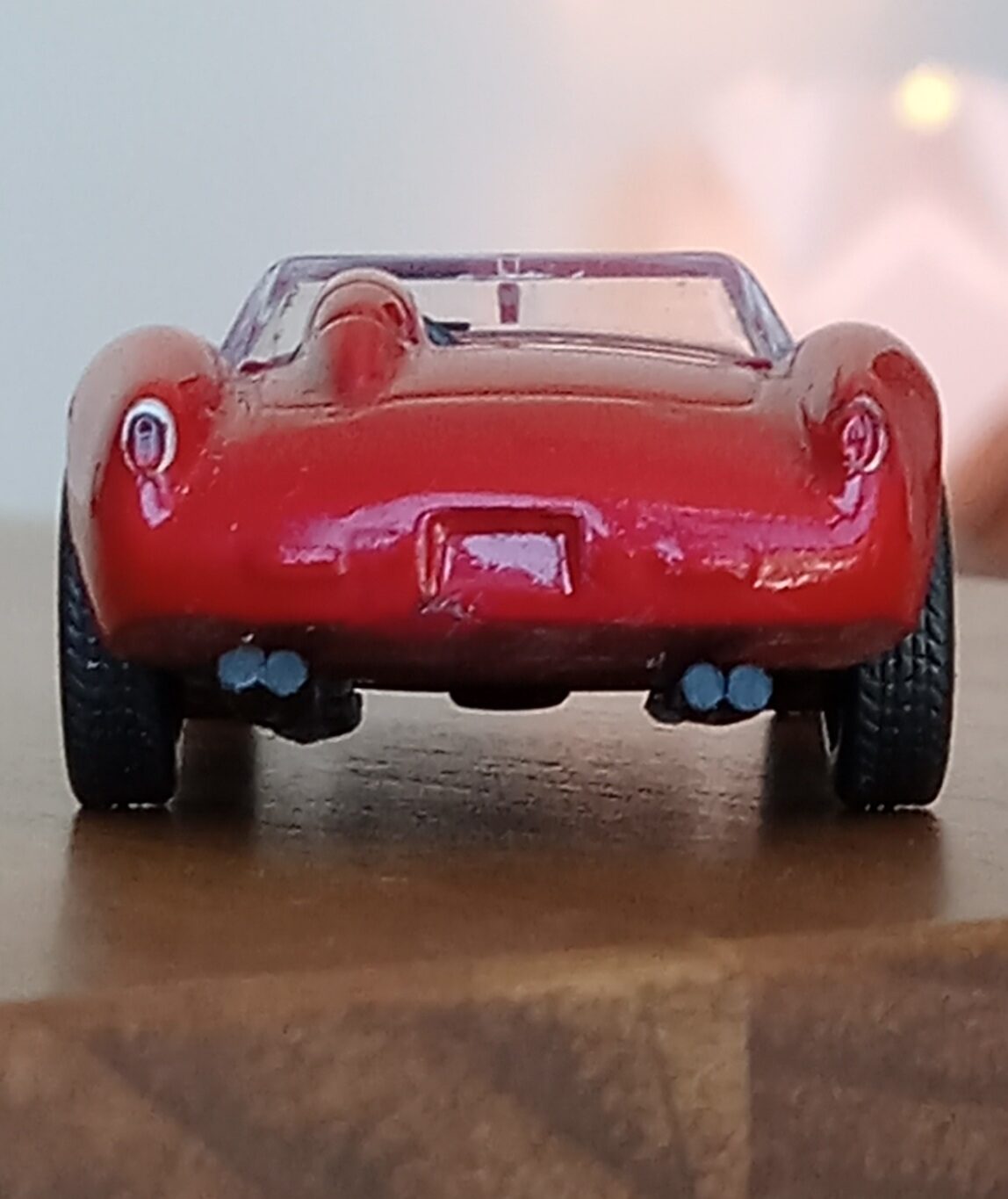
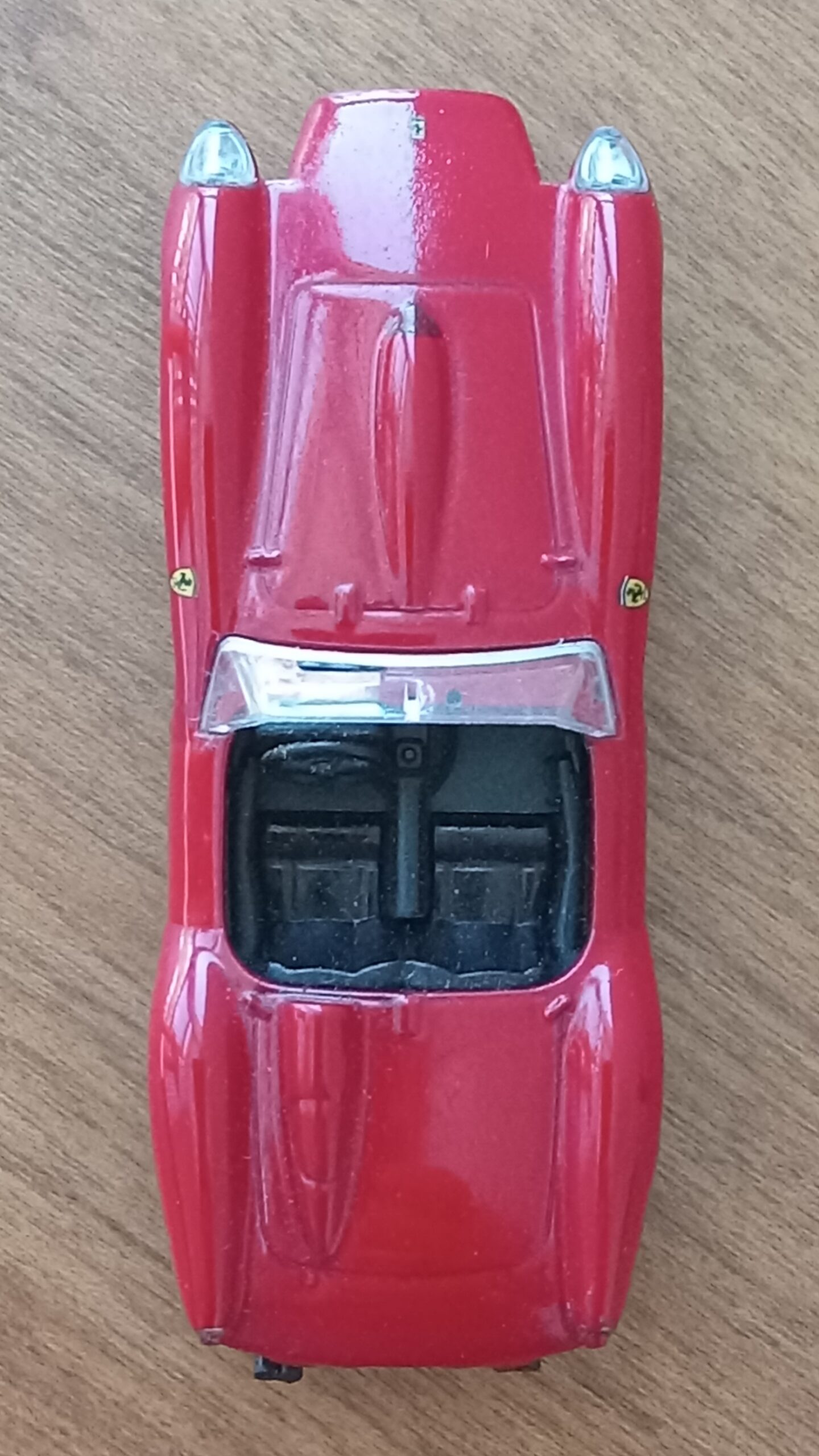
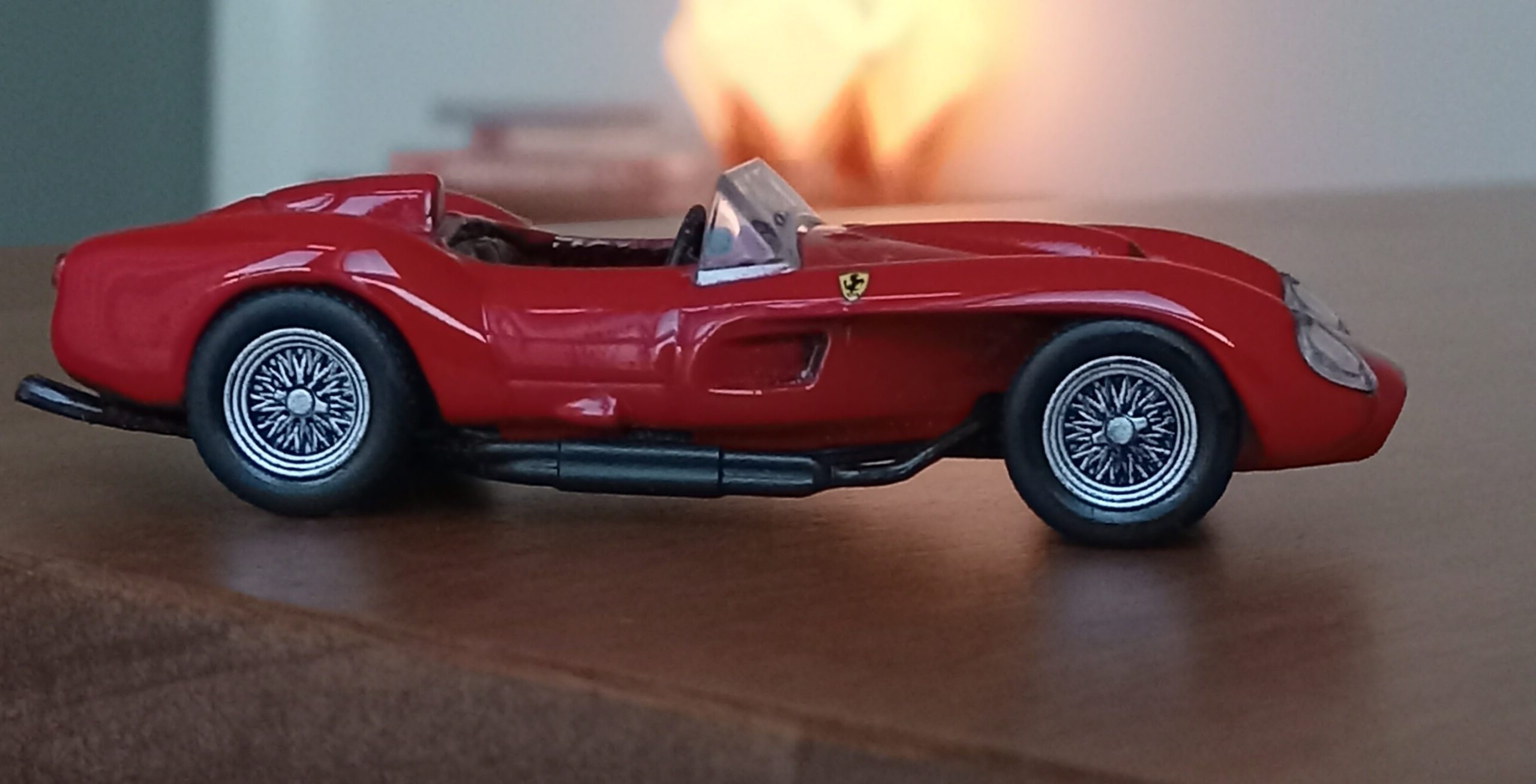
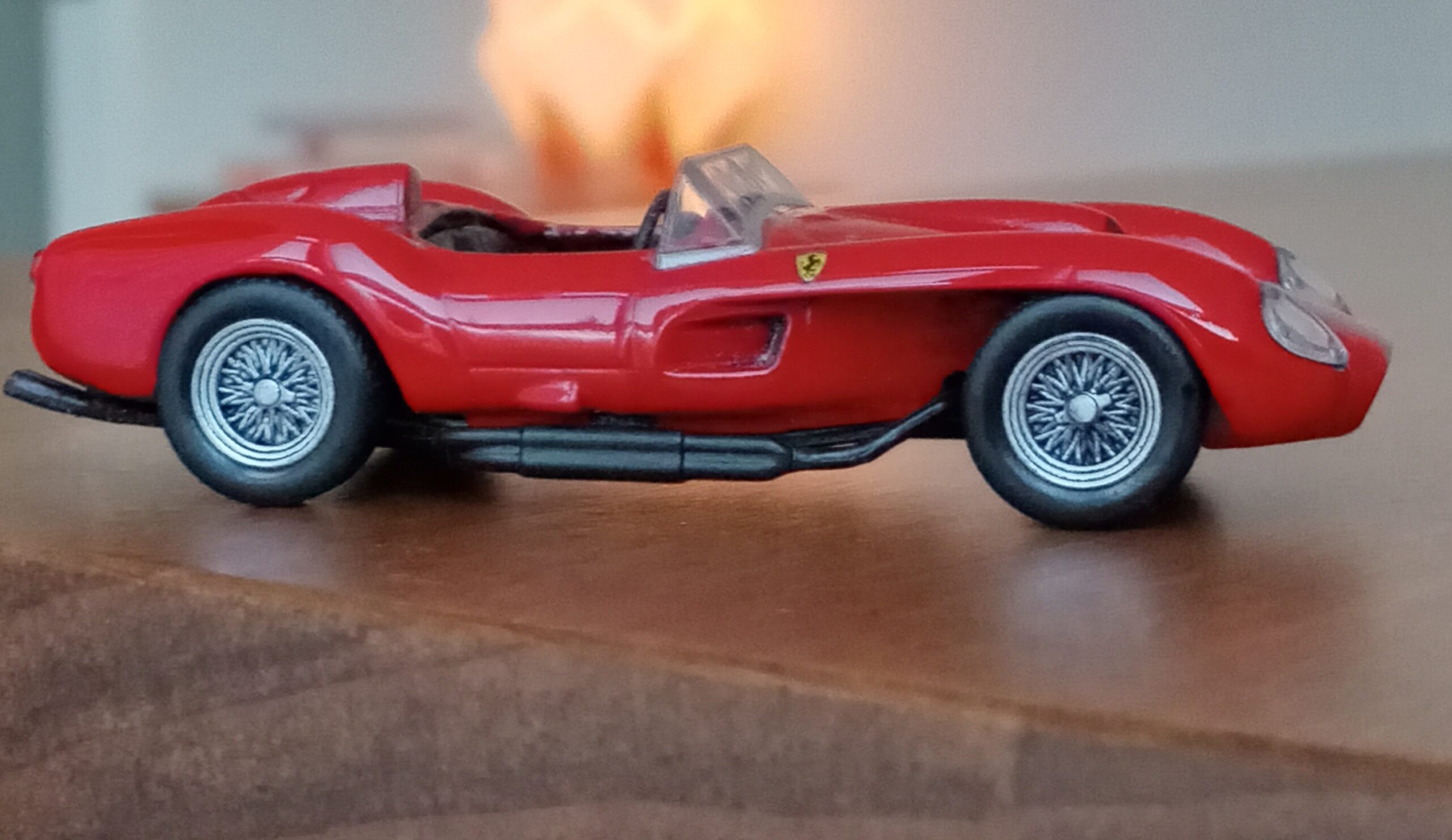
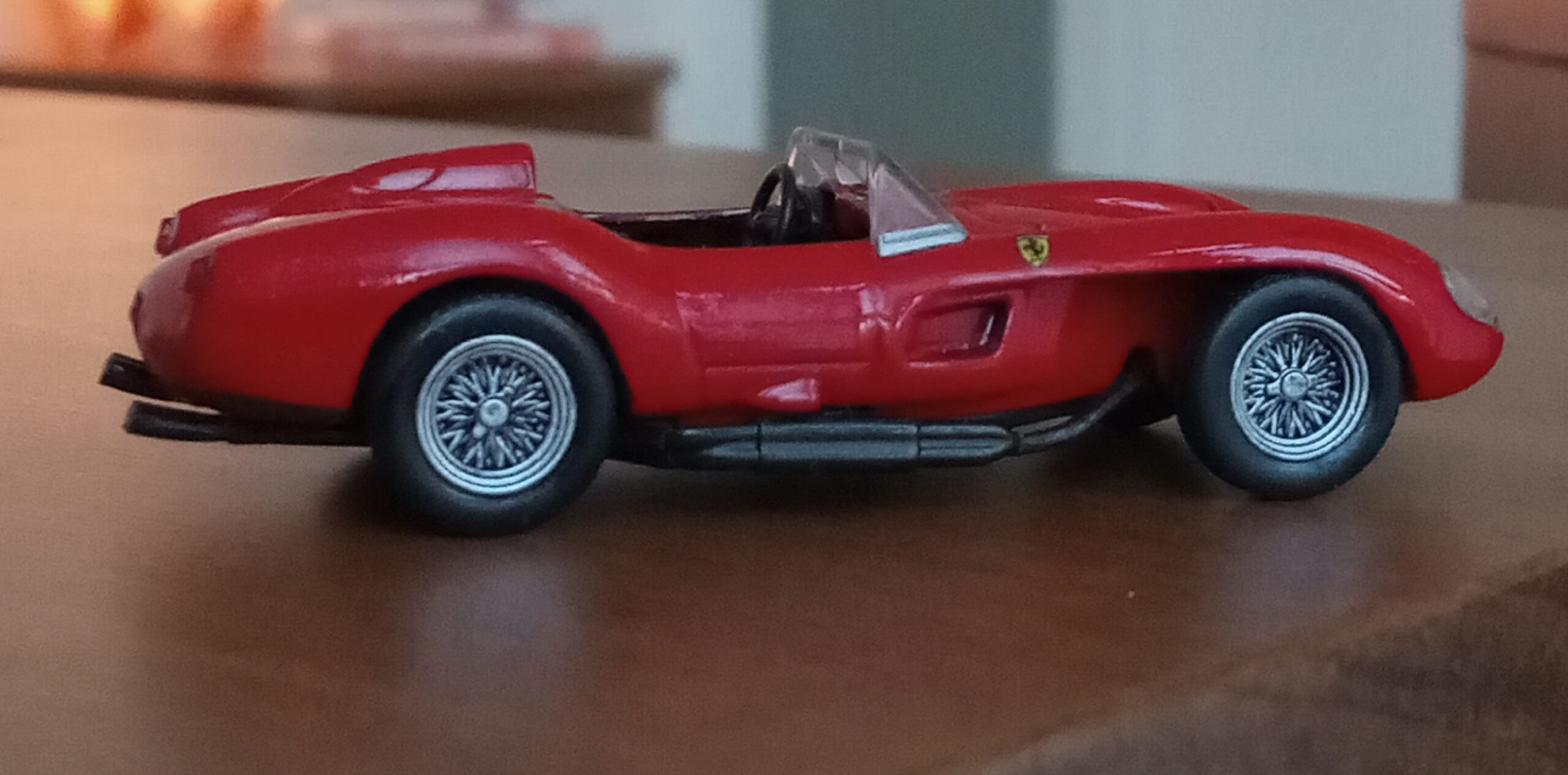
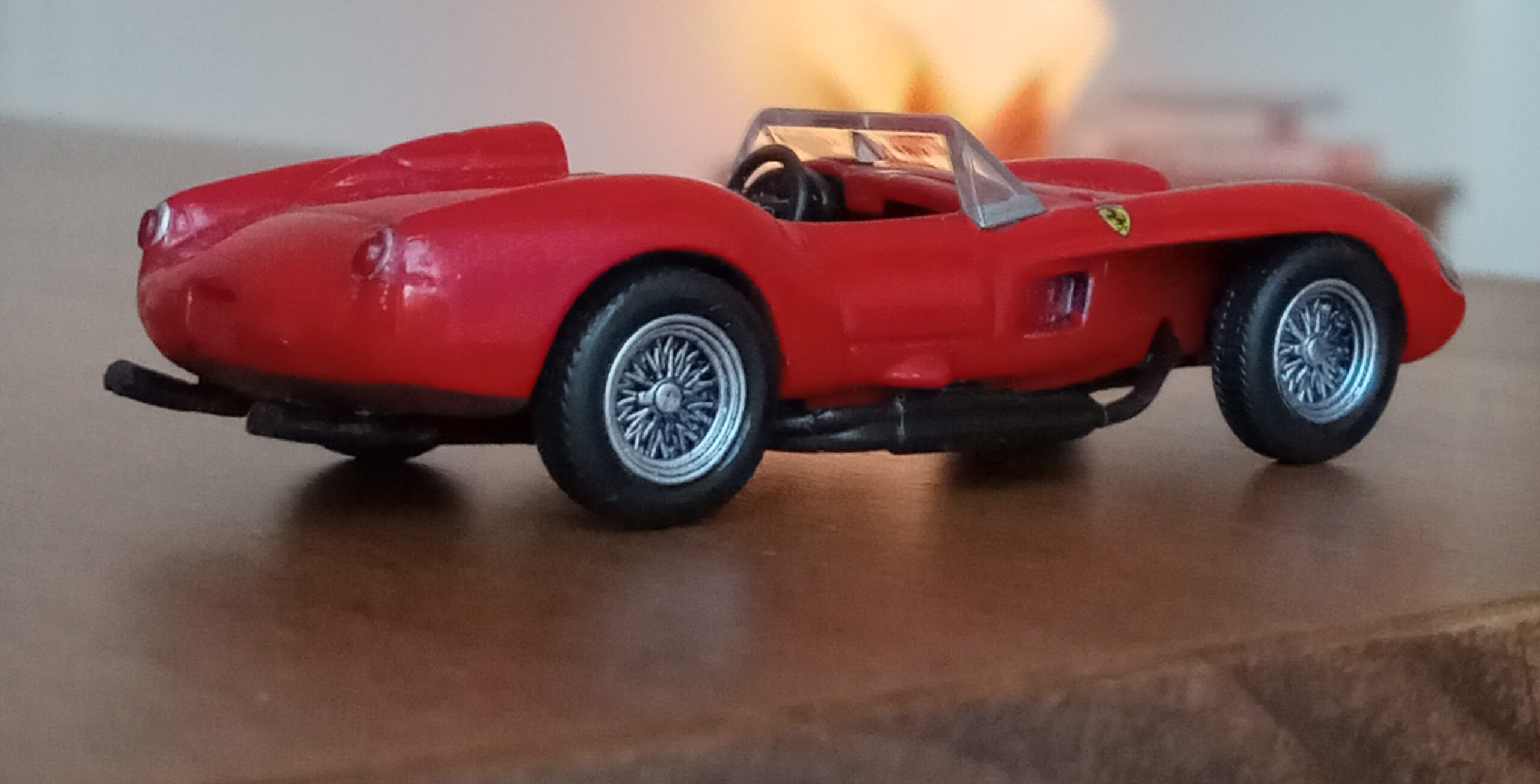
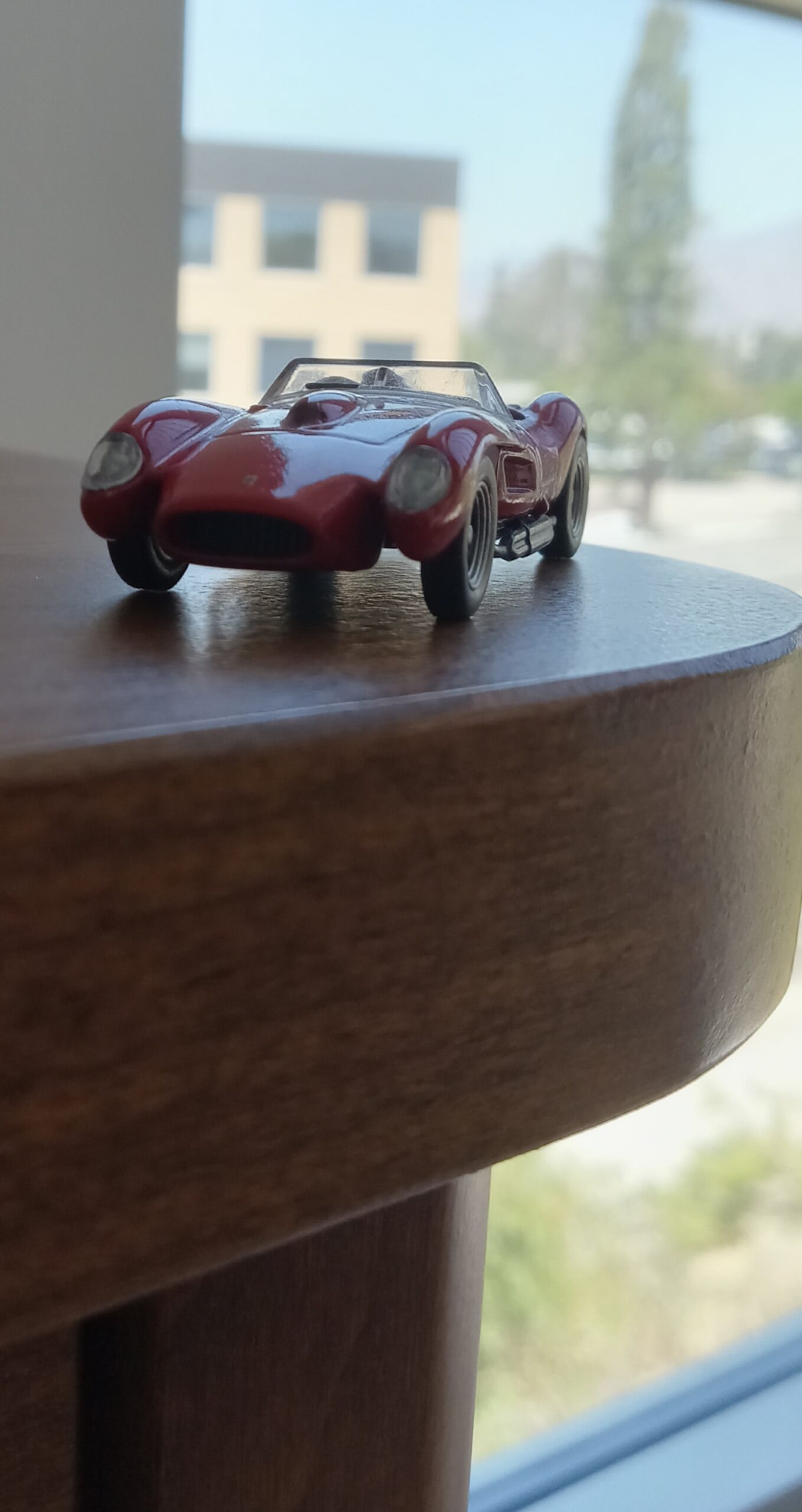
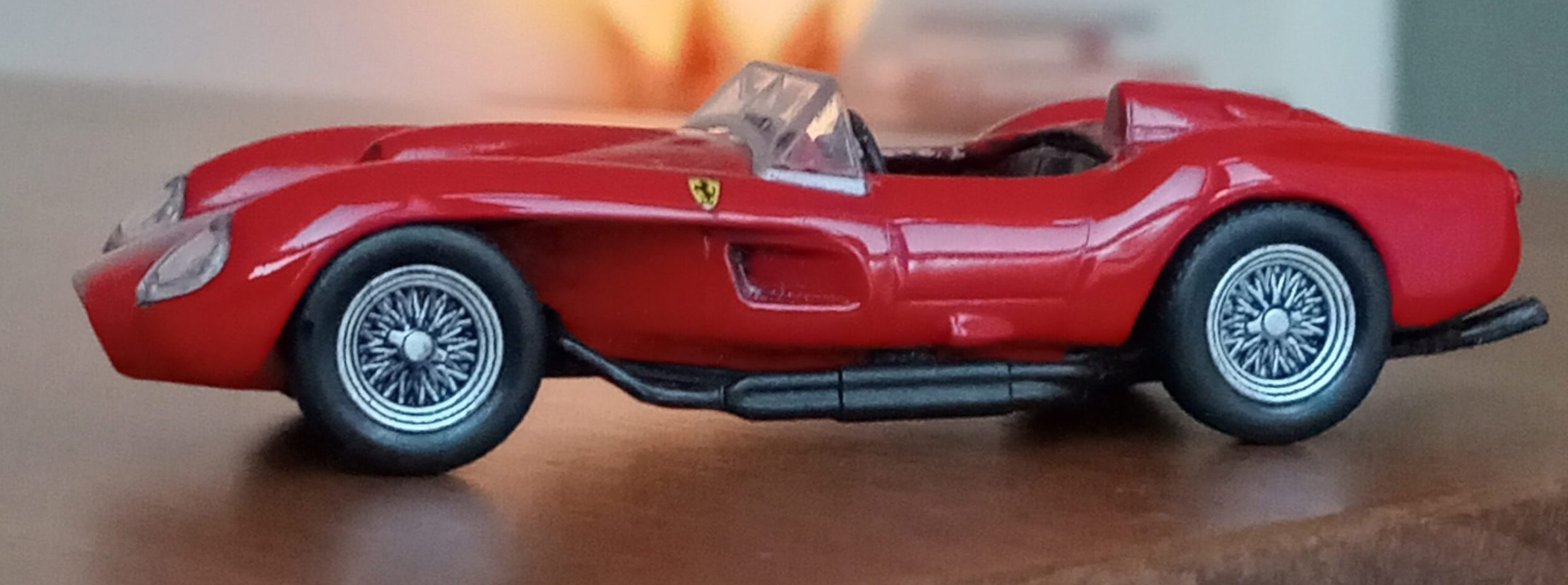
(上の写真が改造後、下が改造前の『素』の京商社製250TR)
撮影用模型:
京商社製、1/64 フェラーリ 250TR テスタロッサ
(ポンツーン・フェンダー使用・イタリアン・レッド)
改造箇所:
*サイドマフラーを切り出し後、形だし位置変更して再接着、
*車軸位置を最適化,
*タイヤホイール位置決め、
*ボディー下面とホイール内、ヘッドライト周りを
暖色系グレーマーカーにて墨入れ&汚し 【完成】
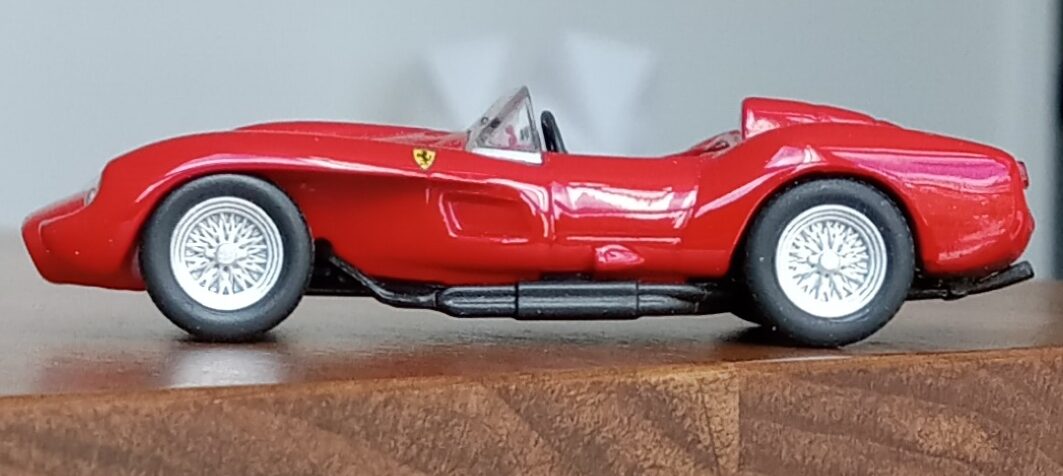
第32回ーー2ドア・クーペ(ロードスター)の系譜: 第12回【イタリア車編】 フェラーリ 250TR テスタロッサ、1957(ポンツーン・フェンダー仕様) Ferrari 250TR Testa Rossa, 1957 (Pontoon Fender Version)
#好みの自動車デザインーー2ドア・クーペ(オープン・スポーツ)の系譜:
第32回目の今回は、『2ドアクーペの系譜、第12回』と題しまして、各国のお国柄や、外観デザインの個性が強く表れる、高級2ドア(GT)クーペ / ロードスターについてお話ししてみたいです。【注意:オープンカーを含む】
以下の要領で進めていきます。
第12回の今回は【イタリア車編】
1957年型
フェラーリ250TR・テスタロッサ(ポンツーン・フェンダー仕様)
についてのお話です。
【2ドア・クーペの系譜:目次】
【米国車編】
第1回:キャデラック・エルミラージュ、2013(メタリック・レッド)
第2回:リンカーン・コンチネンタル MK4、1972(ブラック)
第3回:マーキュリー・クーガー, 1967(LTメタリック・グリーン)
【ドイツ車編】
第4回:MB 500K スペシャル・ロードスター、1936(ブラック)
第5回:MB 300SL ロードスター、1957(シルバー)
第6回:MB SLS AMR ガルウイング、2010(ブラック)
【英国車編】
第7回:マクラーレン・F1、1992(メタリック・オレンジ)
第8回:ジャガー・XKSS ロードスター、1957(ロイヤル・ブルー)
第9回:ジャガー XKR クーペ、1996(ダークメタリック・グリーン)
【日本車・ニッサン編】
第10回:ニッサン 初代シルビア、1965(シャンペン・ゴールド)
第11回:ニッサン 5代目シルビア、1988(LTメタリック・グリーン)
【イタリア車編】
第12回:フェラーリ 250TR ポンツーンフェンダー、1958(赤)
第13回:フェラーリ 250GTO、1962(イタリアン・レッド)
第14回:ランボルギーニ・コンセプトS、2005(パール・ホワイト)
【日本車・マツダ編】
第15回:マツダ コスモ・スポーツ、1967(シルバー)
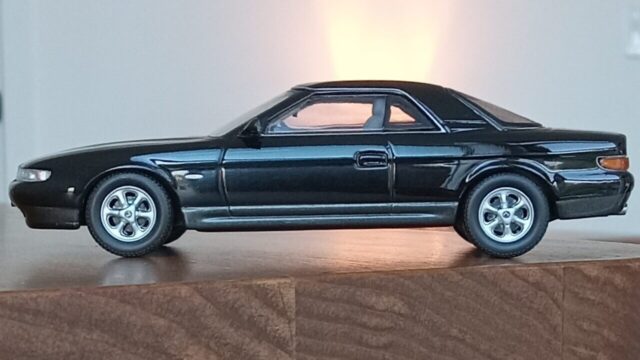
第16回:マツダ ユーノス・コスモ、タイプ‐S(2トン:黒&グレー)
【フランス車編】
第17回:ブガッティ・タイプ59、1935(フレンチ・ブルー)
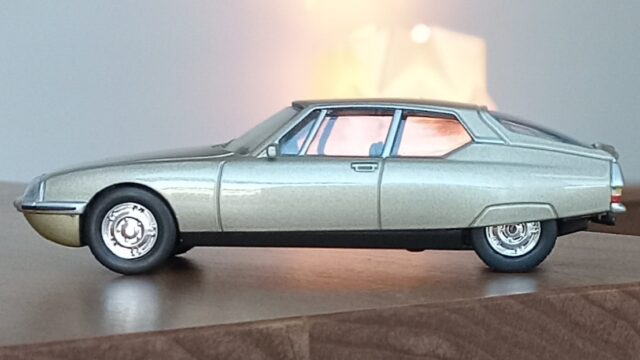
第18回:シトロエン・SM、1970(シャンペーン・ゴールド)
第19回:ブガッティ・ラ・ヴォワチュール・ノワール、2019(黒)
【日本車・トヨタ編】
第20回:トヨタ/ヤマハ・2000GT、1967(アイボリー・ホワイト)
第21回:トヨタ・2代目ソアラ、1986 (2トン:黒&グレー)
第22回:レクサス LC【GWZ100型】、2017(メタリック・レッド)
【米国車編②】
第23回:ダッジ・チャレンジャー&プリムス・バラクーダ、1971
第24回:ダッジ・ヴァイパー SRT‐10 ACR、 2008(ブラック)
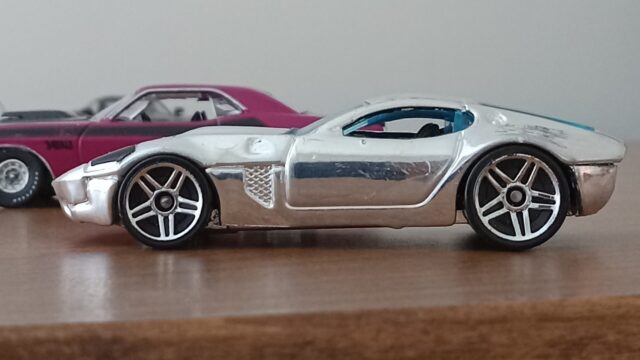
第25回:フォード・シェルビーGR-1 コンセプト、2004(クローム)
【日本車・ミツビシ編】
第26回:ミツビシ・ギャラン λ、1976(ブラウン・メタリック)
第27回:ミツビシ・エクリプス【北米仕様】、2006(オレンジ・メタ)
【ドイツ車編②】
第28回:BMW M635CSi、1984 (ダーク・メタリックブルー))
第29回:MB 560SEC AMG 6.0 ワイドボディー、1989(黒)
第30回:BMW M2 純正パフォーマンス・パーツ仕様、2025(ネオン・ライム)
【日本車・スバル編】
第31回:スバル・クロストレック XV, 2012(ライムグリーン・メタリック)
コルベットの系譜:(番外編)
第1回:1967年型 スティングレー【C2】コンバーチブル(ハードトップ・メタ青)
第2回:1972年型 コルベット 【C3】コンバーチブル(メタリック・ブルー)
第3回:1990年型 コルベット ZR-1【C4】クーペ(レッド)
第4回:スティングレー・コンセプト【先行開発車】、2009(プルー・メタリック)
#ポンツーン・フェンダーの『野獣』参上!
デザイン学校に通っていたころ、
大好きだった雑誌が10冊程度ありまして、
学校の図書館の雑誌ラックに毎月の最新号が掛かっていた、雑誌の中の一つに、
【Sports Car International】という米国の雑誌があるのですが、
この雑誌の、この号が大好きでした。
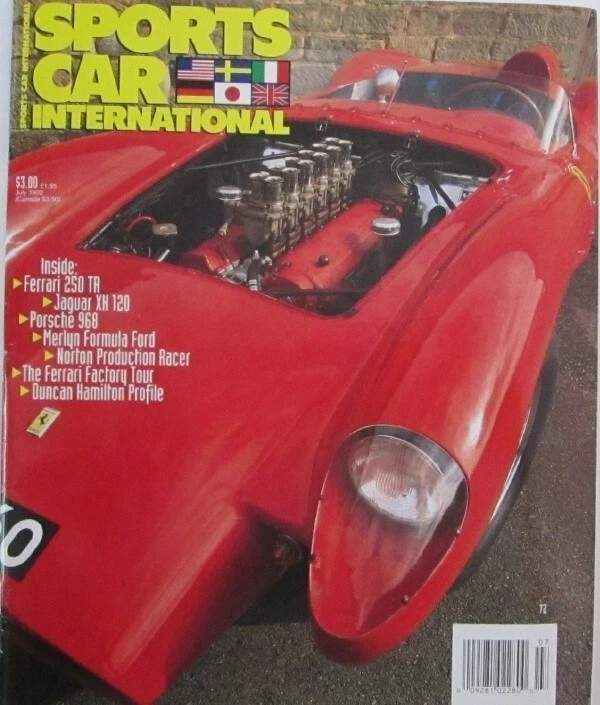
その92年7月号がここにあります。
この号の表紙の
フェラーリ―250TR テスタロッサ
【ポンツーン・フェンダー版】
が本誌内でも特集されてまして、
*この車の強烈な野獣的、たたずまいと、
*古典的独立フェンダーと
*モノコック式の一体フェンダーの過渡期的、
*ポンツーン・フェンダー,
*その味の濃さに、
一撃でやられてしまいました。
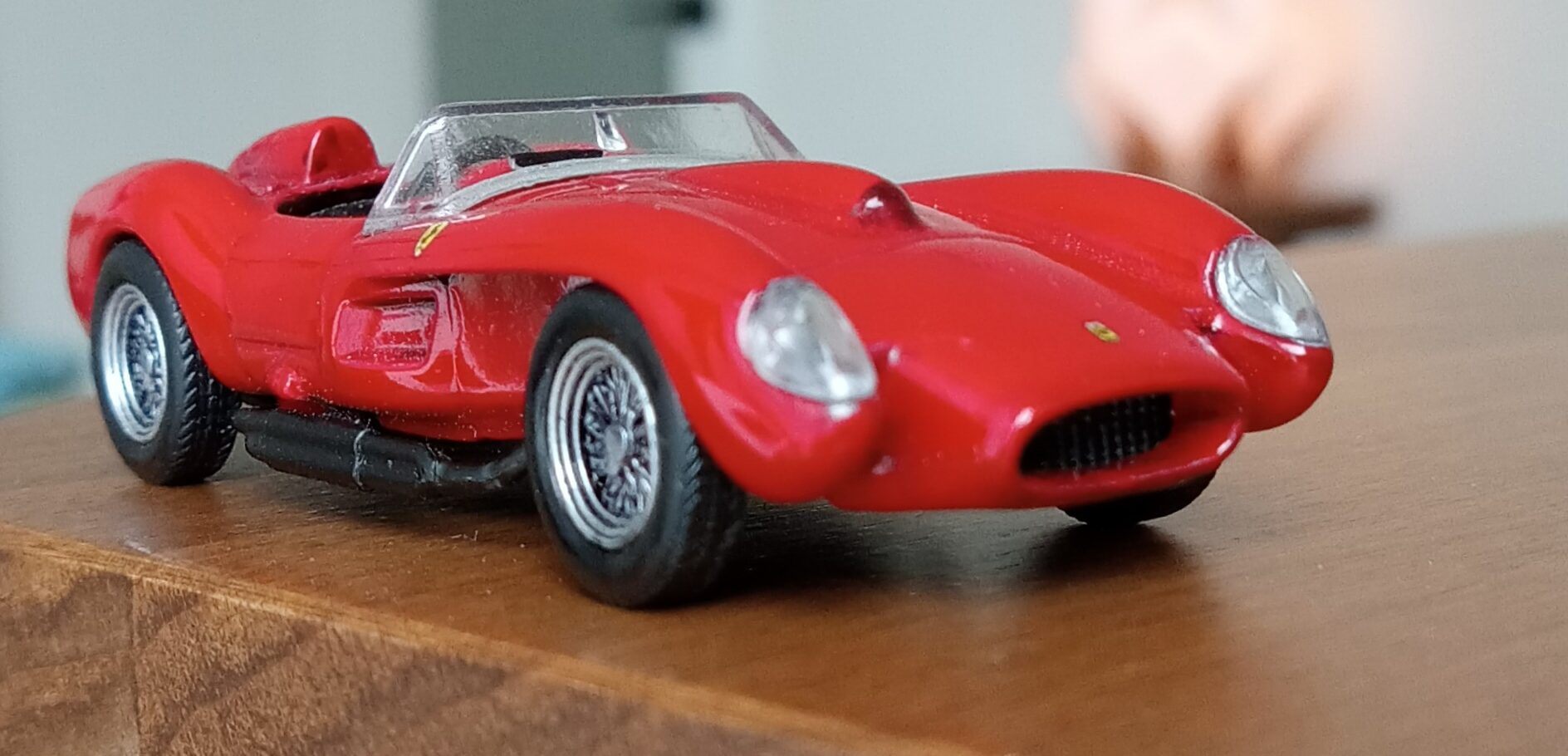
それでは
*野獣性あふれる、
*ポンツーンの化け物、
*私が一番好きなフェラーリ、
『フェラーリ250TR(ポンツーン・フェンダー版)』
につきまして、
以下の要領で、
お話しさせていただきます。
*実車解説:跳びかかる野獣のような『ポンツーン・フェンダー』
*外観デザインの特徴:車体全部が魅力『≒業』のカタマリ
*『私』と’58テスタロッサ
*三題噺:カトキ・ACコブラ427・貝殻
*その他の『過渡期の奇跡』たち
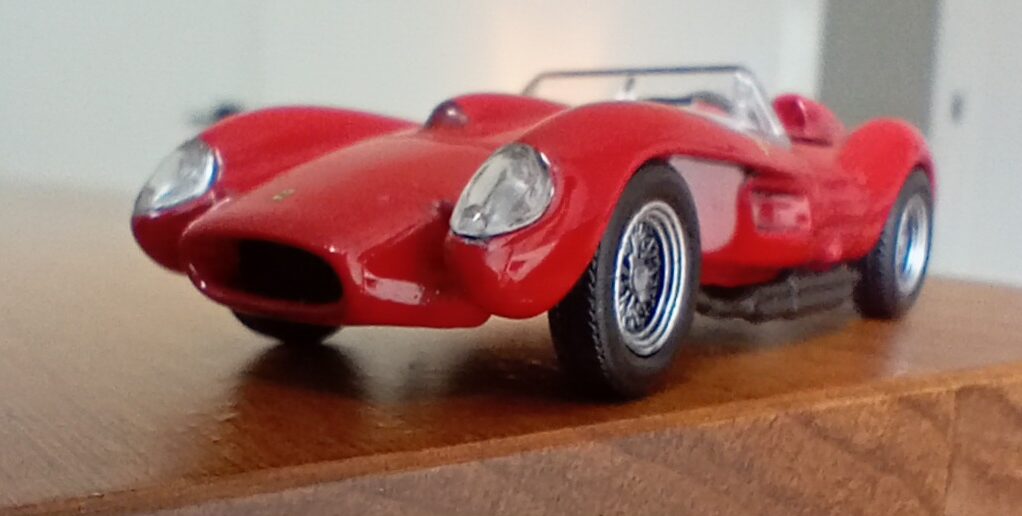
*実車解説 : 跳びかかる野獣のようなフェンダー
n
n
概略:
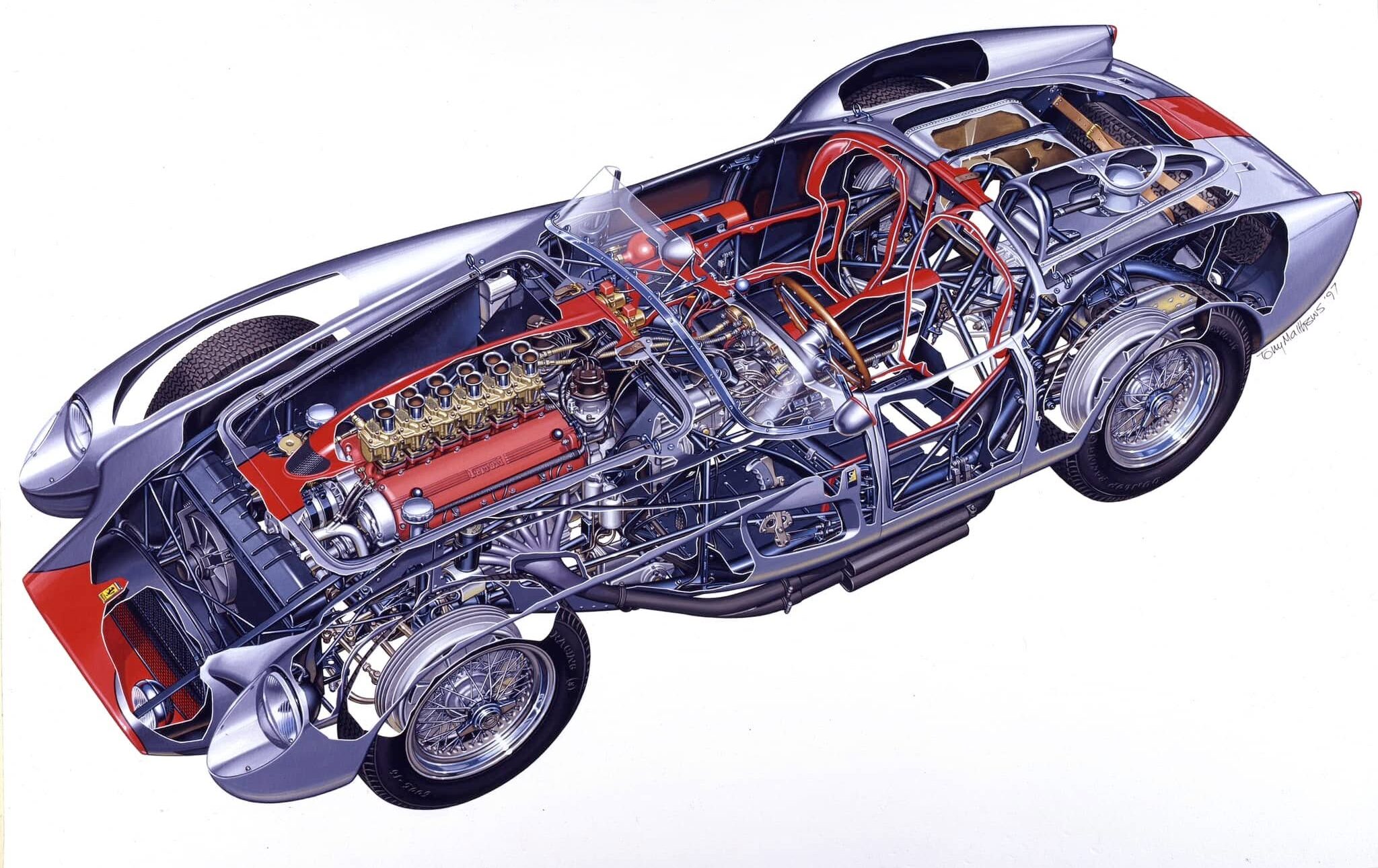
フェラーリが1957年から1961年にかけて開発・製造した伝説的なレーシングスポーツカーです。 「テスタロッサ(Testa Rossa)」はイタリア語で「赤い頭」を意味し、エンジンのカムカバーが鮮やかな赤に塗装されていたことに由来します。外観上の最大の特徴は、自動車史に刻まれる官能的かつアグレッシブなボディラインです。1957年から1961年にかけてわずか34台のみが製造され、その外観は年式によって大きく変化しますが、なかでも初期型(1957〜1958年型)は伝説的な造形美を誇ります。
国際レースで圧倒的な強さを誇り、現在ではオークションで数十億円規模の値がつく世界で最も希少なクラシックフェラーリの1台です。
n
n
n
n
n
n
n
n
n
n
n
n
nn
n
n
n
n
n
n
n
n
n
n
n
n
n
n
n
n
n
n
n
n
nn
n
n
n
n
n
n
1:誕生の背景と歴史:
n
n
n
*圧倒的なレース実績: 1958年、1960年、1961年のル・マン24時間レースで総合優勝を飾ったほか、セブリング12時間レースなどでも勝利を重ね、フェラーリに数々のマニュファクチャラーズ・タイトルをもたらしました。
n
n
外観デザインを詳しく解説します。
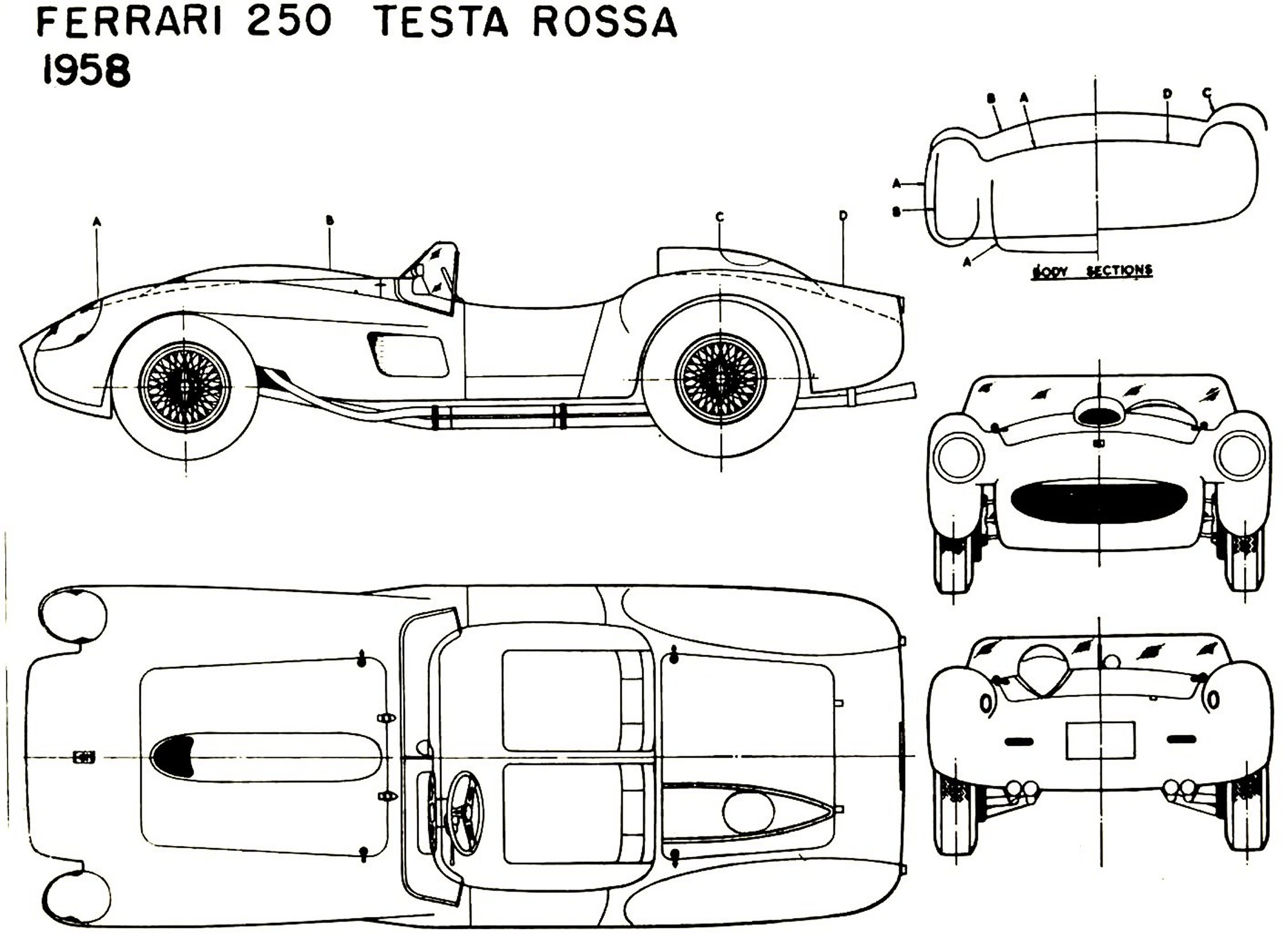
初期型250TRの代名詞が、カロッツェリア・スカリエッティが手掛けたアルミニウム叩き出しの「ポンツーン・フェンダー」です。
*ボディとの深い切れ込み:フロントフェンダーが中央のボンネットから独立した「浮き島(ポンツーン)」のように盛り上がっています。フェンダーのすぐ後ろ側(ドアの前方)のボディが大きく抉り取られたような、特異な形状をしています。
*目的はブレーキ冷却と整備性:このデザインは空力のためではなく、強力なフロントドラムブレーキに走行風を直接当てて冷却し、かつ熱を効率よく逃がすために考案されました。
*F1マシンからのインスピレーション:当時の葉巻型F1マシンのノーズと、タイヤを覆うフェンダーを融合させたような、非常にレーシーな視覚的効果を生み出しています。
n
n
n
*ノーズの開口部:楕円形のフロントグリル(ラジエーターインテーク)が低く構えています。その左右のフェンダー内側が抉れているため、正面から見ると中央のノーズが前方に突き出したように見えます。
*ヘッドライト:左右の盛り上がったフェンダーの先端に、流れるようなアクリル製の透明なライトカバーが密着して装着されています。
n
n
n
n
#ボンネットとコックピット周り:
*パワーバルジ(ボンネットの膨らみ):エンジンルーム内には、3リッターV12エンジンと6基のウェバー製ツインチョーク・キャブレターがそびえ立っています。これらを干渉させずに収めるため、ボンネット中央には大きく美しいクリアランス用の膨らみ(パワーバルジ)と、前方向きのエアインテークが設けられています。
*ラップアラウンド・ウインドシールド:ドライバーを風から守るフロントスクリーンは、コックピットを包み込むように湾曲した、全高の低いレース専用品です。
*ヘッドレスト・フェアリング:ドライバーのシート後方からリアエンドにかけて、空気抵抗を減らすための流線型のスポイラー(ハンプ/コブ)が滑らかに伸びています。
n
n
#リアビューとディテール:
*シャープなテールフィン:リアフェンダーはフロントとは異なり、当時の流行を取り入れたマイルドなフィン状の形状をしています。その縦型の端面に小さなテールランプが埋め込まれています。
*ボラーニ製ワイヤーホイール:細いスポークが幾重にも重なる美しく繊細なBorrani(ボラーニ)製ワイヤーホイールと、大径のセンターロック・スピンナーが足元を引き締めています。
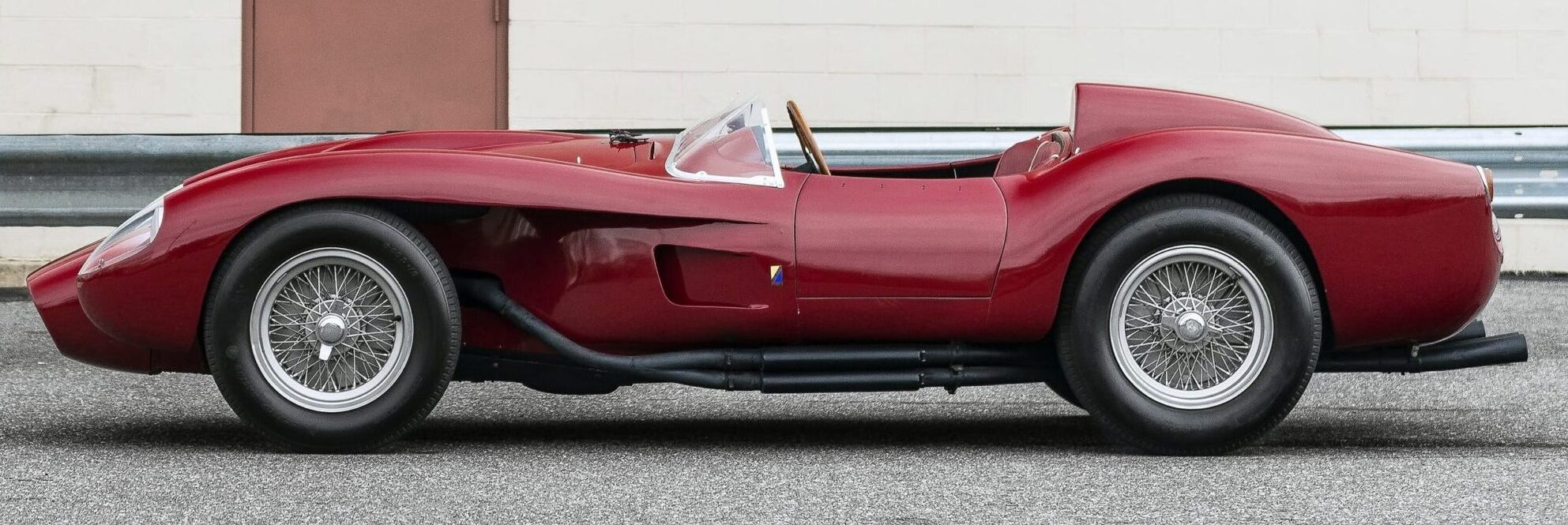
*サイド出しのマフラー:抉られたフロントフェンダーの奥から、ボディサイドを伝ってリヤへと伸びるエキゾーストパイプが、むき出しのレーシングカーらしさを強調しています。
n
#デザインの変遷(後期型への進化)
n
n
n
n
nn
n
n
n
M
Mn
n
n
n
M
n
n
n
n
M
n
n
n
n
n
n
n
n
MM
n
n
n
n
M
n
n
n
n
M
#主要諸元:
- エンジン型式:60度 V型12気筒 SOHC(コロンボ・ユニットベース)
- 燃料供給装置:ウェーバー(Weber) 38 DCN キャブレター × 6基
- 総排気量: 2,953.21 cc (1気筒あたり約250cc)
- 最高出力 : 300 hp / 7,200 rpm
- 最大トルク:300 N⋅m (30.6 kgm) at 5,500 rpm
- 駆動方式:フロント縦置きエンジン・後輪駆動(FR)
- 定員:2名
- 車体形式:2ドア・オープントップ
- ホイールベース:2,350 mm
- 全長:3,959 mm
- 全幅:1,523 mm
- 全高:約 1,013 mm(または 964 mm、個体差や仕様による)
- 車両重量:
約 800 kg(乾燥重量)
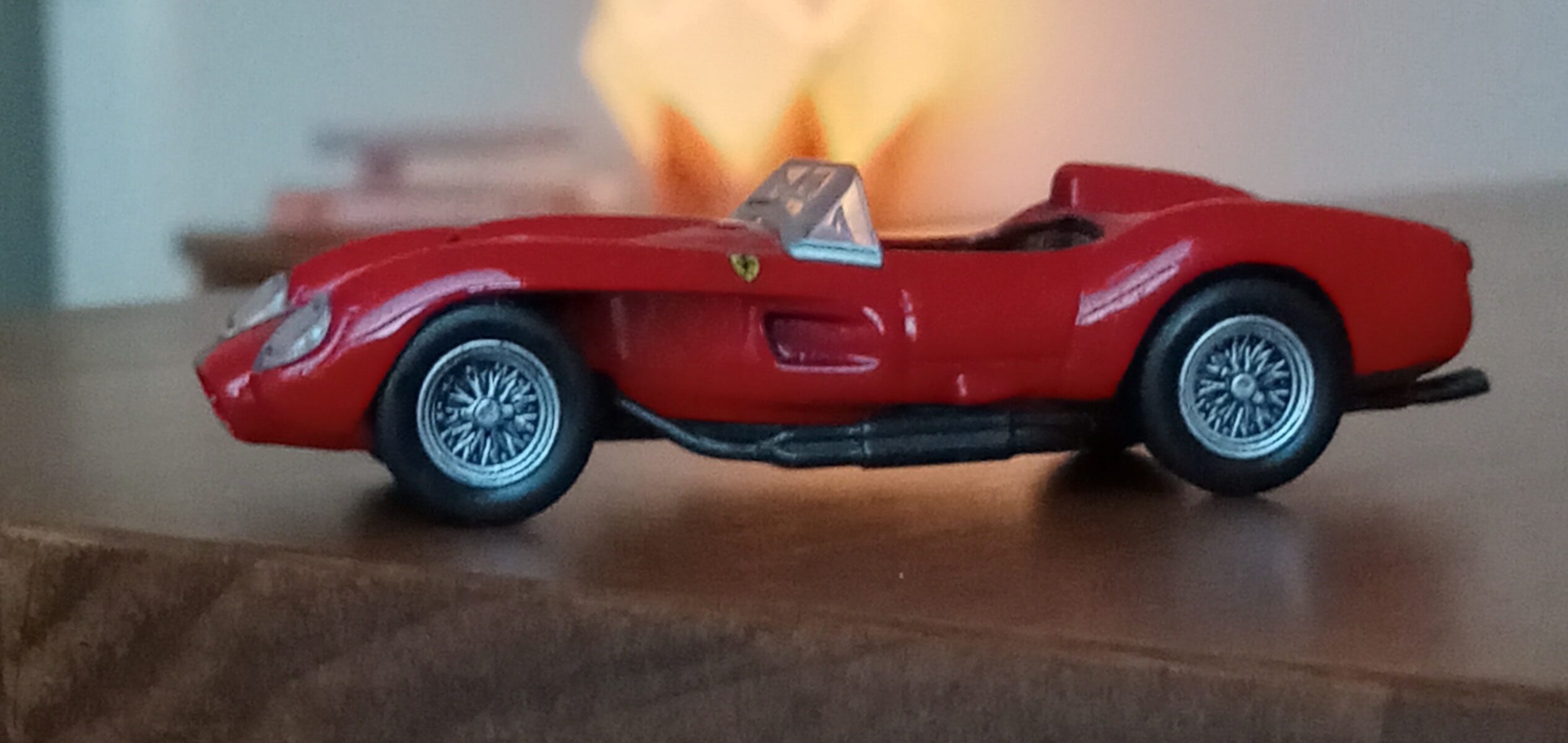
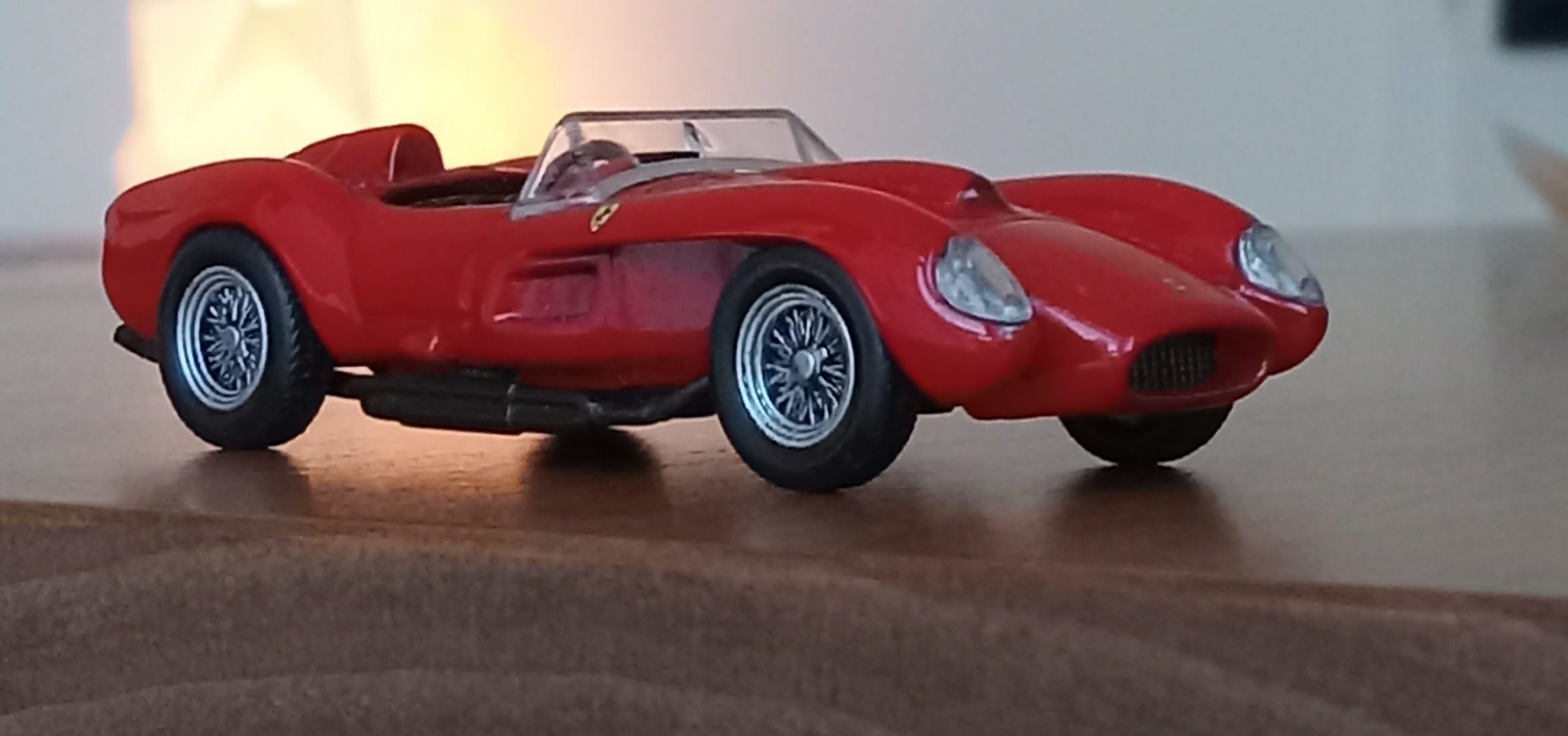
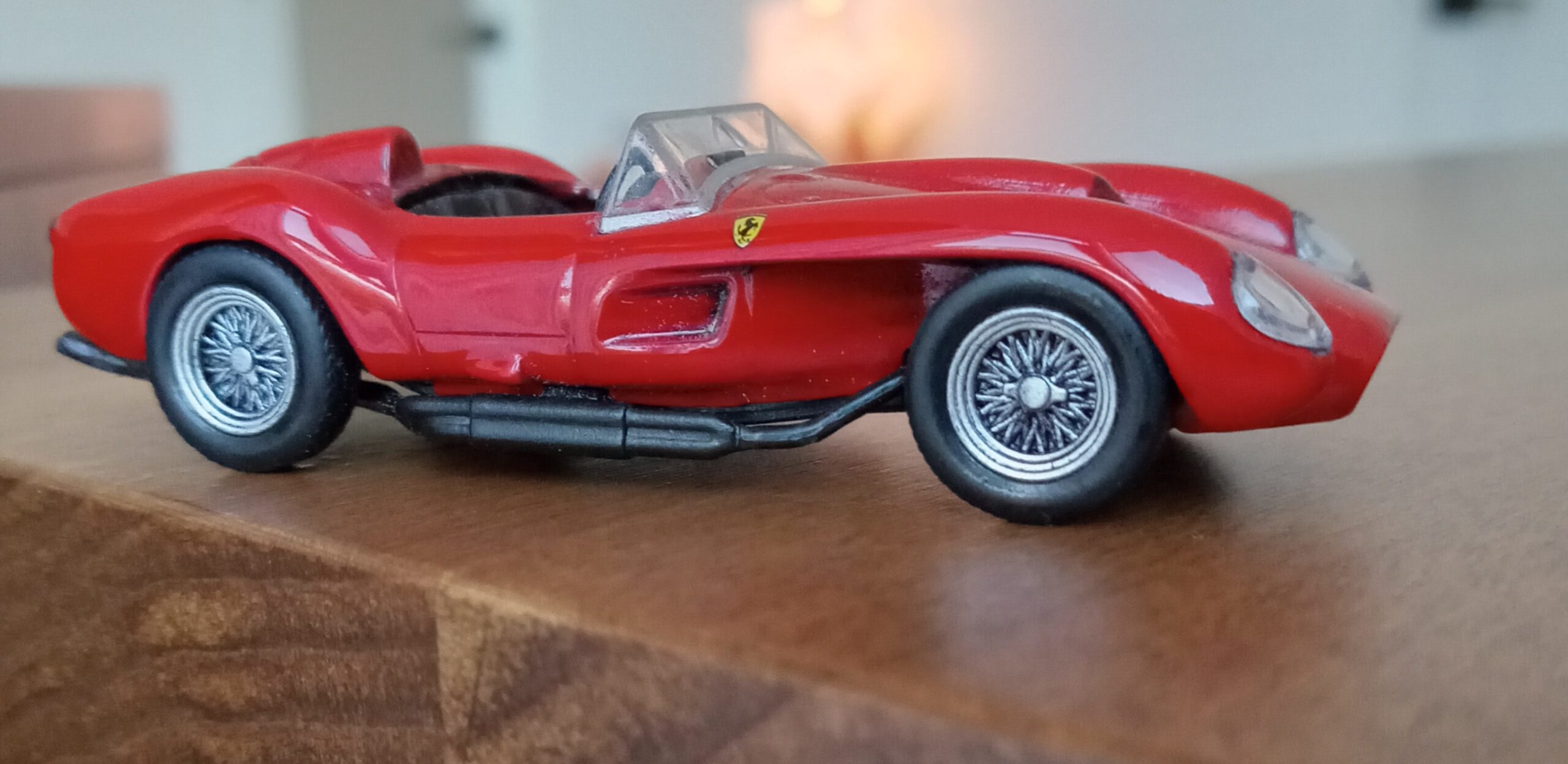
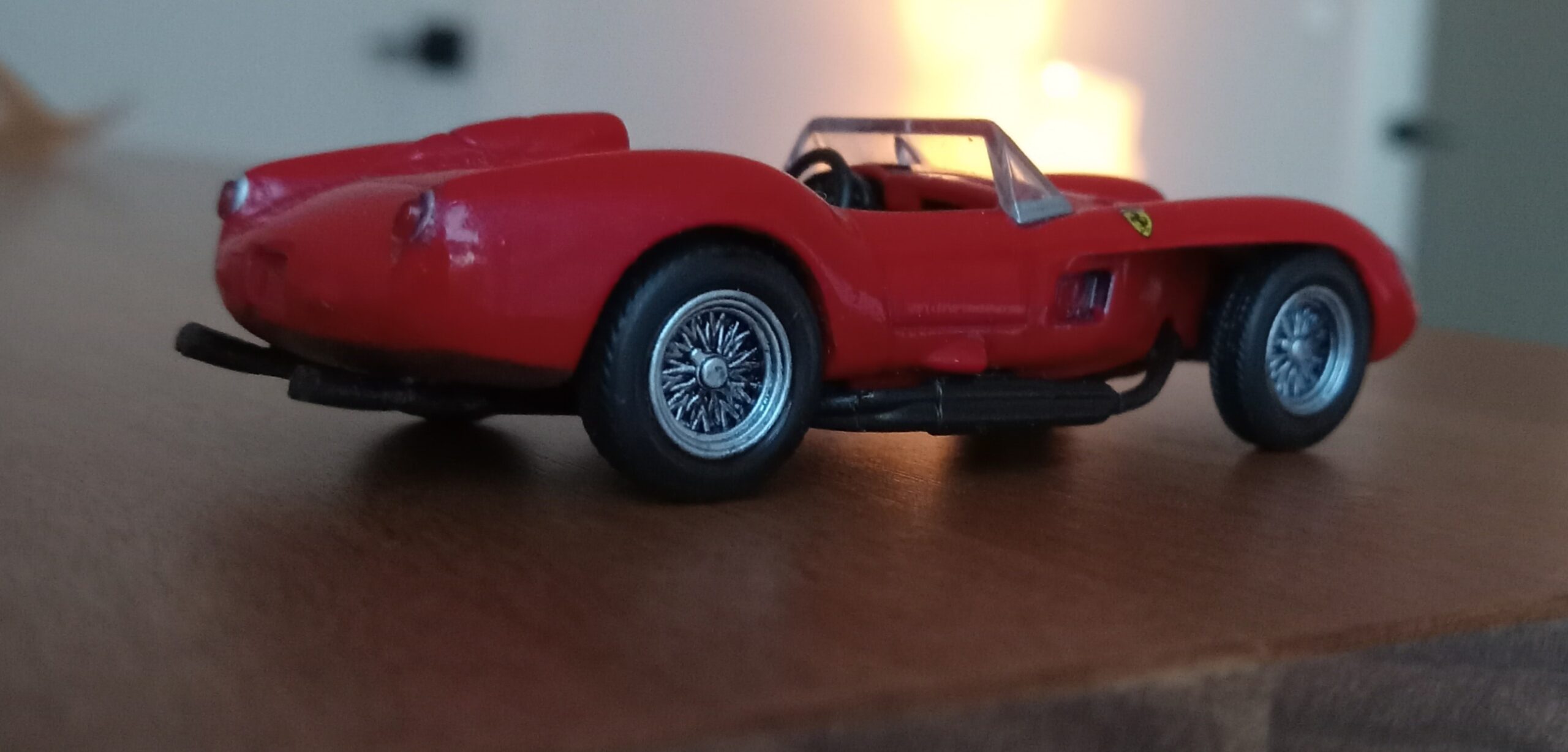
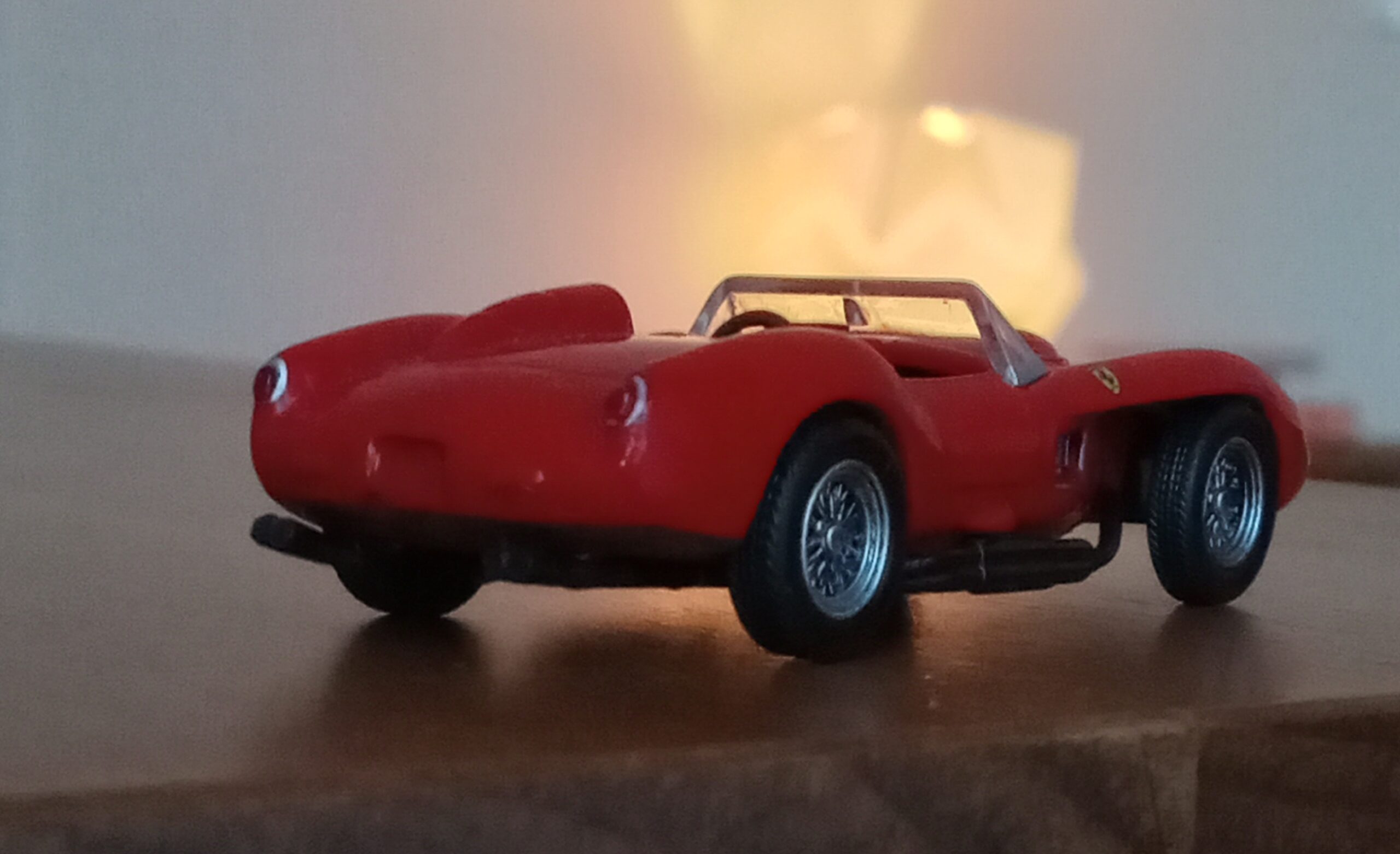
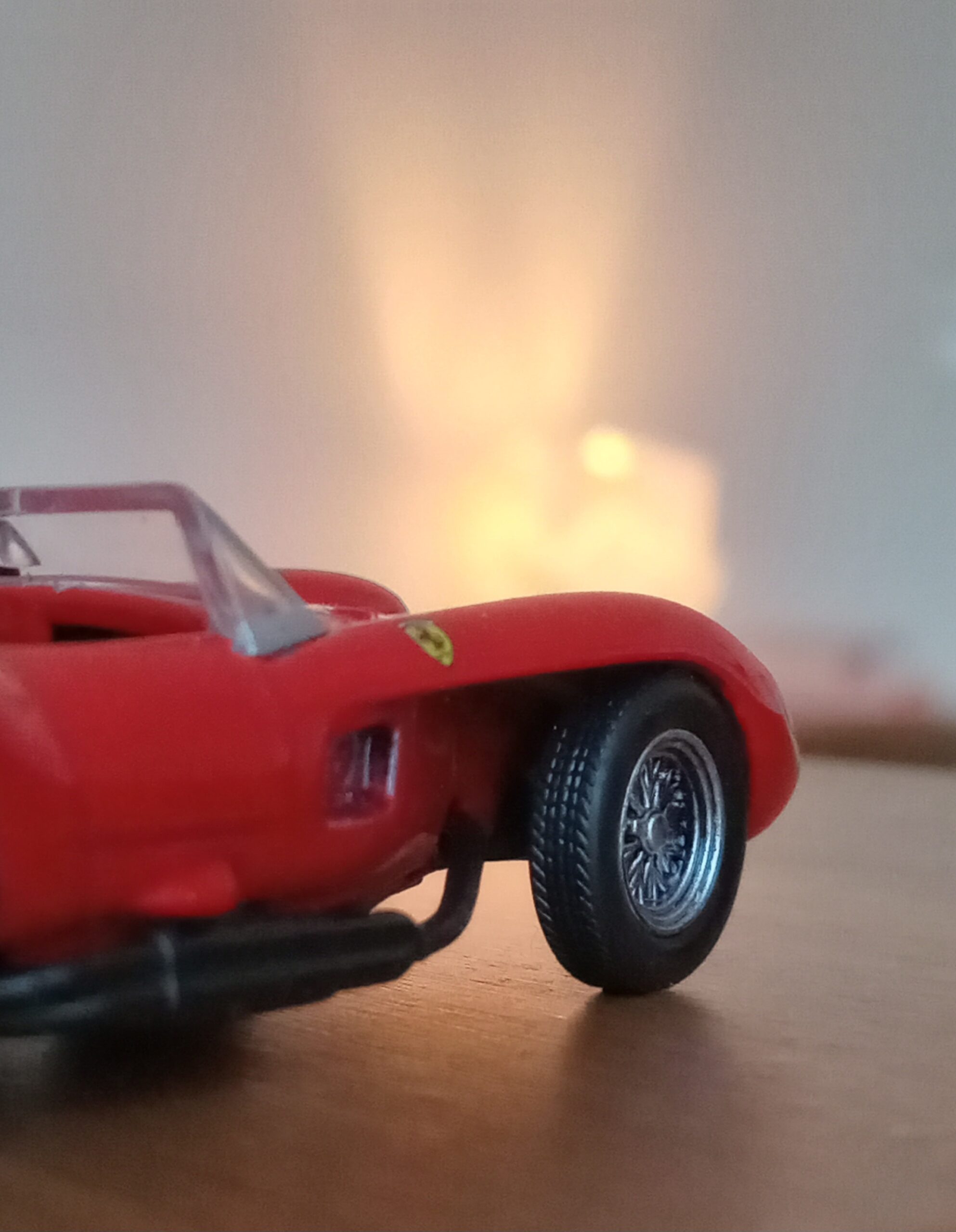
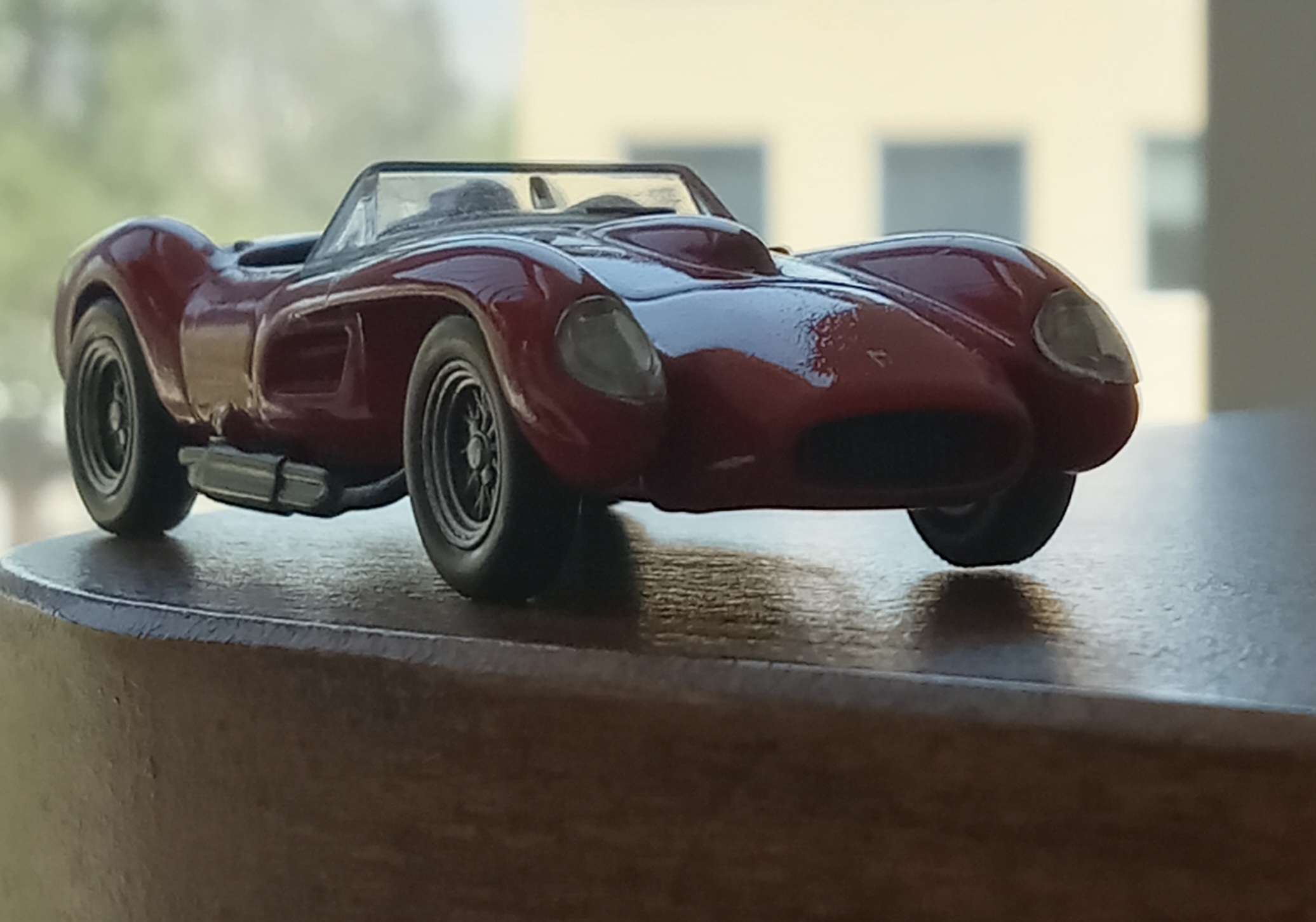
*外観デザインの特徴:車体全体が『魅力のカタマリ』
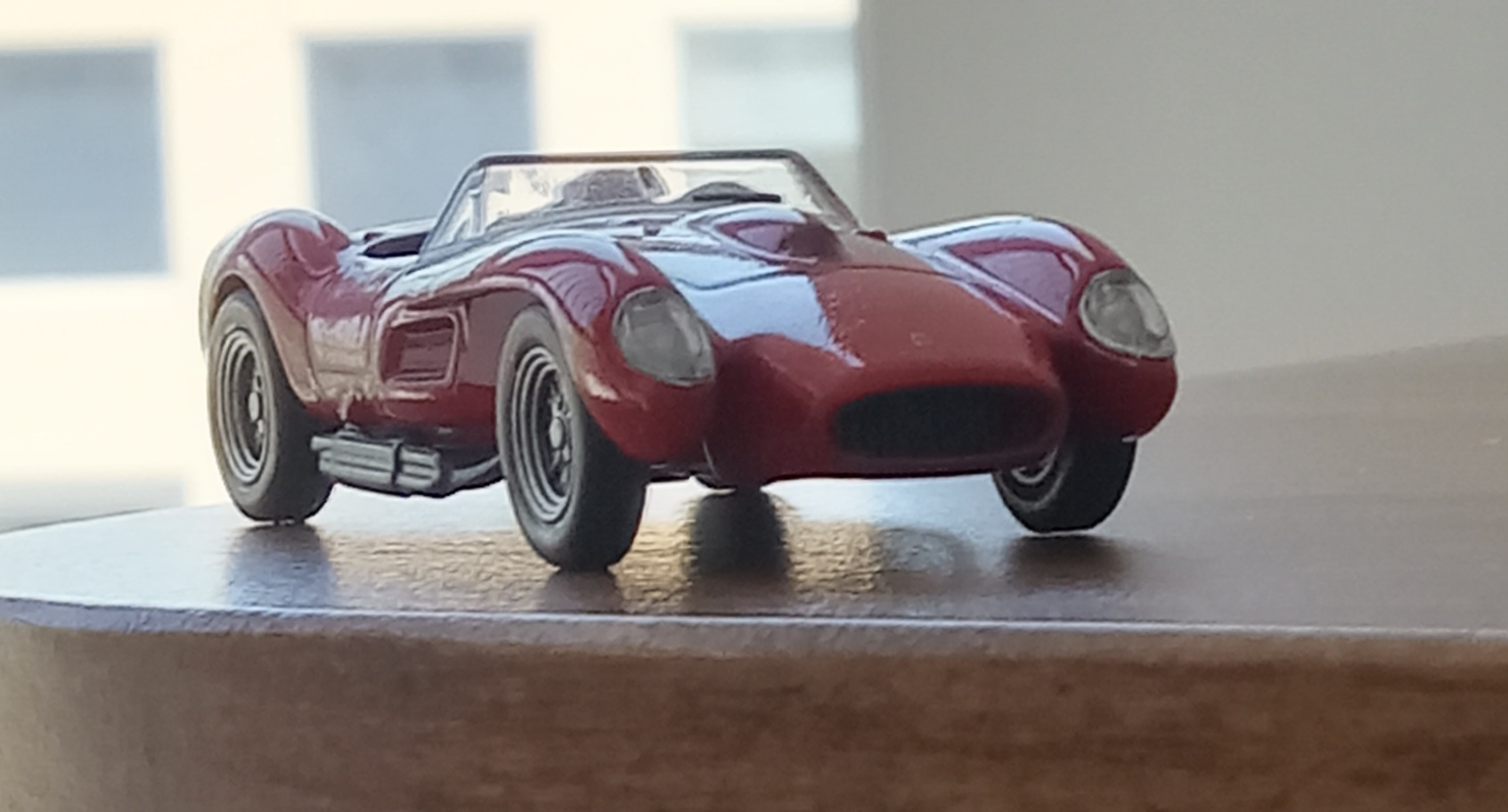
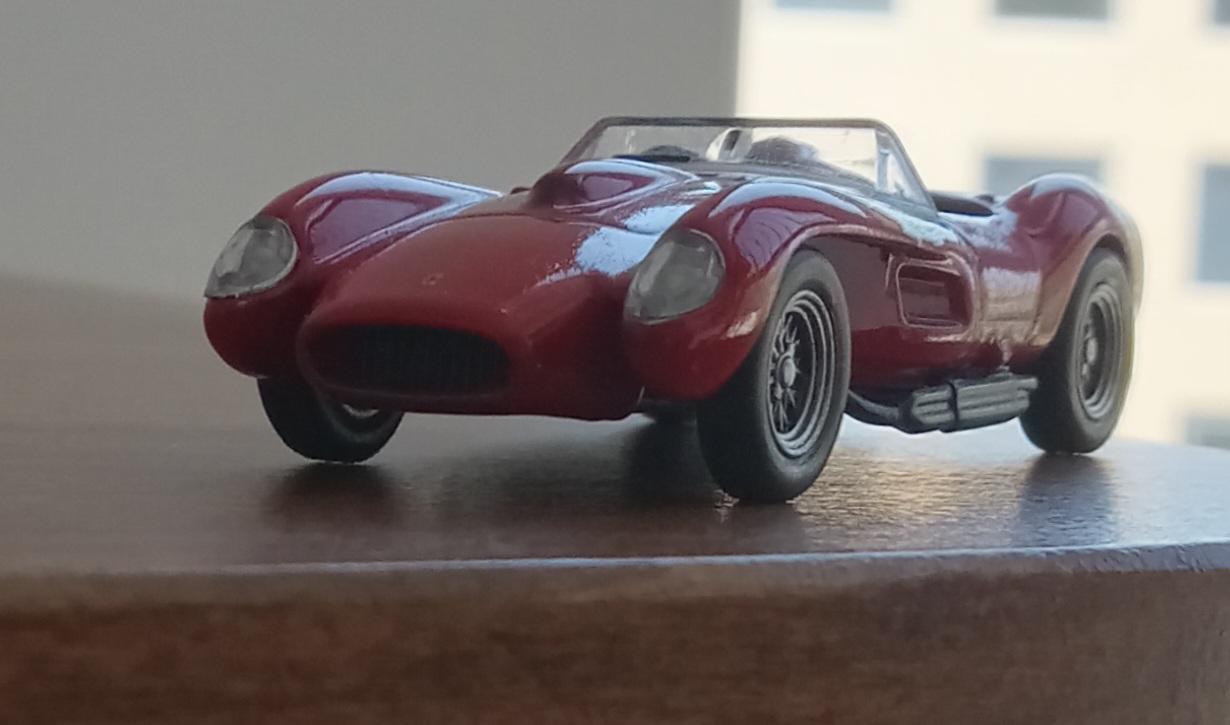
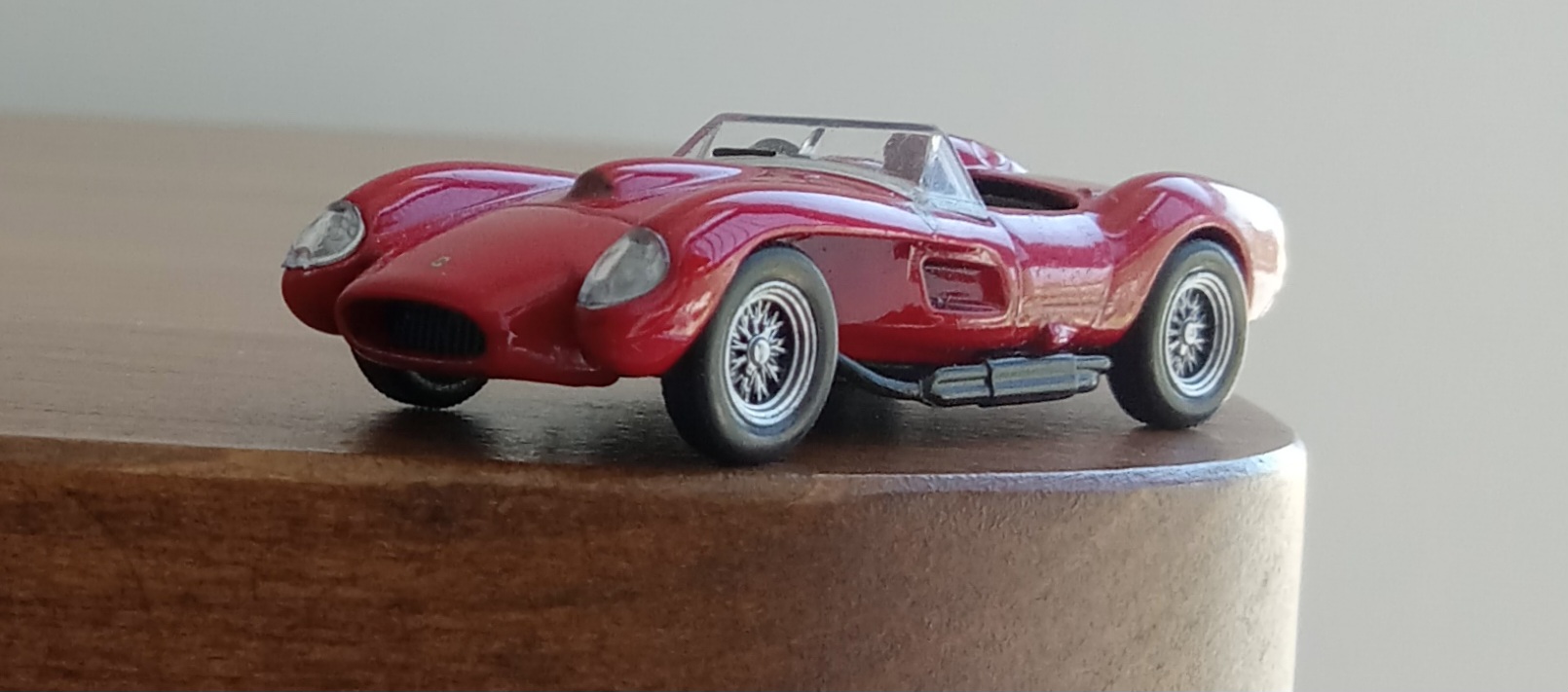
個人的に、
一番好きなフェラーリ、
『全身すべてが見どころ』な
250TR【ポンツーン・フェンダー版】の、
デザイン的な特徴を6個上げてみました。
(この車に関しては、いくらでもあげられますが、、、キリがありません)
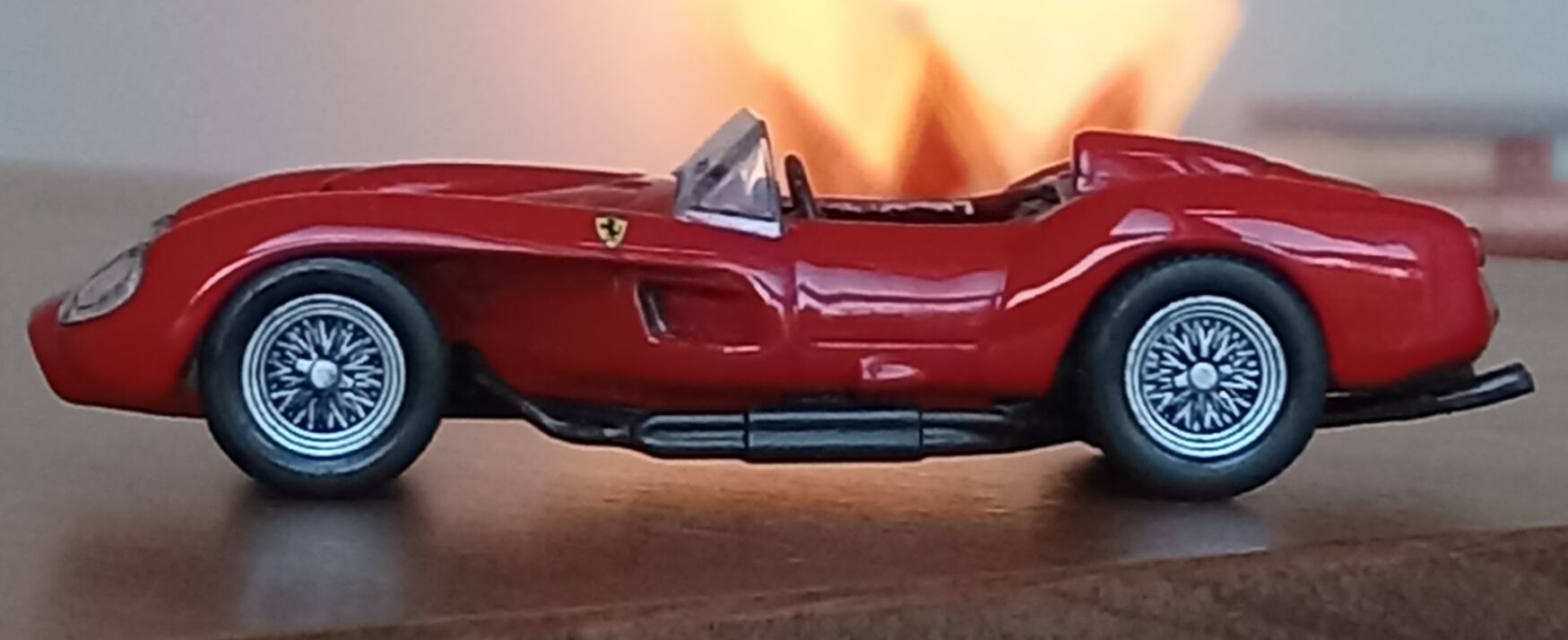
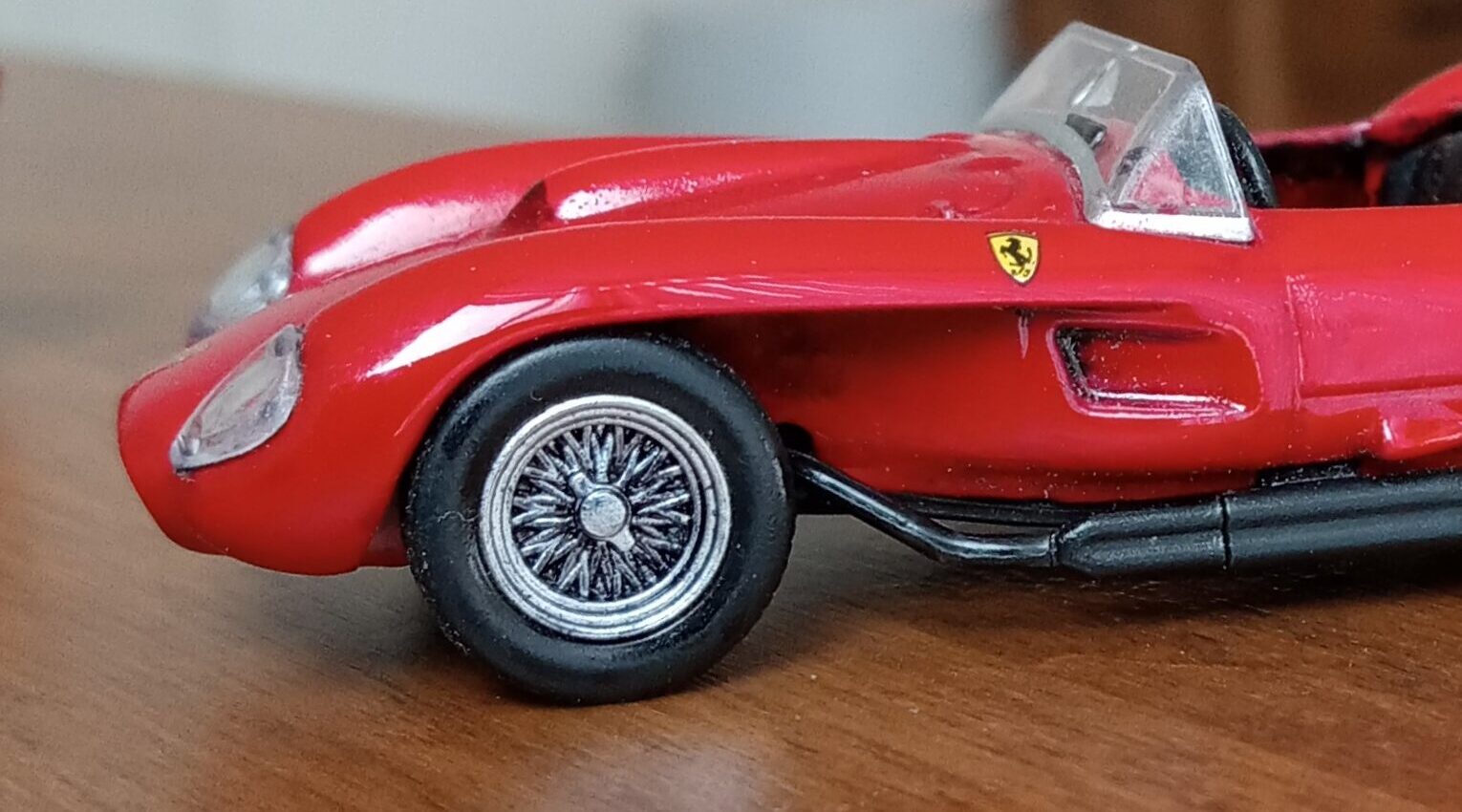
1:文字通り、『あらゆる画角がベストアングル!』的な抑揚溢れる頑強な全身デザイン
ーーーーーー>強烈なデザインが多い当時のレース界でも、ダントツの押し出しの強さ
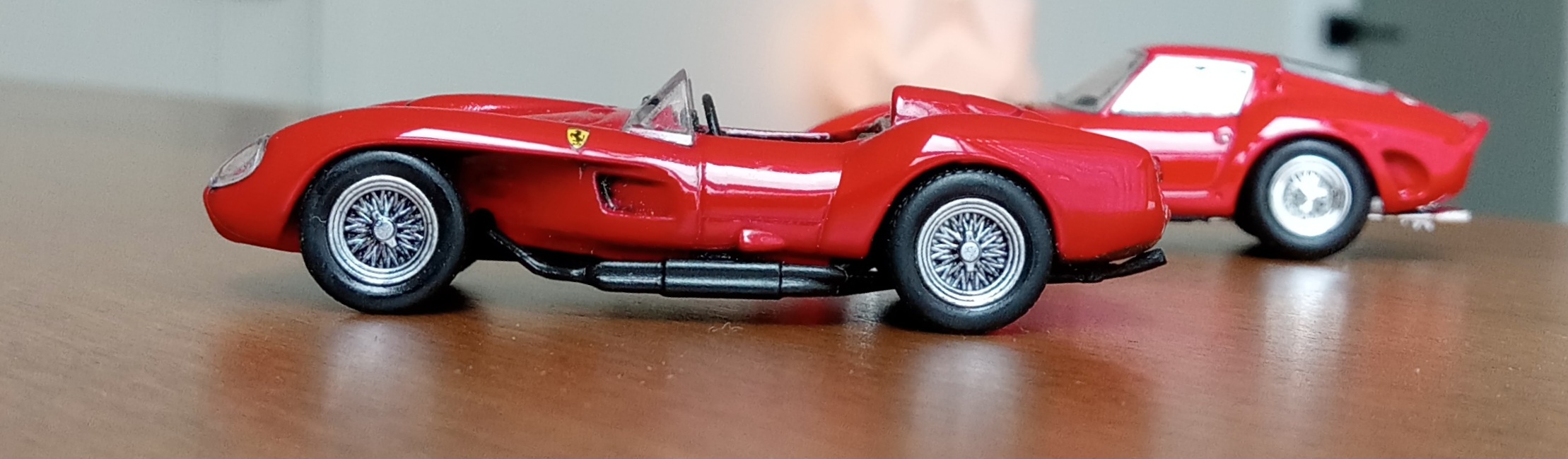
2:前輪ブレーキの冷却のため、、、というのは完全な言い訳に思える、『カッコ良ければそれでよし』的なポンツーン・フェンダーの奥深い彫刻感
ーーーーーー>戦前のサイクルフェンダーへのオマージュ感も泣ける部分です。
3:Ⅴ型12気筒の高性能エンジンを、文字通り前輪車軸以降に搭載した、美しいサイドビュープロポーション
4:ポンツーン・フェンダーに見事に収められたサイド出しマフラーの取り回し方が産む、ーーーーーーーー>サンドビュー下側の勢い溢れるスイープライン
5:葉巻型ボディーの名残のようにも見える、ボンネットかラジエター・グリルに続く野性味あふれる立体構成
6:フロントの『陽』に対するリアビューの『さりげなさ』、、、しかしながらそれだけでは終わらせない、4本出しマフラーの『飛びだし感』の大きさ
それでは、
ひとつづつ写真を添えて見て行きましょう、
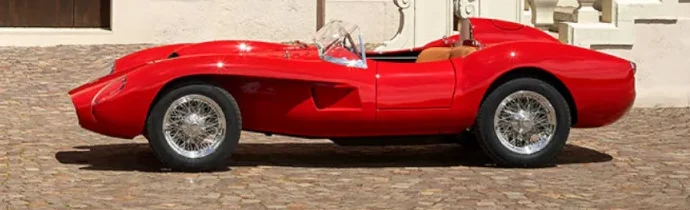
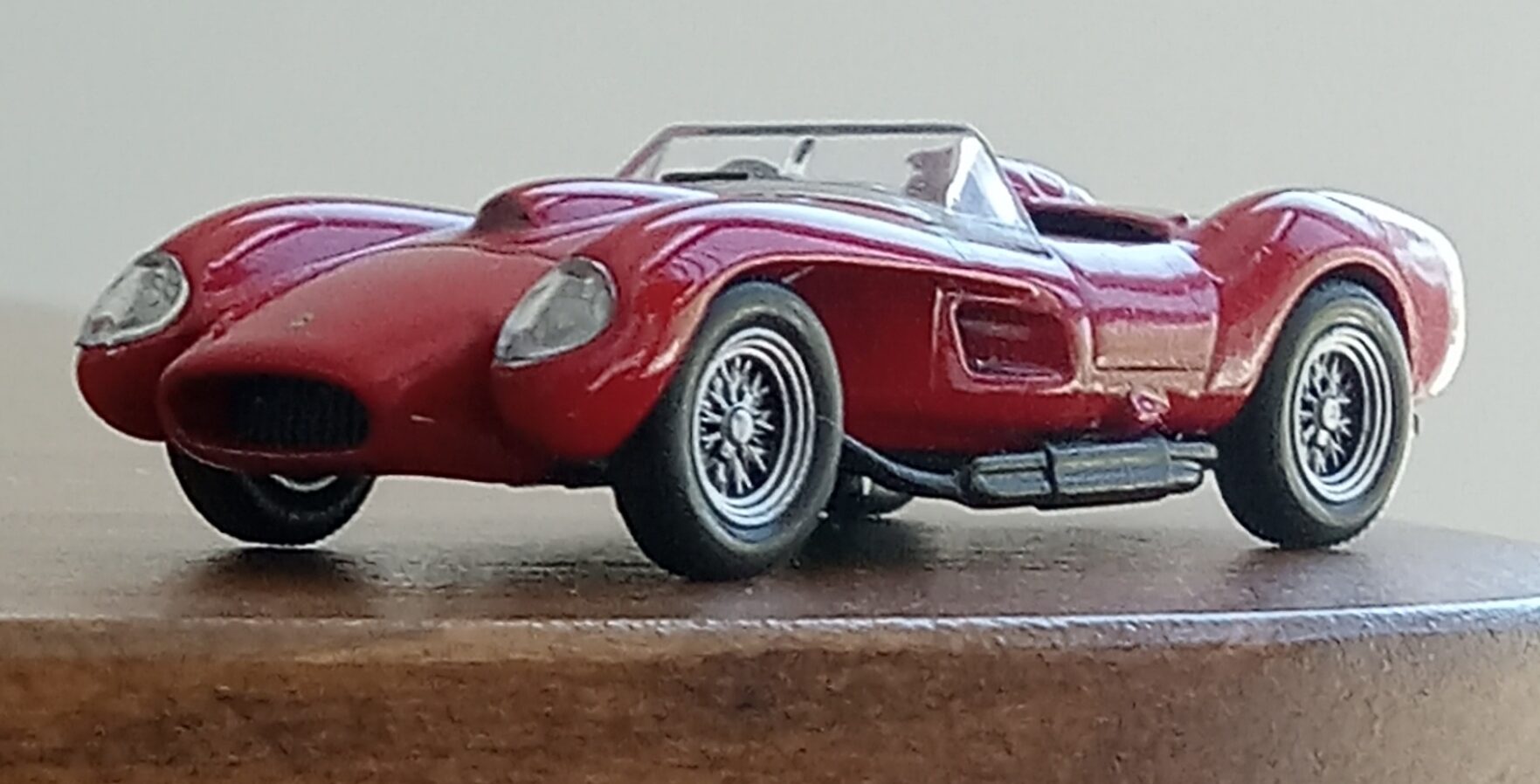
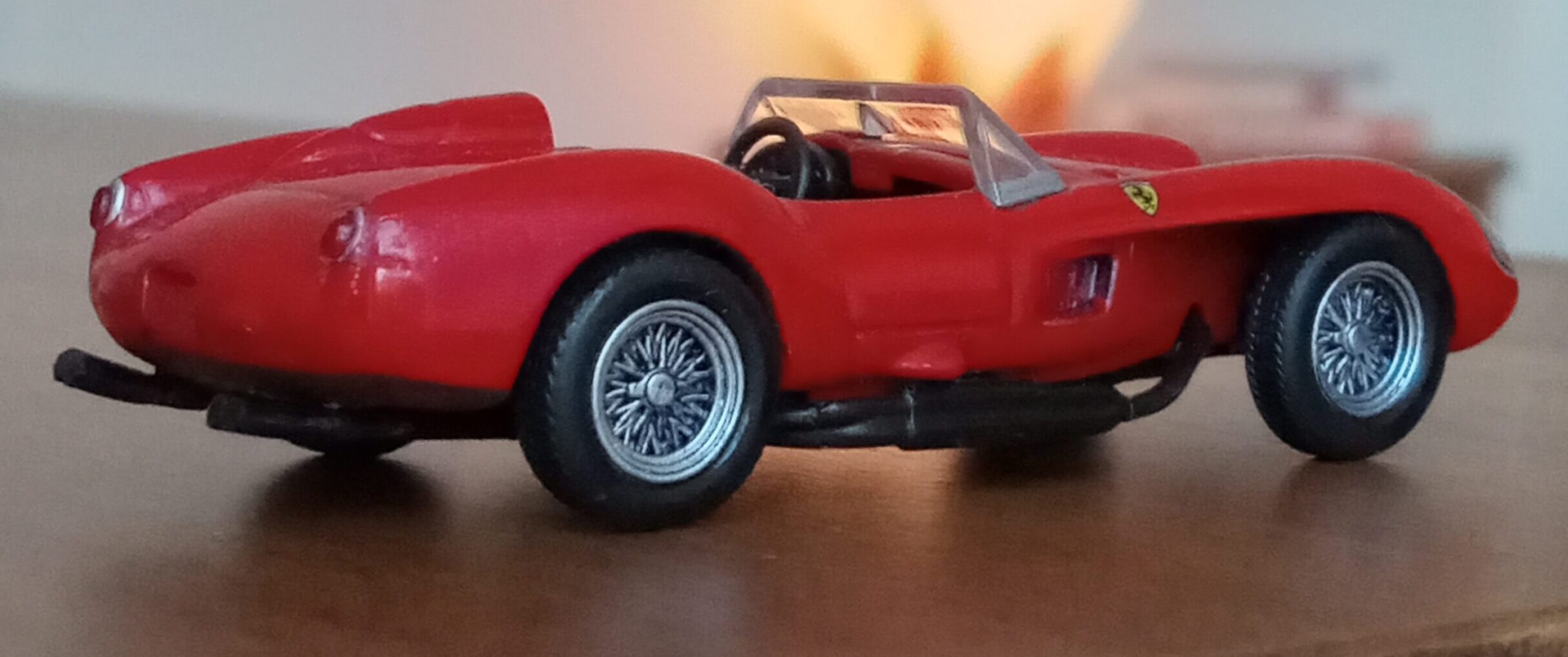
1:文字通り、『あらゆる画角がベストアングル!』的な抑揚溢れる頑強な全身デザイン
(この時代のライバルレーサーが空力や科学的な面構成で、次第に個性が無くなる中、最後まで、ハッタリノきいたセルジオ・スカリエッティ(Sergio Scaglietti)の押し出し)
ーーーーーー>D-タイプ・ジャガーなど、空力化の流れに押しやられる直前、ダントツの押し出しの強さ
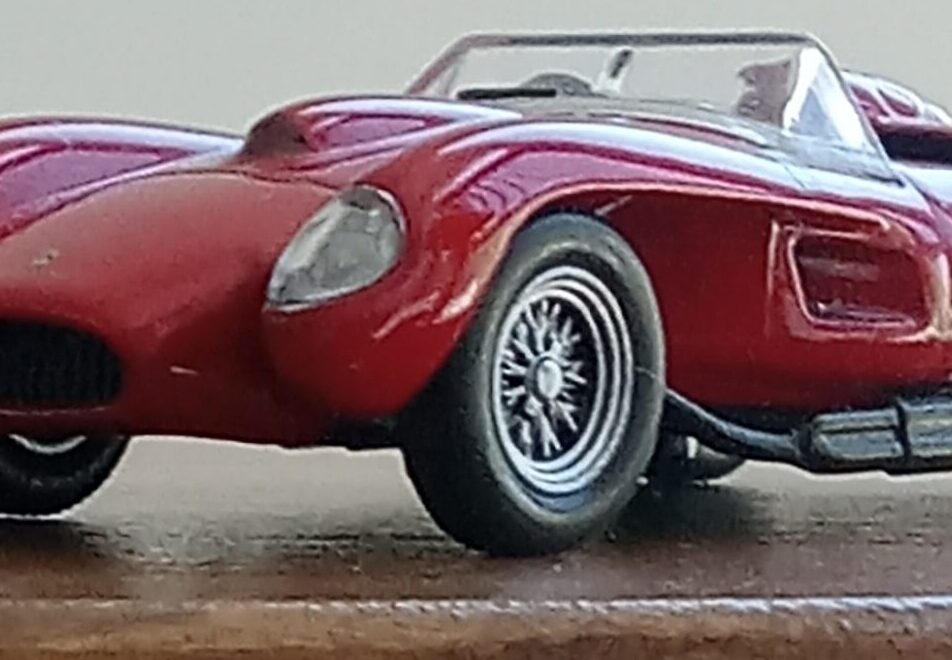
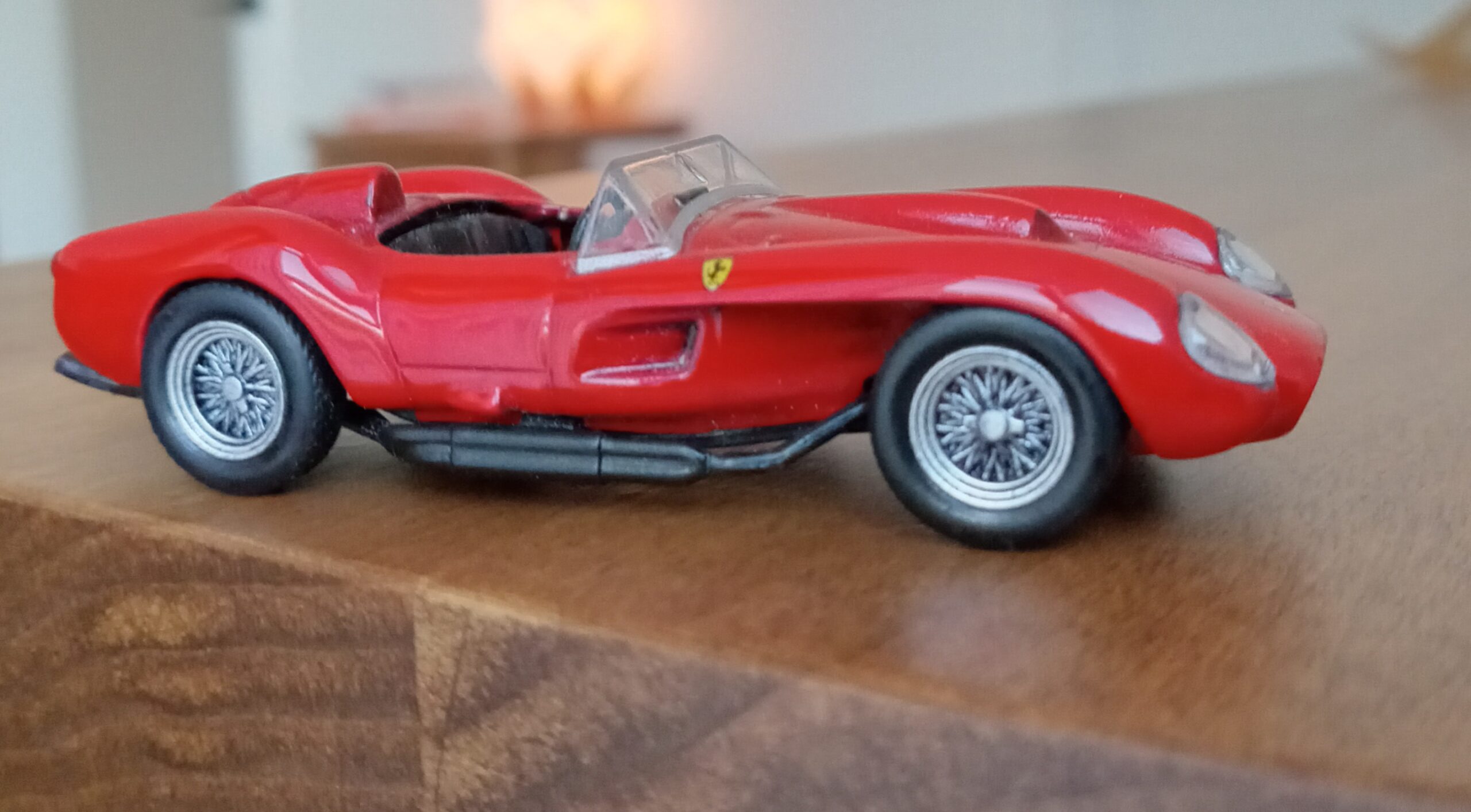
2:前輪ブレーキの冷却のため、、、というのは完全な言い訳に思える、『カッコ良ければ全てよし』的なポンツーン・フェンダーの『業』の深い彫刻感
(1930年代のクラムシェル・フェンダーへのオマージュともとれるボディーサイドの深い切れ込みは、ヘッドライトを収める先端部を飛び出したラジエーター部分と分け隔て、極めてユニークな、得も言われぬフロントエンドの表情を演出しています。)
ーーーーーー>戦前のサイクルフェンダーへのオマージュ感も泣ける部分です。
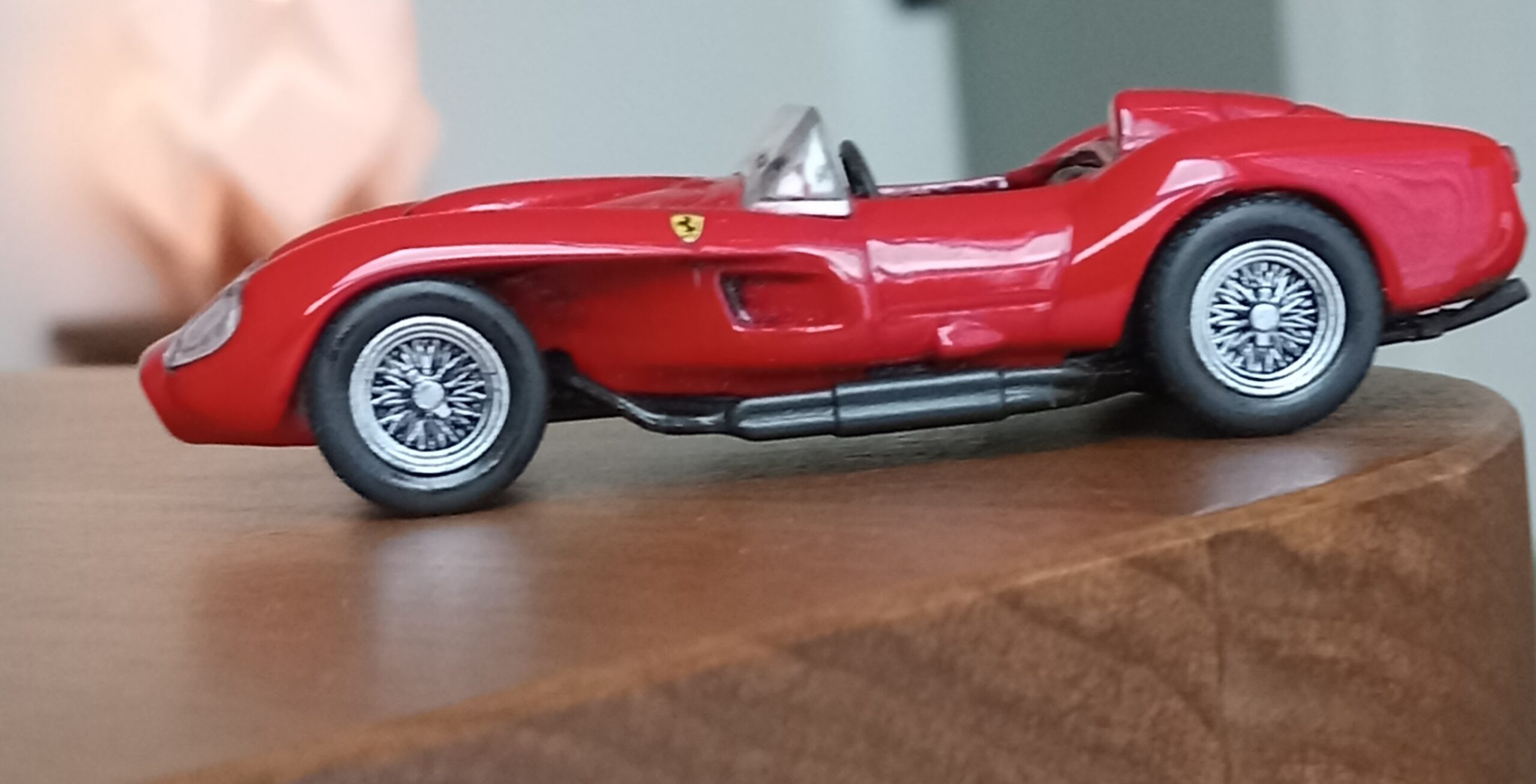
3:Ⅴ型12気筒の高性能エンジンを、文字通り前輪車軸以降に搭載した、美しいサイドビュープロポーション
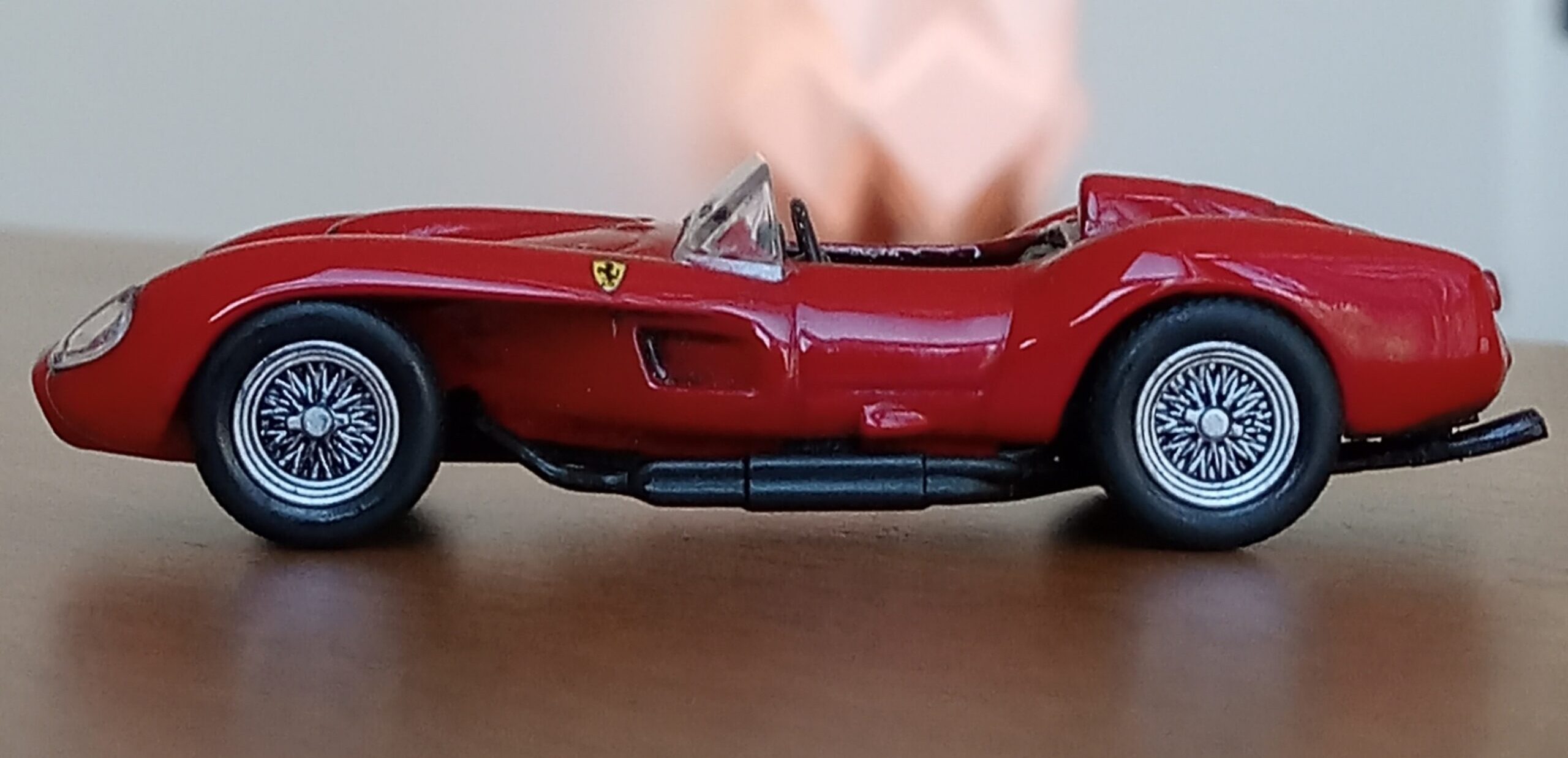
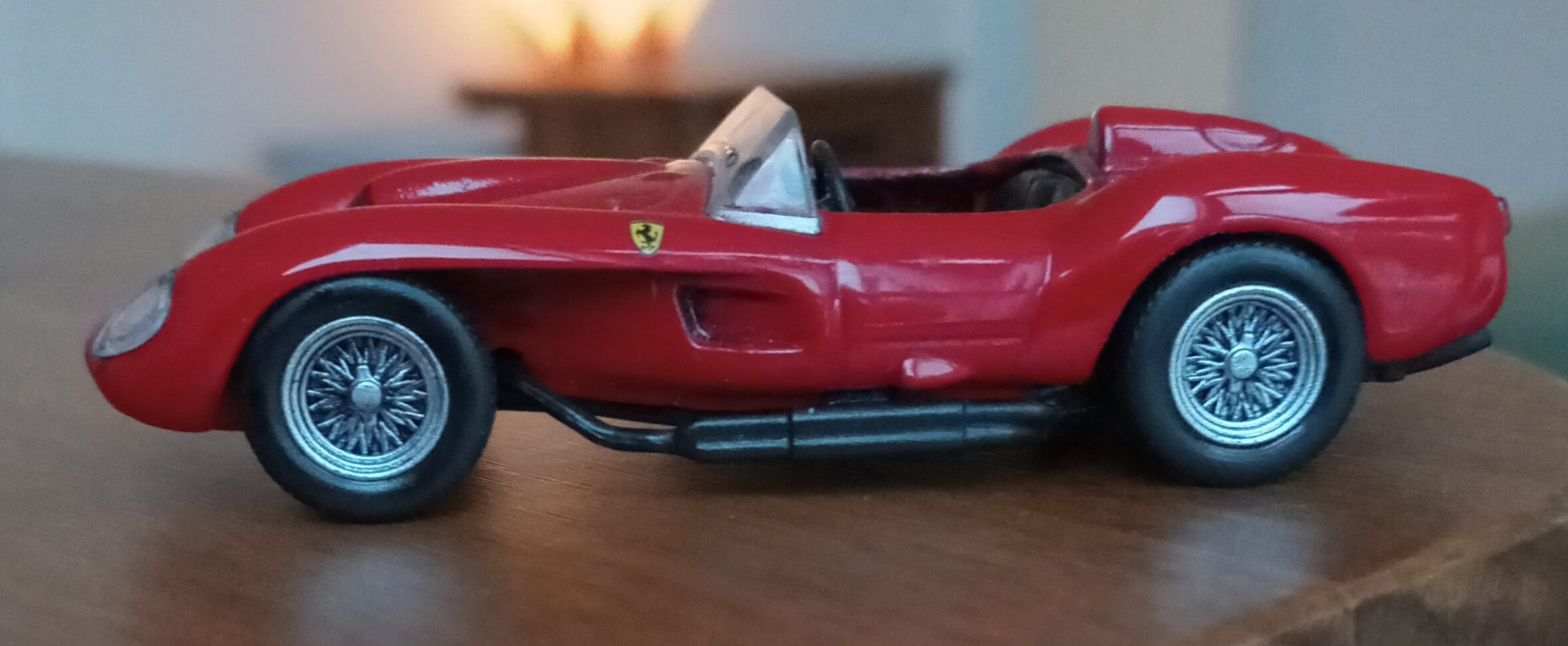
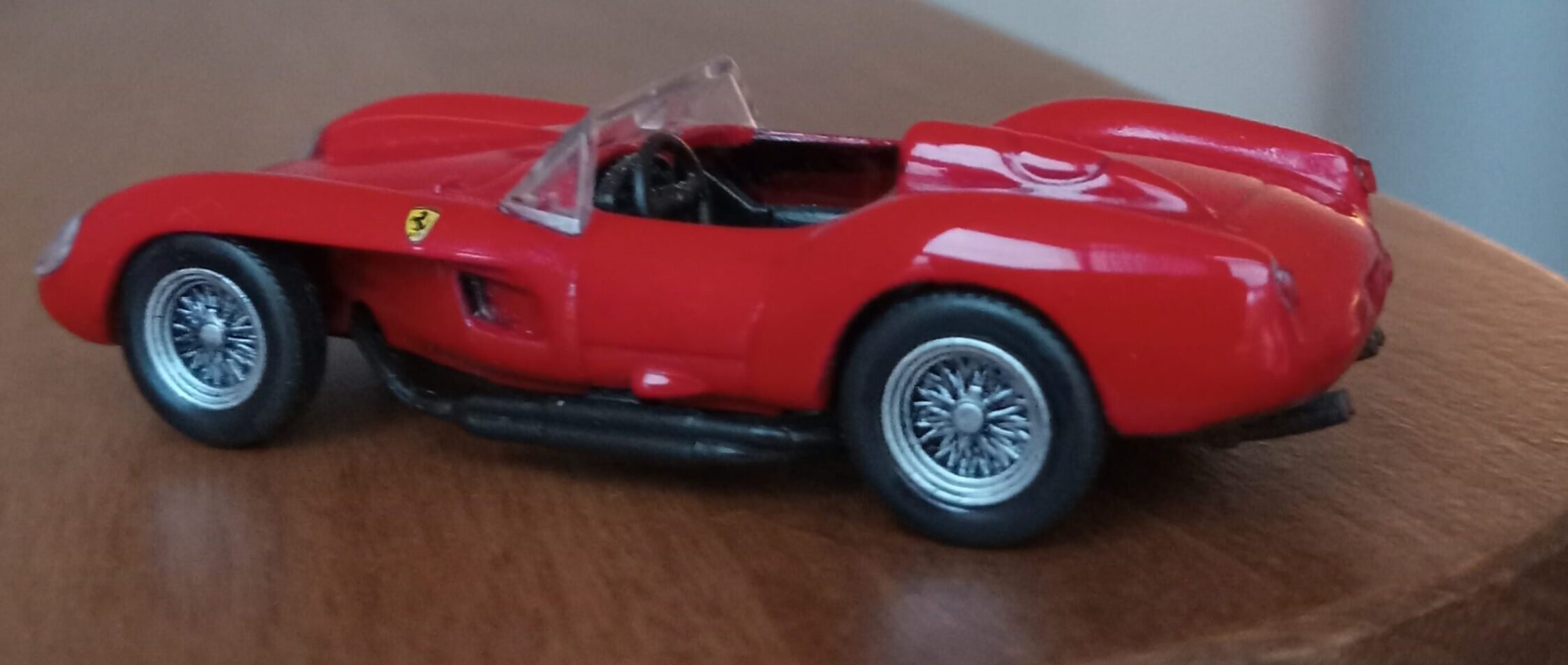
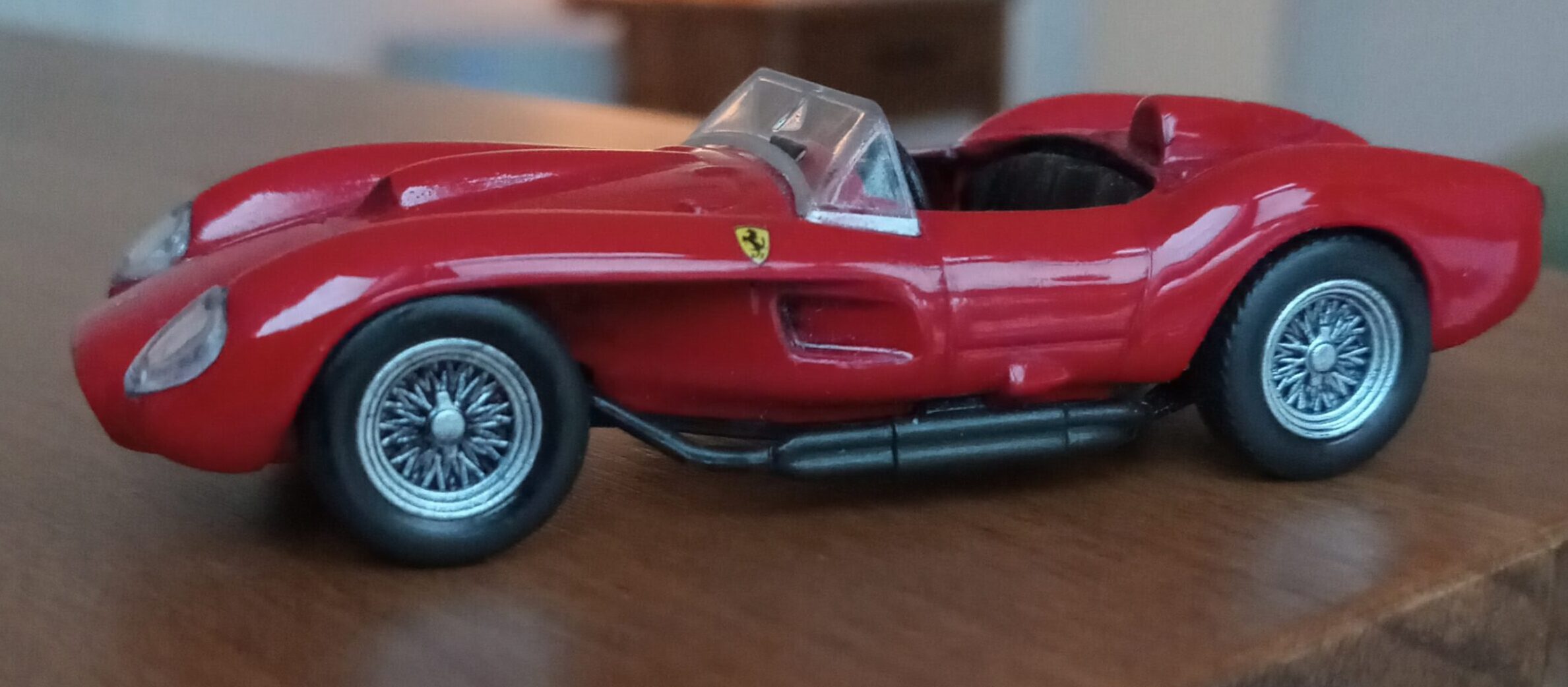
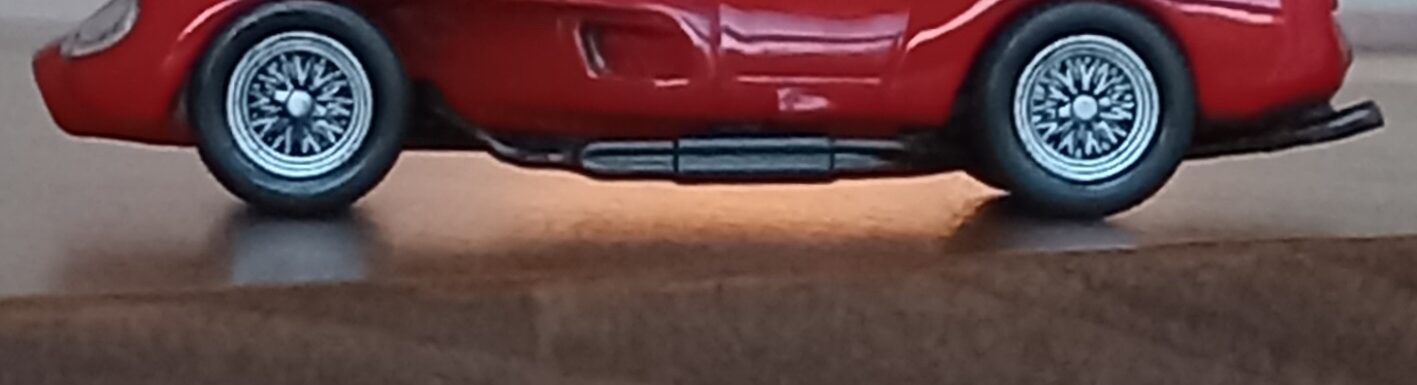
4:ポンツーン・フェンダーに見事に収められたサイド出しマフラーの取り回し方が産む、
ーーーーーーーー>サンドビュー下側の勢い溢れるスイープライン
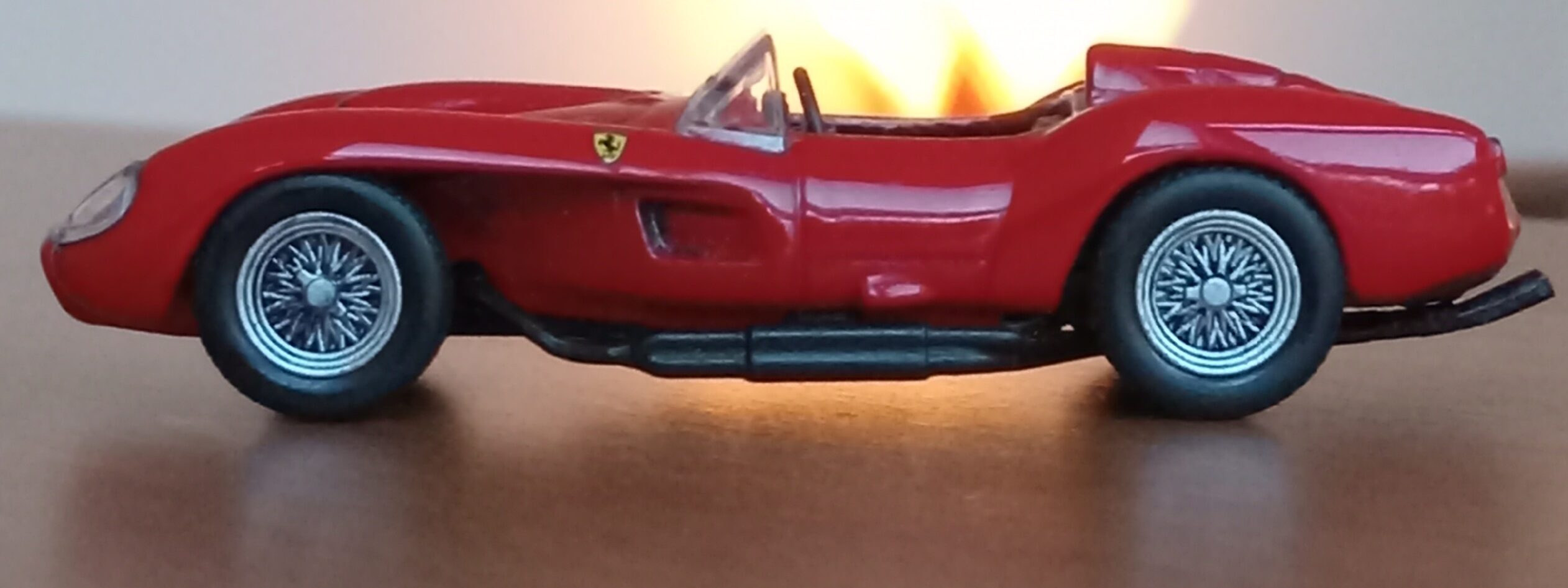
5:葉巻型ボディーの名残のようにも見える、ボンネットかラジエター・グリルに続く野性味あふれる立体構成
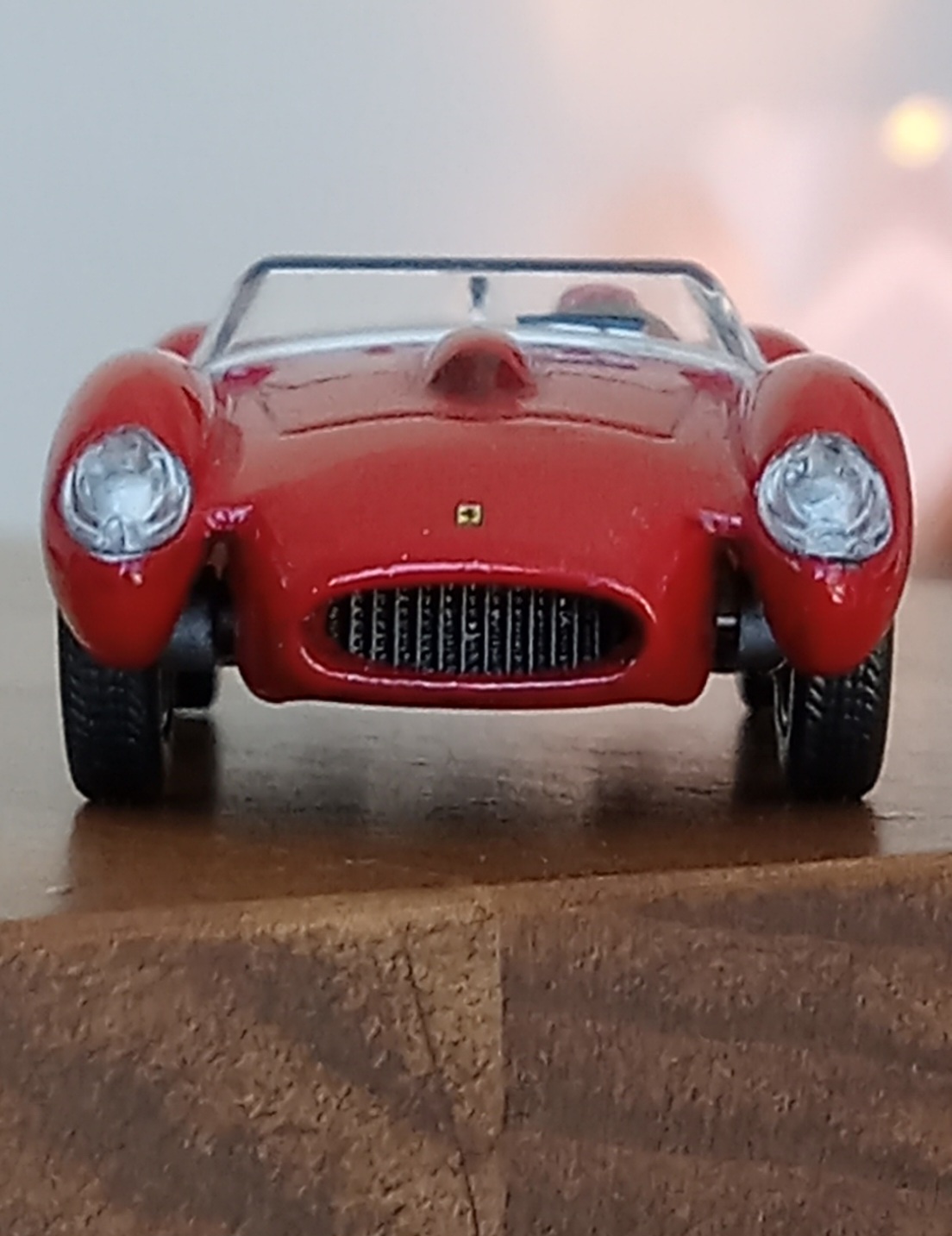
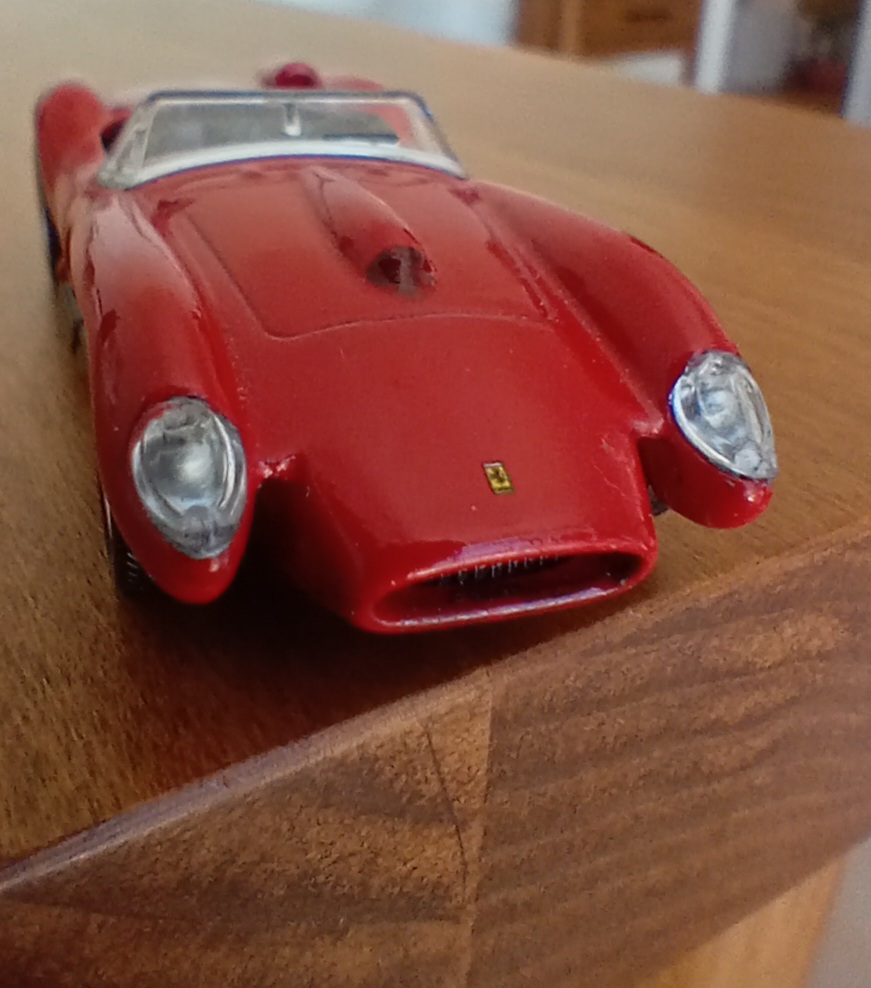
6:フロントの『陽』に対するリアビューの『静=さりげなさ』、、、しかしながらそれだけでは終わらせない、4本出しマフラーの『飛びだし感』の大きさ
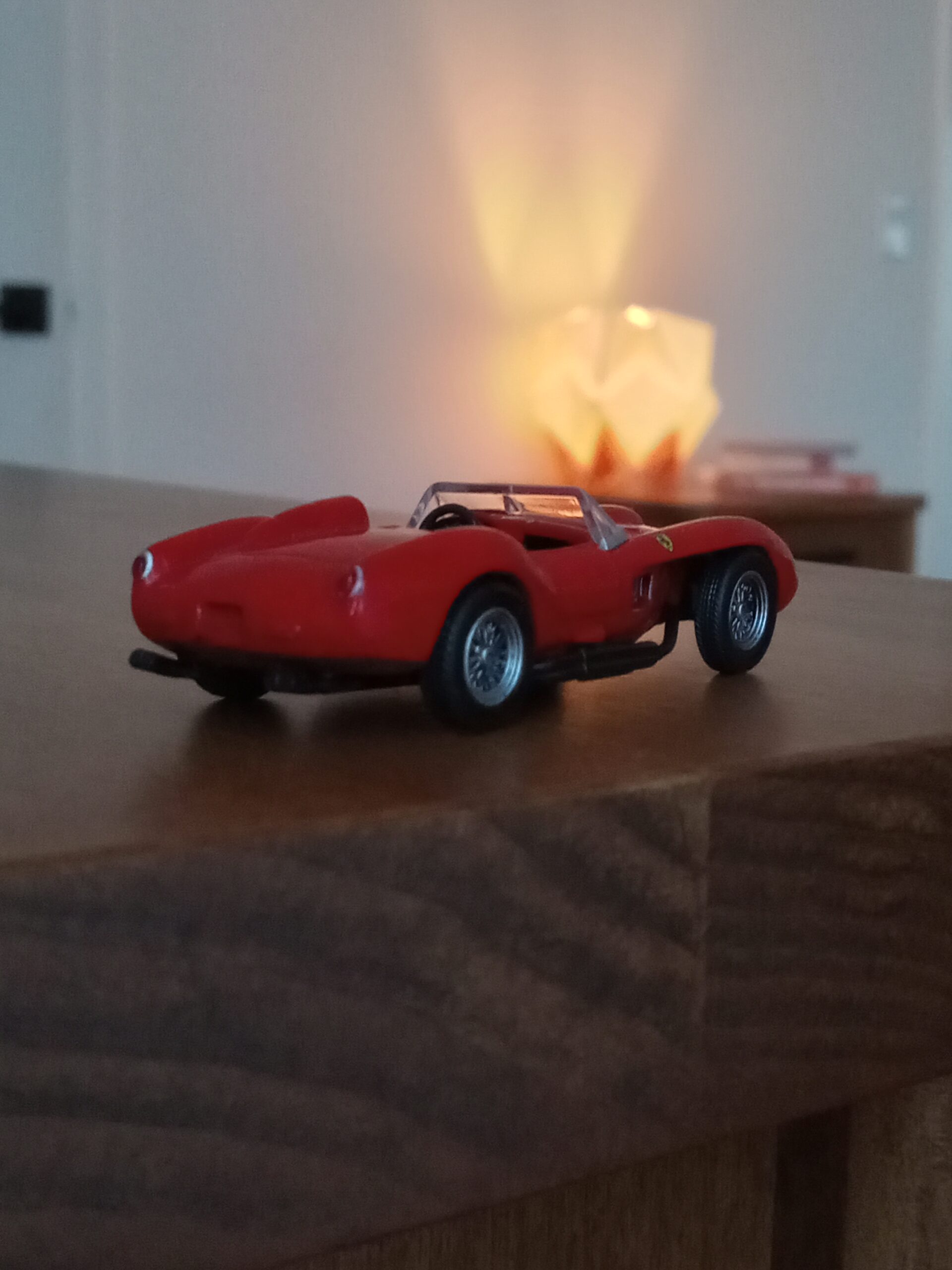
ではお待ちかね、
先が見えない、
『三題噺』行ってみましょう!
*三題噺:カトキ・ACコブラ427・貝殻

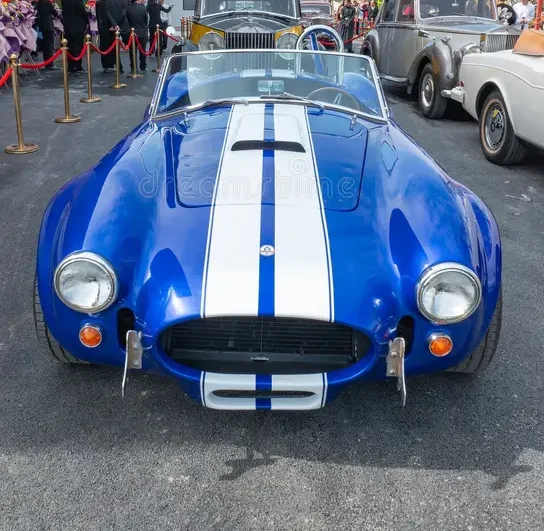

今回のお題、
可なり、バラけましたね、
これは、
なかなか見ものです!
*カトキ・ハジメ
*ACコブラ427
*貝殻
それでは、
『毎度ばかばかしいお笑いを、
一席おつきあいのほどを願っておきますが、、、
近頃この—
『AI』による仕事の置き換えが叫ばれ、
日に日に人間様の出る幕が無くなりそうな今日この頃、
時代の流れが大きく変わるのをひしひしと感じる毎日です、、、
後の世で、今のAIに対する恐怖が、
笑い話になっているといいのですが、、、
そんな
『過渡期』に付いてのお話です。
自動車設計の世界、とりわけレースカーの世界では、
1950年代というのは、ずいぶん面白い時代でして、
丁度、戦前からずーと続いてました、オープンホイール、つまり、タイヤが車体からはみ出していたのが、ボディーと一体化したフェンダー部分で覆うことで、、
空気の抵抗を減らそうとしたんですね、
スムージングとか言ったりします、、、
そんな過渡期に『偶然、時のいたずら?的に』登場したのが、
お題目にあります、
フェラーリ250TR、ポンツーン・フェンダー版ということになります。
この車、何がすごいって、
レーシングカーって、高速走行中に、ブレーキをかけることがあるんですが、
そんな時に、遠方から流れた風をブレーキに直接あてることで、冷却効果を生んで、早く確実に減速可能にしたんです。
すごい機能なんです。
そのために使われたフェンダーの形が、
海岸に落っこちてる『貝殻』に似ていたので、クラムシェル・フェンダーなんかと呼ばれてました。
クラム・チャウダーじゃないですよー
紛らわしいですねェ、
間違えないでね~、
そのうえ、
この車、この有名なスカリエッティーさんが設計した「貝殻の泥除け(フェンダー)」のおかげで、
べらぼうにかっこいいんだよねー。でもちょっと残念なのは、
相手のジャガーと競争が過熱した後でわかったんだけど、
高速で走ってると、貝殻がふわふわと浮かびだして、
跳び出しそうになっちまうって、いうじゃないかー
それは困った、てんで、へこんでた横っ腹をまっすぐなハガネの板で覆ってしまって、
めでたしめでたし、、、、
実際、レースの成績はそれでよかったんだけど、
獲物を狙う獣のような迫力はどっか行っちまったんで、、
見た目が勝負のイタリア車としては、
あっしはイマイチ合点がいかねーな!
ところで、この250TRの貝殻フェンダー付き、ですが、
この車に真っ向から対決した車がございます。
アメリカの荒くれもの:ACコブラ427と申します。
*フェラーリの繊細極まるⅤ12気筒エンジンを貝殻で包んだ、250TR、に対して、
*英国製の軽い車台にアメリカ製の馬鹿でかいV8ヲ無理やり押し込んだコブラ427
この2台はライバルとして、世界各地で、数々の名勝負を演じて、
後継の流線型バージョンへ道を譲りました。
まさに両車ともに、
過渡期が産んだ傑作というにふさわしい名車です。
エ~と、
『過渡期』と言いますと、
思い出すものがあります。
1980年代後半に一世を風靡した模型雑誌モデルグラフィックスの連載
『ガンダム・センチネル』に登場した主人公が乗りますロボット、
その名も:『Sーガンダム』
(スペリオール=究極のガンダムの意)
このガンダムは、スカリオーネさん?ではなく、
日本人の工業デザイナー:カトキハジメさんが設計されました、
250TRと同じく、
機能がカタチに結び付いた、
本格的な工業デザインとして理詰めでデザインされてました、が、、、
こちらも250TRと同じく、機能の追求から偶然生まれた、
『人型を外したかっこよさ』、美しさで有名になりましたが、やはり短命に終わり、
後継の機体、
コブラ427のように恐竜的進化を遂げた
『EX-Sガンダム』へ、道を譲りました、、、
何事も、
大きな流れの中で、渦巻き、逆らい、
それでも次の大波にさらわれ、消える運命、
そんな儚さから生まれる、『時代のあだ花』こそが一番美しいのかもしれません。
せめて、AIの大波にさらわれないよう、
自分の創造性(気まぐれ・変人性)に磨きをかける意味でも、
ーーーーー>自力でこの三題噺を紡いで行きたいです。
それでこそ人間としての甲斐がアラー(貝殻―)これで下げです―ーーって
まだ続きます、、、
(天を仰いで、一呼吸おいて、ゆっくりした口調で、)
『ここで一句、
まさに、
我らが【S-ガンダム】も、
カトキが設計、
過渡期に登場、
その容姿が、
カットキー(かっこいい)
過渡期の3連発で、
お後がよろしいようで。』ペンペン、、

*その他の時代の転換点に咲いたあだ花的、名車(迷車)たち、、、
それでは、
時代の大きなうねりの中に消えていった、
今敢えて、振り返りたい名車の中から
私の心に響いたデザインを上げて行きましょう!
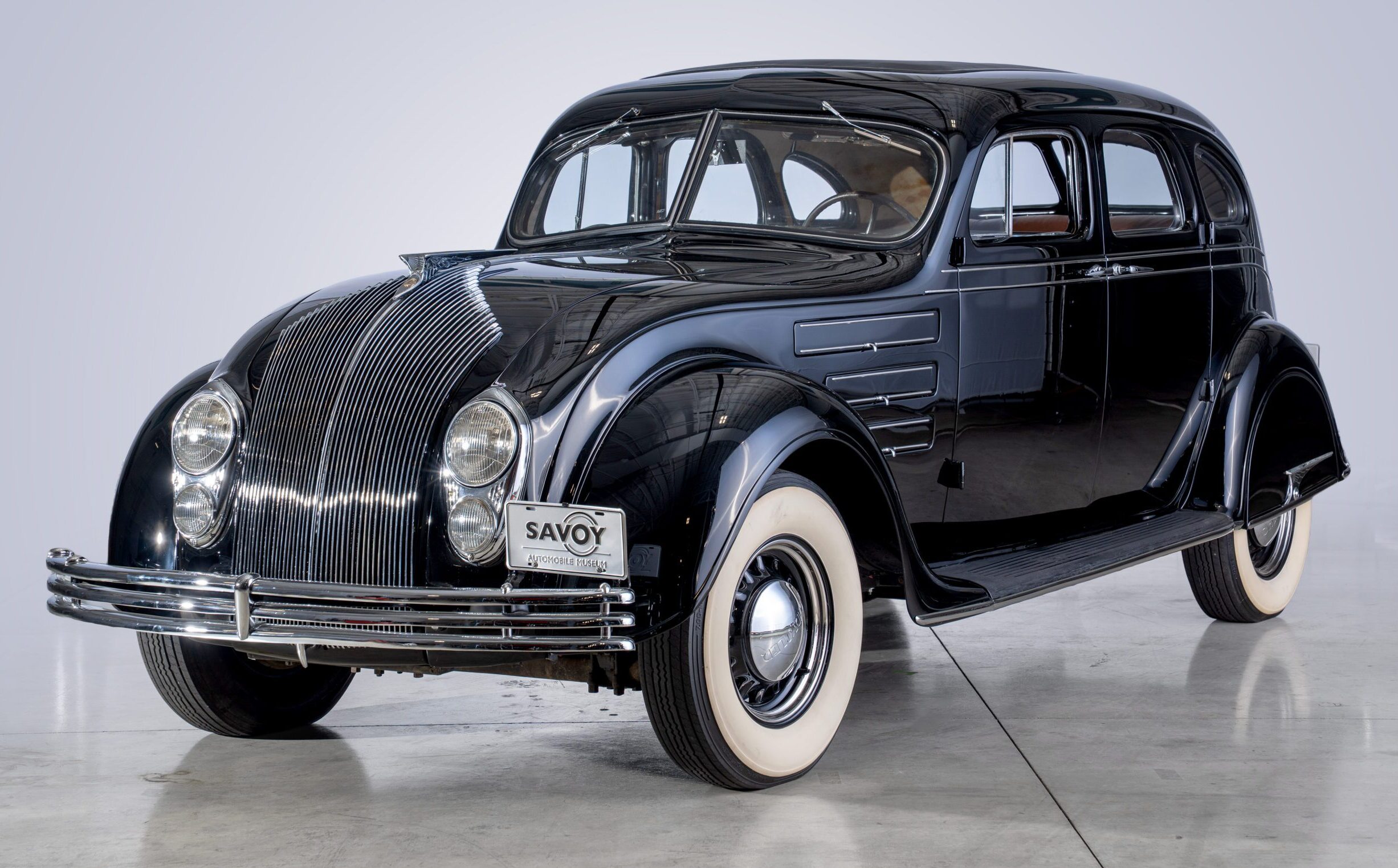
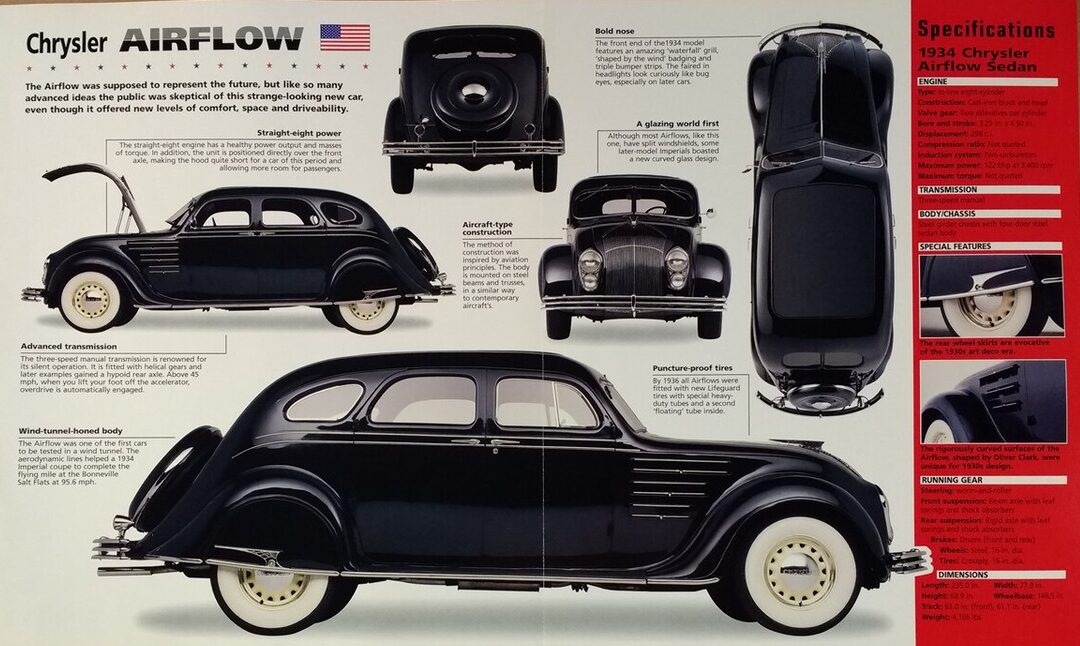
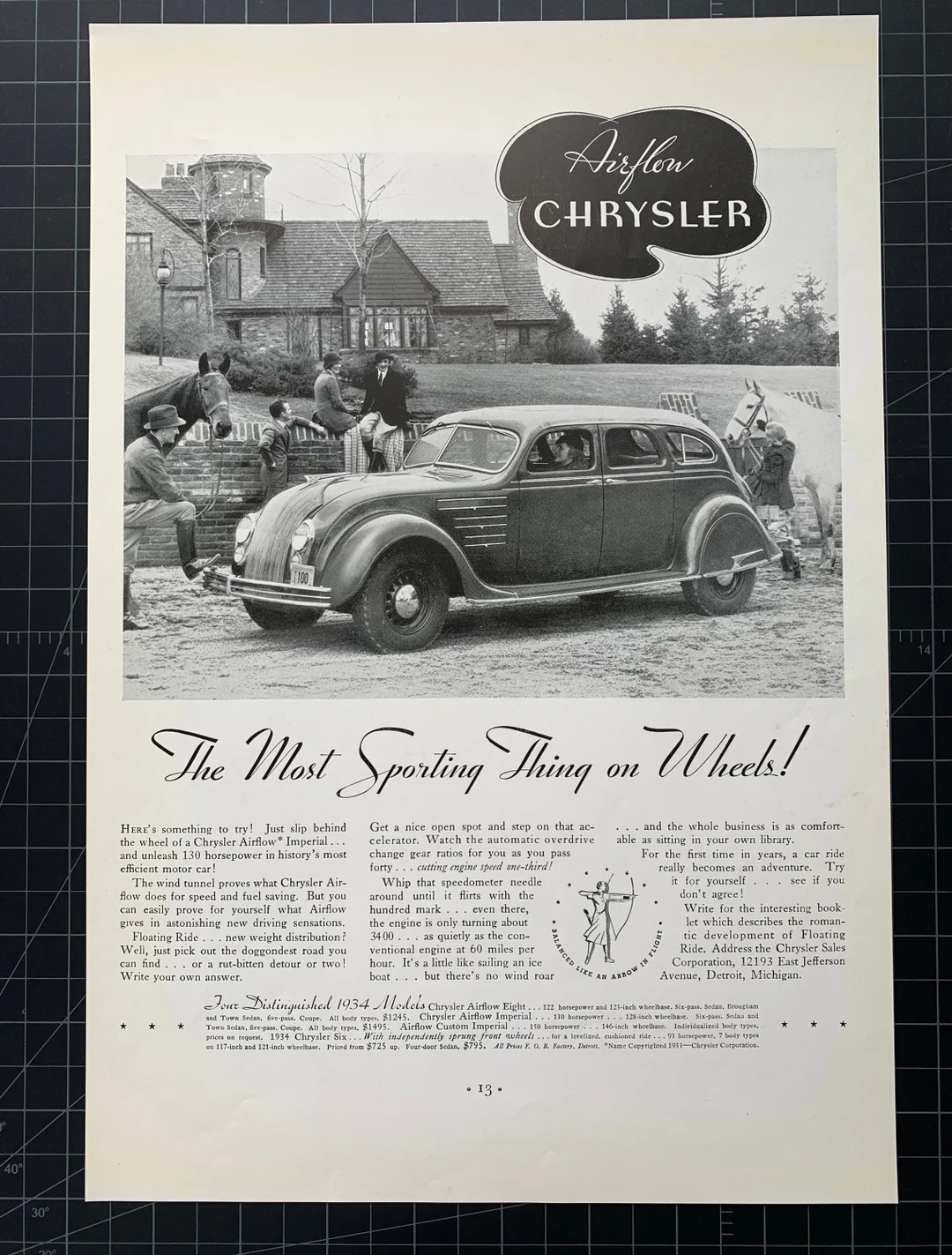
*クライスラー・エアフロー、 (1934)
(本格的な流体力学を導入したものの、当時の大衆には「ジャガイモ」のようだと敬遠されました。)
ーーーーーー>クライスラーから、戦前にこんなきれいなカタチが出ていたとは驚きです。
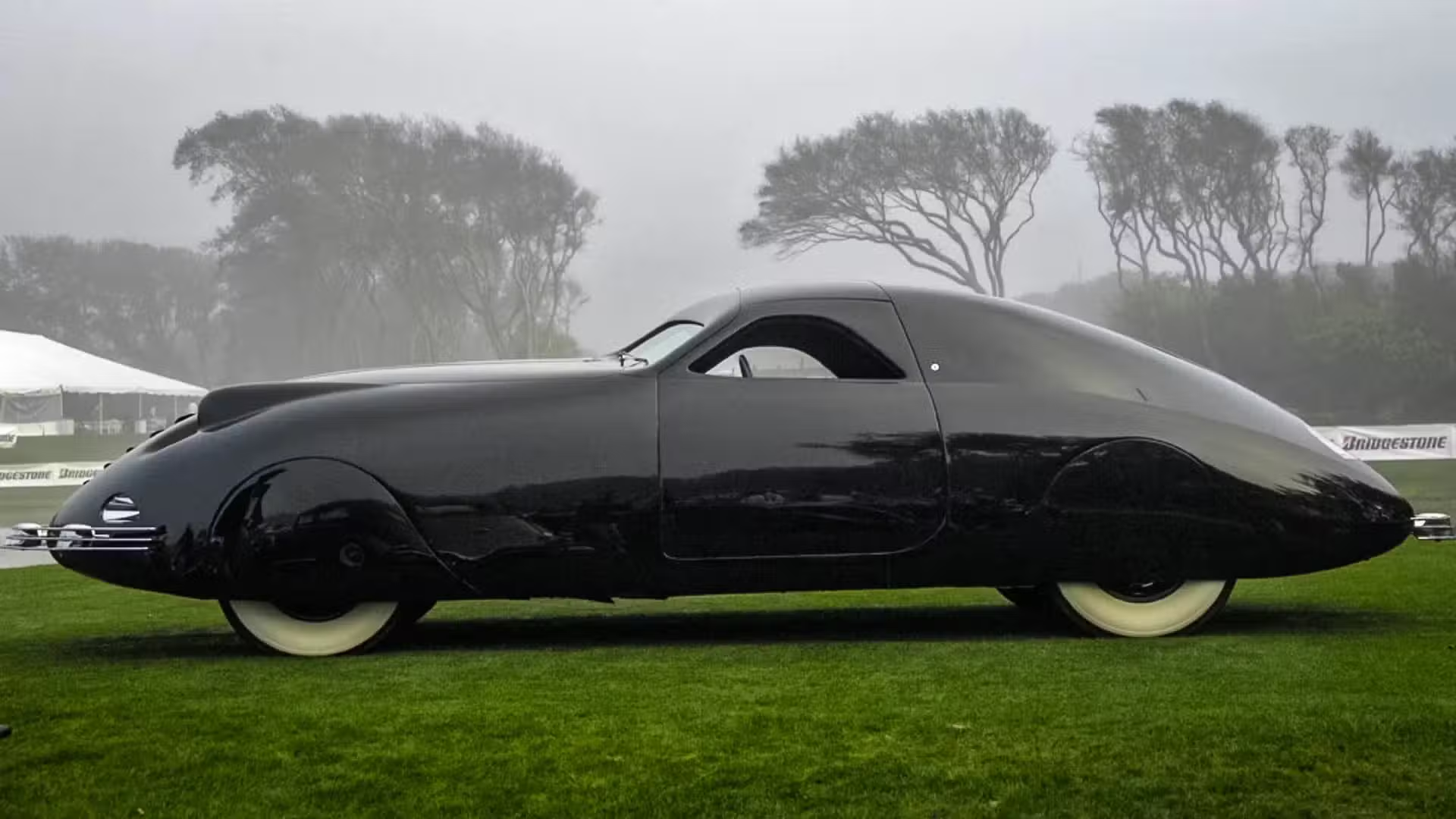
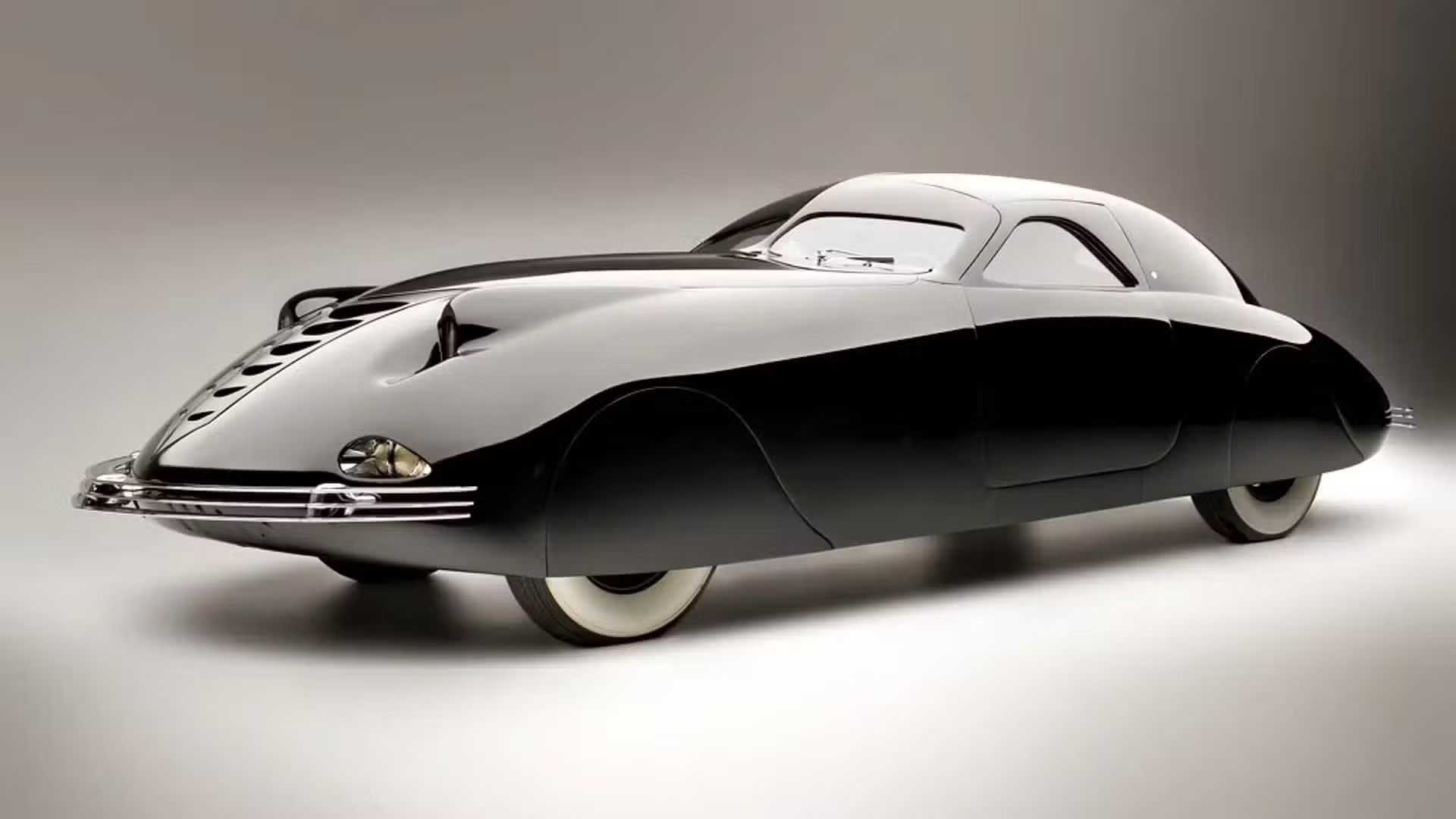
*ファントム・コルセア、(1938)
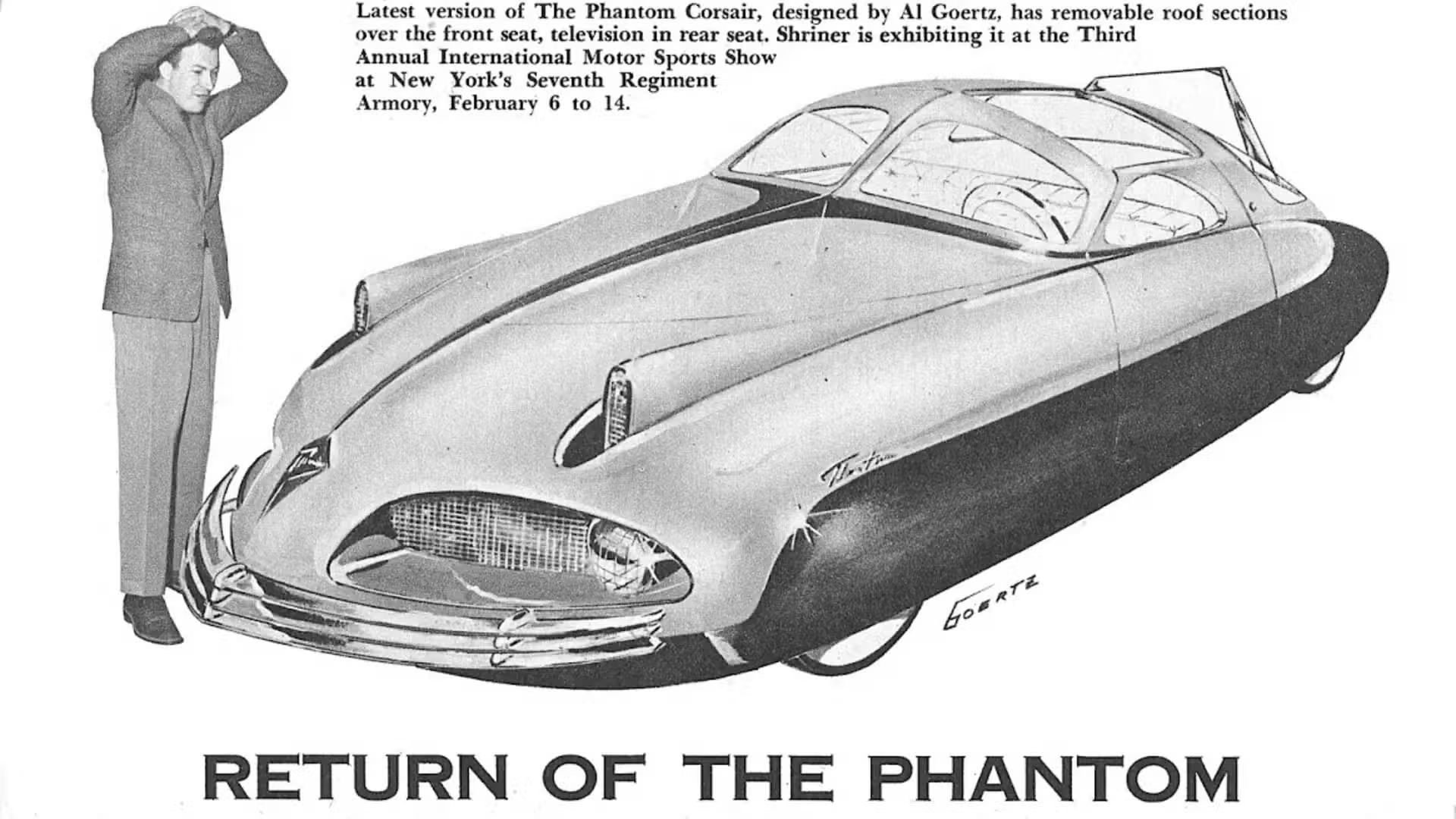
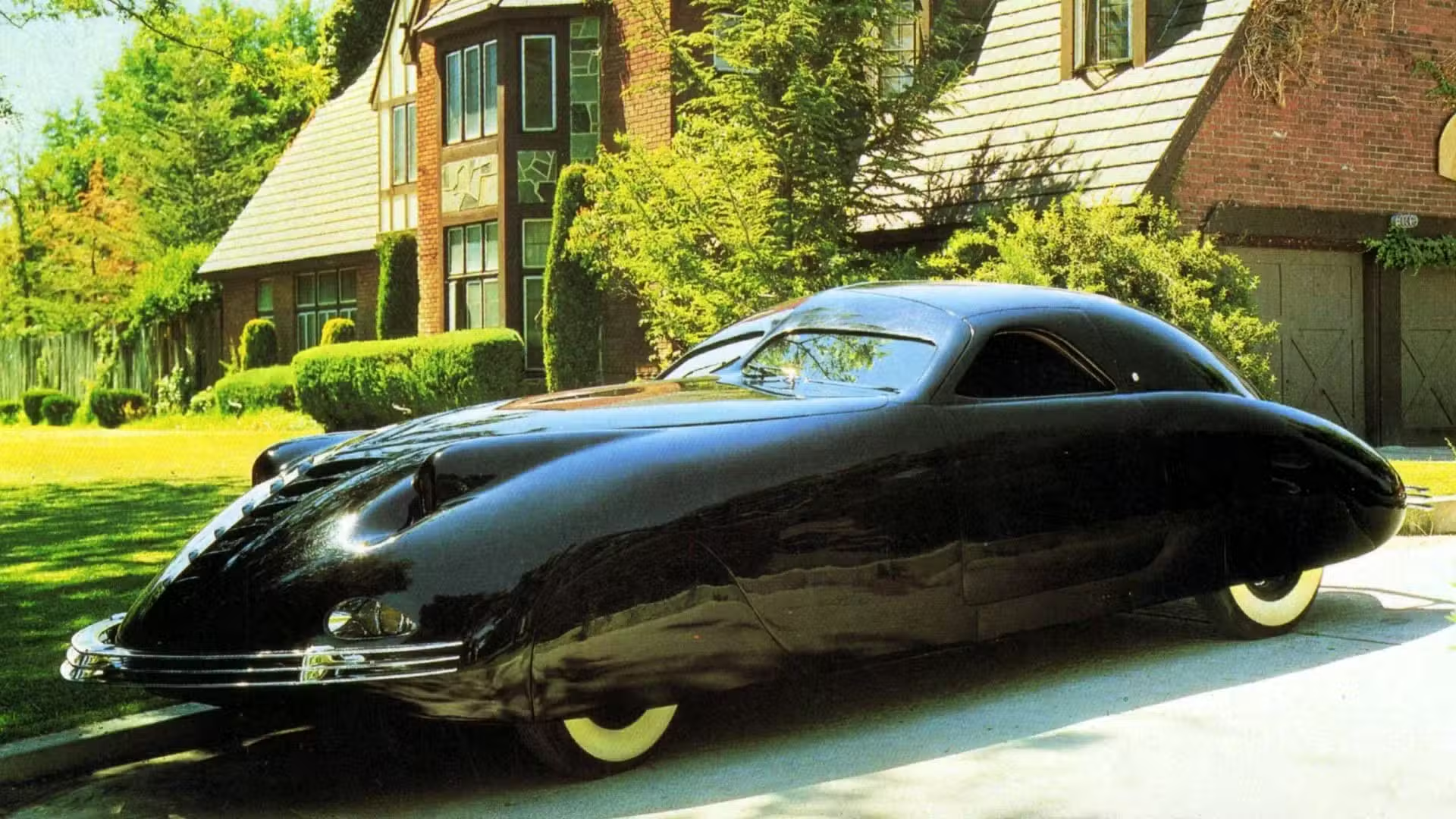
(トマトケチャップで有名なハインツ(H. J. Heinz)社の御曹司であるラスト・ハインツ(Rust Heinz)が私財を投じて企画し、カリフォルニア州パサデナの高級馬車製造業者(コーチビルダー)「ボーマン&シュワルツ(Bohman & Schwartz)」のモーリス・シュワルツと共に設計・開発しました。 その時代を遥かに先取りしたアール・デコ調の流線型デザインと数々の革新的メカニズムから、自動車史における「未来の車」の象徴として語り継がれています。)
ーーーーーー>以前ブルックリン社製の1/43、ホワイトメタルのミニカーを持っていて、その先取り感満点な、オーパーツ的造形に舌鼓を打ってました。(笑)
*AMC ペイサー (1975)
(全幅が広く、車体の半分近くがガラスで覆われた「金魚鉢」スタイル。独特の居住性を目指した過渡期のコンパクト
ーーーー>大学時代に名古屋の田代模型で購入した、MPC社製のプラモデルでその不思議、且つ魅力に満ちた造形を観察しました。
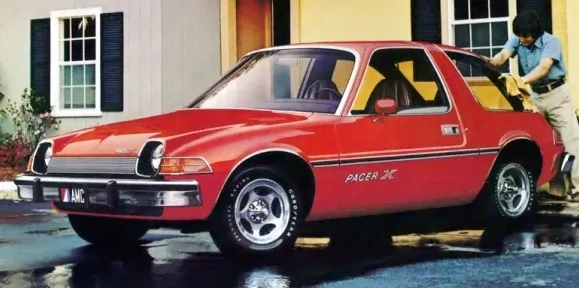
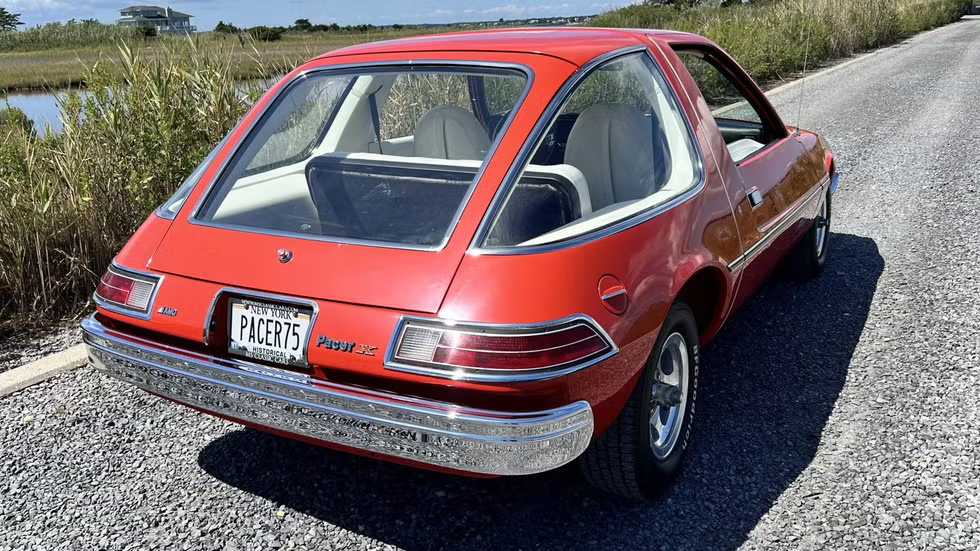
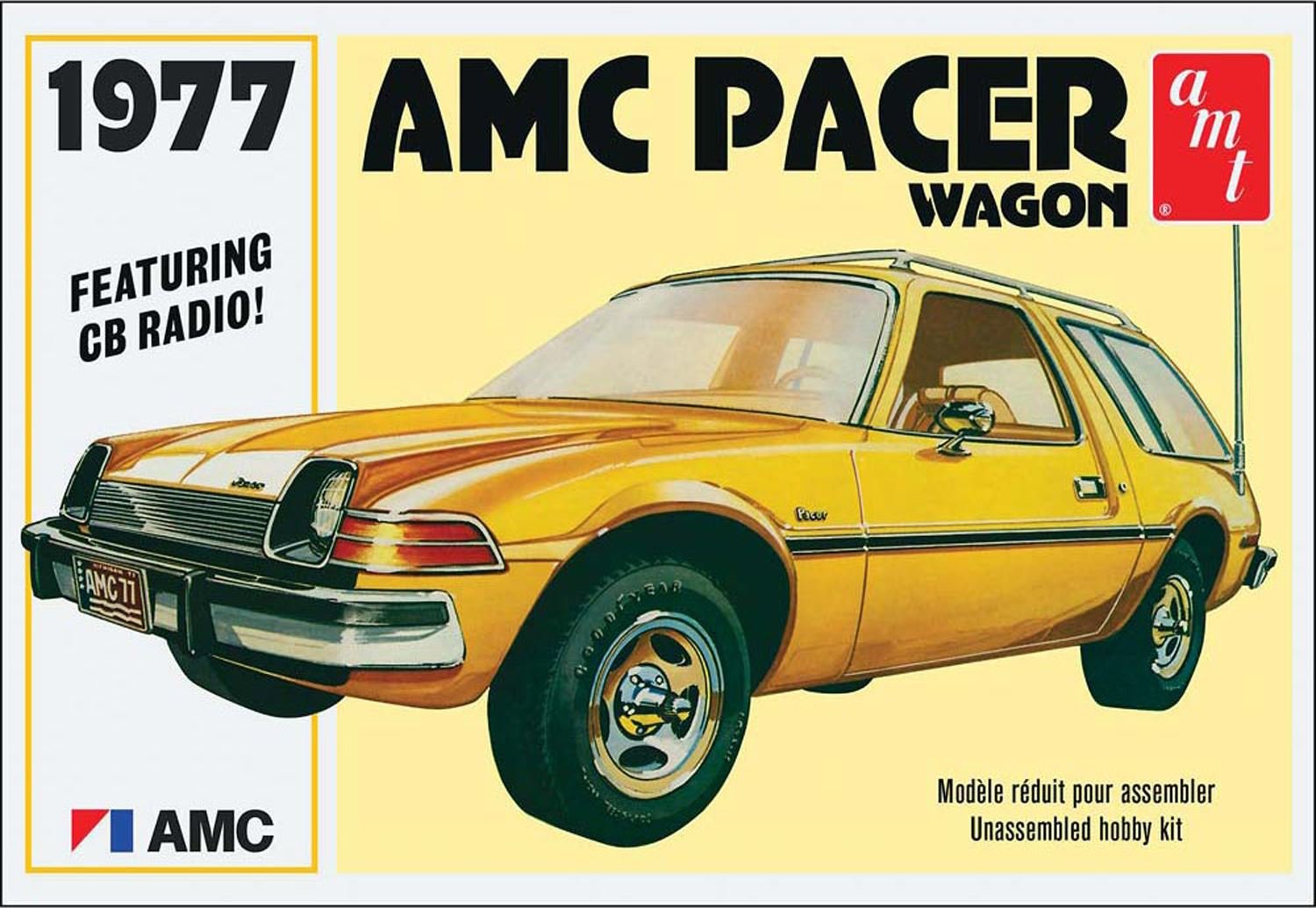
(AMT社製、AMC ペーサーのキットです。
私のはこの後期型・ワゴン仕様でした)
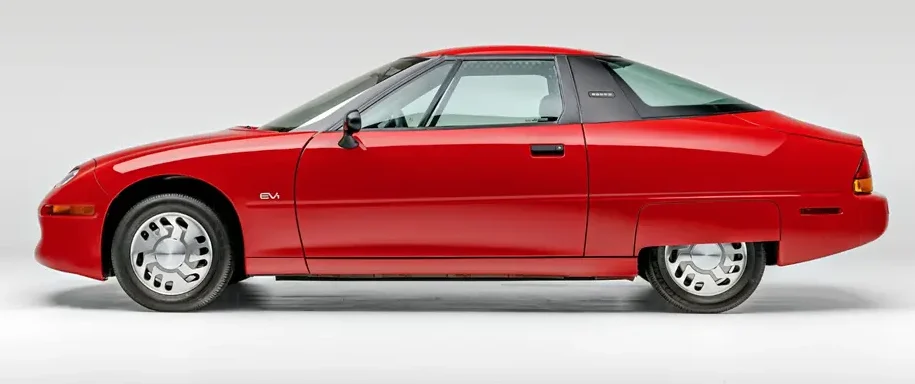
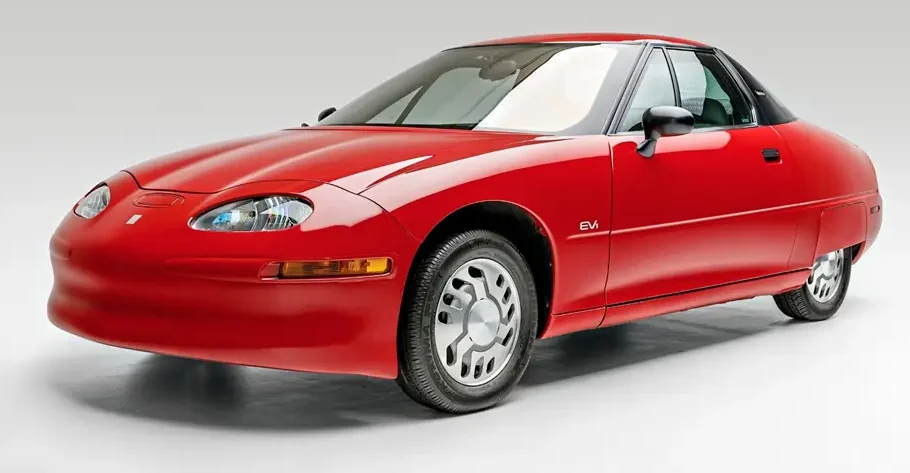
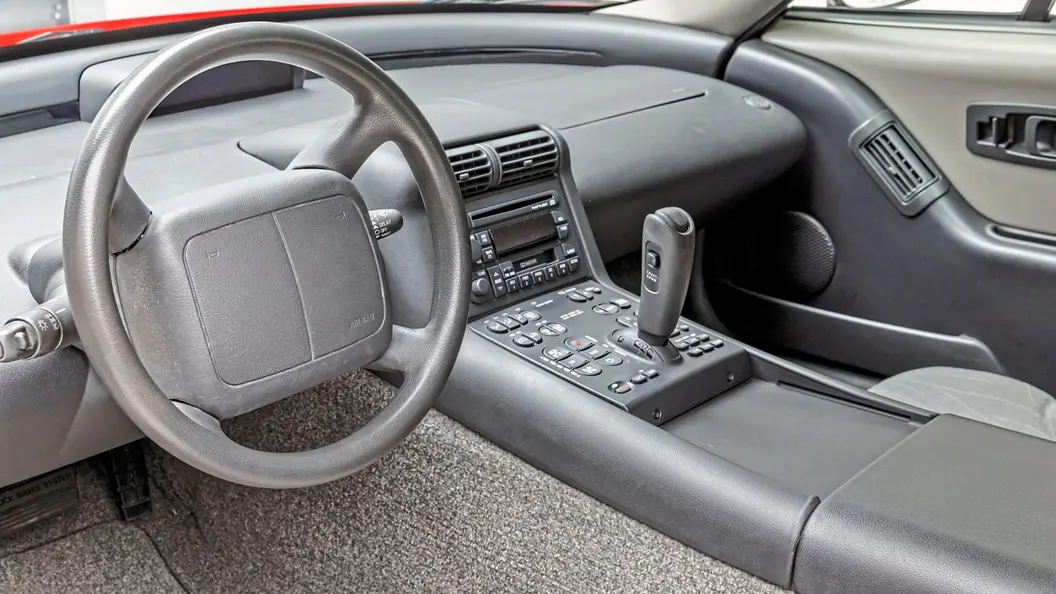
*ゼネラル・モーターズ EV1、(1996)
(俊足で信頼性も高かったが、製造コストの高さや、未成熟なバッテリー技術が足かせに、、、)
------>空気抵抗(CD値)がいかにも低そうなボディー造形やショーカー譲りの内装は今見ても新鮮です。
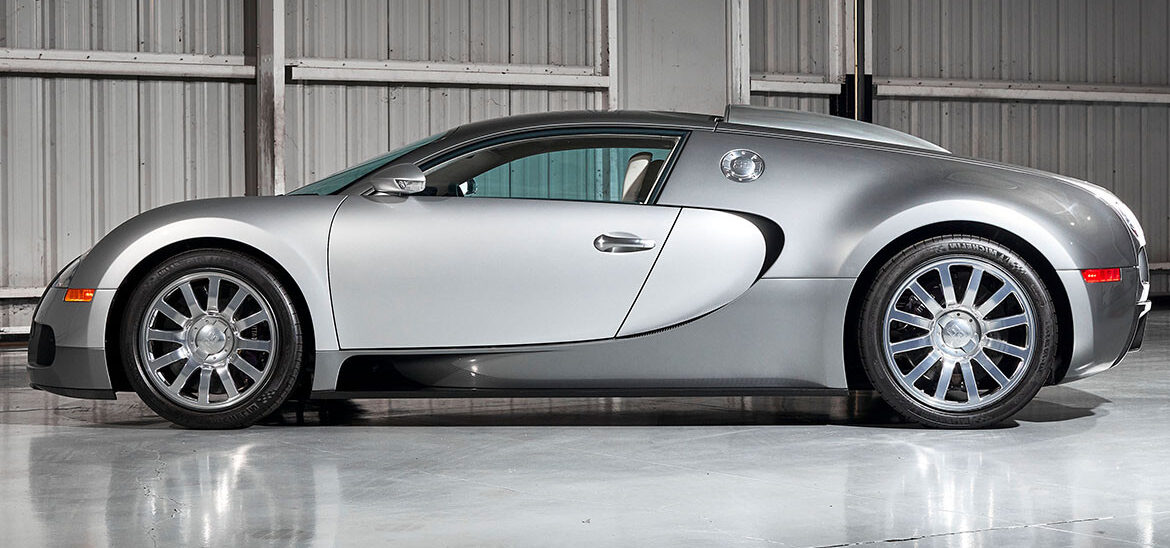
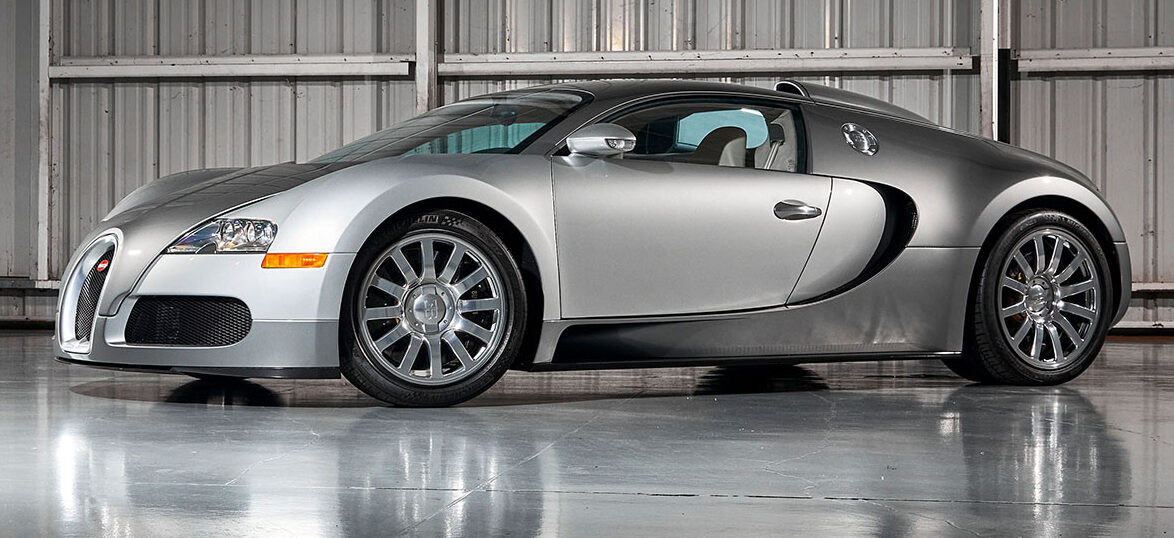
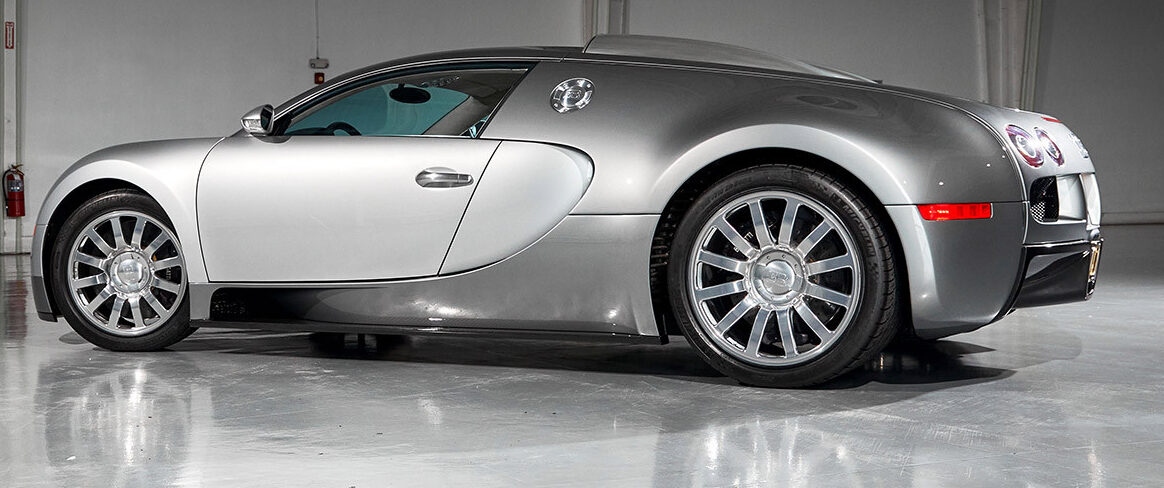
*ブガッティ ヴェイロン,2005
(ドイツ資本主義の権化、フェルディナント・カール・ピエヒ作のスーパーカー第一作として、象徴的なカリスマ感あふれる、マクラーレンF1と並び称される、元祖・ハイパーカー)
ーーーー>一筆書きのようなサイドビューのグラフィックは戦前も出る以上にインパクト大!
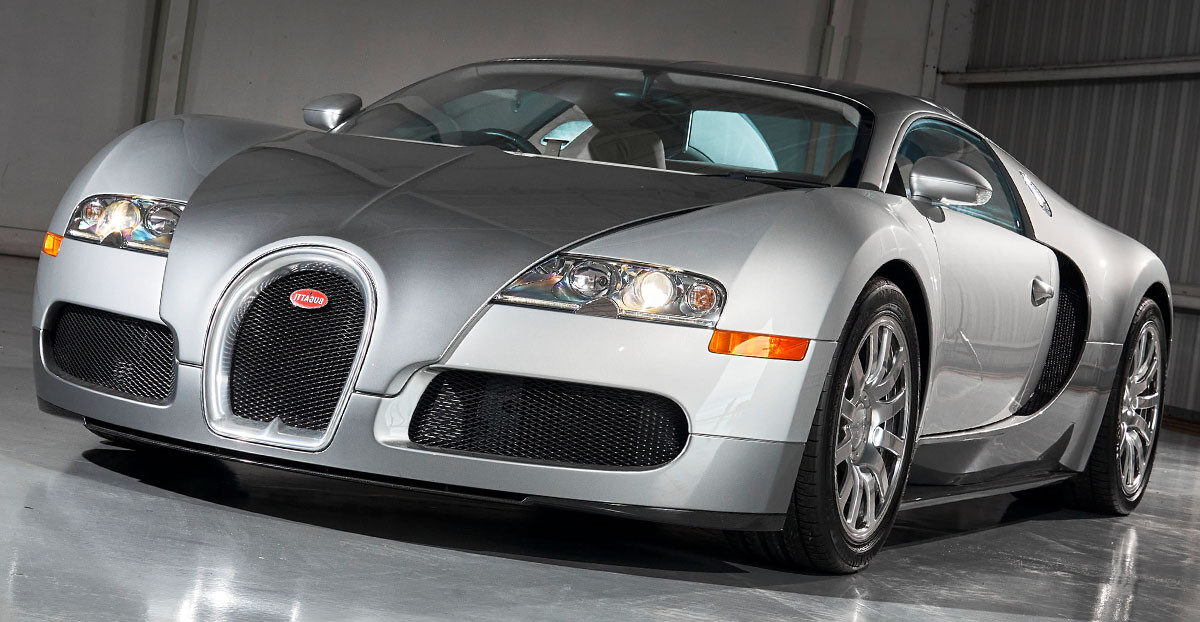
時代の流れに逆らったり、先走り過ぎたり、、、と
創造的人間の意欲を掻き立てまくる、
自動車の設計・デザインには、
常に生々しい人間の『業』が見え隠れして、
鑑賞者たる私の心にも、
嬉し恥ずかしの、
『えぐみ溢れる感情』がドクドク
なだれ込んできます!
かなり、
ぐったりしたところで、
お後がよろしいようで、、
 次回は、
次回は、
フェラーリ第2弾、
1962年型、
250GTOに付いて語ってみたいです。
お楽しみに――
本ブログと記事内容につきまして:
ブログ記事を書くにあたり私の目標は、立体造形(料理も含めて)とのかかわりを通じて、私個人の特徴的(ネジ曲がり方も含めて)な評価軸を解明することで、「美しさ・美味しさ」に対する好奇心や、探求心を、どのように満足・充足させてきたのかを明記しておくことです。
従いまして、記事の中に出てくる、数字や年号、微細なデータなどには細心の注意を払っておりますが、時に大きな間違いや勘違いを犯していることも考えられます。特に自動車記事における主要諸元や、年号などには紛らわしいものも多く、あくまで参考程度に考えていただければ幸いです。
私としては、記事の中で個人的な外観デザインや味覚の評価、そこから広がる後半部分につなげるための、『流れ』を作るための客観的材料として年号やデータを挿入している感じです。あくまで重視したいのは、私個人の頭の中で起こる、記憶の錯そう的混沌から生まれる新たな『見方』や『情報の予想外のつながり』です。その勢いを作り出す、『流れ』の一環として、諸データが副次的に必要となるわけです。
話がそれますが、大好きな落語の世界に「三題噺」という、その場て会場から募った3つのお題を使って1つのお話に仕立てるといったお遊びがございますが、私はそれに近いことを立体造形の特徴や(料理のお味)をお題にして行っている感じがします。その中で頭の中に去来する数々の着想が、全く予想外で楽しく、次回からの記事内容を大幅に変えたり、新展開につながっています。
当ブロブの仕組み:
『好奇心の点と線 x 気まぐれ脳内回路=予想外の新展開』
こんな自分勝手なブログですが、今後ともよろしくお願いいたします。
追記:上記の『流れ』を作る為に必要な写真はできる限り、個人所有のミニカー・自前の料理などを使い撮影しておりますが、その他の必要最小限の図版や写真を他のブログ主様の記事や諸会社ホームページなどからお借りしております。(記事内容に合うよう加工させていただき、使用時は最小の解像度で載せております。)問題がある場合、ご連絡いただければ直ちに降ろさせていただきます。
追記2:当ブログ記事に掲載のミニカー写真等(個人撮影)は許可なしで、どのようにお使いいただいても結構です。私個人の創造性はこの世のもの、と言う認識の上で記事を製作しています。
!!!!!!!!!!!!!!!!!!!!!!!!!!!!!!!!!!! Translated in English !!!!!!!!!!!!!!!!!!!!!!!!!!!!!!!!!!!
(The photo above shows the modified model; the one below shows the “stock” Kyosho 250TR before modification)
Model for photography:
Kyosho, 1/64 Ferrari 250TR Testarossa
(with pontoon fenders, Italian Red)
Modifications:
* Cut out the side mufflers, reshaped and repositioned them, then reattached them,
* Optimized axle positions,
* Adjusted tire and wheel positioning,
* Applied wash and weathering with a warm-toned gray marker
to the underside of the body, inside the wheels, and around the headlights [Completed]
Part 32—The Lineage of 2-Door Coupes (Roadsters): Part 12 [Italian Cars] Ferrari 250TR Testa Rossa, 1957 (Pontoon Fender Version)
#Favorite Car Designs—The Lineage of 2-Door Coupes (Open Sports Cars):
For this 32nd installment, titled “The Lineage of 2-Door Coupes, Part 12,” I’d like to discuss luxury 2-door (GT) coupes and roadsters, which strongly reflect the national characteristics and unique exterior design styles of various countries. [Note: Includes convertibles]
We’ll proceed as follows.
This 12th installment is the [Italian Cars Edition]
1957
Ferrari 250TR Testarossa (Pontoon Fender Version)
That’s what we’ll be discussing.
[The Lineage of 2-Door Coupes: Table of Contents]
[American Cars Edition]
Part 1: Cadillac El Mirage, 2013 (Metallic Red)
Part 2: Lincoln Continental MK4, 1972 (Black)
Part 3: Mercury Cougar, 1967 (LT Metallic Green)
[German Cars]
Part 4: MB 500K Special Roadster, 1936 (Black)
Part 5: MB 300SL Roadster, 1957 (Silver)
Part 6: MB SLS AMR Gullwing, 2010 (Black)
[British Cars]
Part 7: McLaren F1, 1992 (Metallic Orange)
Part 8: Jaguar XKSS Roadster, 1957 (Royal Blue)
Part 9: Jaguar XKR Coupe, 1996 (Dark Metallic Green)
[Japanese Cars / Nissan Edition]
Episode 10: Nissan First-Generation Silvia, 1965 (Champagne Gold)
Episode 11: Nissan Fifth-Generation Silvia, 1988 (LT Metallic Green)
[Italian Cars Edition]
Episode 12: Ferrari 250TR Pontoon Fender, 1958 (Red)
Episode 13: Ferrari 250 GTO, 1962 (Italian Red)
Episode 14: Lamborghini Concept S, 2005 (Pearl White)
[Japanese Cars: Mazda Edition]
Episode 15: Mazda Cosmo Sport, 1967 (Silver)
Episode 16: Mazda Eunos Cosmo, Type-S (2-Ton: Black & Gray)
[French Cars]
Episode 17: Bugatti Type 59, 1935 (French Blue)
Episode 18: Citroën SM, 1970 (Champagne Gold)
Episode 19: Bugatti La Voiture Noire, 2019 (Black)
[Japanese Cars: Toyota Edition]
Episode 20: Toyota/Yamaha 2000GT, 1967 (Ivory White)
Episode 21: Toyota 2nd-Generation Soarer, 1986 (Two-Tone: Black & Gray)
Episode 22: Lexus LC [GWZ100], 2017 (Metallic Red)
[American Cars Part 2]
Episode 23: Dodge Challenger & Plymouth Barracuda, 1971
Episode 24: Dodge Viper SRT-10 ACR, 2008 (Black)
Episode 25: Ford Shelby GR-1 Concept, 2004 (Chrome)
[Japanese Cars: Mitsubishi Edition]
Episode 26: Mitsubishi Galant λ, 1976 (Brown Metallic)
Episode 27: Mitsubishi Eclipse [North American Spec], 2006 (Orange Metallic)
The Corvette Lineage: (Special Edition)
Episode 1: 1967 Stingray [C2] Convertible (Hardtop, Metallic Blue)
Episode 2: 1972 Corvette [C3] Convertible (Metallic Blue)
Part 3: 1990 Corvette ZR-1 [C4] Coupe (Red)
Part 4: Stingray Concept [Pre-production Prototype], 2009 (Metallic Blue)
#The “Beast” with Pontoon Fenders Arrives!
Back when I was attending design school,
I had about ten magazines that I absolutely loved,
One of them—the latest issue of which was always hanging on the magazine rack in the school library every month—
was an American magazine called 【Sports Car International】,
and I absolutely loved this particular issue.
That July 1992 issue is right here.
The Ferrari 250TR Testarossa
[Pontoon Fender Version]
featured on the cover of this issue
was also the subject of a special feature inside the magazine,
*the car’s intense, beast-like presence,
*the classic independent fenders,
*the transitional monocoque-style integrated fenders,
*the pontoon fenders,
*and its rich character—
I was completely blown away at first sight.
So then,
* Brimming with wildness,
* A pontoon monster,
* My absolute favorite Ferrari,
the “Ferrari 250TR (Pontoon Fender Edition),”
I’d like to
discuss it
as follows.
* Real-Car Analysis: The “Pontoon Fenders,” Like a Pouncing Beast
* Exterior Design Features: The Entire Body Is Charming—a Mass of “≈Art”
* “Me” and the ’58 Testarossa
* Three-Theme Story: Katoki, AC Cobra 427, Seashell
* Other “Miracles of the Transition Period”
* Real-Car Commentary: Fenders Like a Pouncing Beast
n
n
Overview:
The Ferrari 250TR (Testa Rossa) is
a legendary racing sports car developed and manufactured by Ferrari from 1957 to 1961. “Testa Rossa” means “red head” in Italian, a name derived from the engine’s cam cover, which was painted a vivid red. Its most striking visual feature is its sensual yet aggressive body lines, which have been etched into automotive history. Only 34 units were produced between 1957 and 1961, and while its appearance varied significantly by model year, the early model (1957–1958 models) boast a legendary aesthetic beauty.
n
It demonstrated overwhelming dominance in international racing and is now one of the world’s rarest classic Ferraris, fetching prices in the tens of billions of yen at auction.
1: Background and History:
n
n
n
In 1957, the Fédération Internationale de l’Automobile (FIA) announced a rule change limiting the maximum engine displacement for prototypes in the World Sports Car Championship to “3 liters or less” in order to enhance racing safety. To comply with this, Ferrari developed a machine based on the already highly reliable “Colombo-designed V12 engine” used in the already highly reliable 250GT. This marked the beginning of the 250TR.
n
* Overwhelming Racing Success: In addition to winning the overall title at the 24 Hours of Le Mans in 1958, 1960, and 1961, the car racked up victories at events such as the 12 Hours of Sebring, bringing Ferrari numerous Manufacturers’ Titles.
n
n
n
2: Distinctive Design and Evolution:
n
n
Focusing on the details,
we’ll provide a detailed explanation of the exterior design.
n
# The Legendary “Pontoon Fenders”:
The hallmark of the early 250TR models is the hand-hammered aluminum “pontoon fenders” crafted by Carrozzeria Scaglietti.
* Deep cutout relative to the body: The front fenders rise up like a “pontoon” (floating island), separate from the central hood. The body just behind the fenders (in front of the door), the body appears to have been significantly cut away, creating a unique shape.
* Purpose: Brake Cooling and Serviceability: This design was not intended for aerodynamics, but was devised to direct airflow directly onto the powerful front drum brakes for cooling and to efficiently dissipate heat.
* Inspiration from F1 cars: It creates a very racy visual effect, as if fusing the nose of the cigar-shaped F1 cars of the era with the fenders covering the tires.
n
n
n
n
# Front fascia configuration:
n
* Nose Opening: The elliptical front grille (radiator intake) is positioned low. Because the inner sides of the fenders on either side are recessed, the central nose appears to protrude forward when viewed from the front.
* Headlights: Flowing, transparent acrylic light covers are fitted snugly to the tips of the raised fenders on both sides.
n
n
n
n
# Hood and Cockpit Area:
* Power Bulge (Hood Bulge): Inside the engine compartment, a 3-liter V12 engine and six Weber twin-choke carburetors tower overhead. To accommodate these components without interference, the center of the hood features a large, elegant power bulge for clearance, along with a forward-facing air intake.
* Wrap-around Windshield: The front screen, designed to protect the driver from the wind, is a low-profile, race-specific unit curved to envelop the cockpit.
* Headrest Fairing: A streamlined spoiler (hump) extends smoothly from behind the driver’s seat to the rear end to reduce aerodynamic drag.
n
n
# Rear View and Details:
* Sharp Tail Fins: Unlike the front fenders, the rear fenders feature a mild, fin-like shape that reflected the trends of the era. Small taillights are embedded in their vertical edges.
* Borrani Wire Wheels: Beautiful and delicate Borrani wire wheels, with multiple layers of thin spokes, and large-diameter center-lock spinners give the wheels a sleek, refined look.
* Side-Exit Exhaust: The exhaust pipes, which extend from deep within the recessed front fenders along the sides of the body to the rear, emphasize the car’s raw, racing-car character.
n
# Design Evolution (Transition to Later Models)
n
Although the “pontoon fenders” were visually striking, they had an aerodynamic weakness: at ultra-high speeds exceeding 250 km/h, the front end would lift off the ground (due to lift). Starting in 1959, the car transitioned to a sleek, streamlined, enclosed body redesigned by Pininfarina and manufactured by Fanzi. Furthermore, the braking system was upgraded from drum brakes to disc brakes, significantly improving braking performance.
n
n
n
nn
n
n
n
M
Mn
n
n
n
M
n
n
n
n
M
n
n
n
n
n
n
n
n
MM
n
n
n
n
M
n
n
n
n
M
# Key Specifications:
Engine Type: 60-degree V12 SOHC (based on the Colombo unit)
Fuel System: 6 × Weber 38 DCN carburetors
Total Displacement: 2,953.21 cc (approx. 250 cc per cylinder)
Maximum Power: 300 hp / 7,200 rpm
Maximum Torque: 300 N·m (30.6 kgm) at 5,500 rpm
Drivetrain: Front-mounted longitudinal engine, rear-wheel drive (FR)
Seating Capacity: 2 passengers
Body Style: 2-door, open-top
Wheelbase: 2,350 mm
Overall length: 3,959 mm
Overall width: 1,523 mm
Overall height: Approx. 1,013 mm (or 964 mm, depending on individual vehicle and specifications)
Curb weight:
Approx. 800 kg (dry weight)
*Exterior Design Features: The entire body is a “bundle of charm”
Personally,
this is my favorite Ferrari—
the 250TR [Pontoon Fender Version],
where “every part of the car is a highlight”—
I’ve listed six of its design features.
(I could list countless more about this car, but… there’s no end to it.)
1: A robust, dynamic overall design where, quite literally, “every angle is the best angle!”
ーーーーーー>Even in the racing world of that era, which was full of striking designs, it stood out with unmatched presence
2: The deep, sculpted lines of the pontoon fenders—which seem like a mere excuse to cool the front brakes… but really embody the “if it looks cool, that’s all that matters” philosophy
—————> The homage to pre-war bicycle fenders is another heartwarming detail.
3: Beautiful side-view proportions, with the high-performance V12 engine mounted—literally—behind the front wheel axle
4: The routing of the side-exit exhaust, masterfully integrated into the pontoon fenders, creates—————> a dynamic, sweeping line along the lower part of the side view
5: The wild, three-dimensional composition extending from the hood or radiator grille—which seems to echo the cigar-shaped body of yesteryear
6: The “boldness” of the front versus the “understated elegance” of the rear view… yet it doesn’t stop there—the striking “protrusion” of the quad exhaust pipes
Now then,
let’s take a look at each point one by one, accompanied by photos:
1: Literally, a robust, dynamic full-body design where “every angle is the best angle!”
(While rival racers of this era were gradually losing their individuality due to aerodynamics and scientific design, Sergio Scaglietti’s bold, flamboyant style stood out until the very end)
ーーーーーー>Just before being swept up in the trend toward aerodynamic design—as seen with the Jaguar D-Type—it possessed an unrivaled sense of boldness
2: The claim that the deep, sculpted lines of the pontoon fenders were “for cooling the front brakes…” seems like a complete excuse—it’s more a case of “if it looks cool, anything goes”
(The deep cutouts on the body sides—which could be interpreted as an homage to 1930s clamshell fenders—separate the front section housing the headlights from the protruding radiator section, creating an extremely unique and indescribably captivating front-end expression.)
ーーーーーー>The sense of homage to pre-war bicycle fenders is also a heartwarming touch.
3: Beautiful side-view proportions, with the high-performance V12 engine mounted—literally—behind the front wheel axle
4: The routing of the side-exit muffler, masterfully integrated into the pontoon fenders, creates
ーーーーーーーー>a dynamic, sweeping line along the lower part of the side view
5: The wild, three-dimensional composition extending from the hood or radiator grille, which seems to echo the cigar-shaped body of the past
6: The “vitality” of the front contrasts with the “calmness” and “understatement” of the rear view… yet it doesn’t end there—the striking “protrusion” of the quad exhaust pipes
Now, without further ado,
let’s dive into the unpredictable,
“Three-Theme Story”!
*Three-Theme Story: Katoki, AC Cobra 427, Seashell
This time’s themes—
they’re quite all over the place, aren’t they?
This is
quite a sight to behold!
* Hajime Katoki
* AC Cobra 427
* Seashell
Well then,
“I hope you’ll bear with me
for another round of my usual ridiculous comedy…
Lately, there’s been a lot of talk about
“AI” replacing jobs,
and these days, it seems like there’s less and less room for us humans,
I feel the tide of the times shifting dramatically every single day…
I hope that in the future, our current fears about AI
will become a laughing matter…
This is a story
about that “transitional period.”
In the world of automotive design, particularly in the world of race cars,
the 1950s were a fascinating era.
It was precisely then that the open-wheel design—which had been around since before the war, where the tires protruded from the chassis—was covered by fenders integrated into the body…
in an effort to reduce air resistance.
This is often referred to as “smoothing,”…
It was during this transitional period that—as if by “chance or a twist of fate”—
the car mentioned in the title appeared:
the Ferrari 250TR, the “pontoon fender” version.
What’s so amazing about this car is that,
when you need to brake while driving at high speeds,
it directs the wind flowing in from a distance directly onto the brakes, creating a cooling effect that allows for quick and reliable deceleration. It’s an incredible feature.
The shape of the fenders used for this purpose
resembled a “seashell” washed up on the beach, so they were called “clamshell fenders.”
Clam chowder, you say?
That’s confusing, isn’t it? It’s not that at all—
don’t get it mixed up, okay?
On top of that,
thanks to these “seashell fenders” designed by the famous Scaglietti,
this car looks ridiculously cool. But here’s the slightly disappointing part—
I only realized this after the competition with that Jaguar got really heated—
they say that when you’re driving at high speeds, the seashell starts to float up a bit,
and it looks like it’s about to pop right off, you know?
That was a problem, so they covered the dented side panels with straight steel plates,
and all’s well that ends well…
Actually, my race results were fine thanks to that,
but the fierce presence of a predator stalking its prey was gone…
For an Italian car where looks are everything,
I just can’t quite wrap my head around it!
By the way, regarding this 250TR with its shell-shaped fenders,
there’s a car that went head-to-head against it.
It’s an American bad boy: the AC Cobra 427.
* The 250TR, with its exquisitely delicate Ferrari V12 engine encased in a clamshell, versus
* the Cobra 427, which crammed a massive American V8 into a lightweight British chassis.
As rivals, these two cars staged countless legendary battles all over the world,
before making way for their streamlined successors.
Truly, both cars
are legendary vehicles worthy of being called masterpieces born of a transitional era.
Um,
speaking of a “transitional era,”
something comes to mind.
It’s the robot piloted by the protagonist in the serialized manga *Gundam Sentinel*, which took the world by storm in the late 1980s,
whose name is: “S-Gundam”
(Superior = meaning “the ultimate Gundam”)
This Gundam was designed not by Mr. Scaglione—
but by Japanese industrial designer Hajime Katoki.
Just like the 250TR,
it was logically designed as a genuine piece of industrial design
where function and form were seamlessly integrated—but…
Like the 250TR, it became famous for its
“coolness that defies the humanoid form”—a beauty born by chance from the pursuit of function—but, as expected, its run was short-lived,
and it gave way to its successor,
the “EX-S Gundam,” which underwent a dinosaur-like evolution
much like the Cobra 427…
In all things,
we swirl and struggle against the great current,
yet are destined to be swept away by the next massive wave and vanish.
Perhaps it is precisely these “ephemeral flowers of the era,” born of such transience, that are the most beautiful.
At the very least, to avoid being swept away by the tidal wave of AI—and to hone my own creativity (my whimsy and eccentricity)—
ーーーーー>I want to weave this three-topic story on my own.
That is what gives life as a human being its worth—Ala (seashell—) That’s the conclusion—but it still continues…
(Looking up at the sky, pausing for a breath, in a slow, measured tone,)
“Here’s a haiku:
Indeed,
our very own [S-Gundam], too,
designed by Katoki,
appearing in a transitional period,
its appearance—
Cutkey (cool)
With this trio from the transitional era,
I think that’s all for now.” Tap tap…
*Other iconic (or infamous) cars that bloomed like ephemeral flowers at turning points in history…
Now then,
from among the iconic cars that vanished amid the great tides of history,
let me list the designs that resonated with me!
*Chrysler Airflow, (1934)
(Although it incorporated full-fledged aerodynamics, the general public at the time shunned it, saying it looked like a “potato.” ーーーーーー> I’m surprised Chrysler produced such a beautiful design before the war.)
* Phantom Corsair (1938)
(Rust Heinz, the heir to the Heinz (H. J. Heinz) Company—famous for tomato ketchup—invested his own fortune in the project and designed and developed it in collaboration with Maurice Schwartz of “Bohman & Schwartz,” a luxury coachbuilder in Pasadena, California. Thanks to its Art Deco-inspired streamlined design—which was far ahead of its time—and numerous innovative mechanisms, it has gone down in automotive history as a symbol of the “car of the future.”)
—————> I used to own a 1/43-scale white-metal die-cast model made by Brooklyn, and I was absolutely captivated by its avant-garde, “out-of-place artifact”-like design. (laughs)
*AMC Pacer (1975)
(A “goldfish bowl” style with a wide overall width and nearly half the body covered in glass. A transitional compact car designed for unique interior space.
ーーーー>Back in college, I bought an MPC plastic model kit at Tashiro Model in Nagoya and marveled at its mysterious yet captivating design.
* General Motors EV1, (1996)
(It was fast and highly reliable, but high manufacturing costs and immature battery technology held it back… ------> Even now, the body design—which looks like it would have an incredibly low drag coefficient (Cd value)—still feels fresh.
* Bugatti Veyron, 2005
(The epitome of German capitalism, the first supercar designed by Ferdinand Karl Piëch, brimming with symbolic charisma—a pioneer “hypercar” that stands alongside the McLaren F1 and brings a smile to one’s face.)
ーーーー> The side view, with its graphic lines that look like a single continuous stroke, has an impact even greater than anything seen before the war!
Whether it goes against the tide of the times or runs too far ahead of its time…
In automotive design—which so fiercely stirs the creative drive of human beings—
the raw human “passion” is always visible,
and into my heart as a viewer,
a mix of joy and embarrassment—
“bitter-sweet emotions”—
pour in, throbbing and surging!
Now that I’m
quite exhausted,
I think I’ll wrap it up here…
Next time,
I’d like to talk about
the second installment on Ferrari:
the 1962
250 GTO.
Stay tuned――
Regarding this blog and its content:
My goal in writing these blog posts is to clarify my personal, distinctive criteria for evaluation—including my own quirks—through my involvement with three-dimensional art (including cooking), and to document how I’ve satisfied and fulfilled my curiosity and desire to explore “beauty and deliciousness.”
Consequently, while I pay the utmost attention to the numbers, model years, and detailed data that appear in my articles, it’s possible that I may occasionally make significant errors or misunderstandings. In particular, key specifications and model years in automotive articles can often be confusing, so I would appreciate it if you treated them as general references only.
For my part, I feel that I’m inserting dates and data into the articles as objective material to create a “flow” that connects my personal assessments of exterior design and taste to the broader themes explored in the latter half of the piece. What I ultimately prioritize are the new “perspectives” and “unexpected connections between pieces of information” that emerge from the chaotic jumble of memories in my own mind. The various data points are needed secondarily as part of that “flow” to generate that momentum.
As a slight digression, in the world of rakugo—which I love—there’s a playful format called “san-dai-banashi,” where a performer weaves a single story using three topics solicited on the spot from the audience. I feel like I’m doing something similar here, using the characteristics of three-dimensional sculptures and (the taste of food) as my prompts. The countless ideas that flit through my mind during this process are completely unexpected and delightful; they often drastically change the content of future articles or lead to new developments.
How This Blog Works:
“Spots and Lines of Curiosity x Whimsical Mental Circuits = Unexpected New Developments”
This blog may be a bit self-indulgent, but I hope you’ll continue to follow along.
Note: To create the “flow” described above, I take as many photos as possible using my own die-cast cars and home-cooked meals. However, I do borrow the bare minimum of other illustrations and photos from other bloggers’ posts and company websites. (I edit them to fit the article’s content and post them at the lowest possible resolution.) If there are any issues, please contact me and I will remove them immediately.
Addendum 2: You are free to use the photos of die-cast cars and other images (taken by me) featured in this blog’s posts in any way you like without permission. I create these posts with the understanding that my personal creativity belongs to me alone.
Translated with DeepL.com

これはCTAサンプルです。
内容を編集するか削除してください。