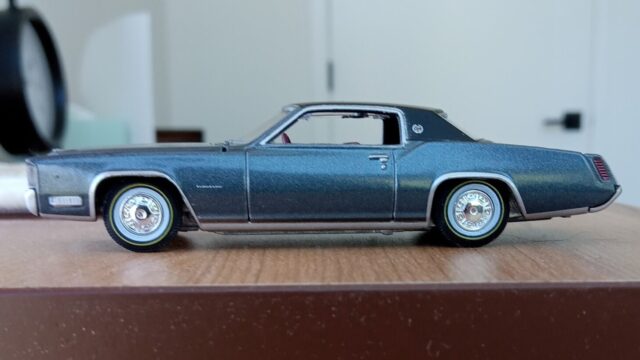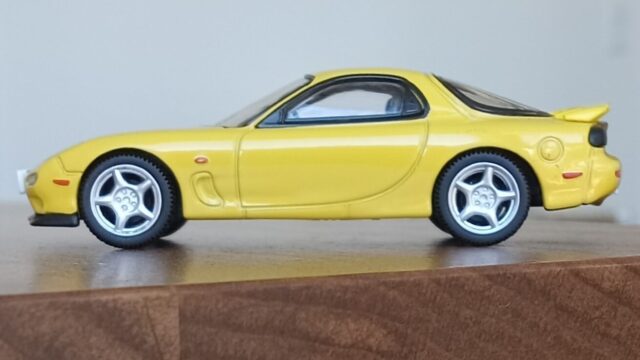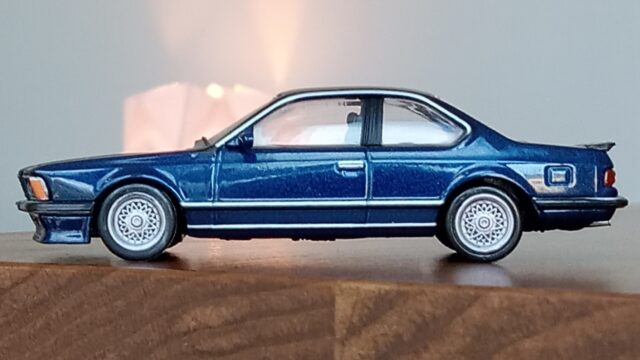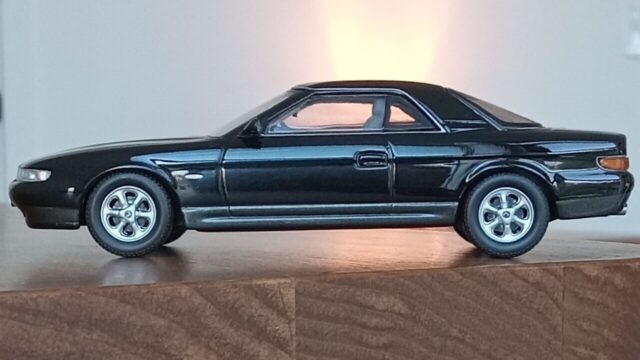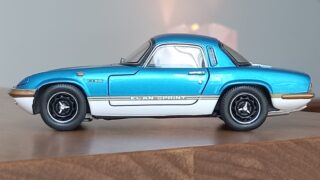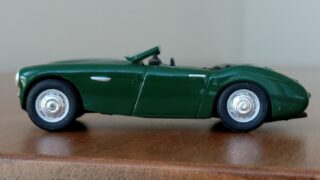
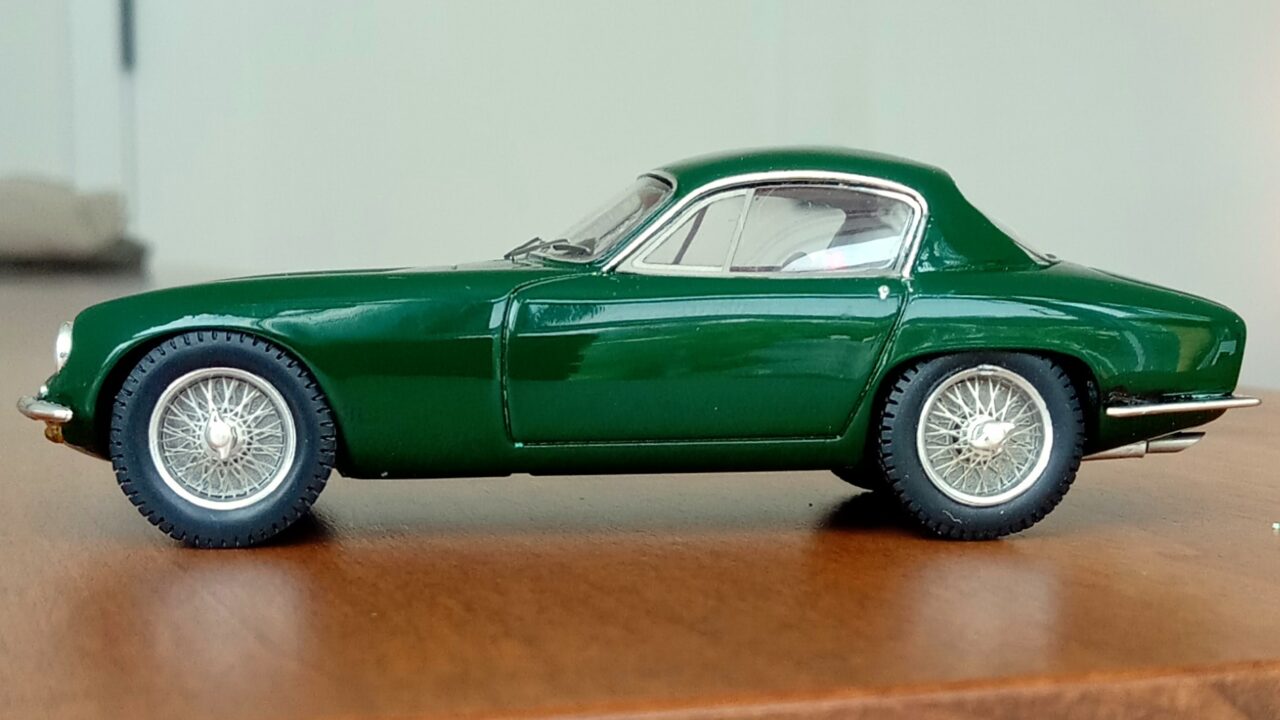
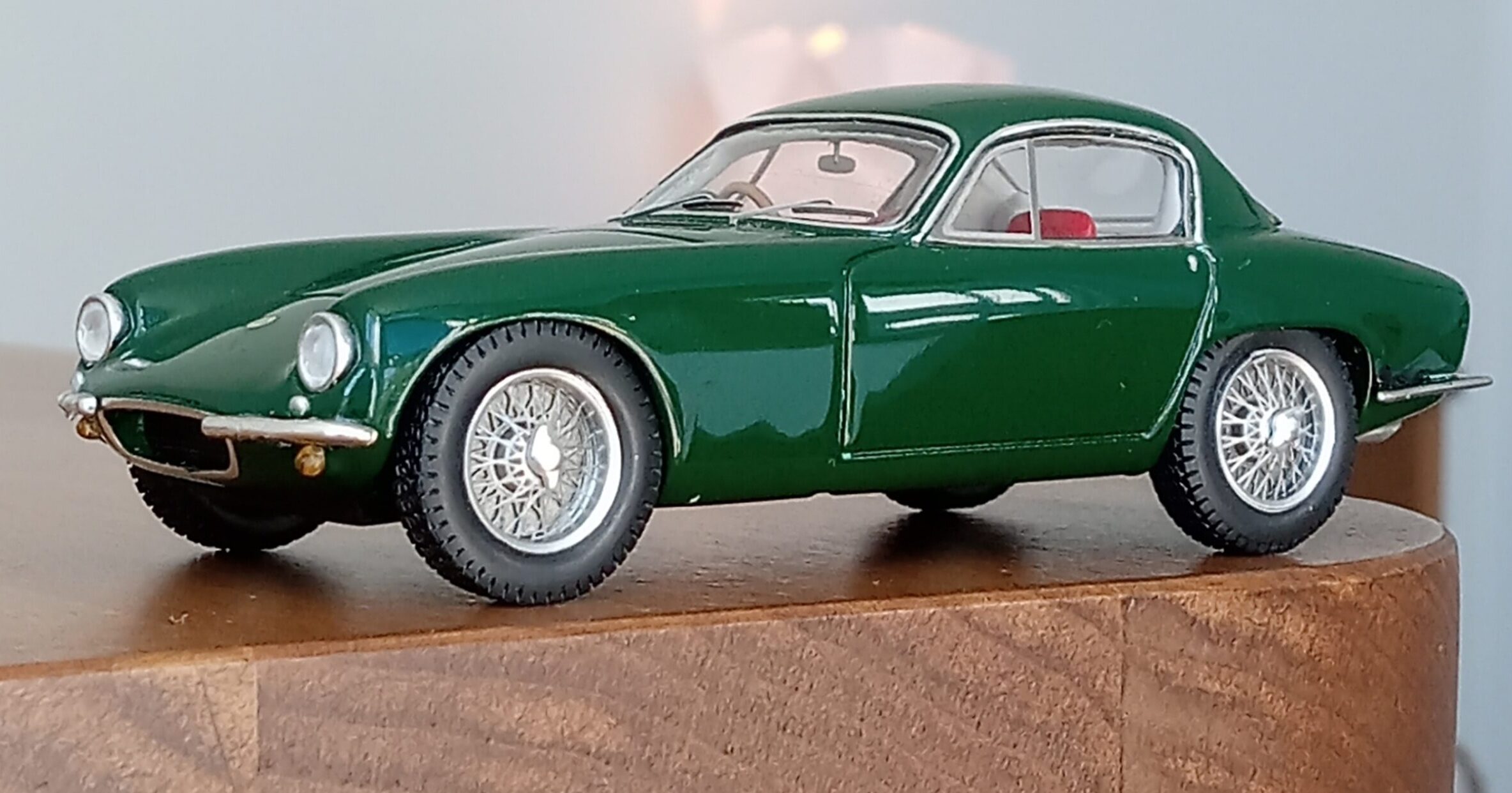
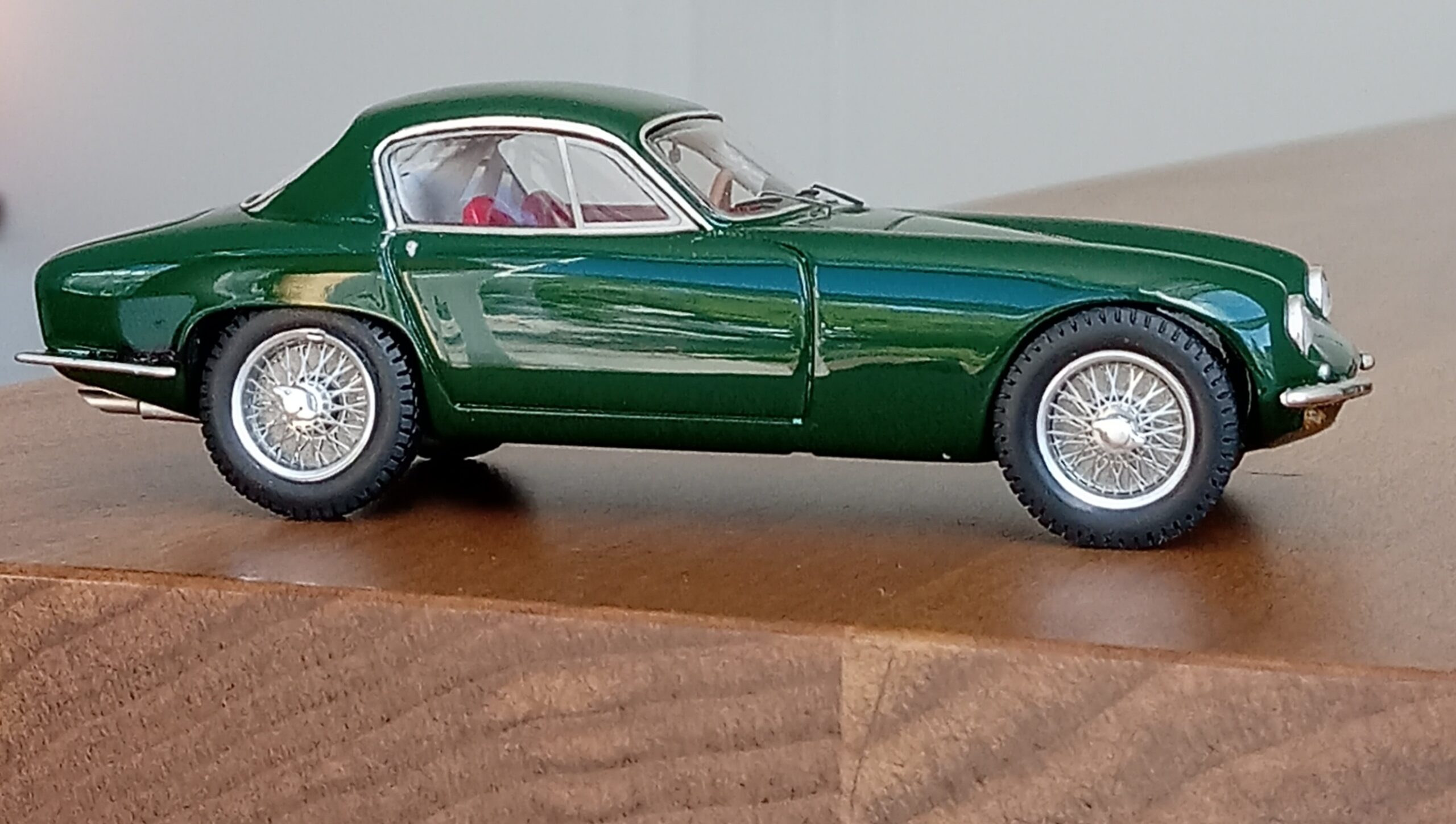
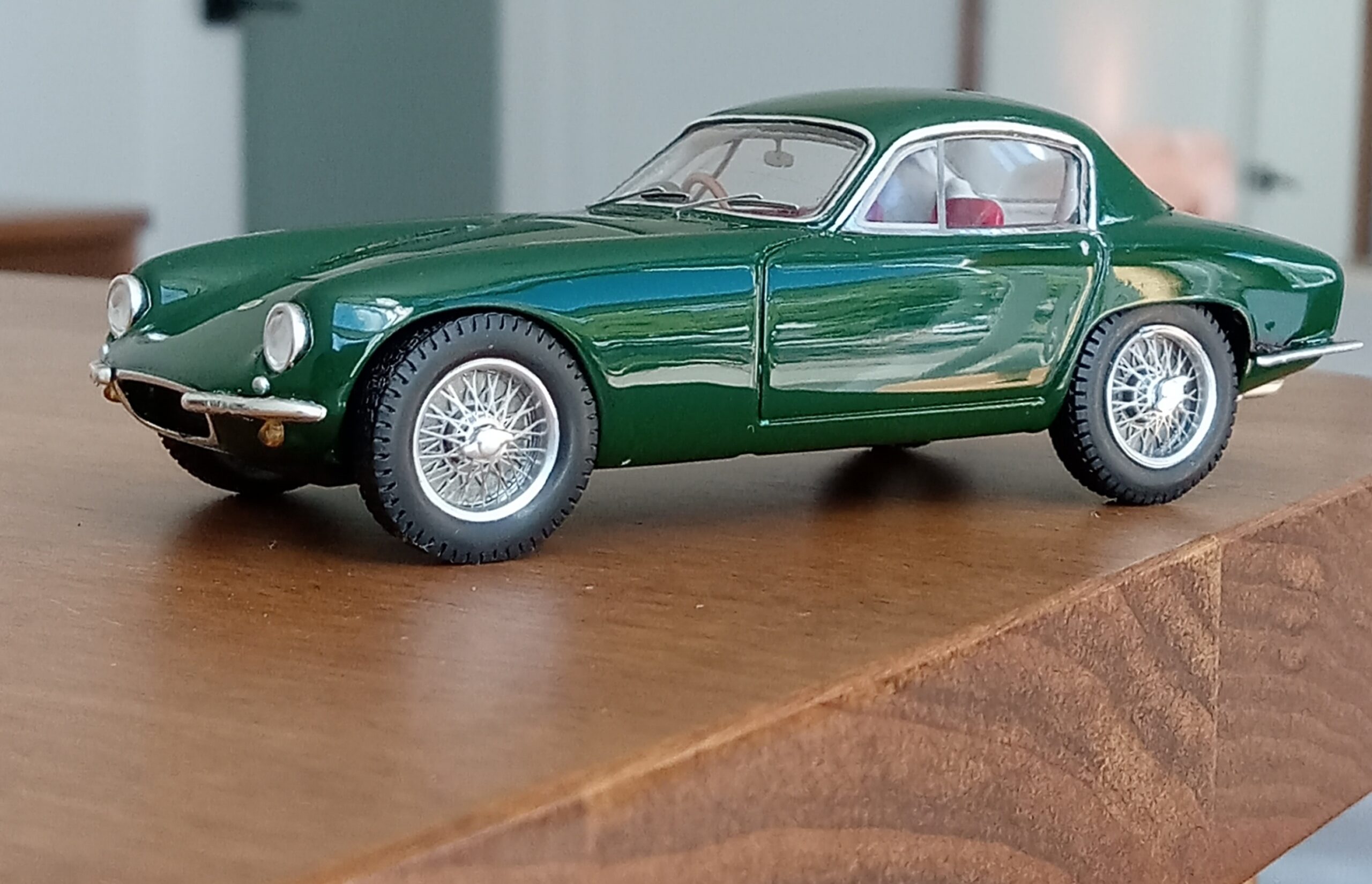
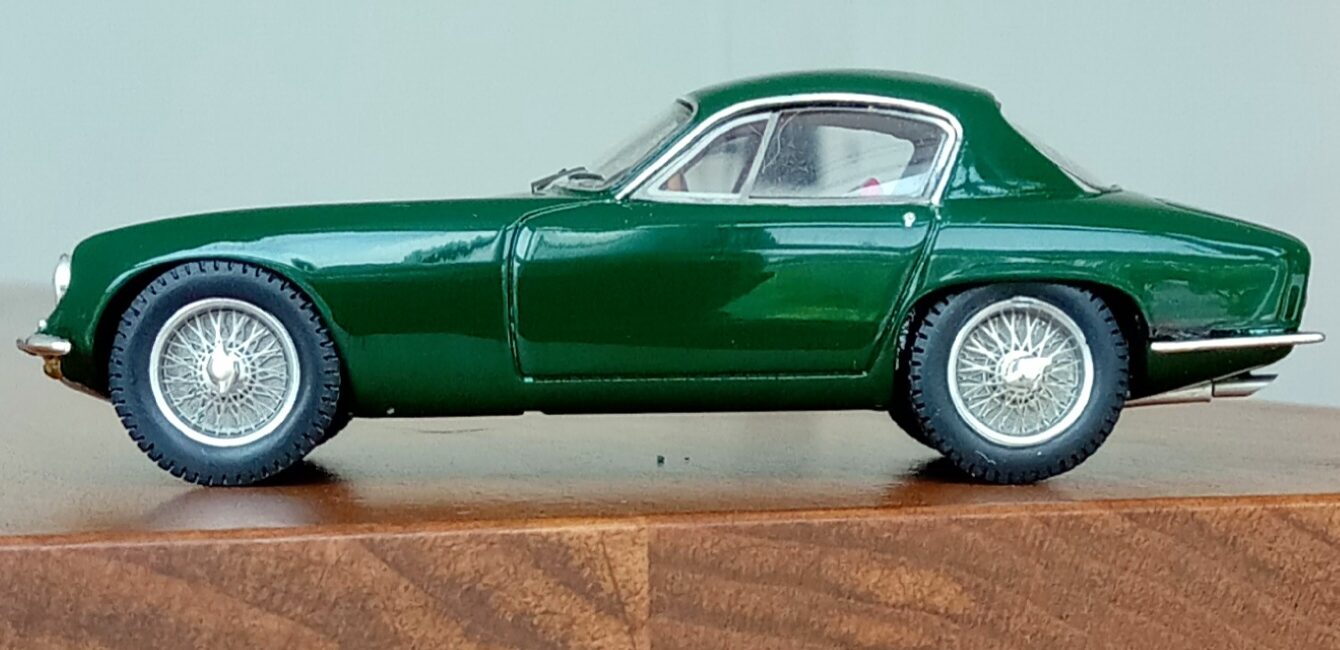
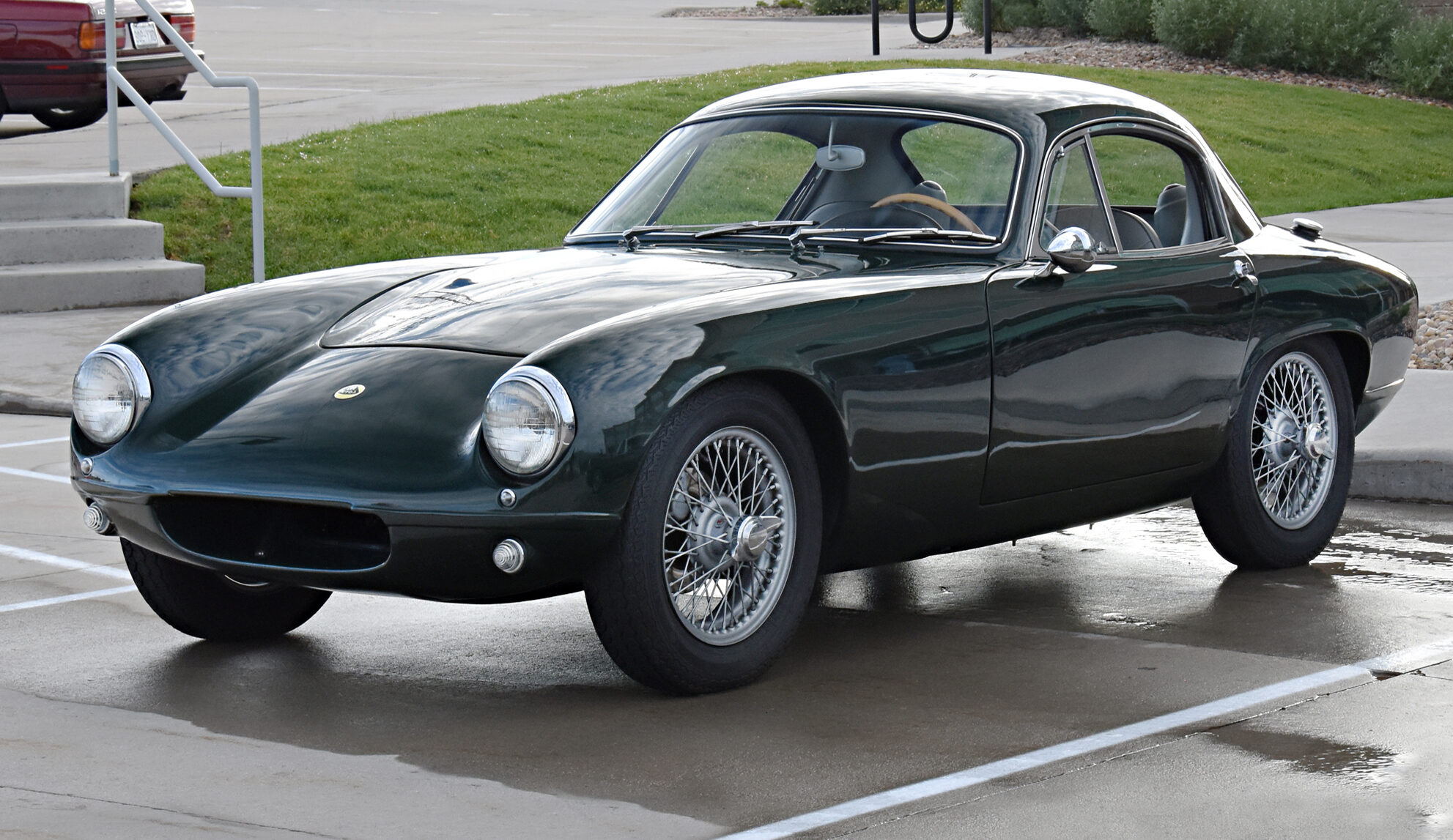
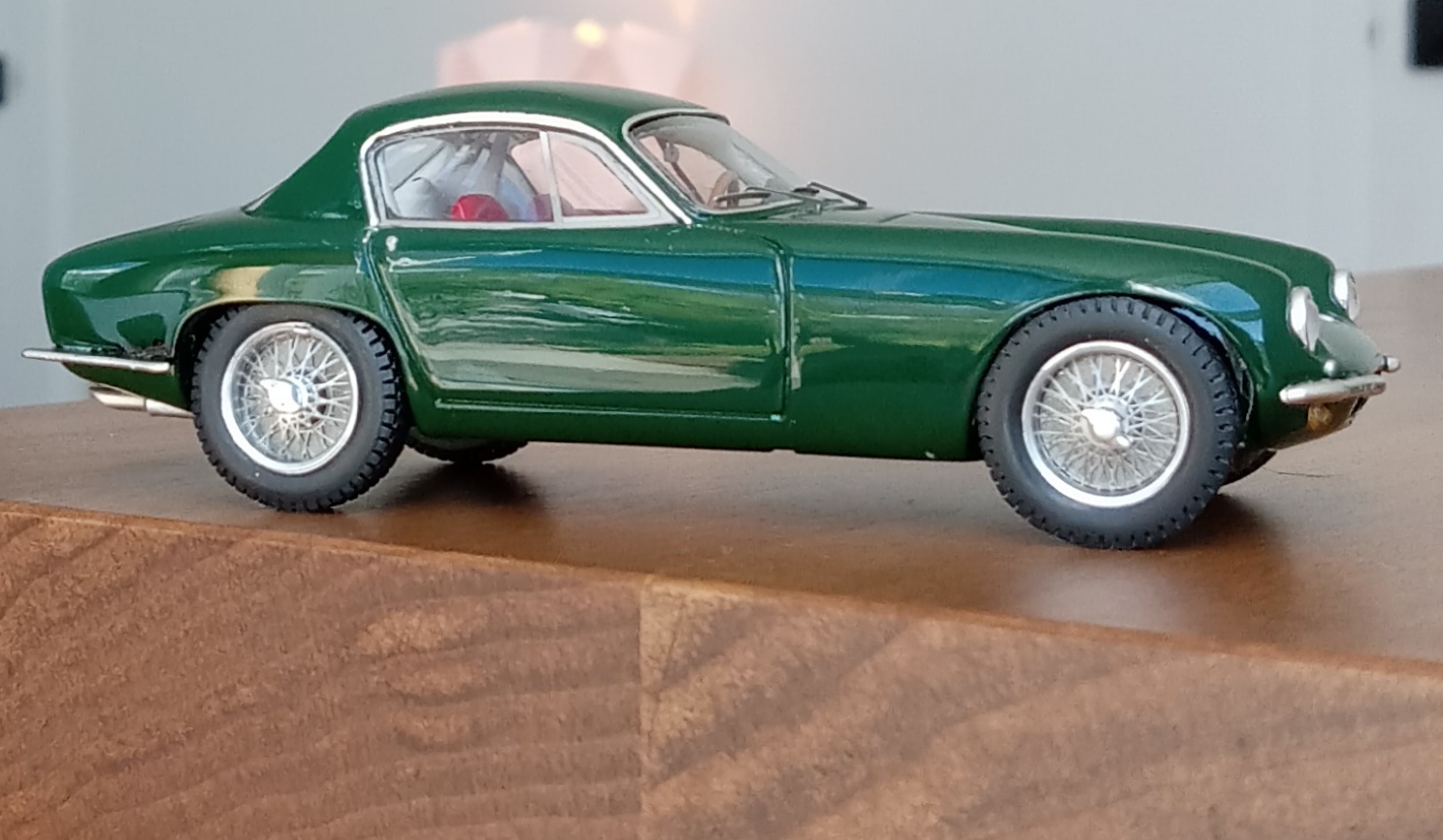
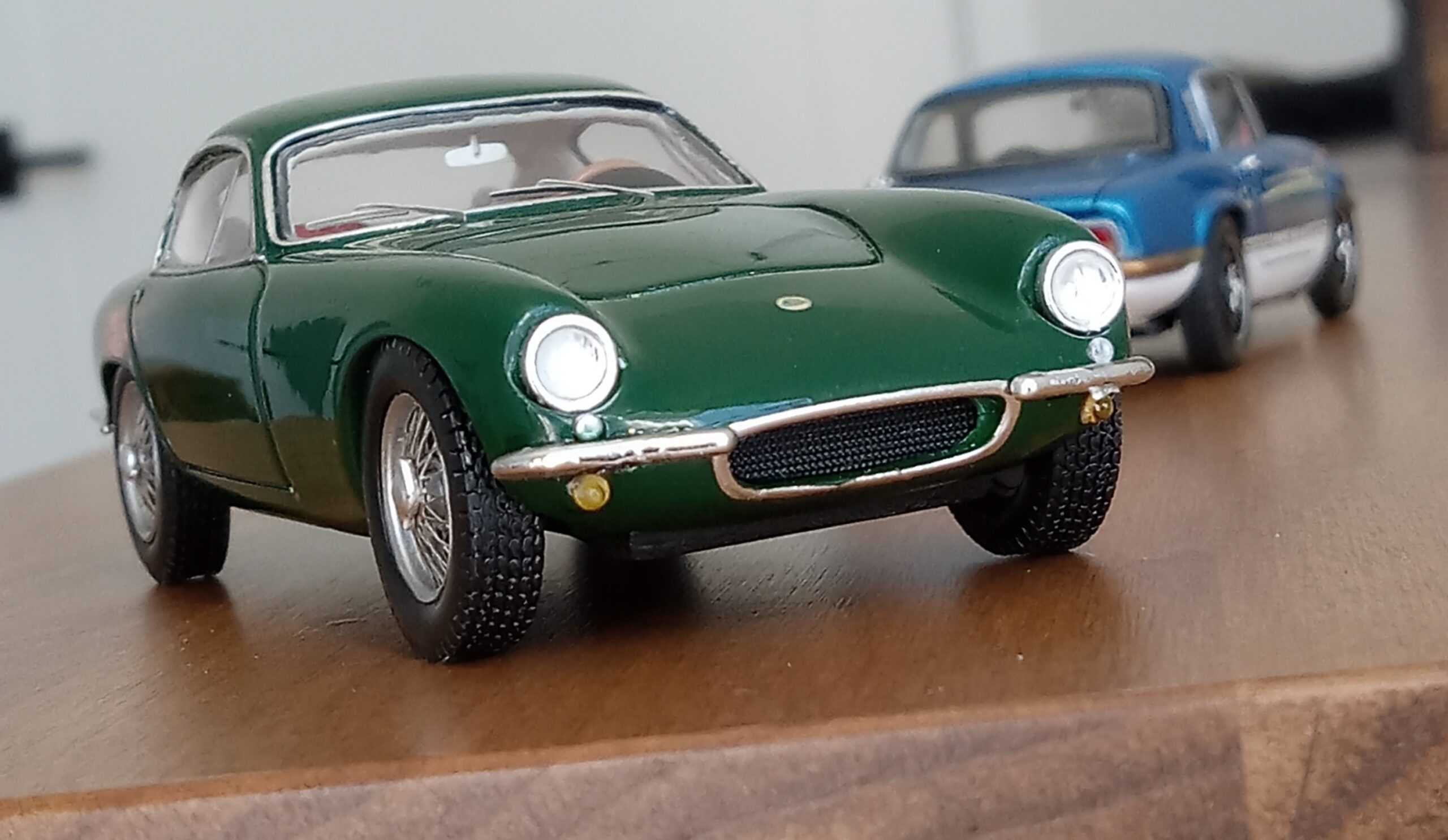
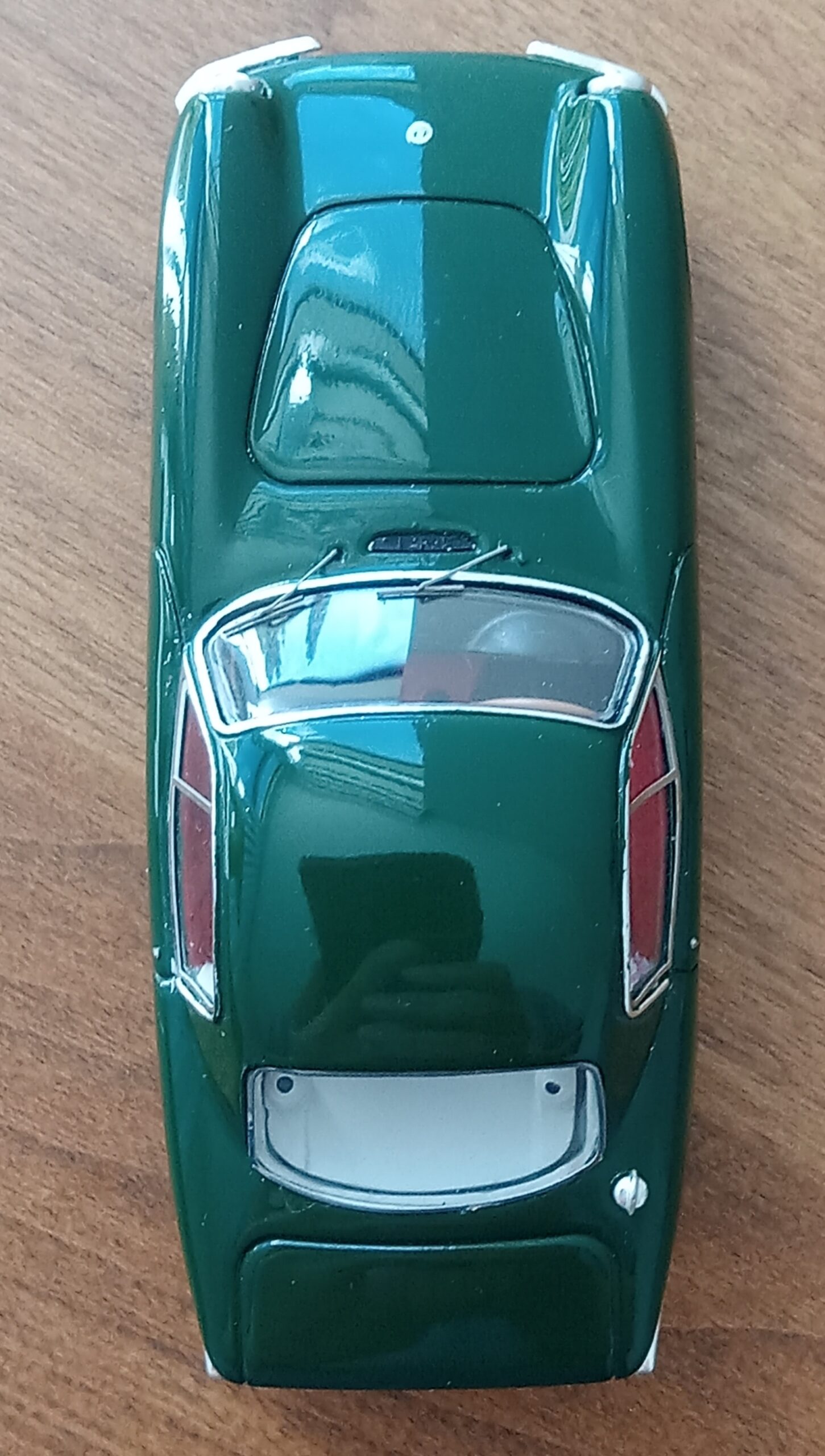
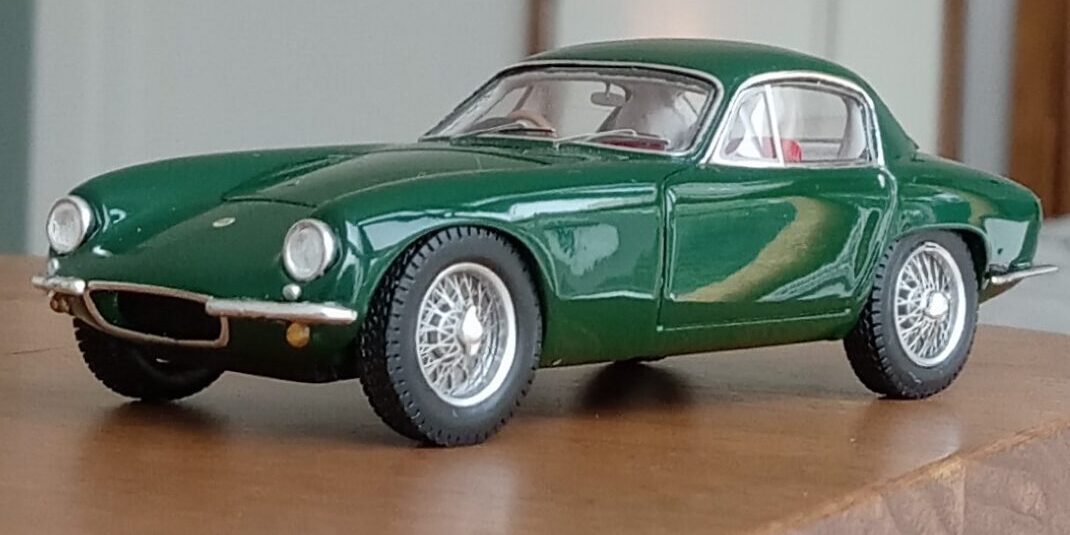
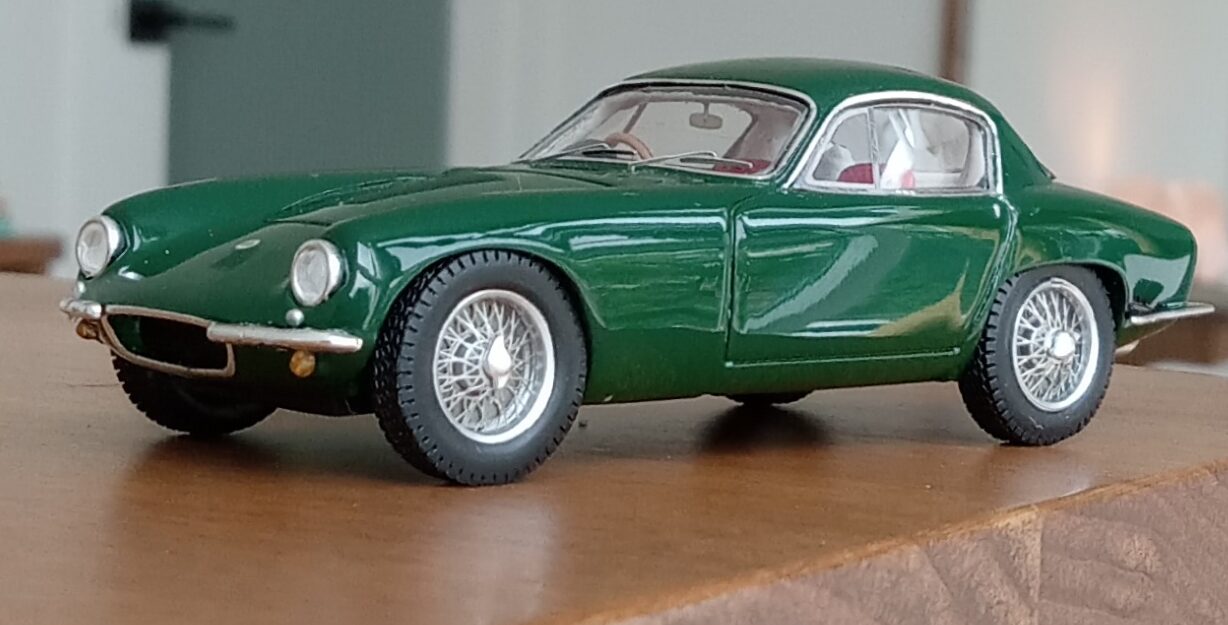
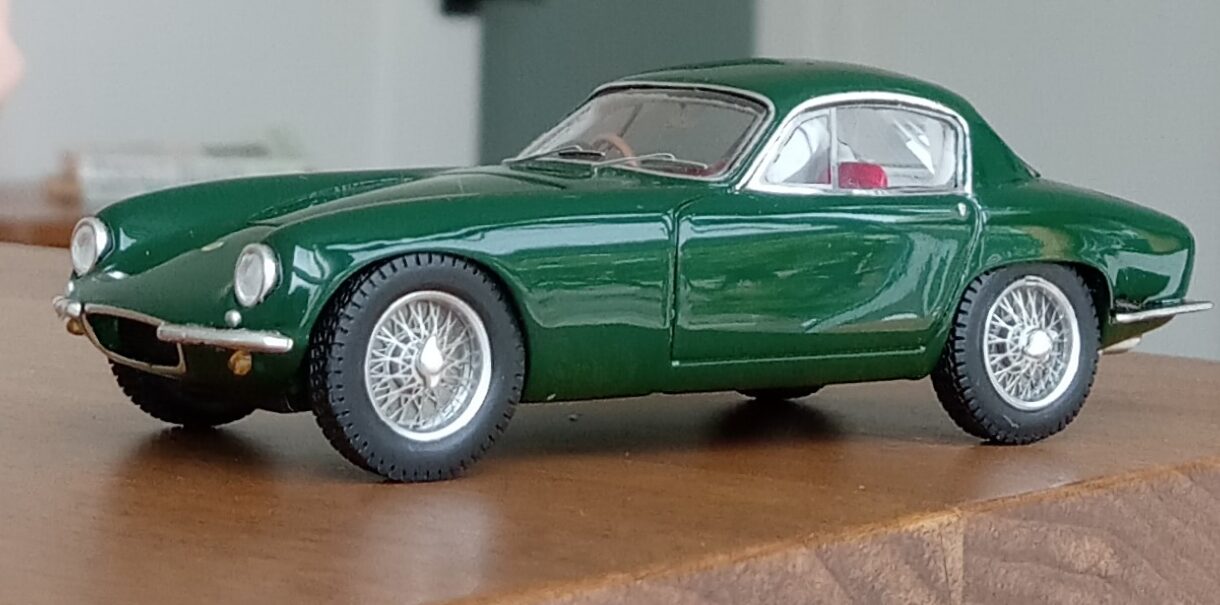
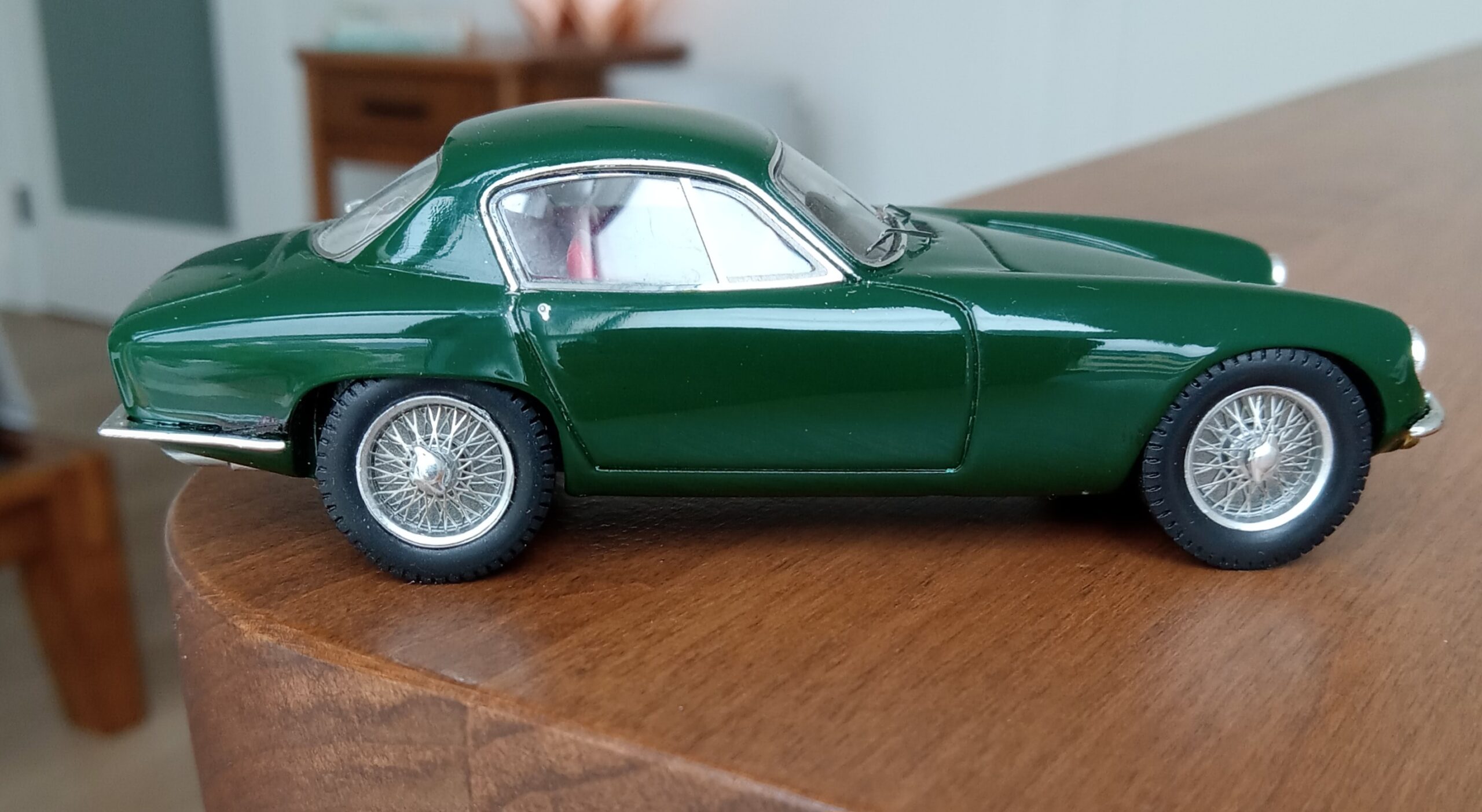
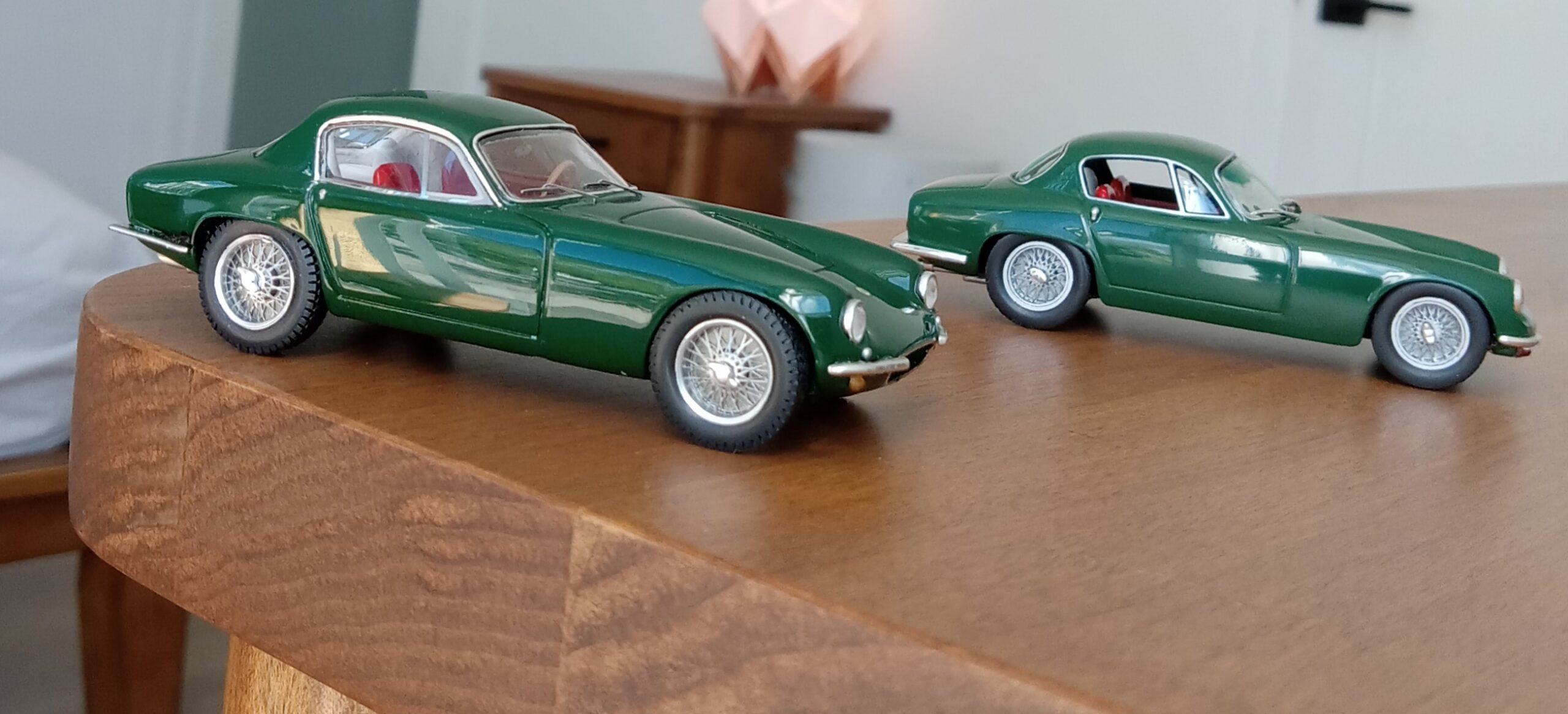
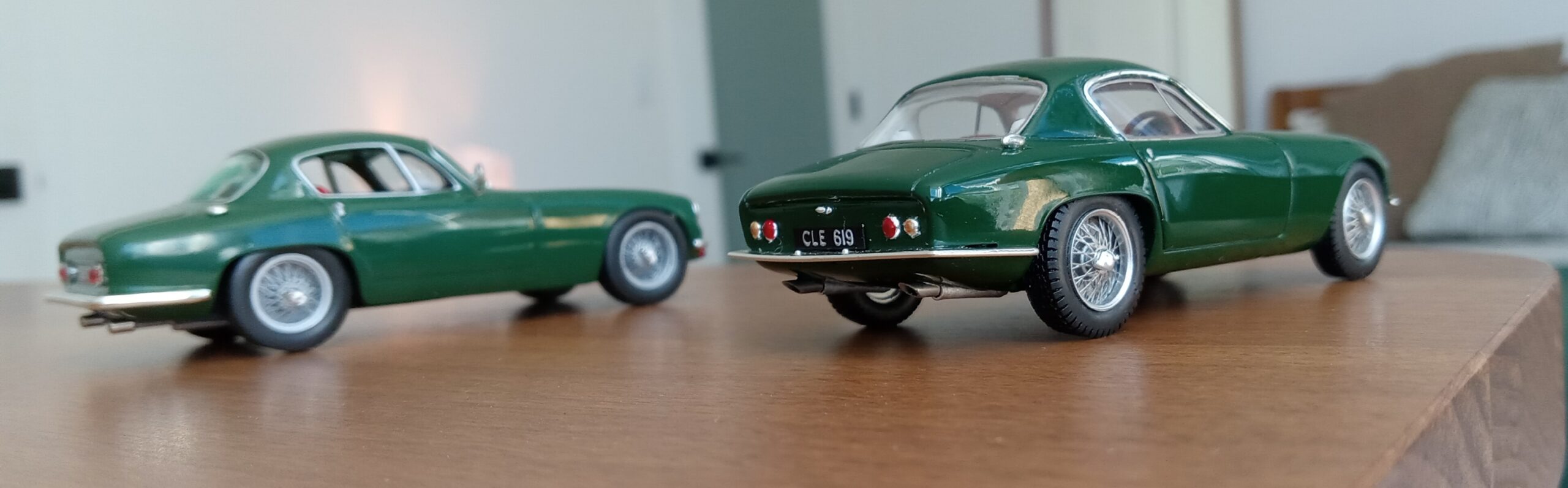
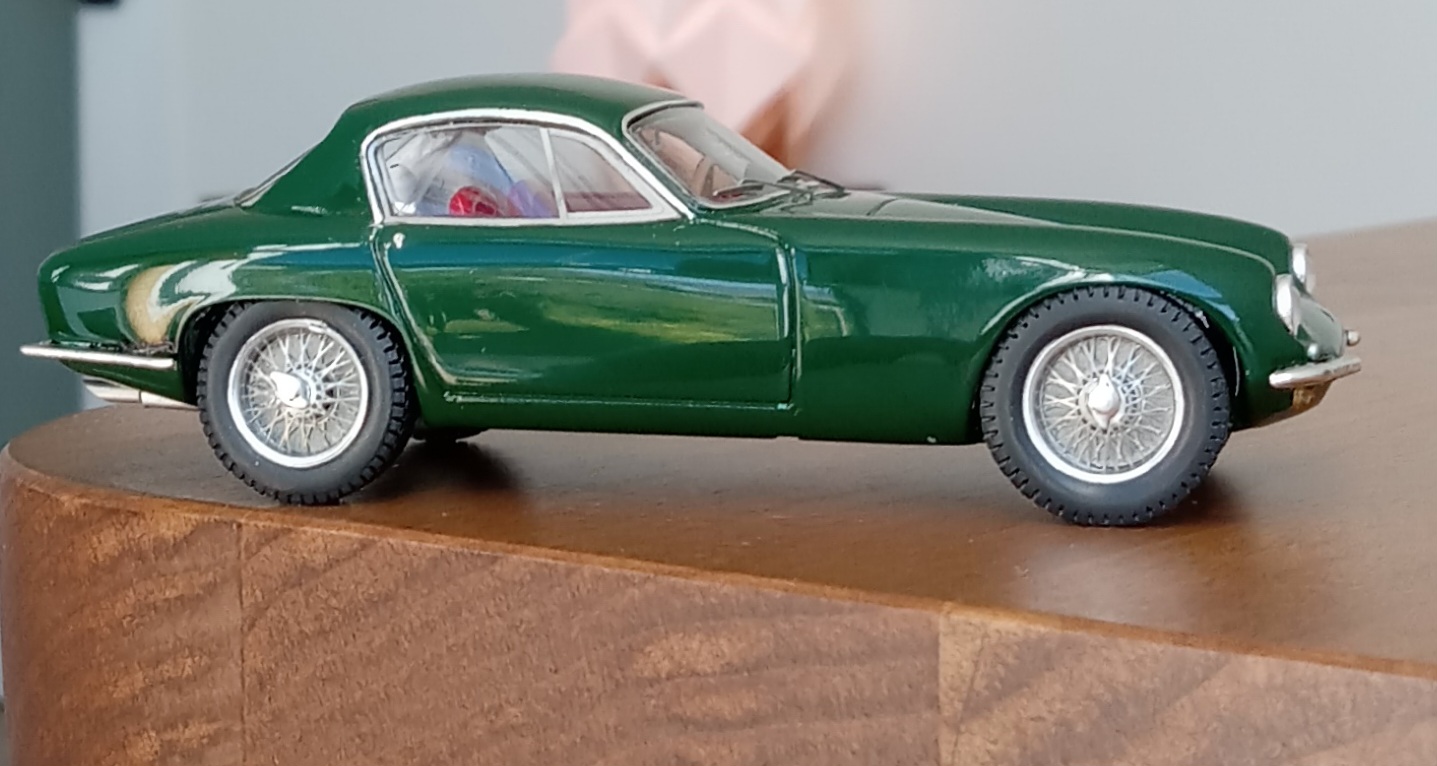
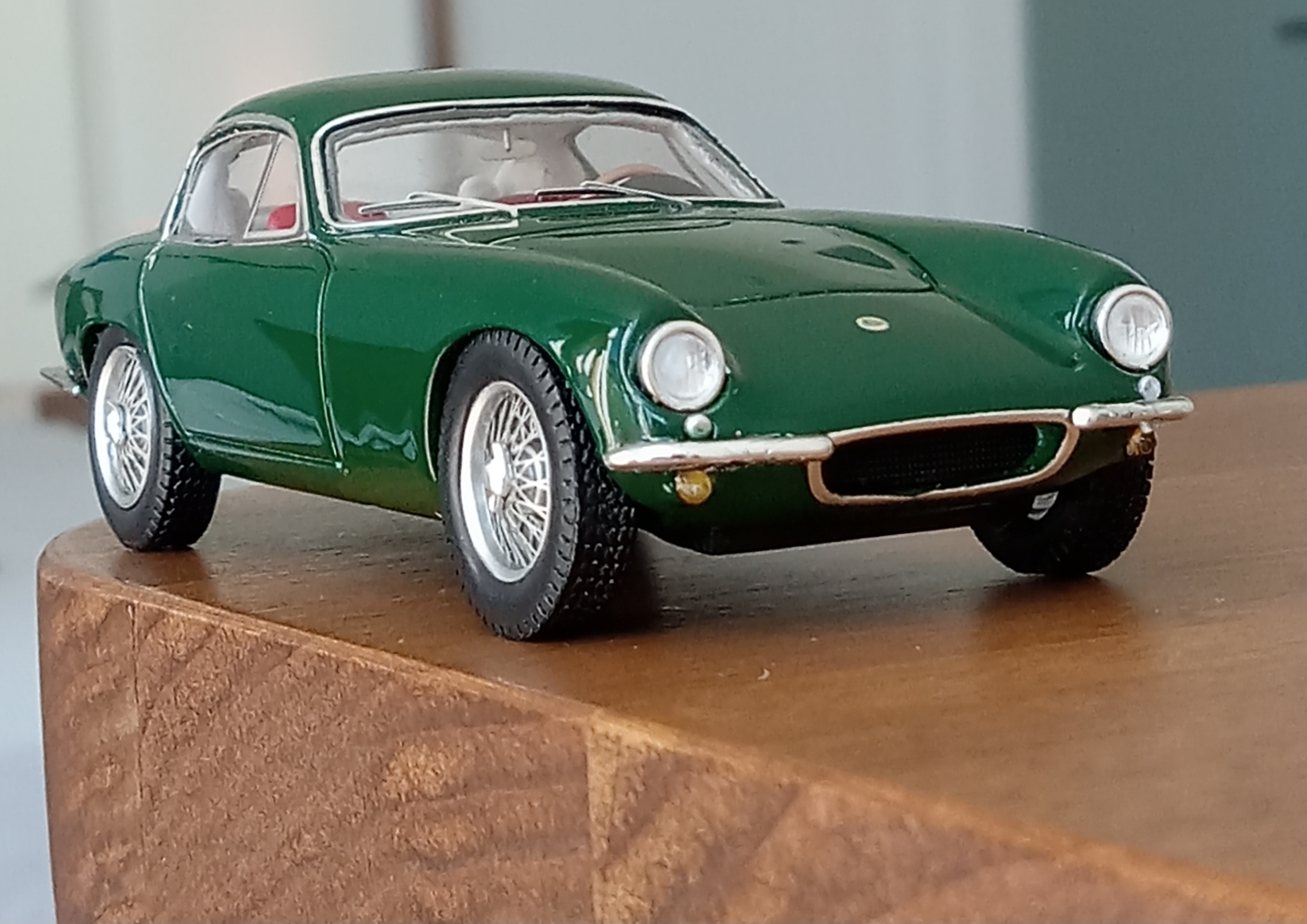
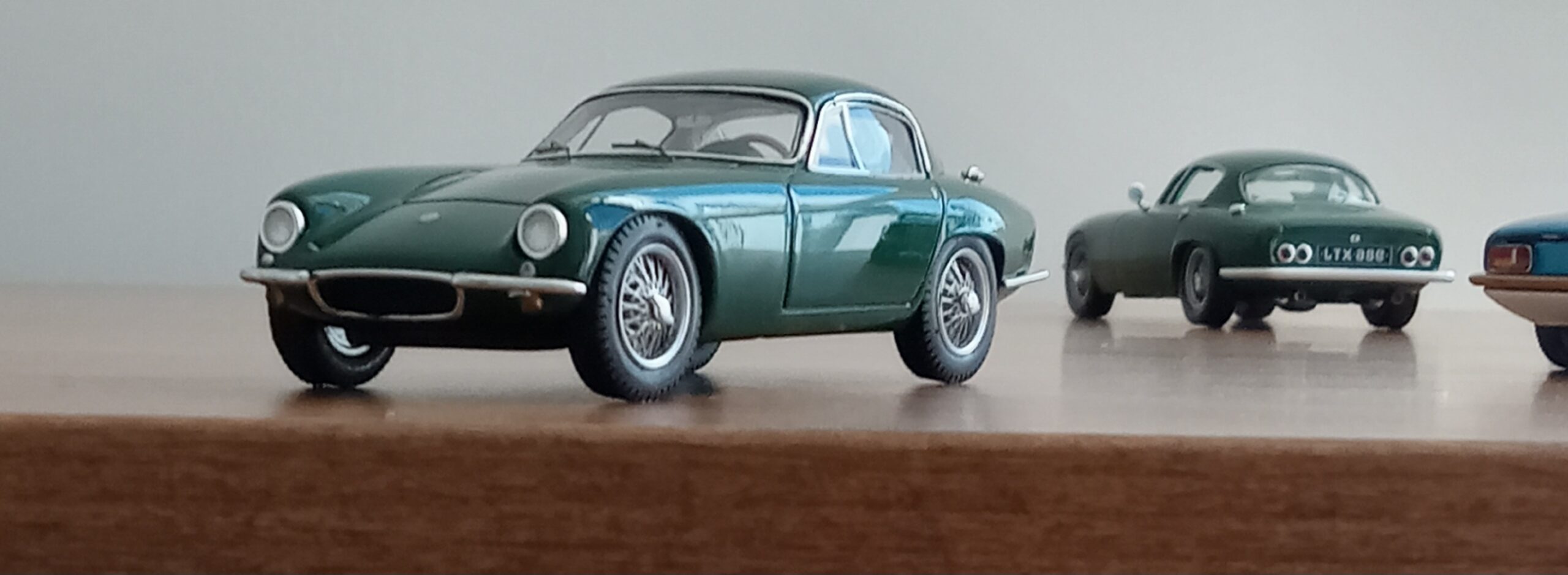
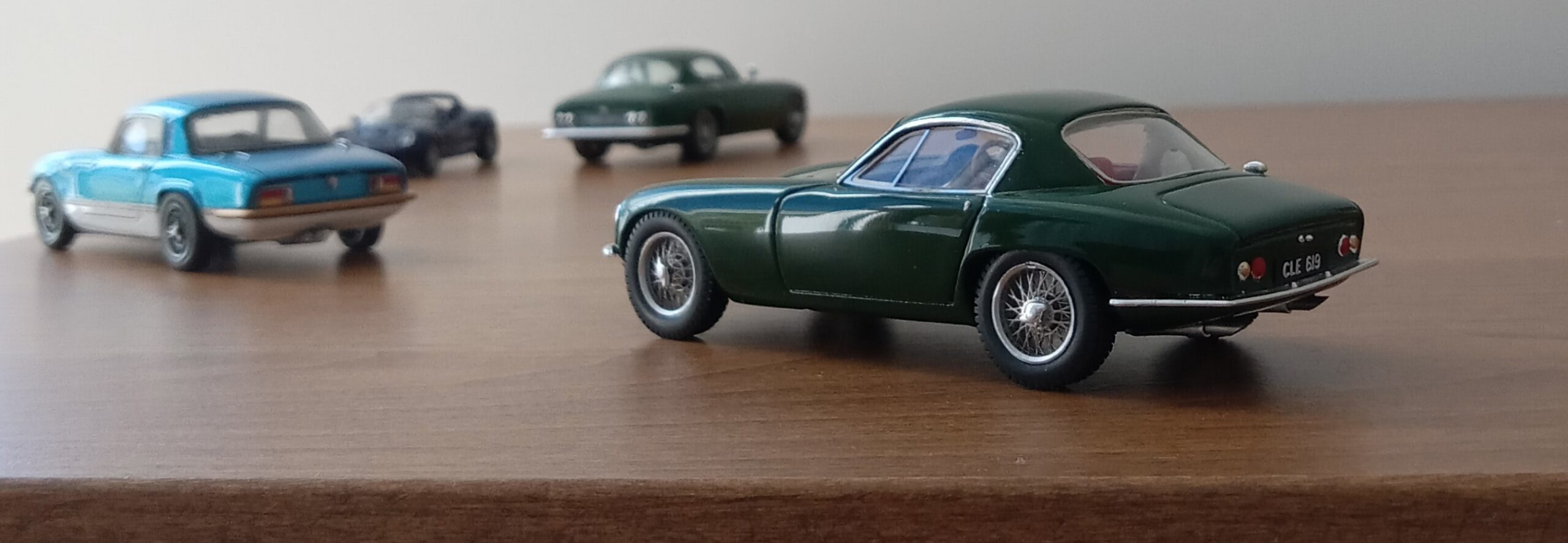
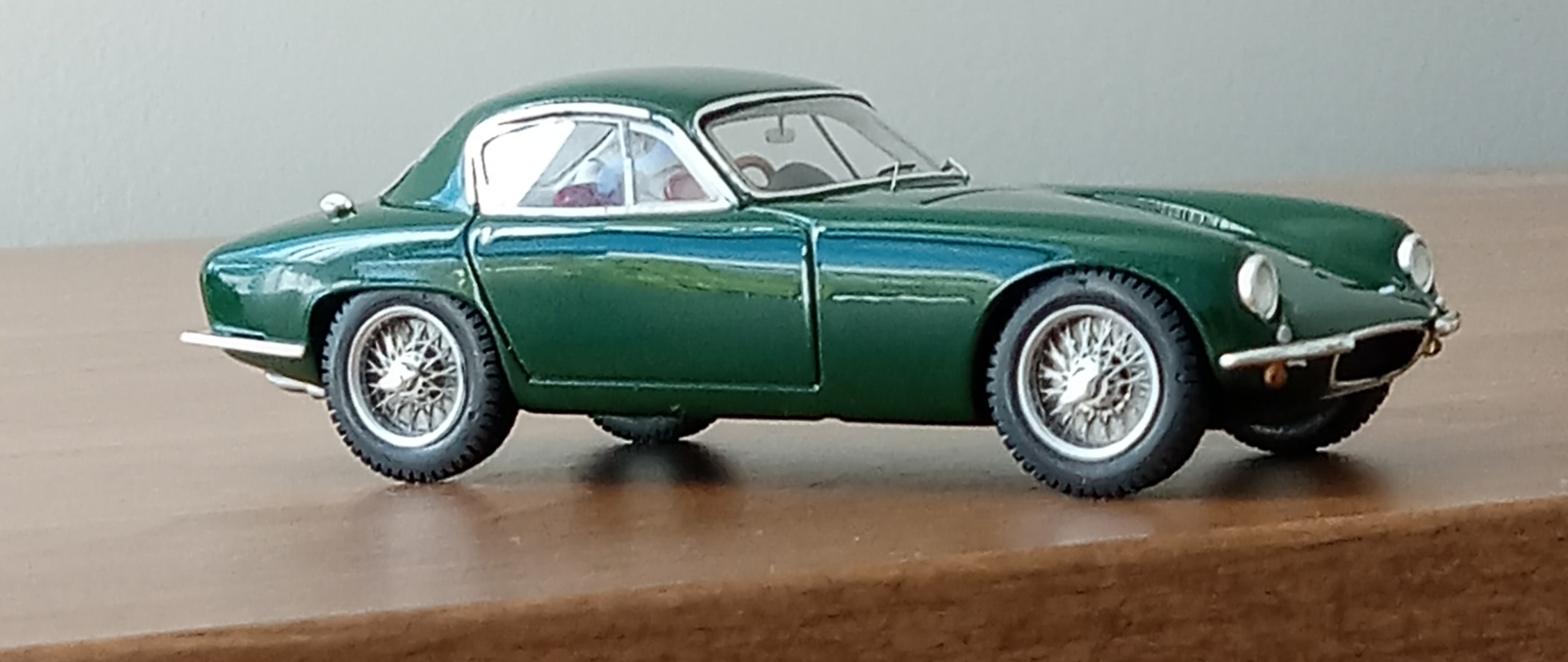
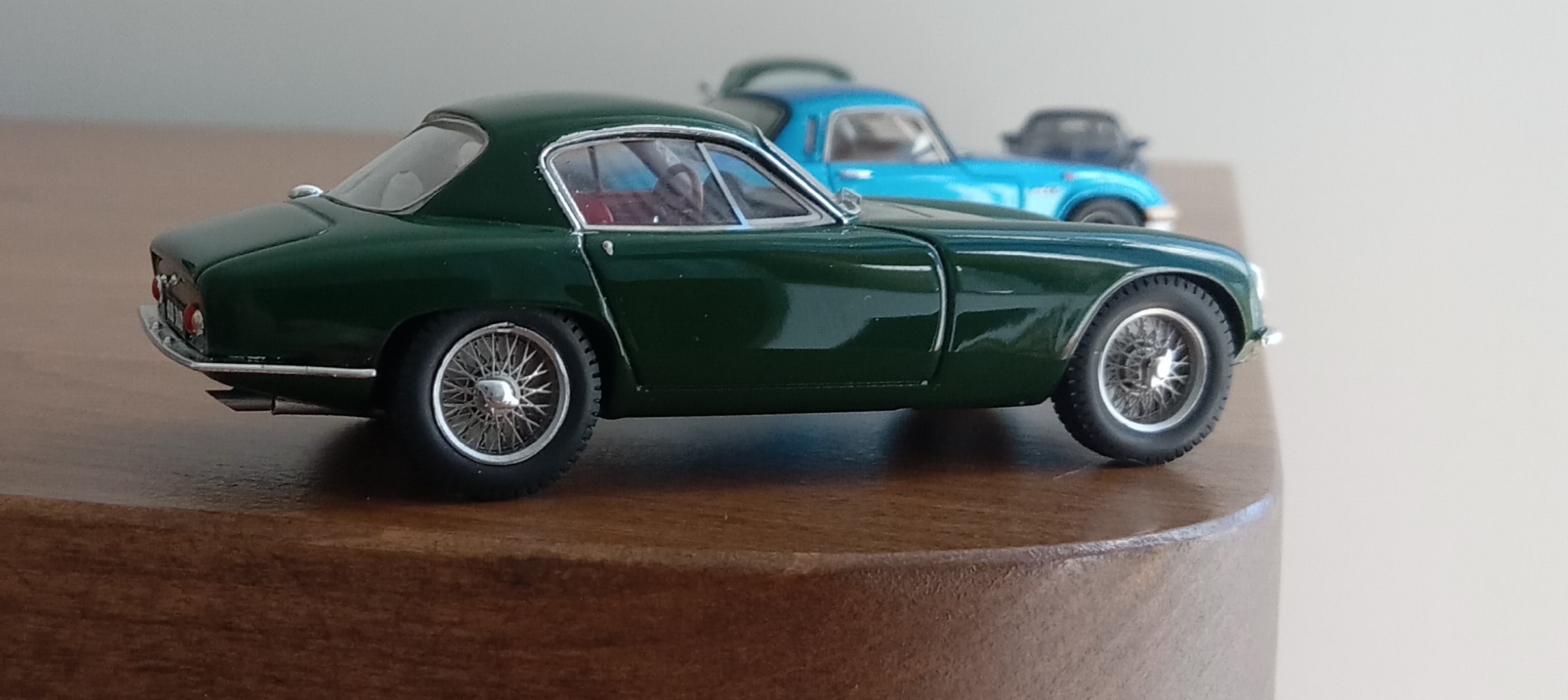
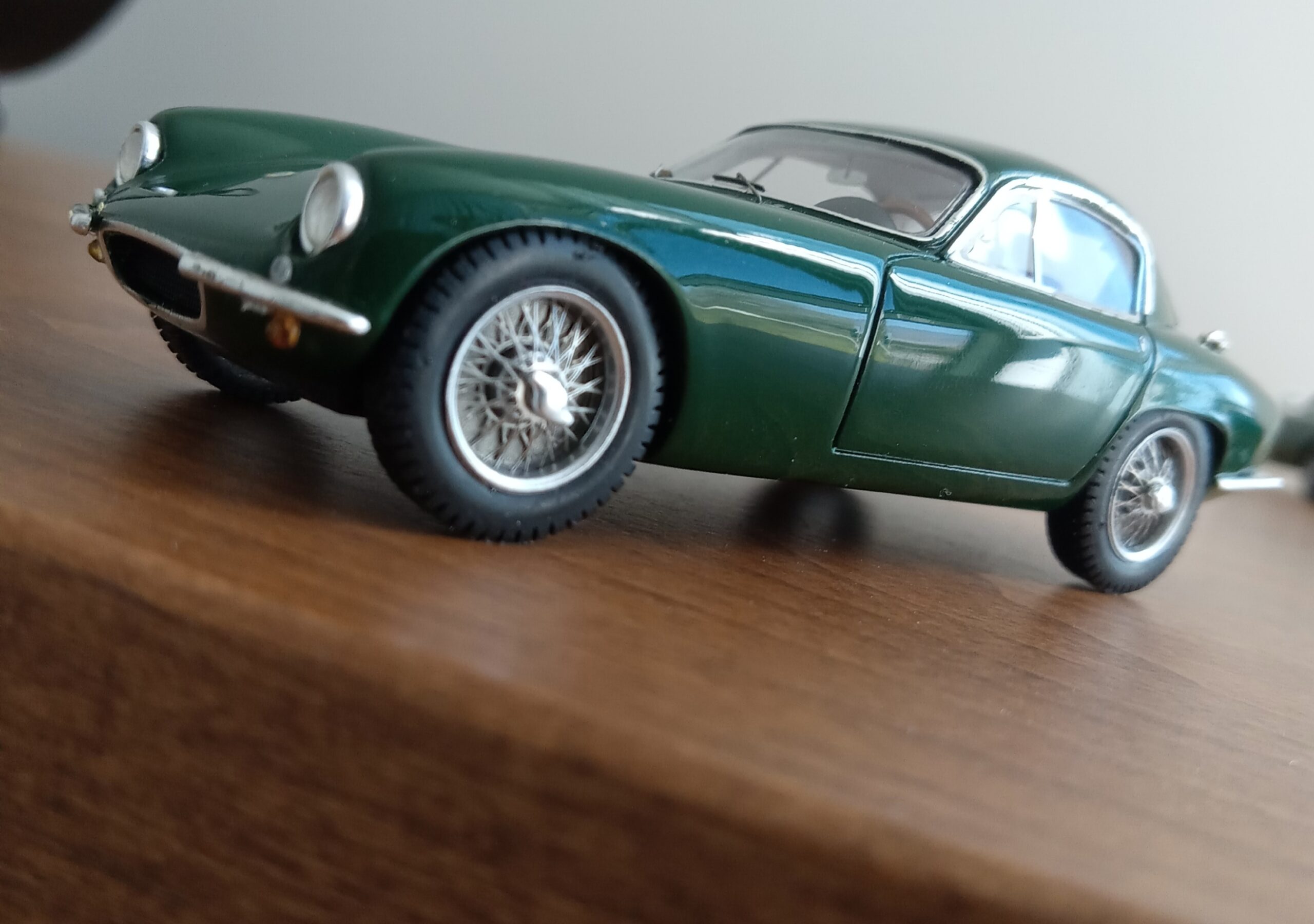
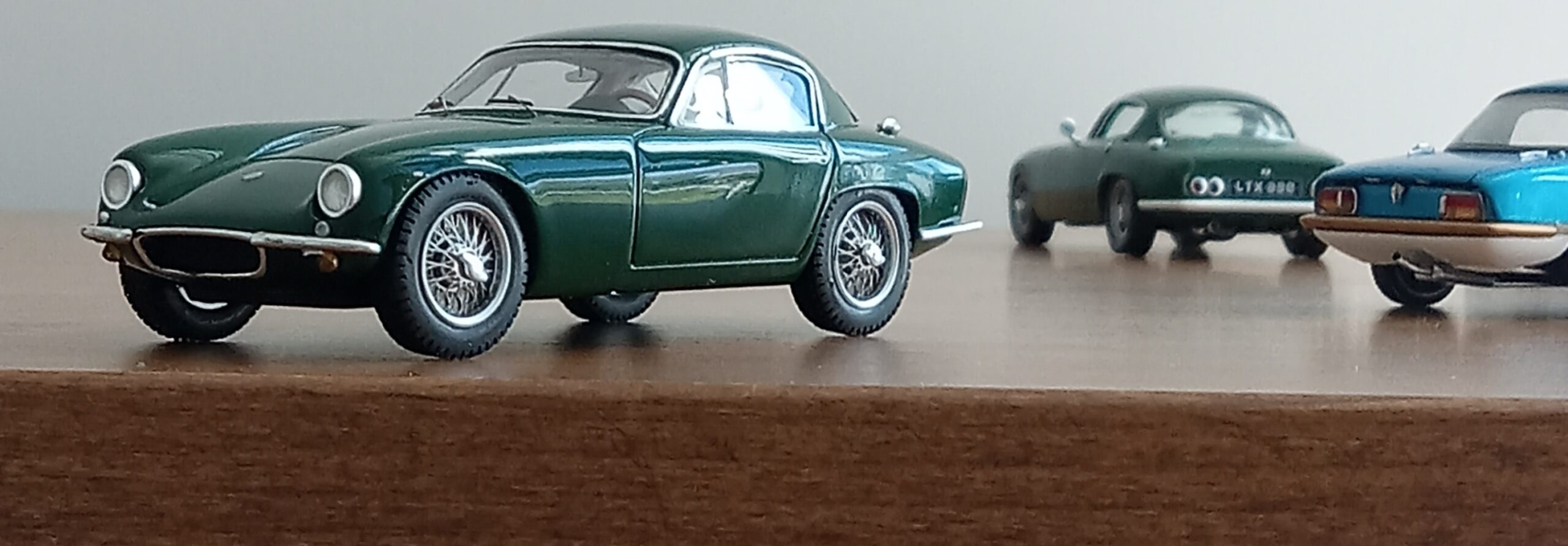
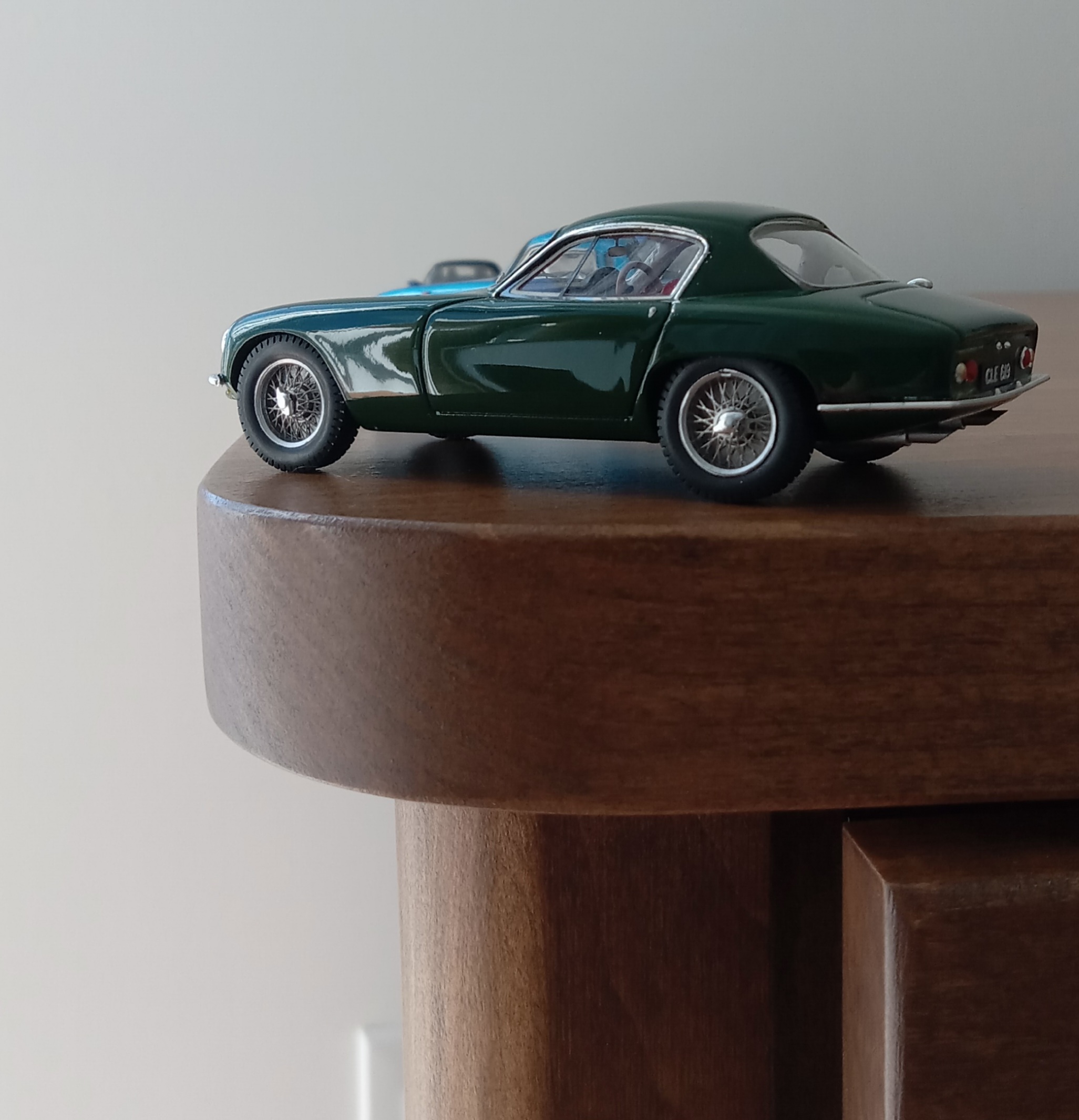
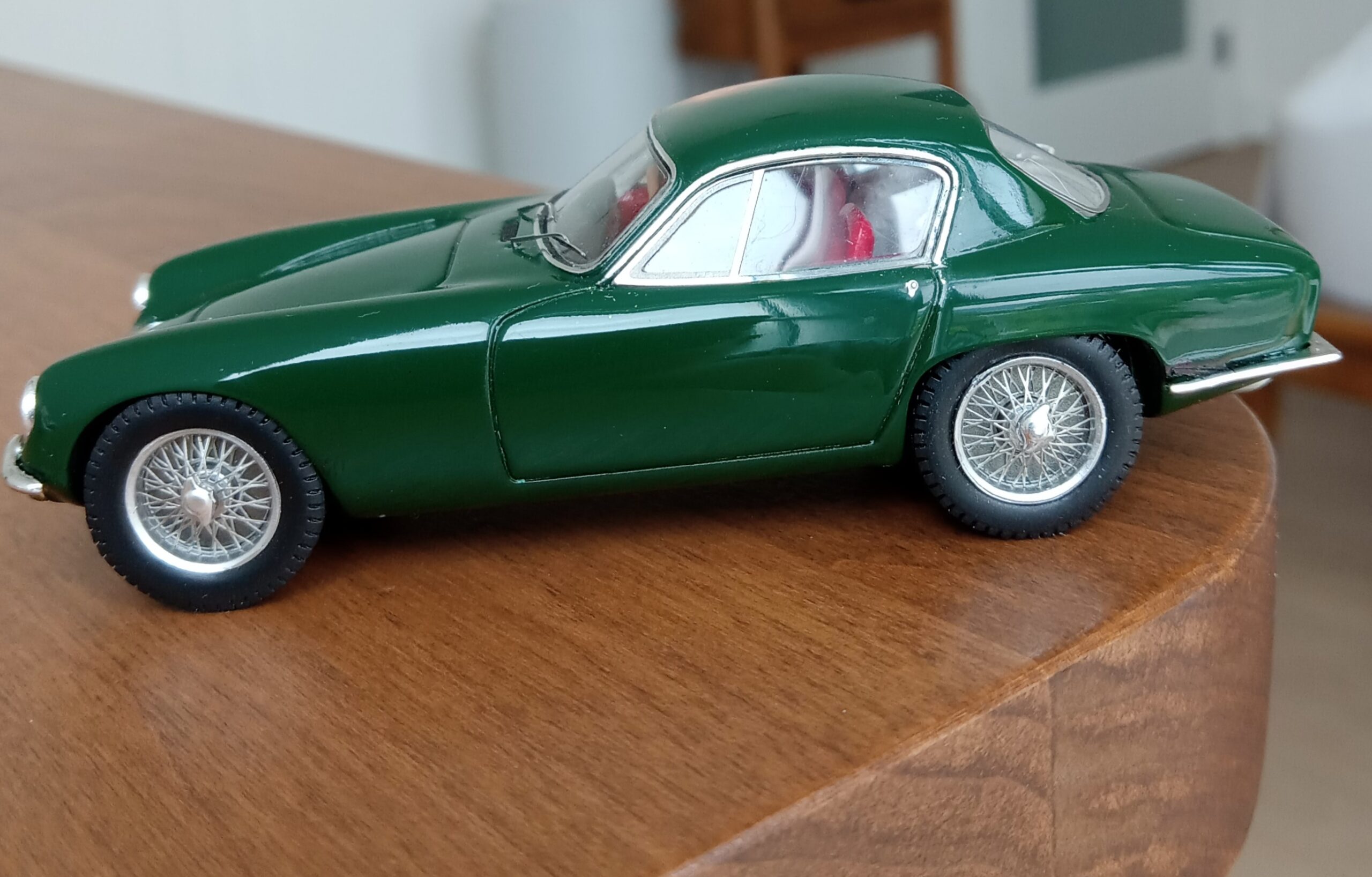
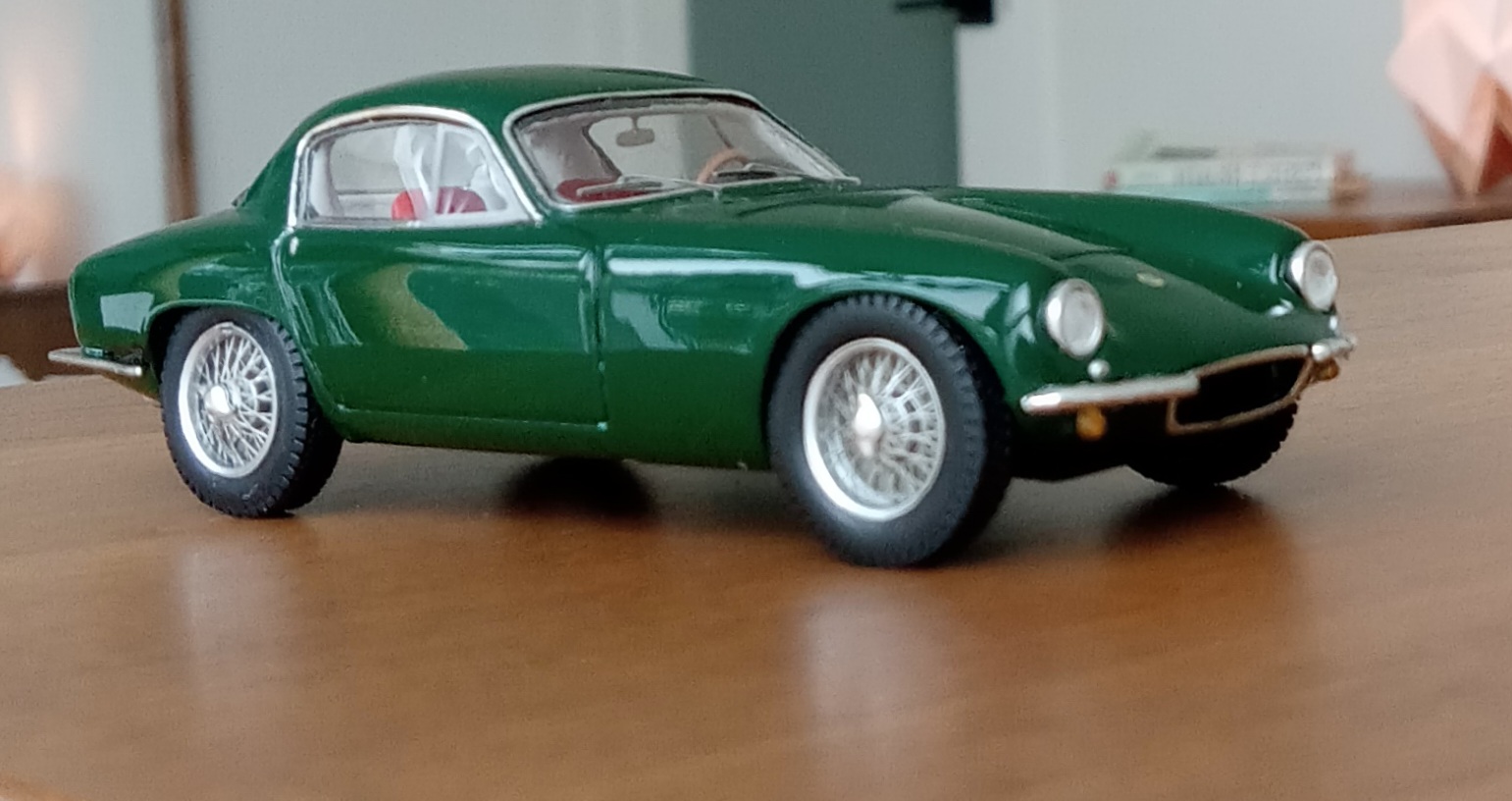
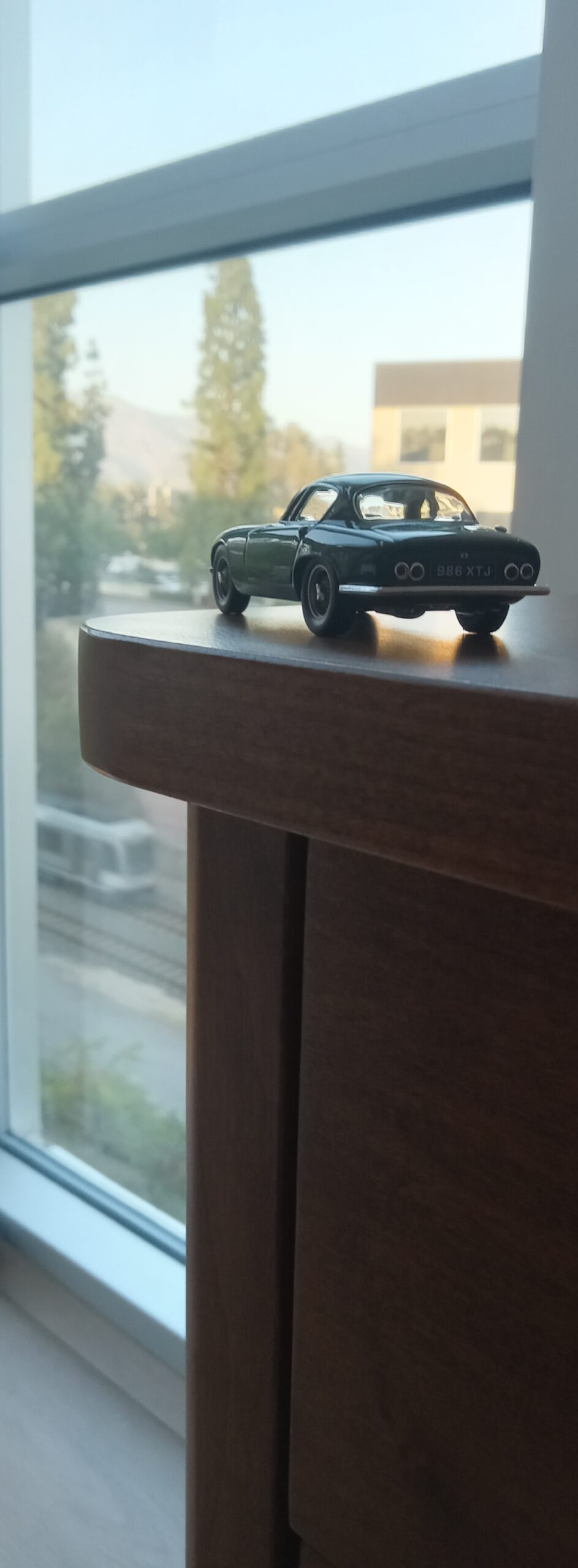
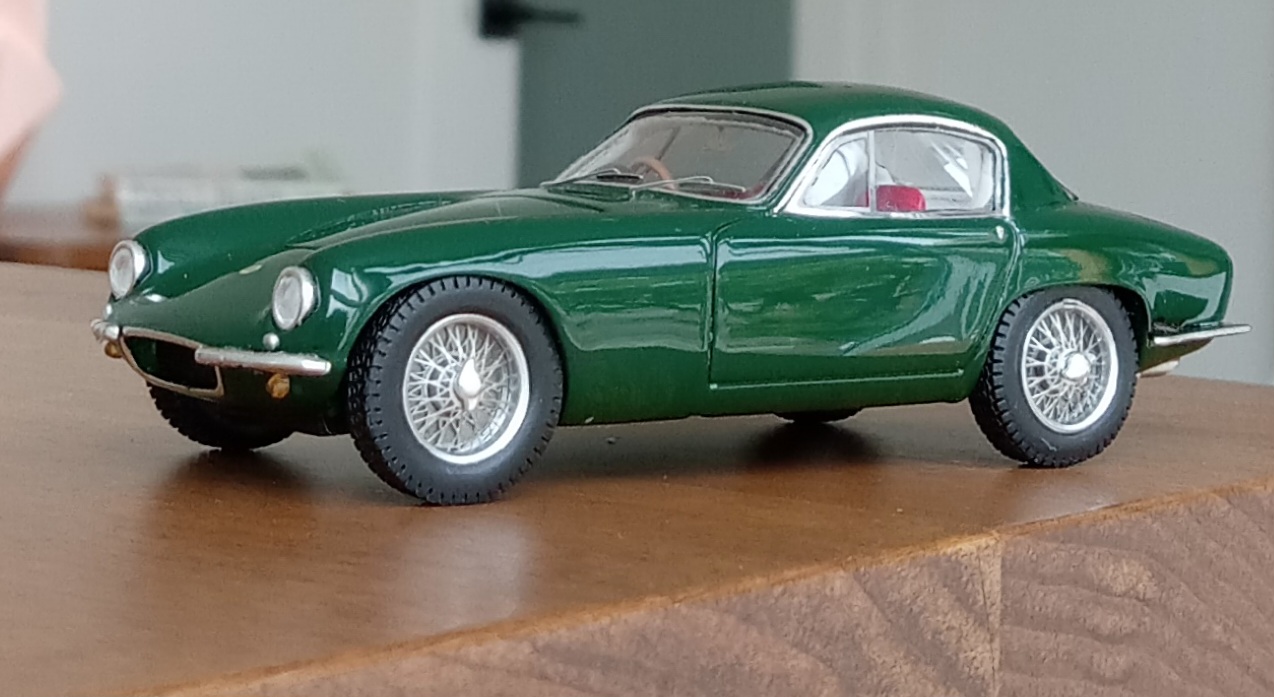
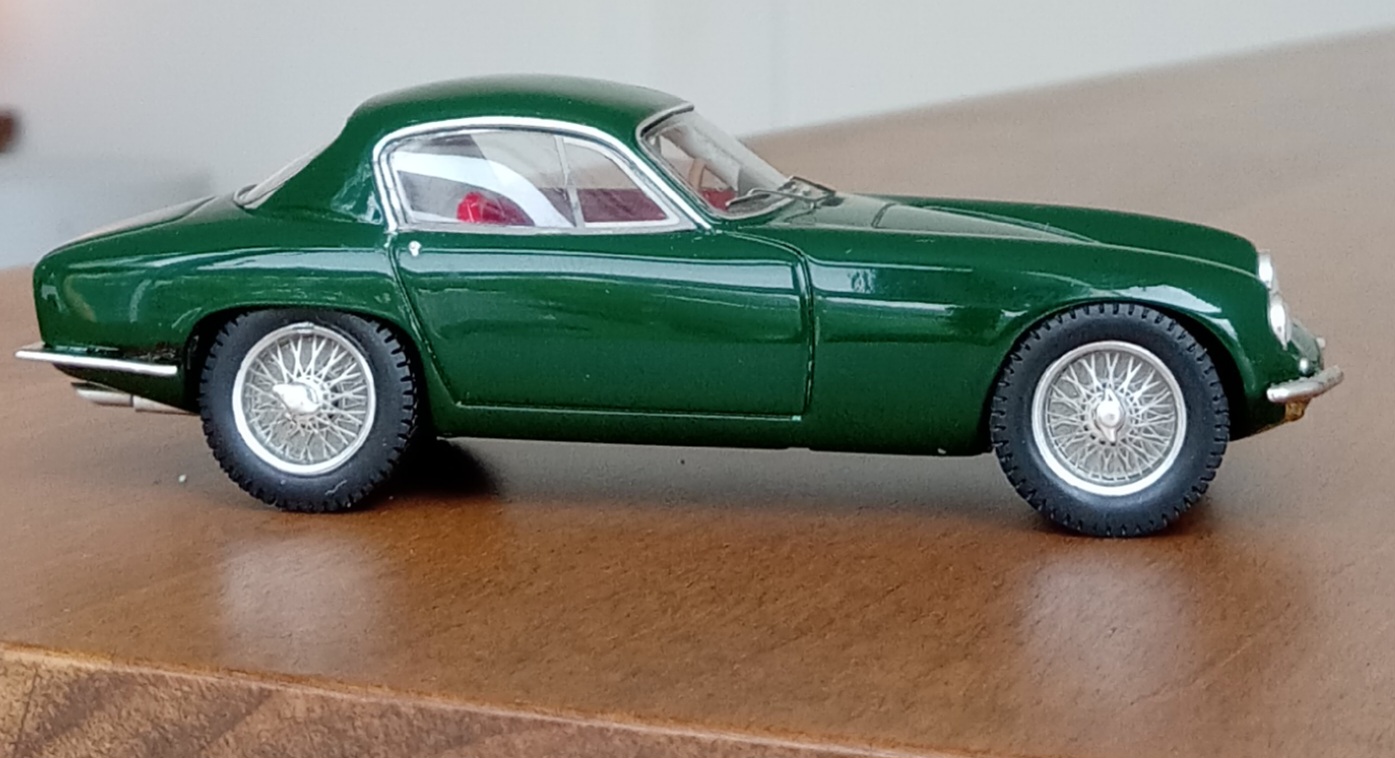
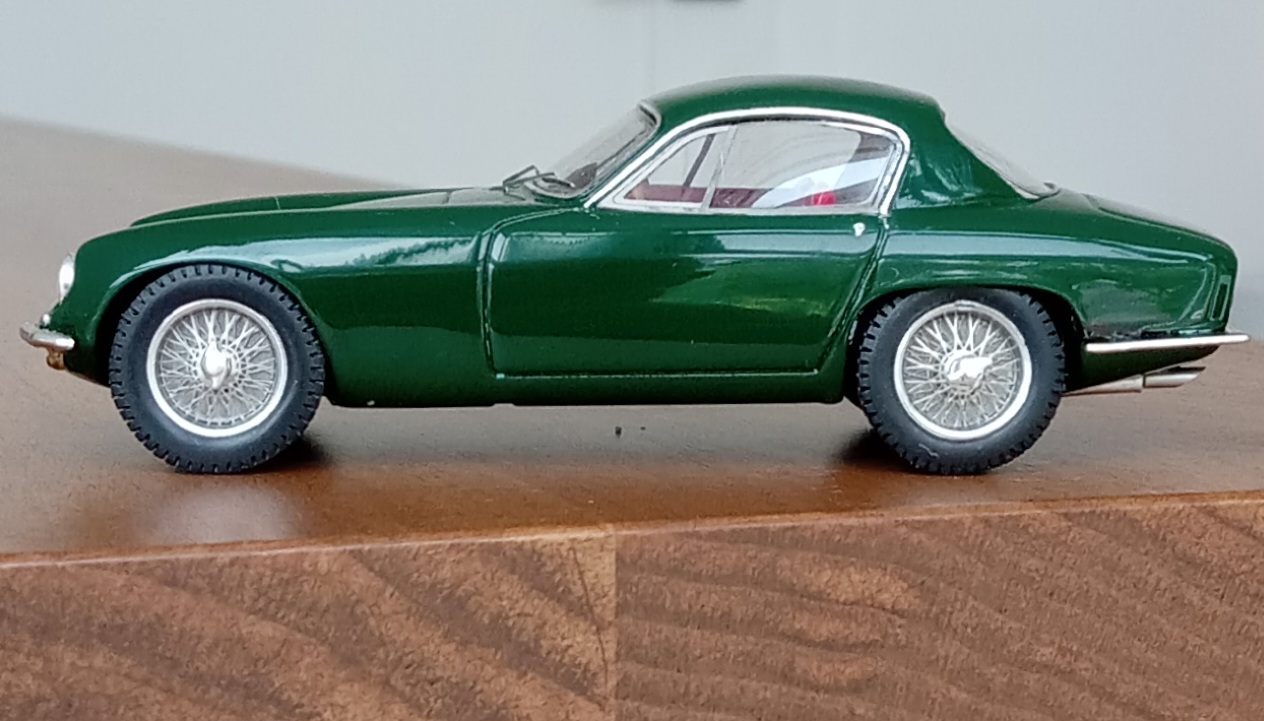
(写真撮影に使用したミニカー①:スパーク社製、1/43レジン完成品、初代ロータス・エ ラン S1、1958(ブリティッシュ・レーシング・グリーン)ーーー改造箇所: 前後のバンパーのゆがみを修正後、ボディーを上下にばらして、タイヤ&ホイールのトラックと軸位置を微調整、当時の英国車独特のスタンスを半日かけて徹底再現)


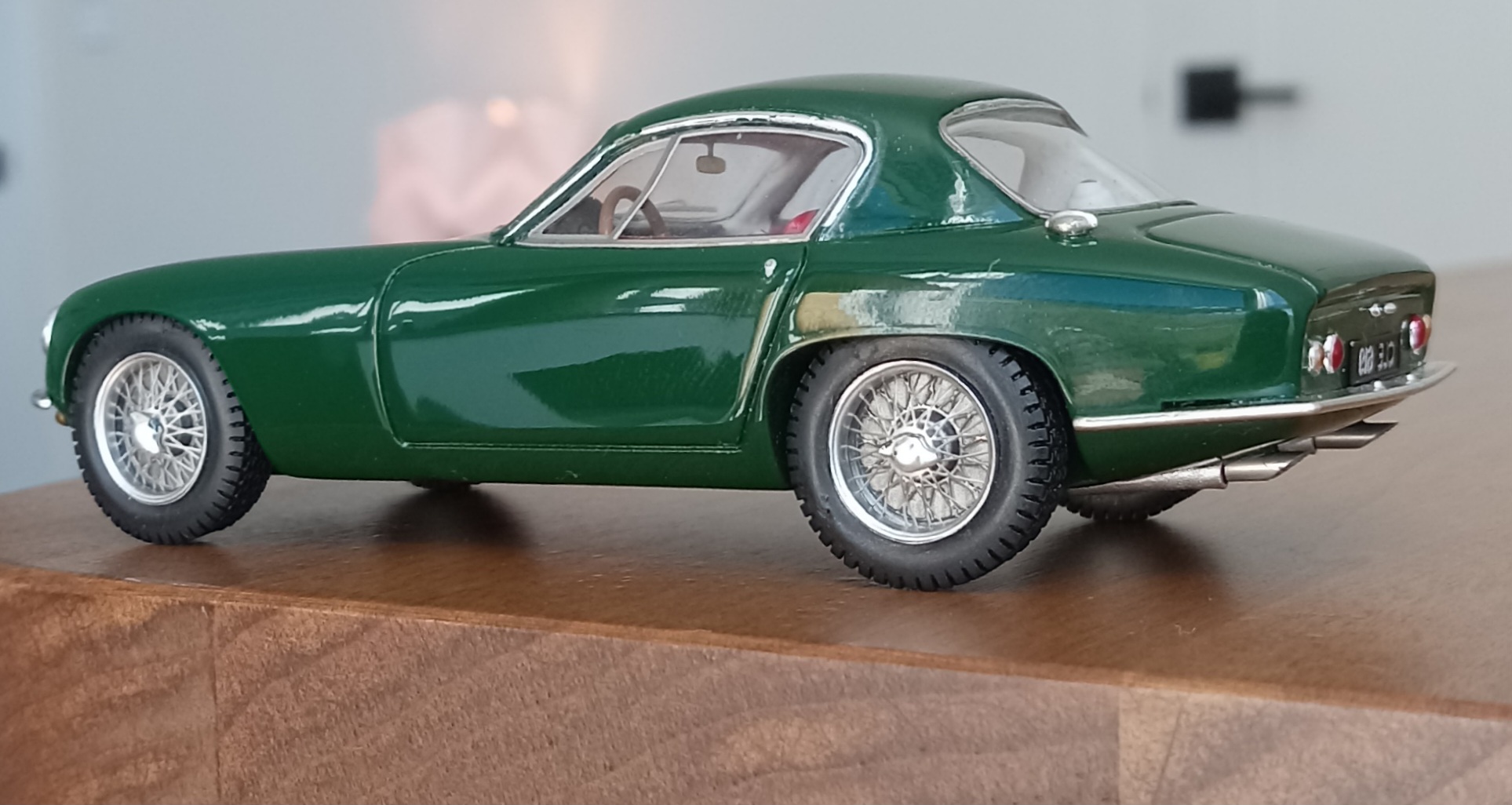
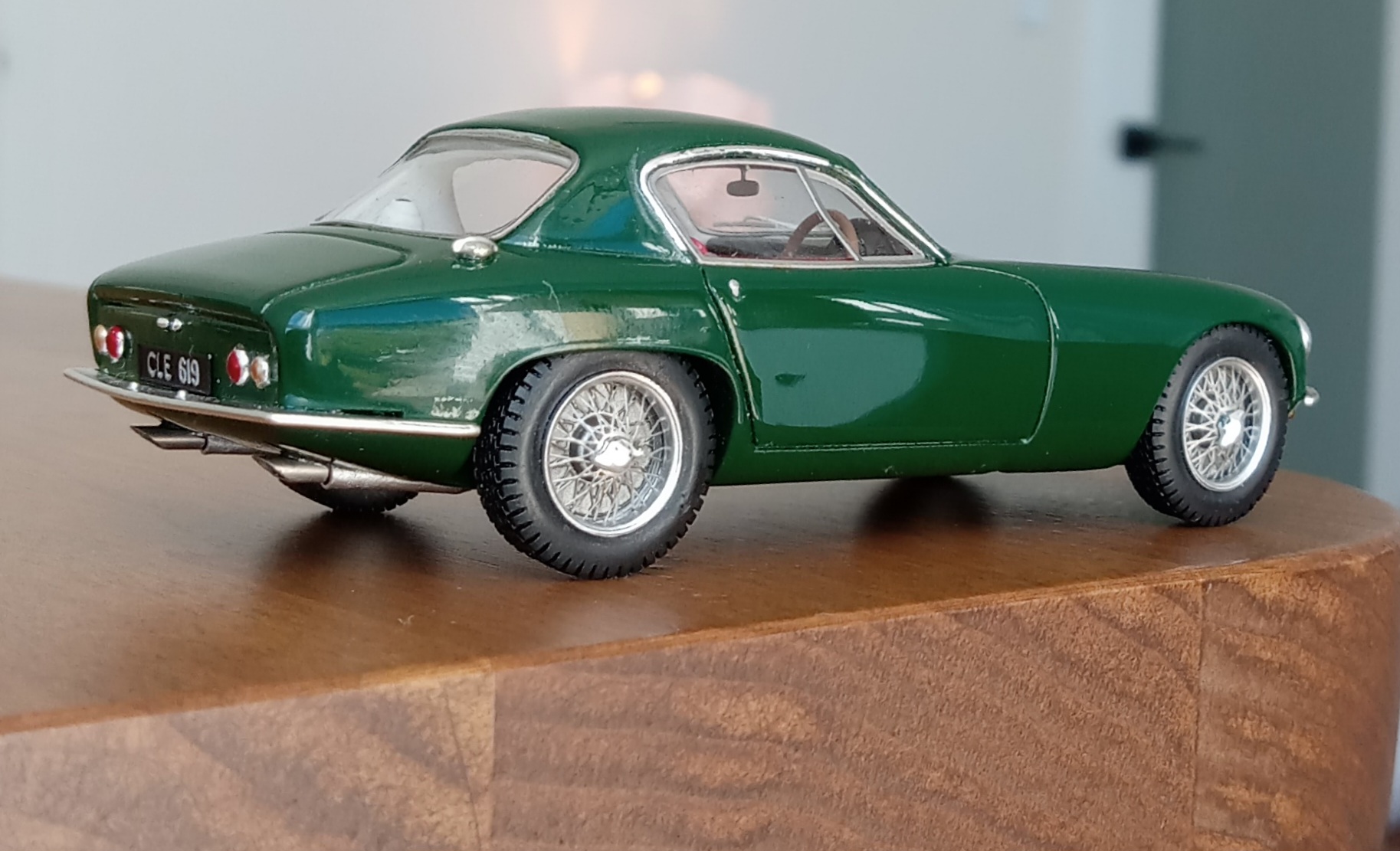
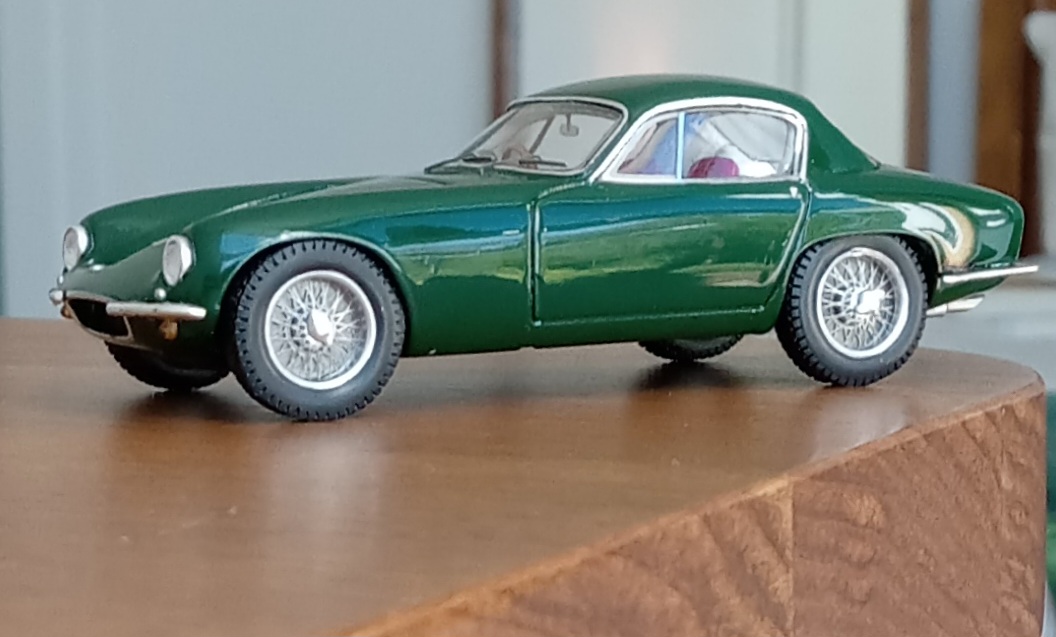
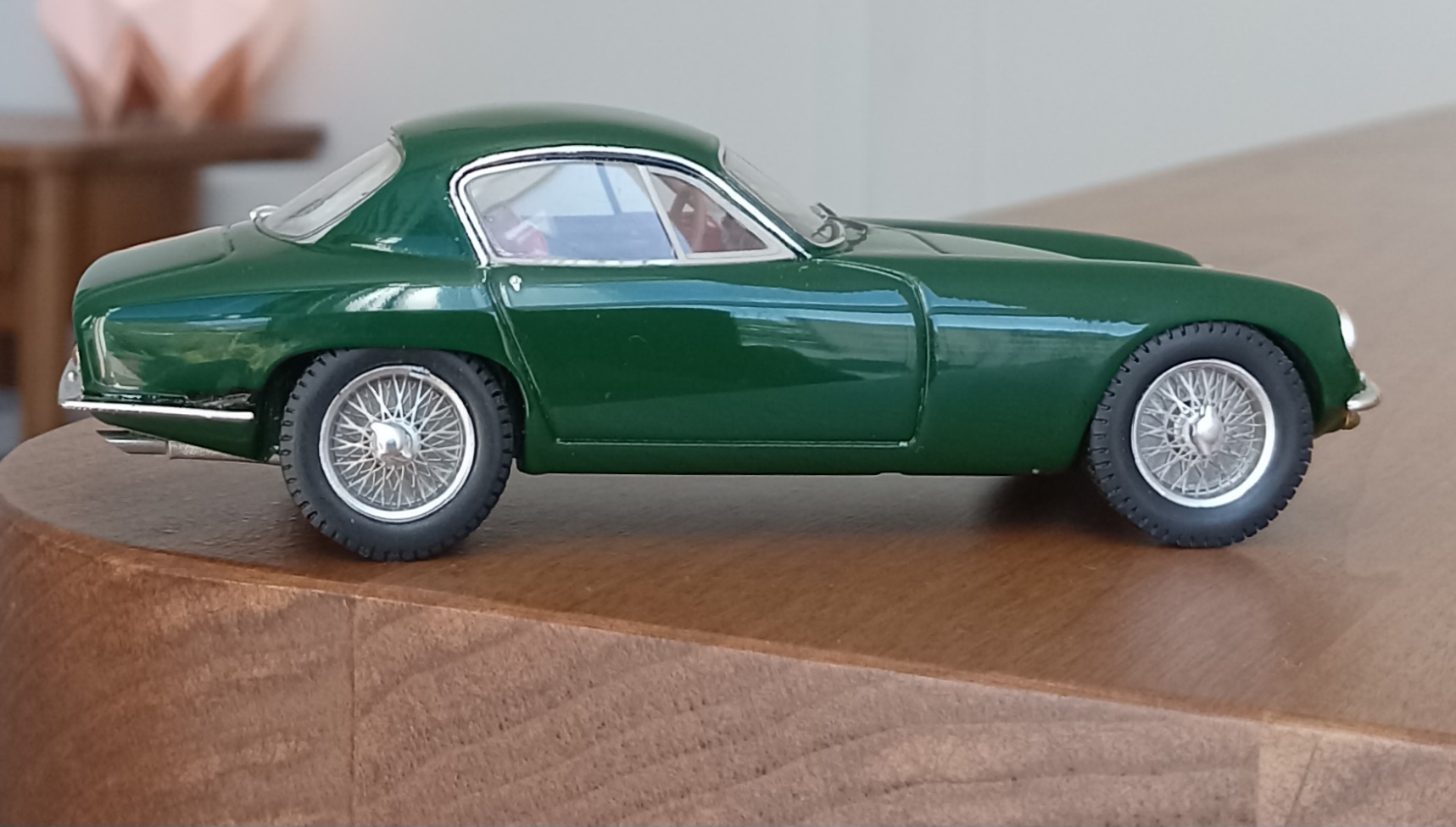
好みの自動車デザイン:第53回ーー2ドア・クーペの系譜: 第33回【英国車②】 ロータス・初代エリート、1958(ブリティシュ・グリーン)『チャップマンの超軽量スポーツ・カー』Lotus Elite、1959(British Green)『Chapman’s Idealism』
#改造プロジェクト:
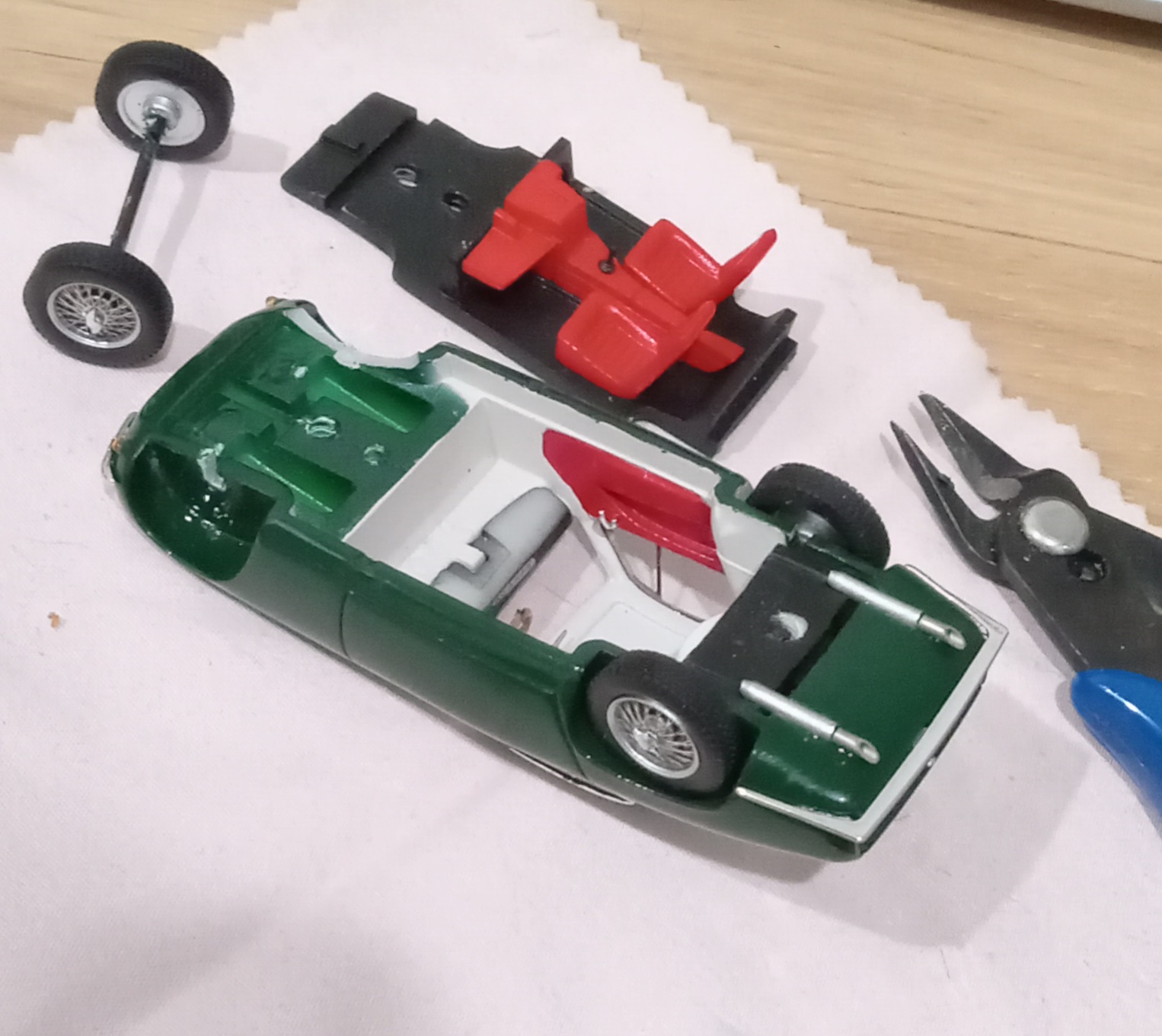
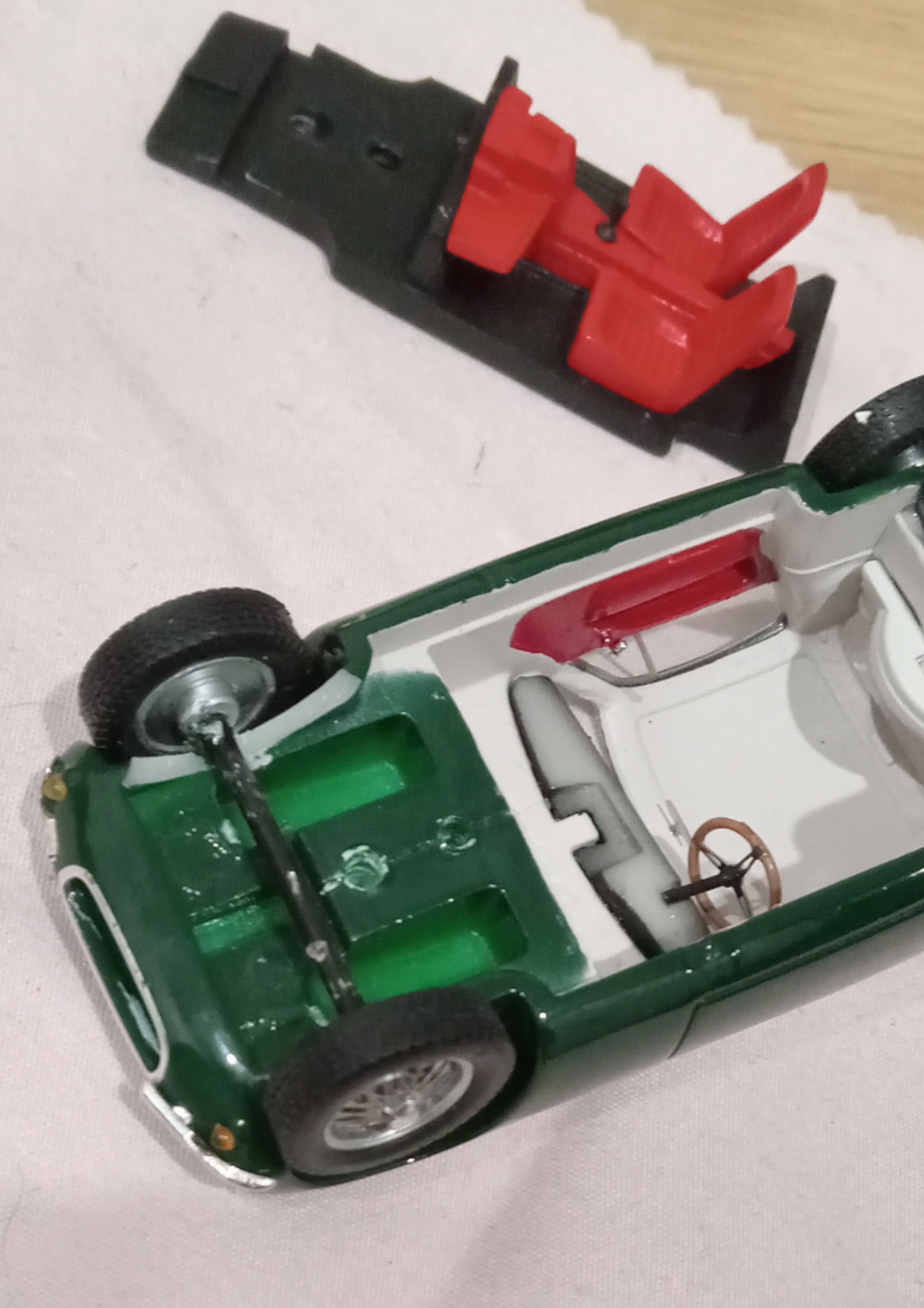
改造行程:
1:リアバンパーとフロントバンパーを取り外し、カタチを修正した後、再接着、
2:ボディーを上下に分解して、接着された全輪軸を外し、
3:前後のボディー側軸受けを2-3mm深く削り、
4:前後の車軸からホイール&タイヤを外し、トラックを最大化、
5:軸の高さを微調整しながら、理想的な前傾姿勢になるよう繰り返す、
6:ピッタリ決まったら、上下ボディーを再接着
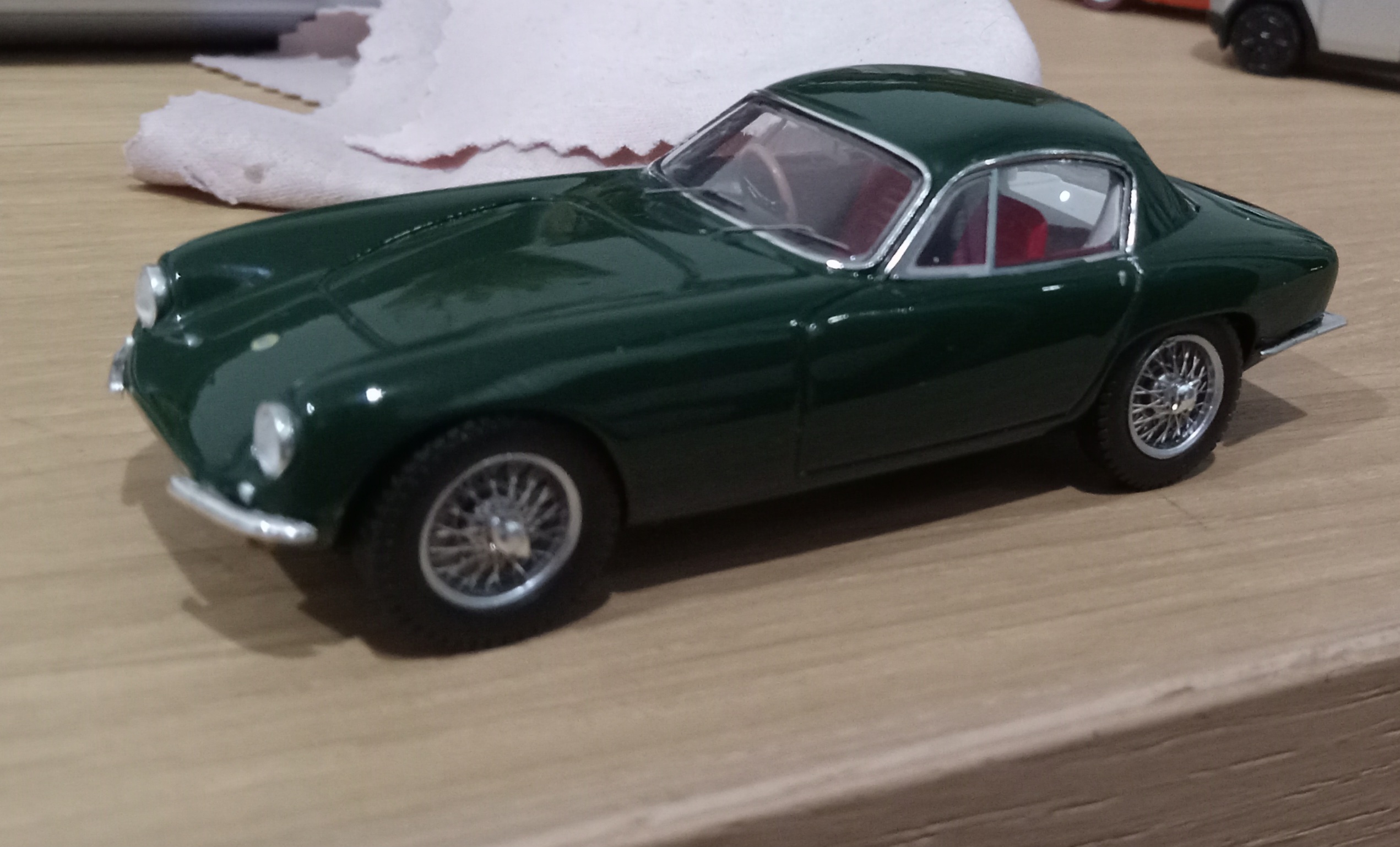
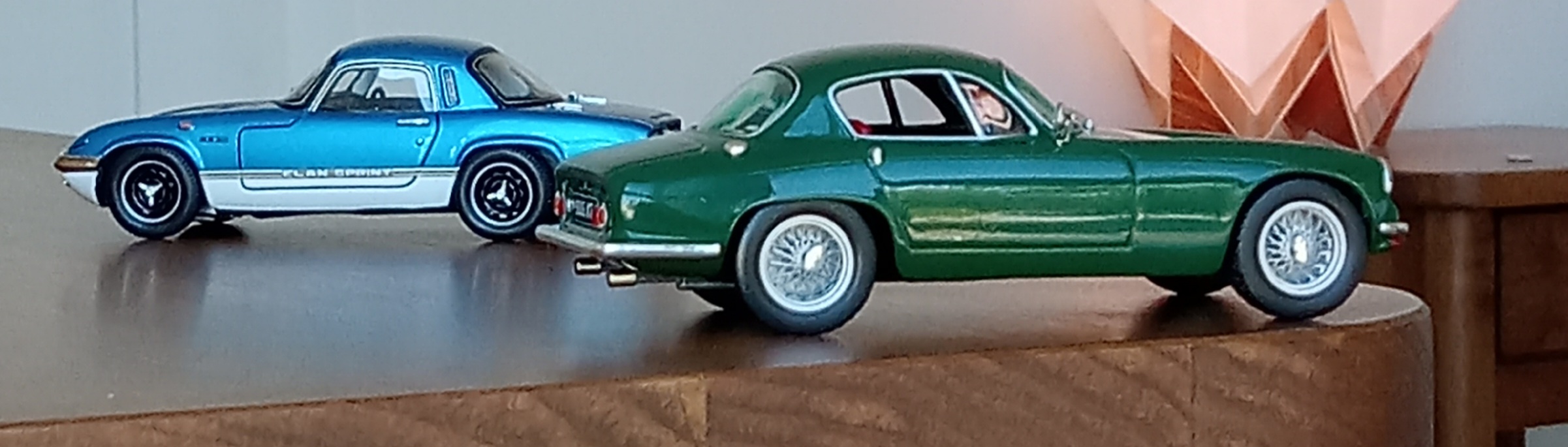
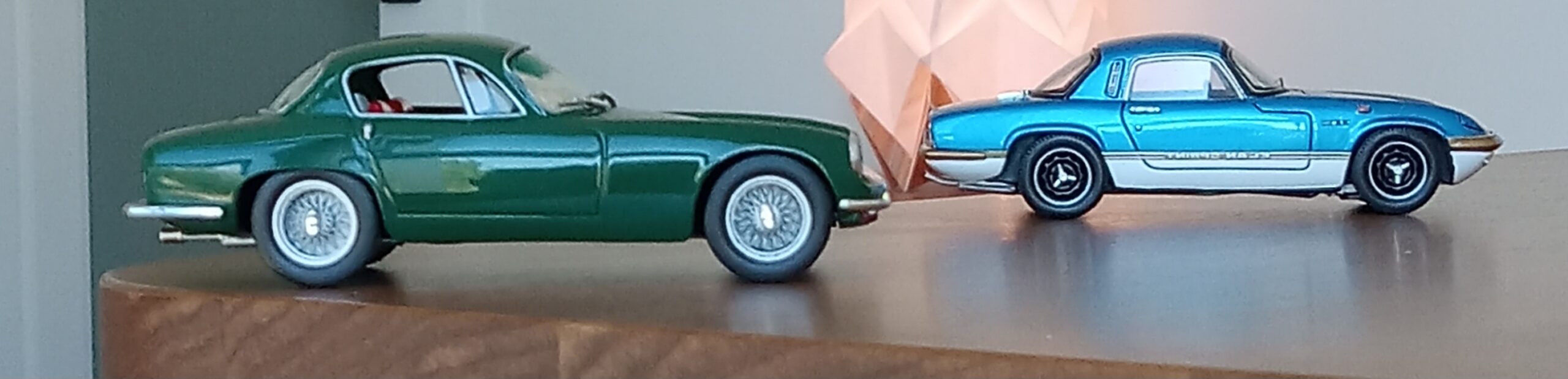
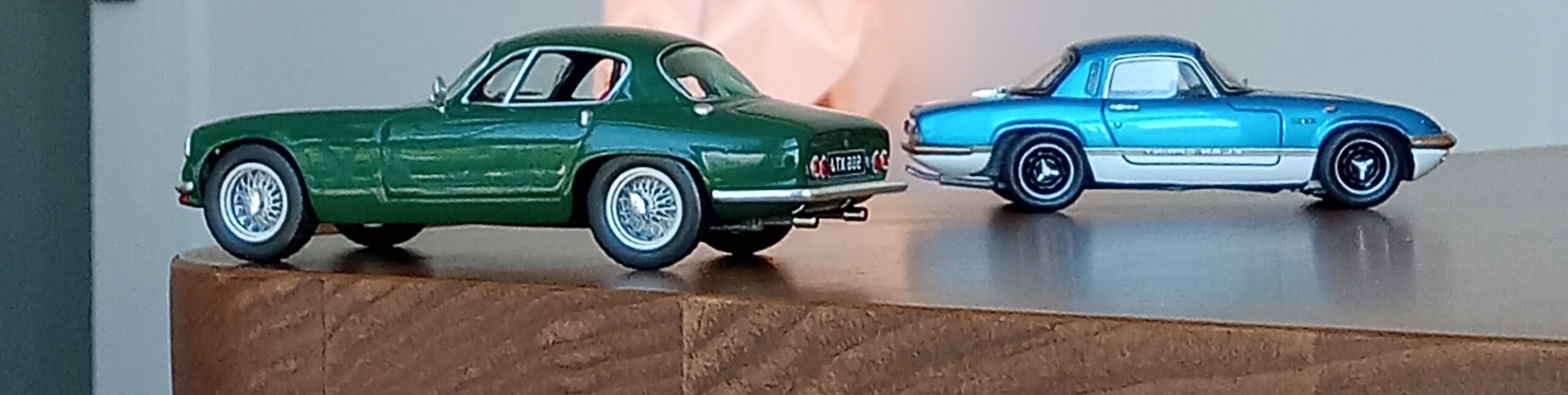
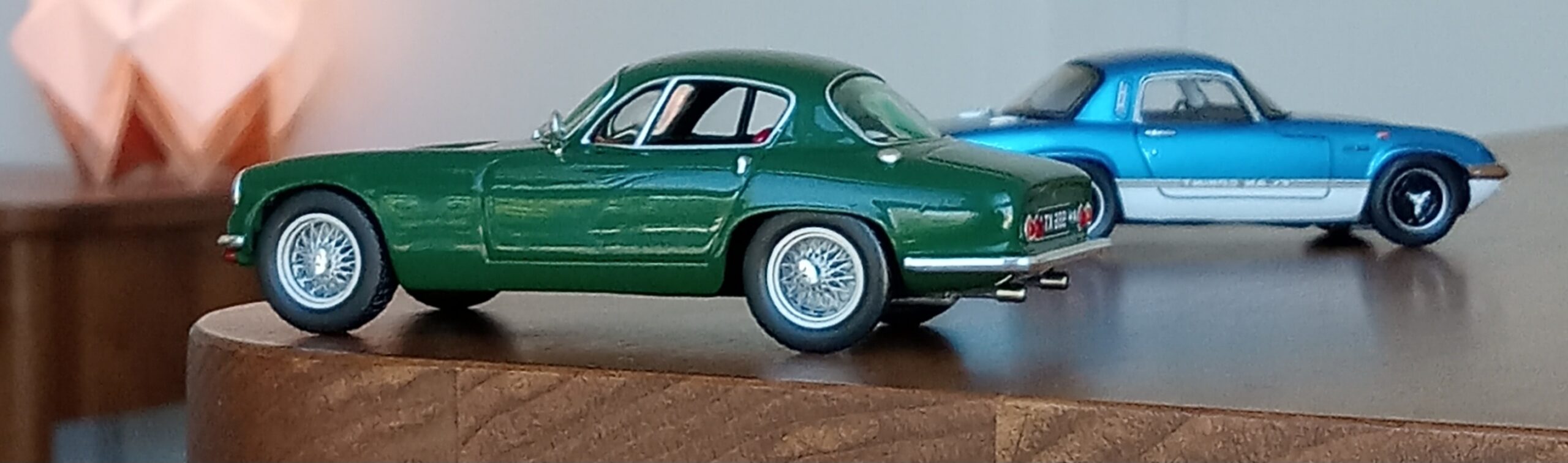
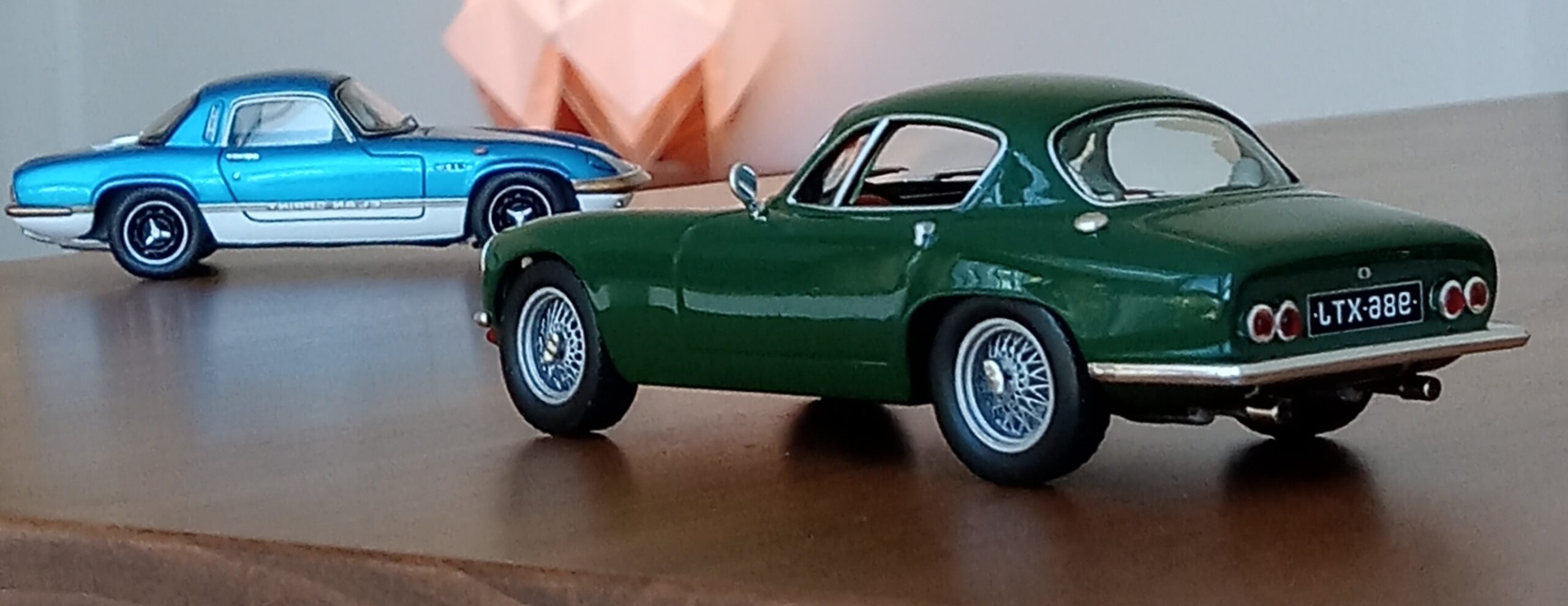
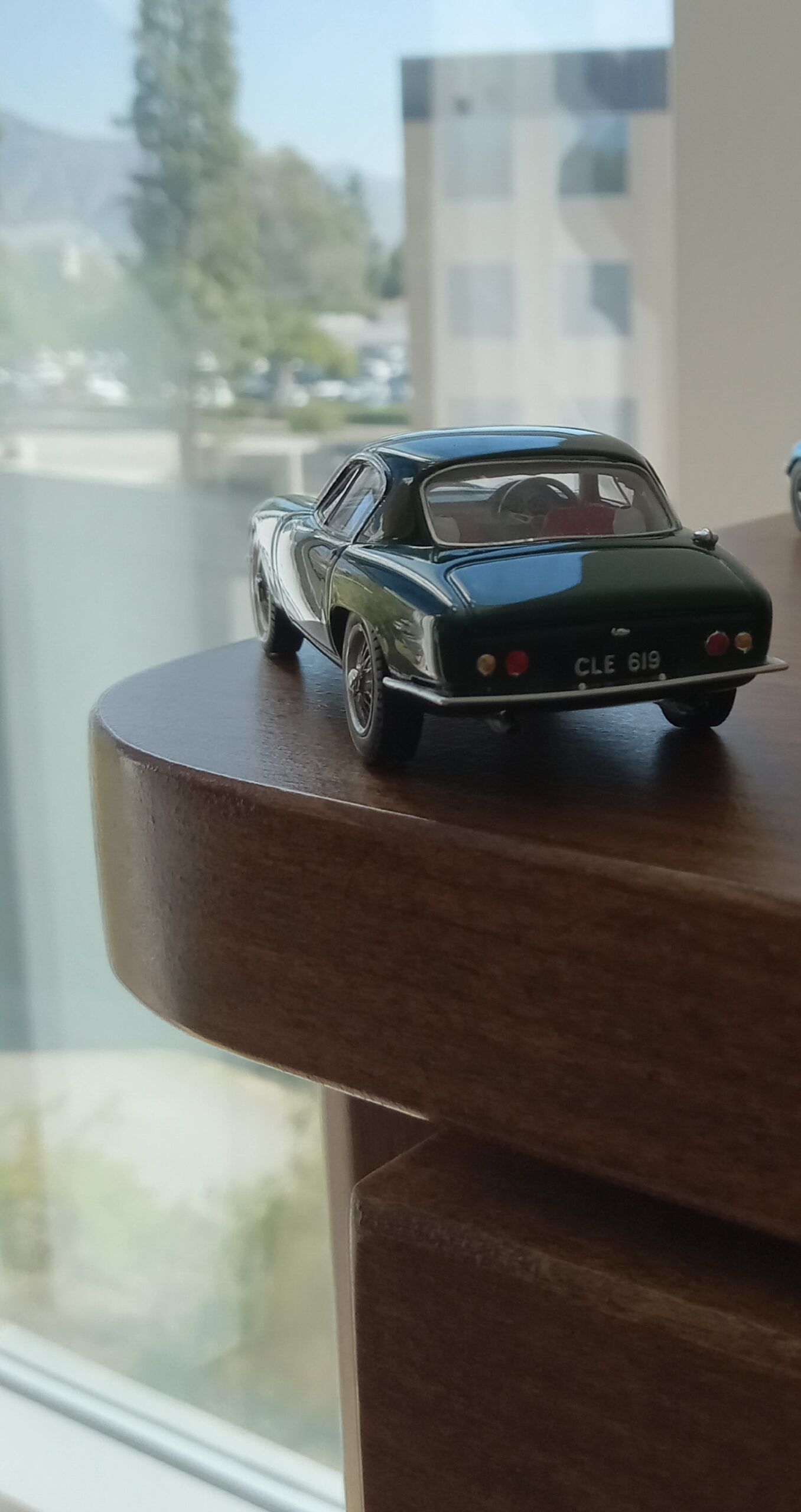
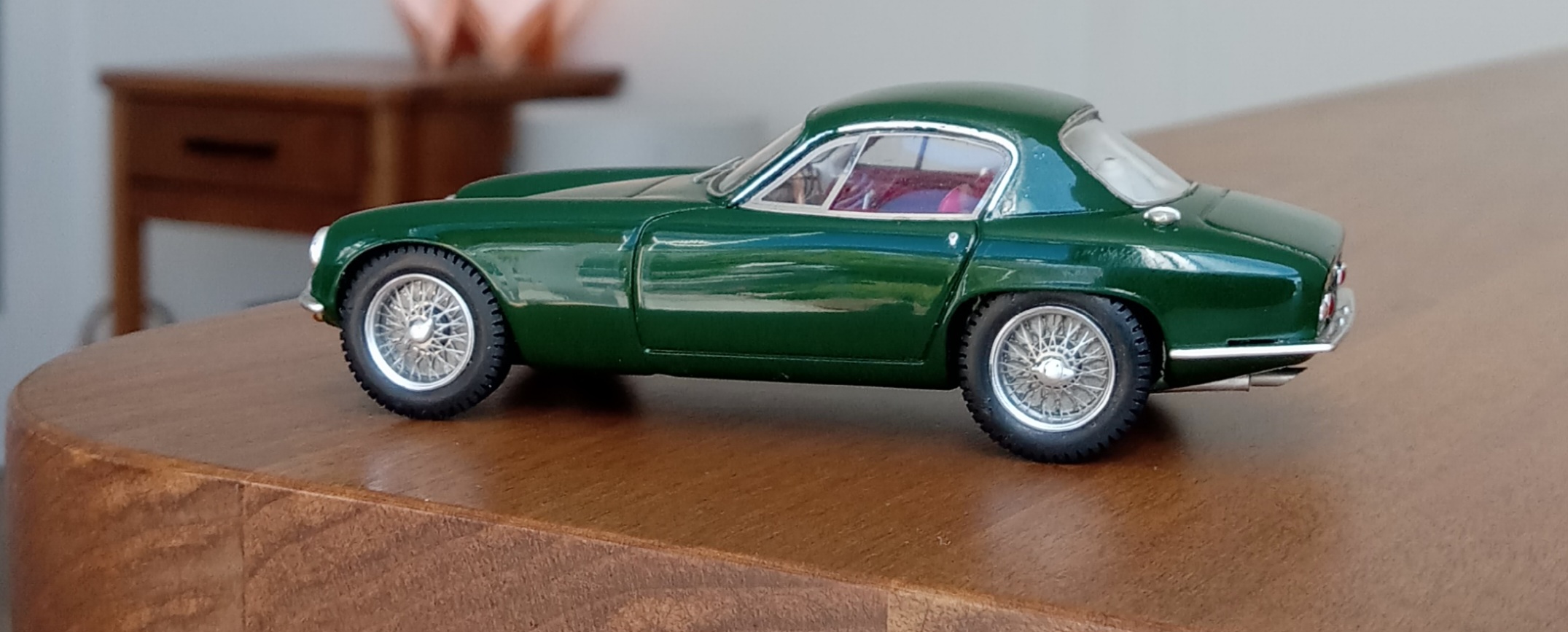
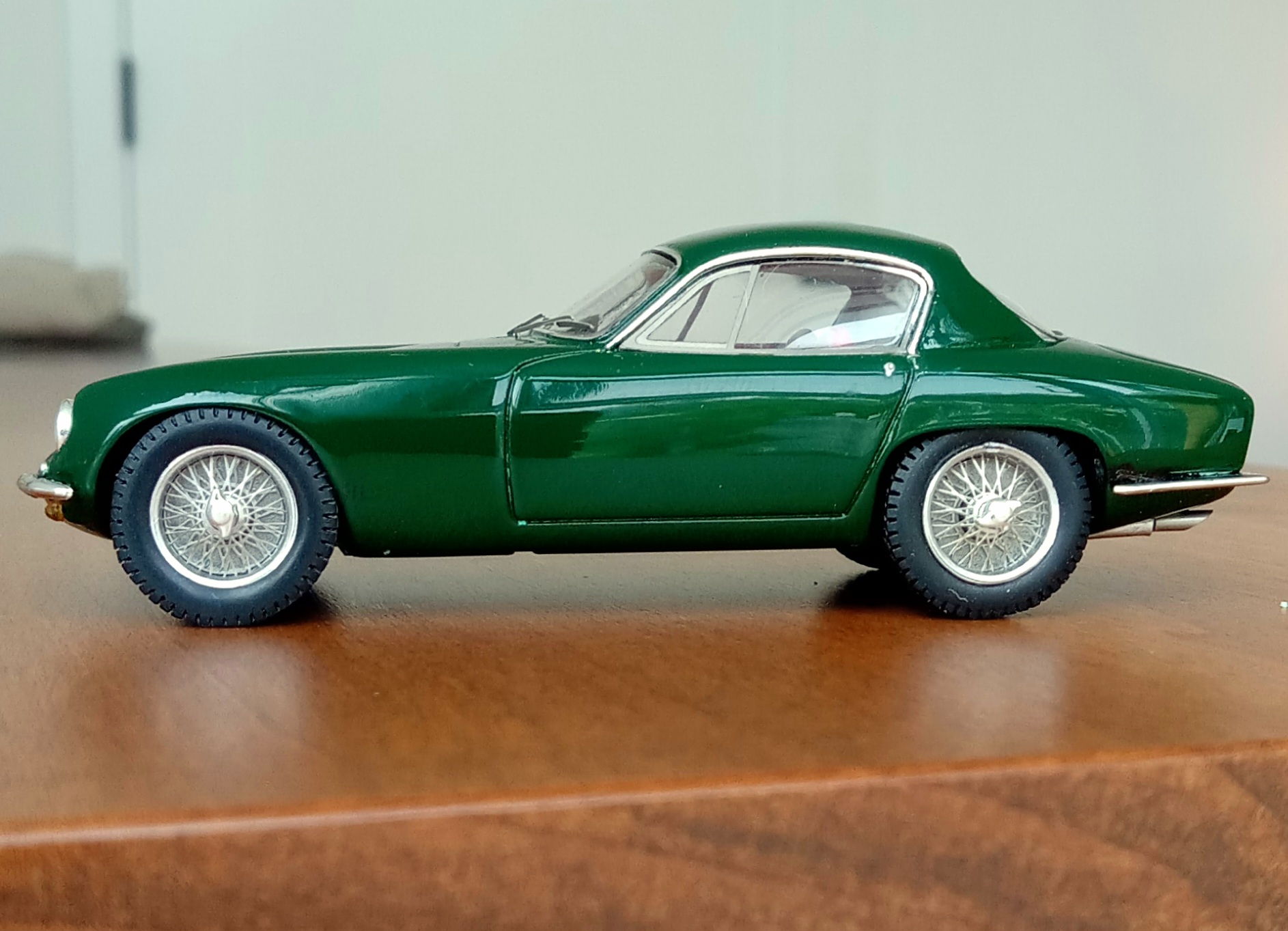
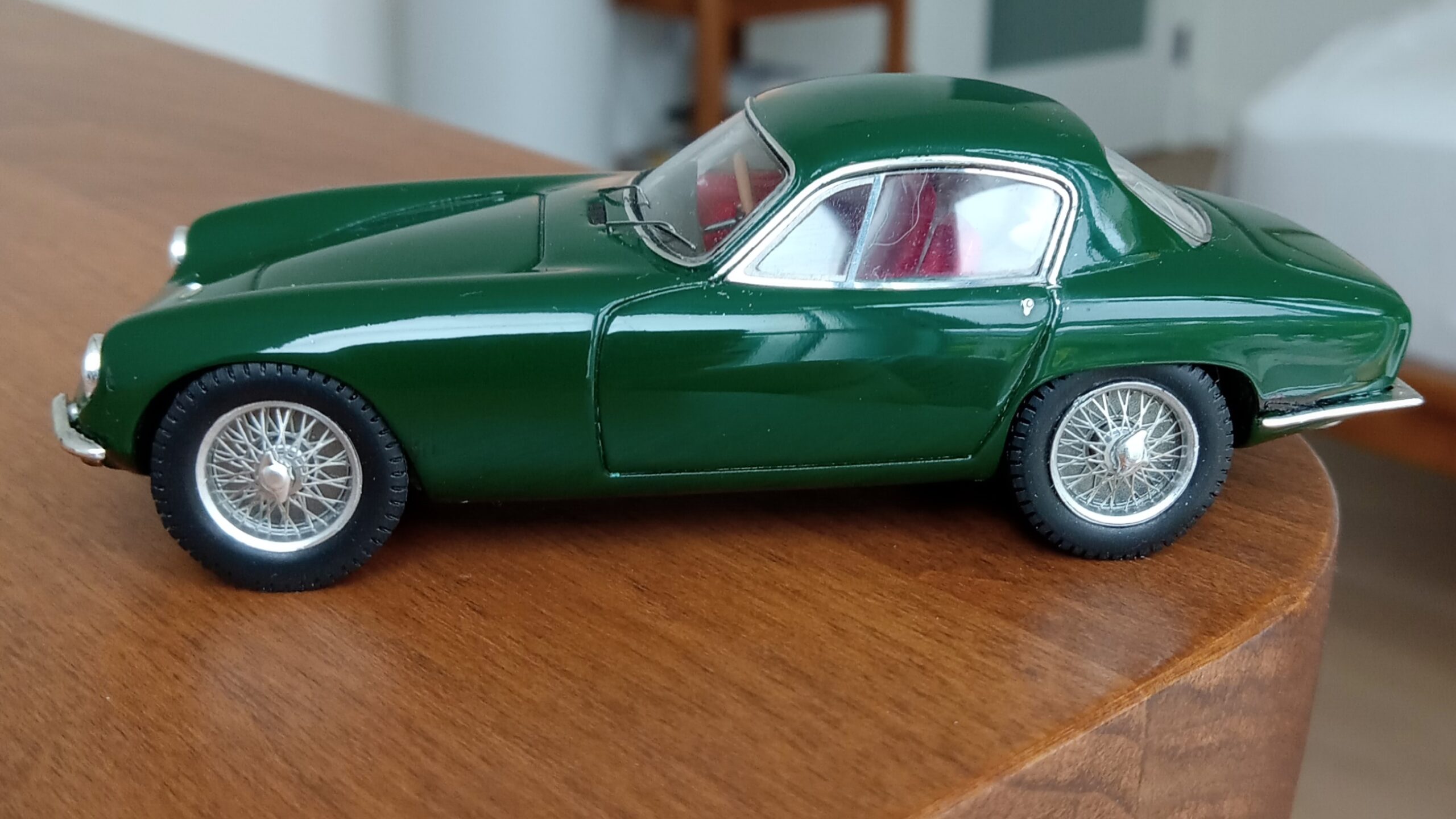
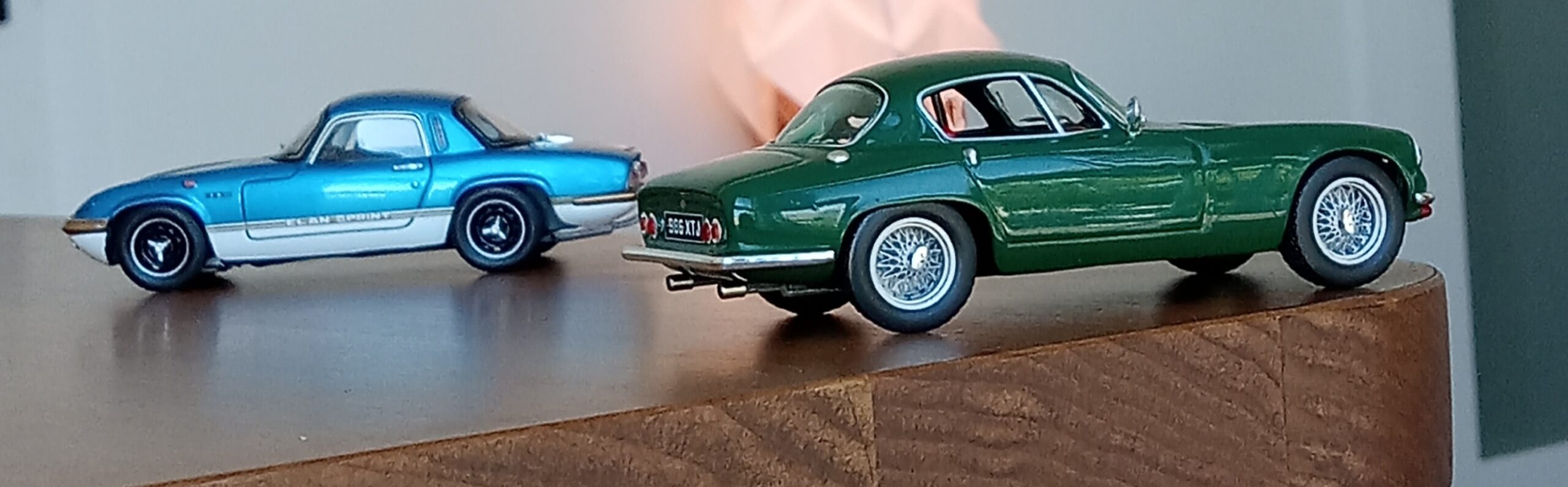 (写真撮影に使用したミニカー②:IXO社製、1/43ダイキャスト完成品、初代ロータス・エ ラン S1、1959(ブリティッシュ・レーシング・グリーン)ーーー改造箇所:ボディーを上下にばらして、タイヤ&ホイールのトラックと軸位置を微調整、当時の英国車独特のスタンスを半日かけて徹底再現)
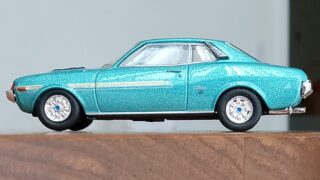
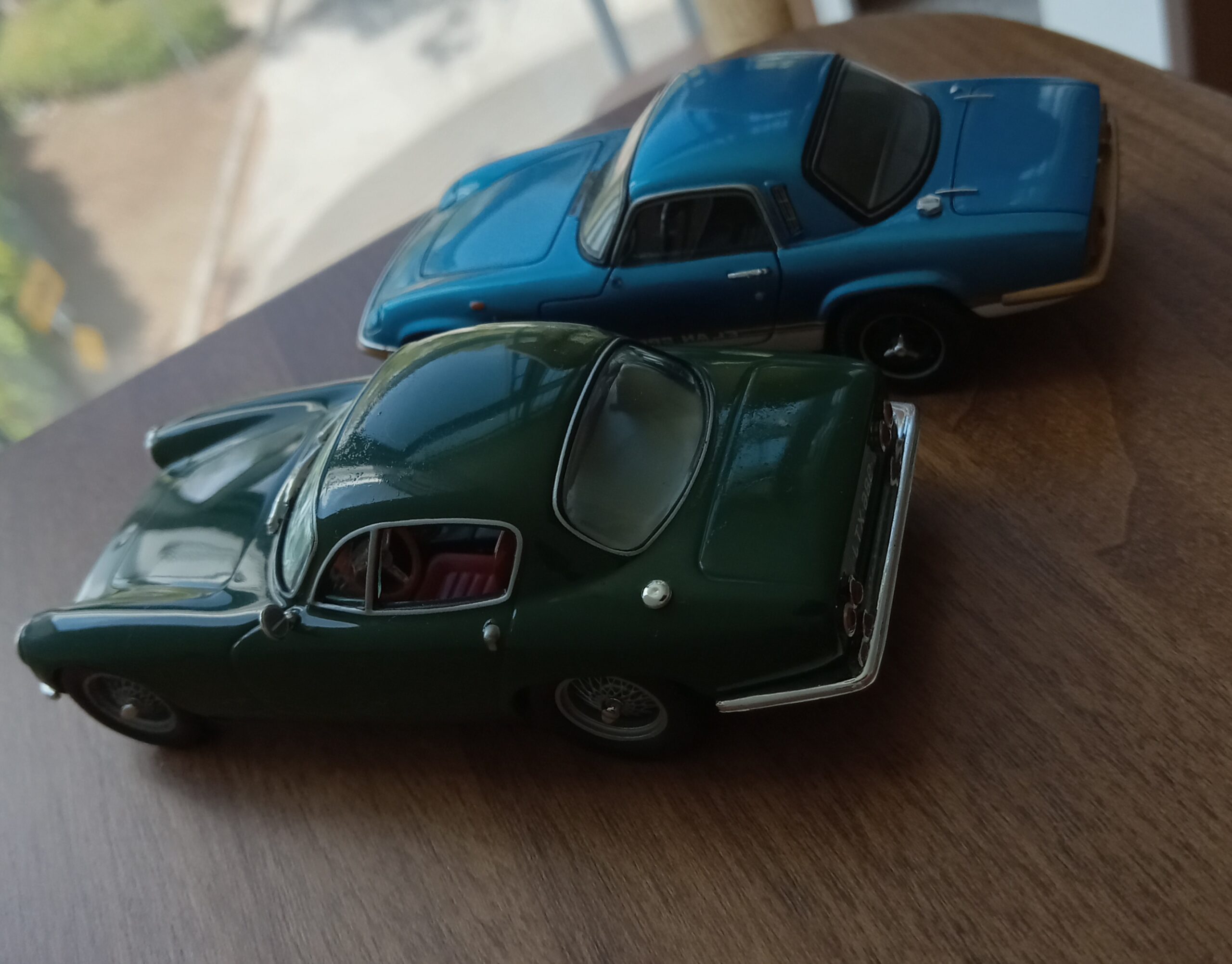
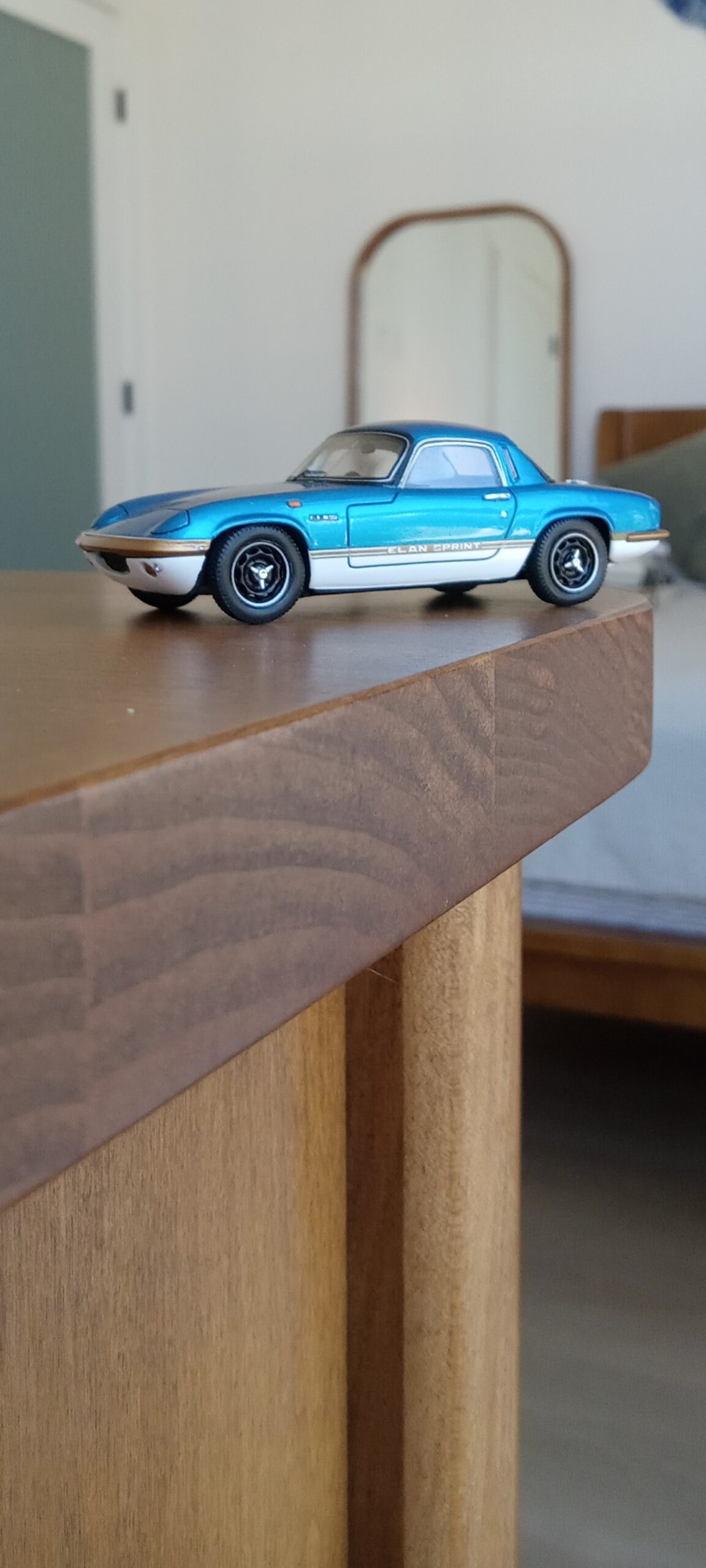
(写真撮影に使用したミニカー③:SPARK社製、1/43レジン完成品、ロータス・エラン S4 スプリント(メタリックブルー、白&金)---改造箇所:上下を分割後、タイヤ&ホイールのトラック最大化⁺前後軸位置を若干の前傾姿勢になるように微調整)
第53回目の今回は、『2ドアクーペの系譜、第33回』と題しまして、各国のお国柄や、外観デザインの個性が強く表れる、高級2ドア(GT)クーペ / ロードスターについてお話ししてみたいです。【注意:オープンカーを含む】
以下の要領で進めていきます。
第33回の今回はいよいよ
【英国車編②】001としまして、
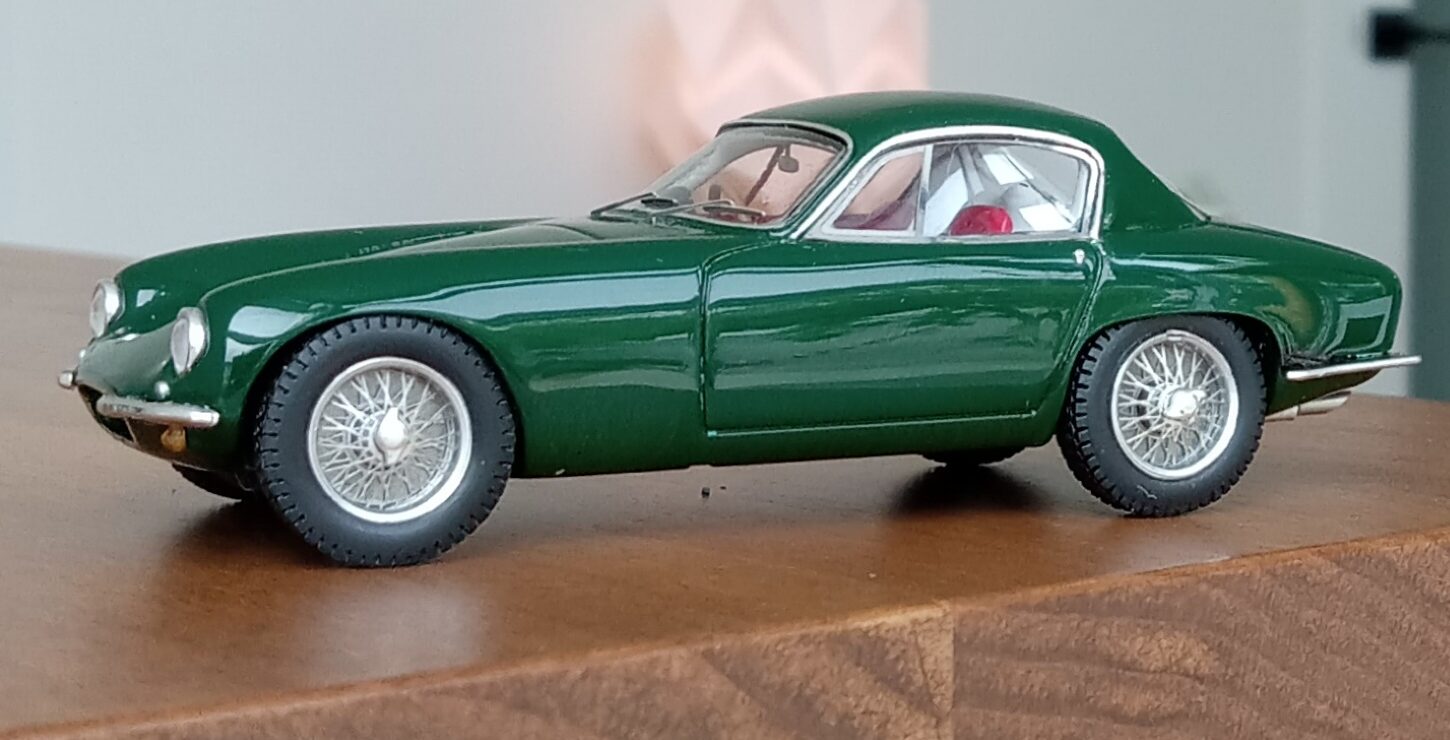 1958年発売の
ロータス・初代エリート(ブリティシュ・グリーン)
についてのお話です。
【2ドア・クーペの系譜:目次】
【米国車編】
第1回:キャデラック・エルミラージュ、2013(メタリック・レッド)
第2回:リンカーン・コンチネンタル MK4、1972(ブラック)
第3回:マーキュリー・クーガー, 1967(LTメタリック・グリーン)
【ドイツ車編】
第4回:MB 500K スペシャル・ロードスター、1936(ブラック)
第5回:MB 300SL ロードスター、1957(シルバー)
第6回:MB SLS AMR ガルウイング、2010(ブラック)
【英国車編】
第7回:マクラーレン・F1、1992(メタリック・オレンジ)
第8回:ジャガー・XKSS ロードスター、1957(ロイヤル・ブルー)
第9回:ジャガー XKR クーペ、1996(ダークメタリック・グリーン)
【日本車・ニッサン編】
第10回:ニッサン 初代シルビア、1965(シャンペン・ゴールド)
第11回:ニッサン 5代目シルビア、1988(LTメタリック・グリーン)
【イタリア車編】
第12回:フェラーリ 250TR ポンツーンフェンダー、1958(赤)
第13回:フェラーリ 250GTO、1962(イタリアン・レッド)
第14回:ランボルギーニ・コンセプトS、2005(パール・ホワイト)
【日本車・マツダ編】
第15回:マツダ コスモ・スポーツ、1968(レーシング・ホワイト)
第16回:マツダ ユーノス・コスモ、タイプ‐S(2トン:黒&グレー)
【フランス車編】
第17回:ブガッティ・タイプ59、1935(フレンチ・ブルー)
第18回:シトロエン・SM、1970(シャンペーン・ゴールド)
第19回:ブガッティ・ラ・ヴォワチュール・ノワール、2019(黒)
【日本車・トヨタ編】
第20回:トヨタ/ヤマハ・2000GT、1967(アイボリー・ホワイト)
第21回:トヨタ・2代目ソアラ、1986 (クリスタル・ホワイトⅡ)
第22回:レクサス LC500【GWZ100型】、2017(MT・レッド)
【米国車編②】
第23回:ダッジ・チャレンジャー、1970&プリムス・バラクーダ、1971
第24回:ダッジ・ヴァイパー SRT‐10 ACR、 2008(ブラック)
第25回:フォード・シェルビーGR-1 コンセプト、2004(クローム)
【日本車・ミツビシ編】
第26回:ミツビシ・ギャラン λ、1976(ブラウン・メタリック)
第27回:ミツビシ・エクリプス【北米仕様】、2006(オレンジ・メタ)
【ドイツ車編②】
第28回:BMW M635CSi、1984 (ダーク・メタリックブルー)
第29回:MB 560SEC AMG 6.0 ワイドボディー、1989(ブラック)
第30回:BMW M2 純正パフォーマンス・パーツ仕様、2025(ネオン・ライム)
第31回:初代アウディー・TT、1998(レイク・シルバー・メタリック)
【日本車・スバル編】
第32回:スバル・クロストレック XV, 2012(ライムグリーン・メタリック】
【英国車編②】
第33回:ロータス・初代エリート, 1958(ブリティシュR・グリーン)
第34回:ロータス・エラン S4 スプリント(2トン:ブルー、ホワイト&金)
第35回:ジャガー・Eタイプ ロードスター(ライトブルー・メタリック)
【日本車:ホンダ(軽量スポーツ編)】
第36回:ホンダ S800、1966(レッド)
第37回:ホンダ 初代CR-X 1.5i、1983(ブルー&シルバー2トン)
第38回:ホンダ ビート、1991(サンバ・イエロー)
【イタリア車編➁】
第39回:ランチア ガンマ・クーペ、1976(グリジオ・アージェント(銀))
第40回:マセラティ― メラク SS、1975(ブルー・セーラ・メタリック)
第41回:フェラーリ ラ・フェラーリ、2013(ロッソ・コルサ(赤))
【日本車:トヨタ編②】
第39回:トヨタ コロナ・ハードトップ 1800GT-TR、1982 (レッド)
第40回:トヨタ GRスープラ 【DB型・A90/A91】 (シルバー)
第41回:トヨタ GR GT, 2027【予定】(ガンメタル系)
【米国車③番外編】:コルベットの系譜
第1回:1967年型 スティングレー【C2】コンバーチブル(ハードトップ・メタ青)
第2回:1972年型 コルベット 【C3】コンバーチブル(メタリック・ブルー)
第3回:1984年型 コルベット 【C4】クーペ(ブライト・レッド)
第4回:コルベット・インディー、1986【ミッド・シップの先行開発車】(シルバー)
第5回:スティングレー・コンセプト【先行開発車】、2009(プルー・メタリック)

#コーリン・チャップマンの夢:ブリティッシュ・ライトウエイト・スポーツの元祖!

 n
N
N
N
N
N
N
N
N
N
N
N
n
N
N
N
N
N
N
N
N
N
N
N
n
N
N
N
N
N
N
N
N
N
N
N
n
自称:【立体造形フェチ】の私が最も長きにわたり、
その『美しさの秘密』を解き明かしたいと思い、
*ホワイトメタル・キットや、
*クラシックカー博物館、
*コンコー・ド・エレガンス【ビンテージ・カー展示会】、
*図鑑、ネットやウエブサイトで散見する写真など、
あらゆる媒体を通じて、
『あーでもない、こーでもない』と、独り言ち
研究してきた車です。(笑)
今回いよいよ、
この車に切り込めることとなり、
武者震いしております。嬉

それでは、
天才設計者、コーリンチャップマンの傑作:
『超軽量クーペ』に付いての記事は、
こんな要領で進めて行きたいです。
*実車解説:ファイバーグラス製ーーー>『美の極致』
*外観デザインの特徴:空力追求の先ーーー>有機面
*『私』と初代ロータス・エリート:付かず離れずの30年
*三題噺:超軽量・トヨタ2000GT・有機面
*その他の英国産、『軽量スポーツカー』たち、、、
*実車解説:ファイバーグラス製ーー>『美の極致』

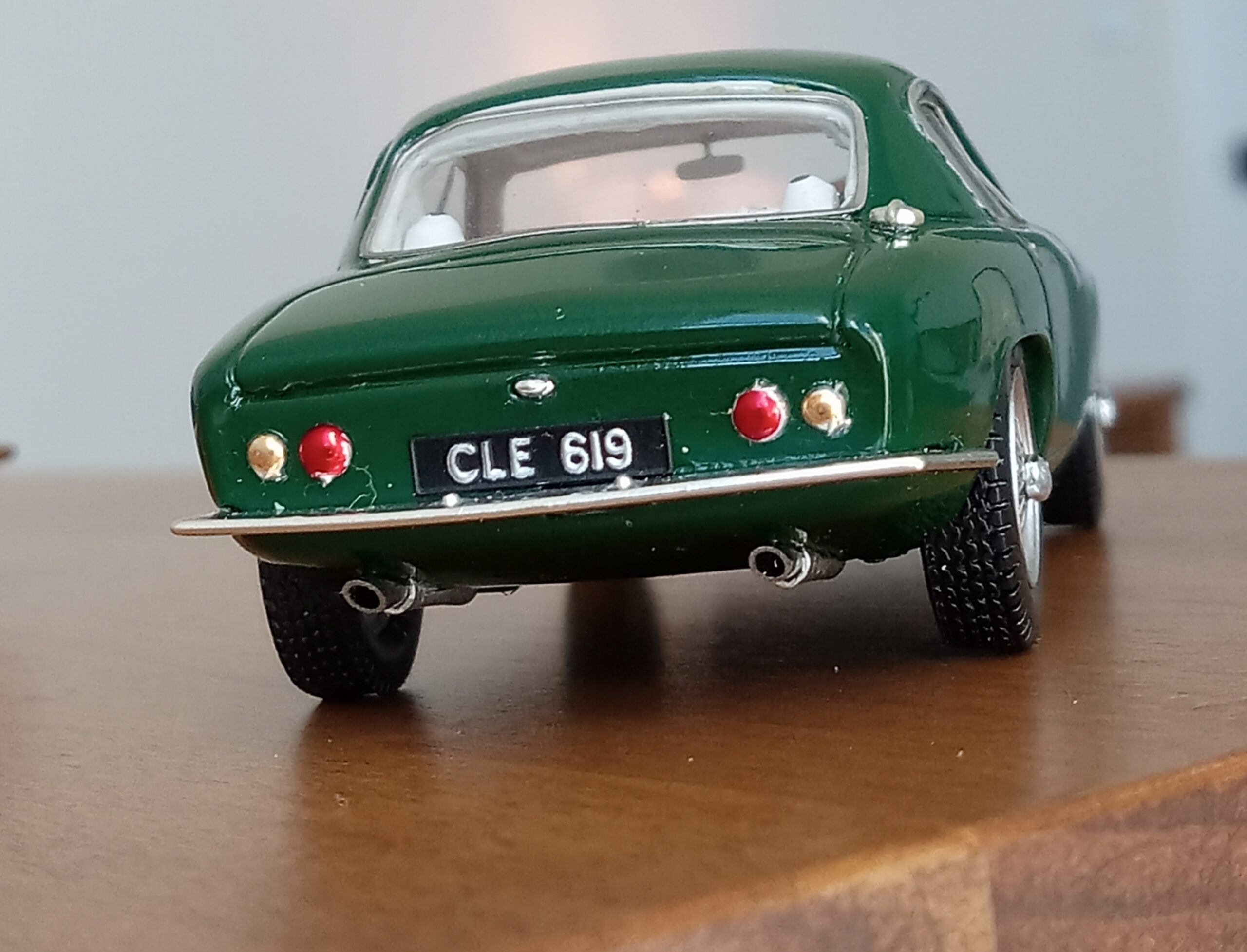
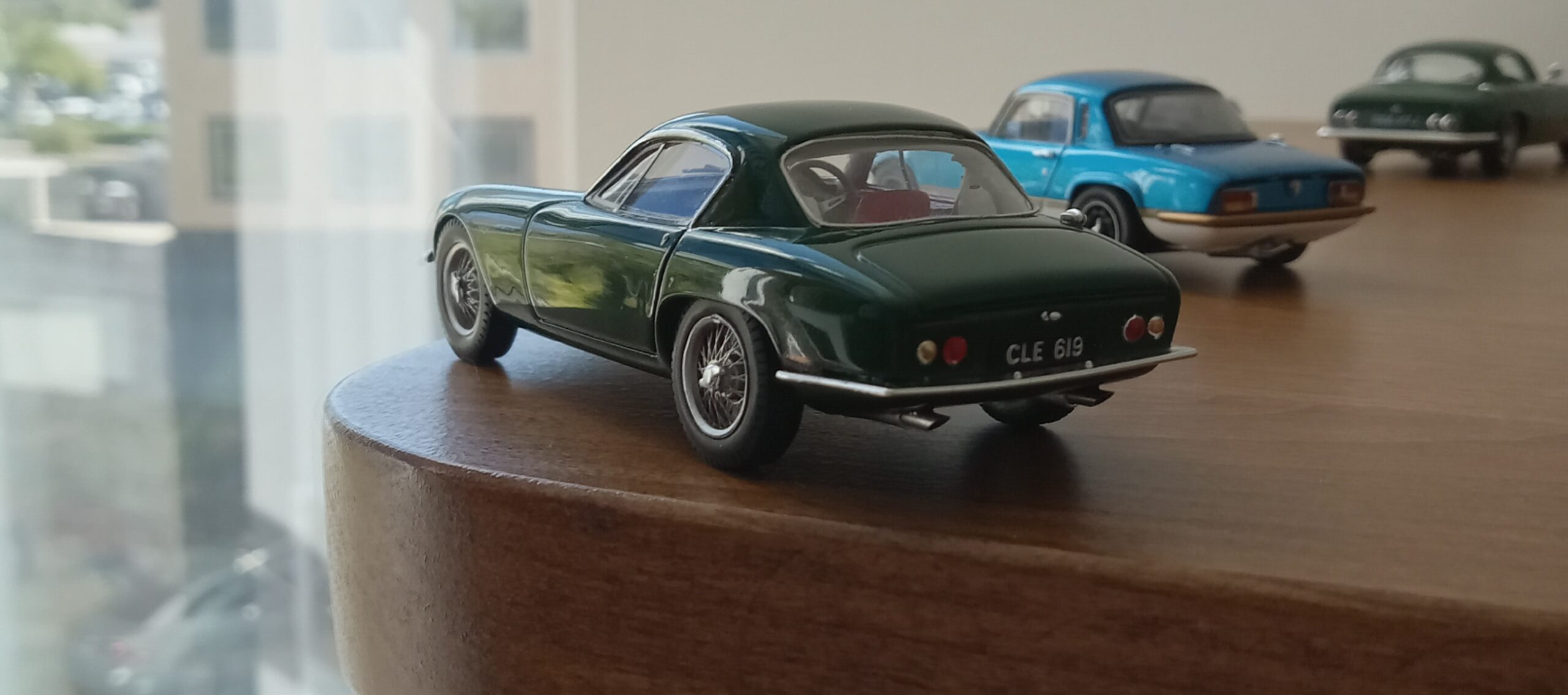
概要:
n
ロータス・初代エリート(1959年)は、天才技術者コーリン・チャップマンの「軽さこそ正義」という哲学を極限まで具現化した、軽量FRスポーツカーの偉大なる元祖です。
n
本稿では、自動車史に今なお燦然と輝くこの傑作について、メカニズムの革新性と外観デザインの美学、そして後世の名車たちに与えた計り知れない影響をデザイナーの視点から解き明かします。
n
n


 n
N
N
N
N
N
N
N
N
N
N
N
n
N
N
N
N
N
N
N
N
N
N
N
n
N
N
N
N
N
N
N
N
N
N
N
n
N
N
N
N
N
N
N
N
N
N
Nn
N
N
N
N
N
N
N
N
N
N
Nn
N
N
N
N
N
N
N
N
N
N
N
n
n
n
N
n
n
n
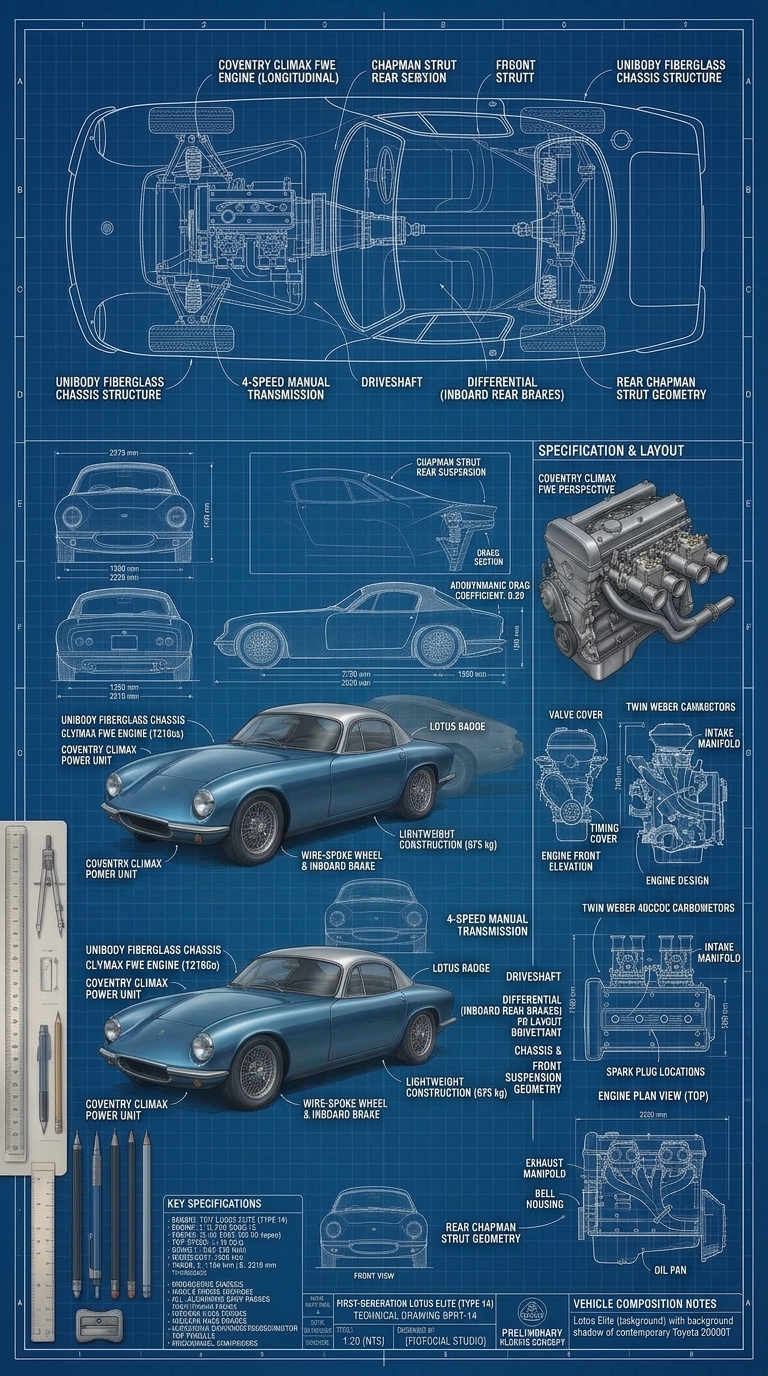
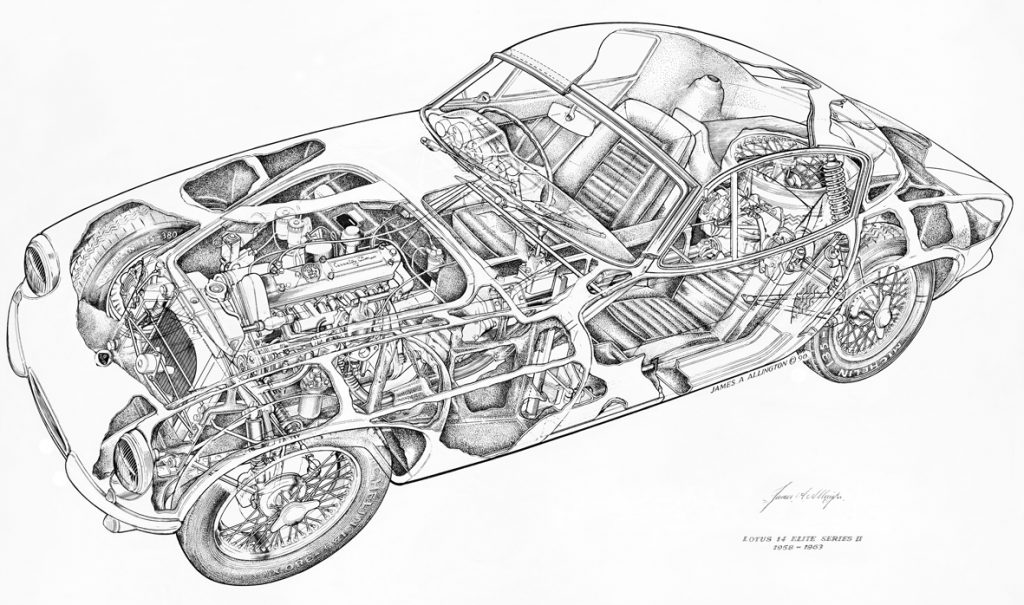
- 構造と機能の一体化: フロントサスペンションの取付部や、エンジンマウントの極一部にスチール製のサブフレームが埋め込まれている以外、応力を受ける構造体のほぼ全てがFRPで作られています。これは「1つの部品に複数の役割を持たせる」というチャップマンのミニマリズムの極致であり、結果として車重わずか約500kg強という驚異的な軽さを達成しました。
- パワー・ウェイト・レシオの思想: 搭載されたコヴェントリー・クライマックス製1.2L直列4気筒「FWE」エンジンは、当初75馬力(後に高性能版も登場)と控えめな数値でした。しかし、圧倒的な軽さのおかげで、当時の大排気量スポーツカーをサーキットでカモにするほどの俊敏性と、極上のハンドリング性能を手に入れたのです。
n
n
n

n
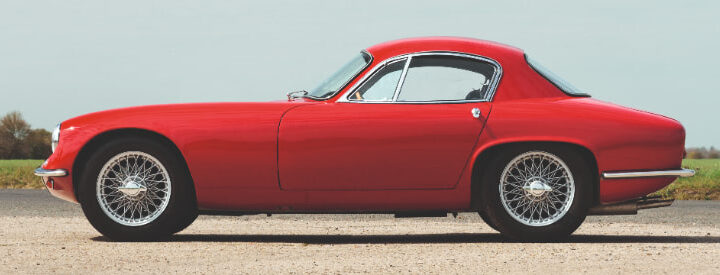
初代エリートのエクステリアは、ピーター・キルワン・テイラー(本職は会計士でありながら非凡なセンスを持っていた)が基本スケールを描き、後に高名なコスト・エンジニアであるフランク・コスティン(空力専門家)らがリファインしました。その造形は、現代のデザイナーが見ても非の打ち所がないほど完璧なプロポーションを誇ります。
- 引き締まったFRプロポーション: ロングノーズ・ショートデッキというFRスポーツの王道を征きながら、全体のボリュームは驚くほどコンパクトです。FRP成形の自由度を活かした、一切の無駄な肉がないアスリートのような有機的な曲面で構成されています。
- 卓越した空力マネジメント: フロントの開口部は最小限に抑えられ、低く滑らかなボンネットフードから美しく傾斜するフロントガラスへと空気を流します。ルーフからリアエンドにかけては、流れるようなファストバックスタイルを採用。この時代にしてCd値(空気抵抗係数)0.29という、現代の最新エコカーにも匹敵する驚異的な空力性能を達成しています。
- ディテールの洗練: バンパーや過度なクローム飾りのような「装飾のための装飾」を排し、彫刻的な美しさだけで勝負しています。FRPの特性上、パネルの分割ライン(パーティングライン)を最小限に抑えられたことも、この車の一体感とクリーンな美しさを強調する要因となっています。
n
N
n
n
n
n
n
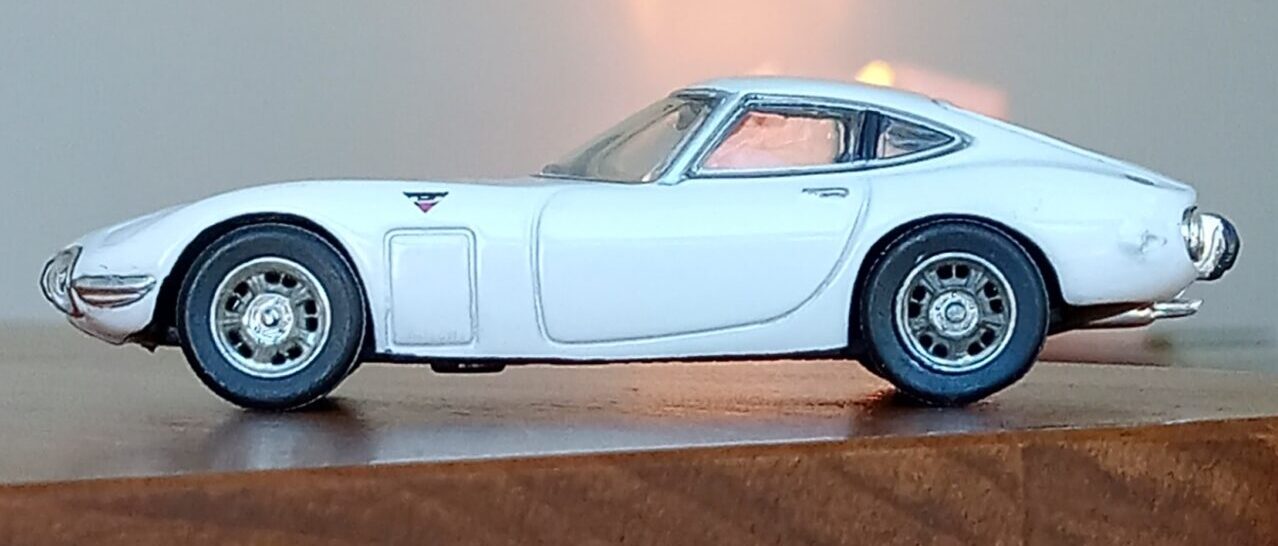
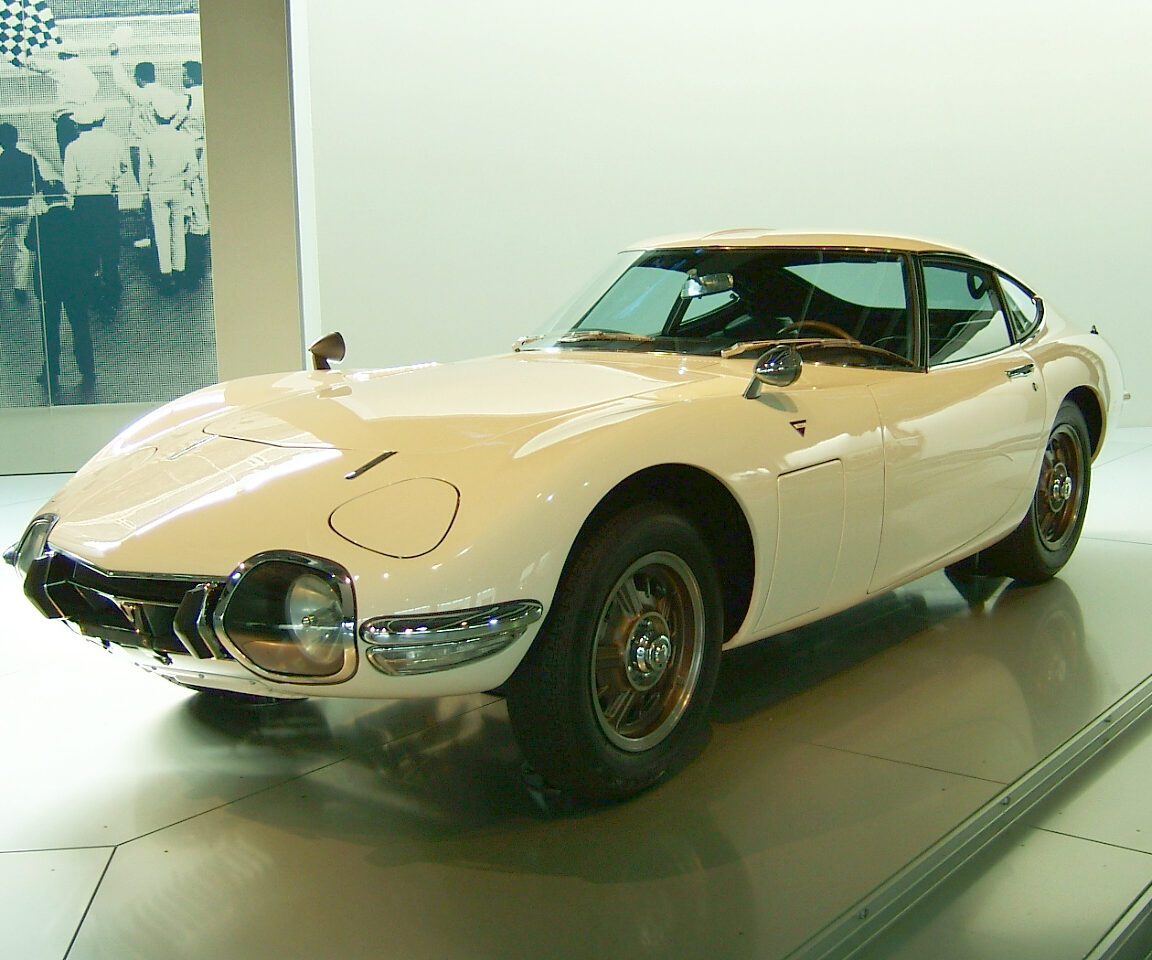
② トヨタ2000GTへの美学的影響
n
n
 n
N
N
N
N
N
N
N
N
N
N
Nn
N
N
N
N
N
N
n
n
極限まで低く構えたボンネット、フロントフェンダーからドア、そしてリアフェンダーへと滑らかにうねるコークボトルライン、コンパクトに絞り込まれたキャビンとファストバックのリアエンド。これらトヨタ2000GTが持つ「情緒的で緊密な美しさ」の本質は、エリートが提示した空力と美学の融合に対する、日本からの最高峰のアンサーであったとデザイナーの目からは映ります。
n
N:
n
n
N
#こぼれ話:
ロータス・初代エリートを語る上で、「FRP製造上の課題(技術的限界)が、結果として唯一無二の洗練されたデザインを生み出した」という歪みのない事実は、デザイナーにとって最もエキサイティングなストーリーです。
n
n
n
N
- デザインへの影響:
デザイナーとエンジニアは、ボディから一切の「鋭いエッジ」と「広い平面」を排除しました。応力を均等に分散させ、かつ面としての剛性を高めるために、すべてのパネルを張りのある有機的な3次元曲面(ダブルカーブ)で構成したのです。
フロントフェンダーからドア、リアへと流れる緊密で肉感的なコークボトルラインや、バルジ(膨らみ)を持たせたボンネットは、単なる審美的な理由ではなく、「FRPを割れにくくし、強度を持たせるための構造的必然」から生まれた造形です。
n
N
- デザインへの影響:
N
- デザインへの影響:
彼らはこの継ぎ目を隠すのではなく、デザインの主役(キャラクターライン)へと昇華させました。ボディサイドを水平に走る細いプレスライン状の造形は、実は上下のFRP型を結合した際のリップ(フランジ)部分を滑らかに削り落として整形した跡です。
結果として、現代の車のような「複数のパネルが組み合わさったメカっぽさ」とは無縁の、ひとつの塊から削り出されたような彫刻的一体感(シームレス・ルック)が誕生しました。
n
N
n
- デザインへの影響:
n
n
- デザインへの影響:
エリートのボディ下部(サイドシルまわり)や前後エンドが、内側へ過度に巻き込まず、スッと下に向かって美しく収束しているのは、型からスムーズに引き抜くための「抜き勾配」を計算し尽くしているからです。
この制約により、余計な凹凸や複雑な段差を作ることが物理的に不可能となり、結果として極めてクリーンで、どこから見ても視線が引っかからない流麗なシルエットが強制的に導き出されることになりました。
n
N
n
- デザインへの影響:
n
n
n
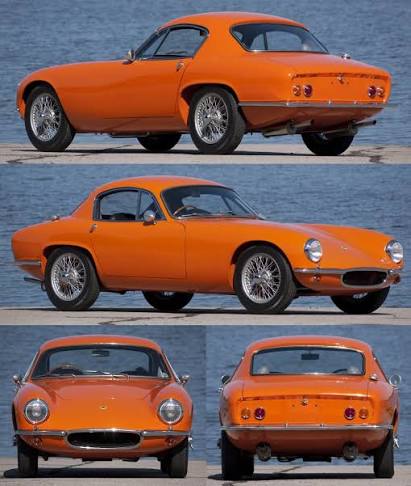
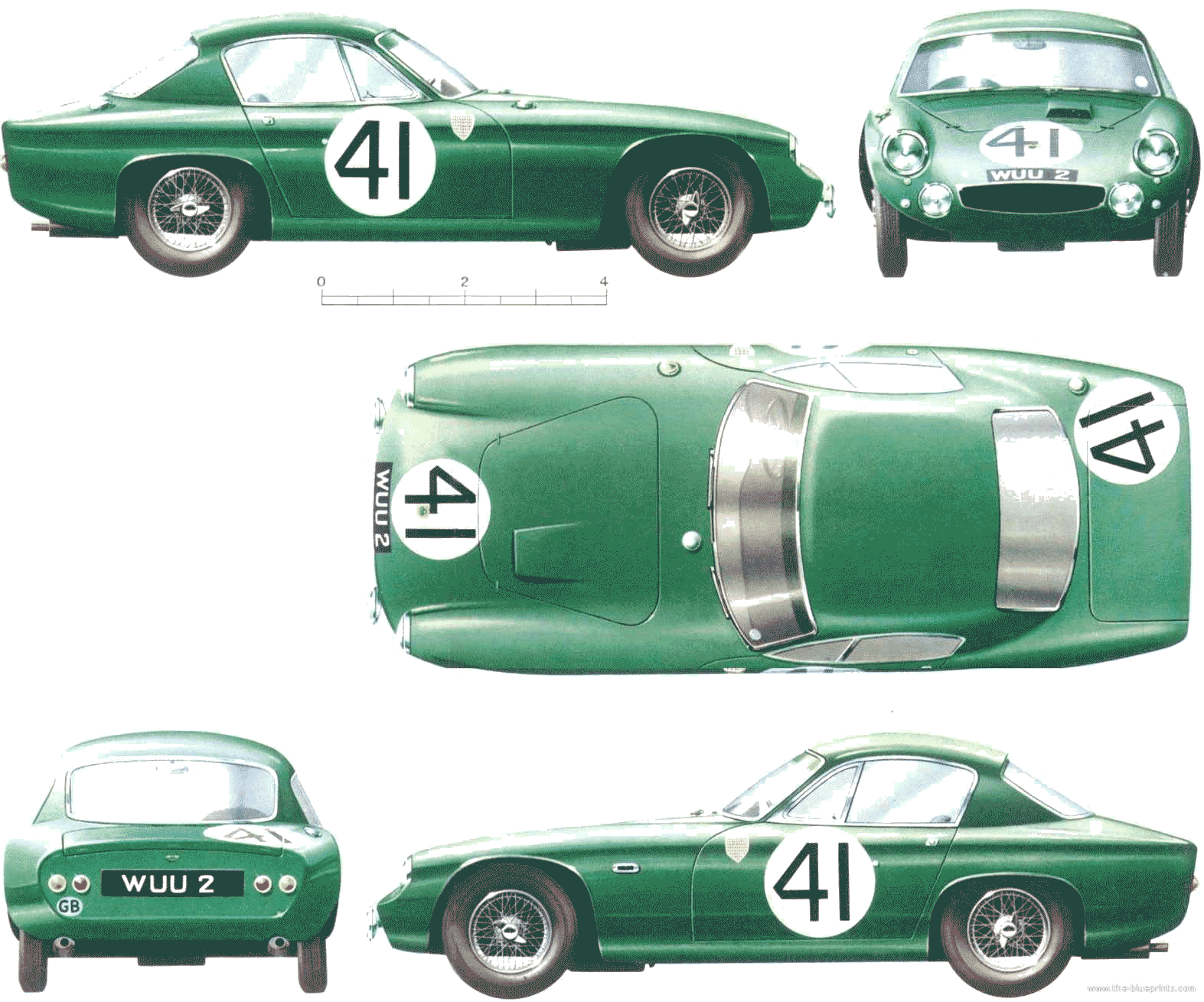
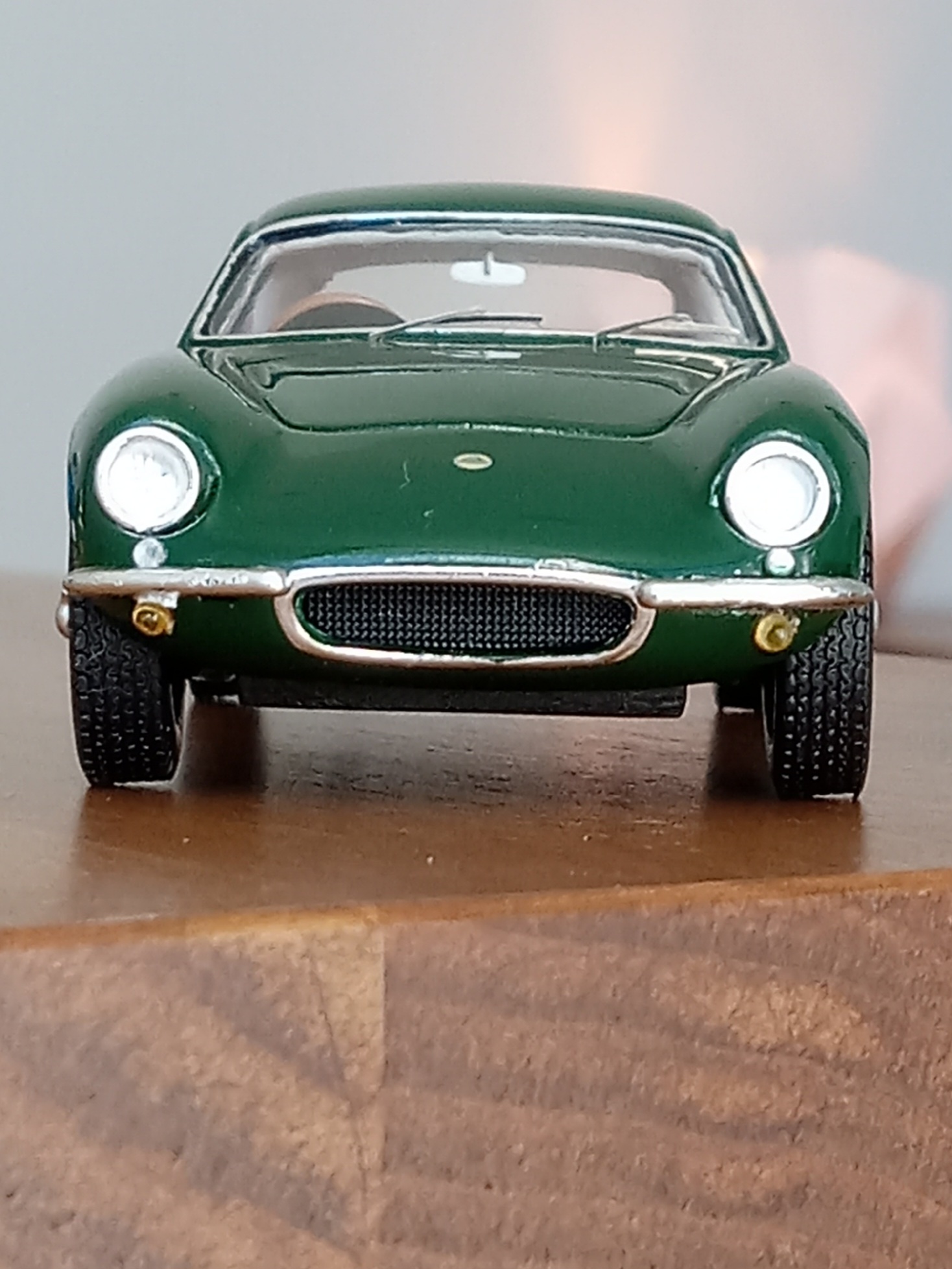
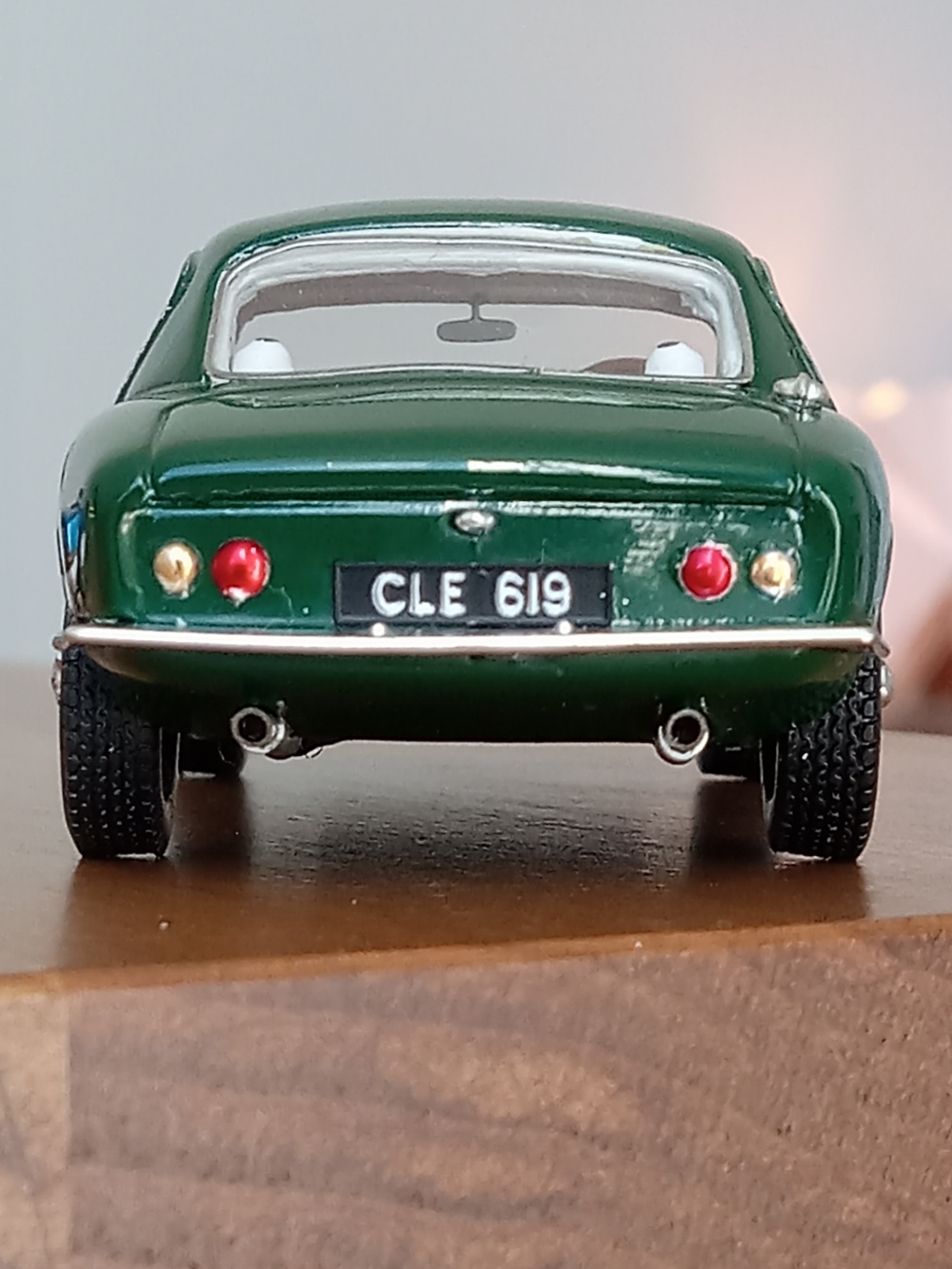
#三面写真:
#主要諸元:
- 型式:コヴェントリー・クライマックス FWE
- 総排気量: 1,261cc(直列6気筒 DOHC)
- 燃料供給 : SU キャブレター(標準はシングルまたはツイン)
- 最高出力 : 72 hp (75 PS) / 6,100 rpm
(※標準仕様。チューンにより異なり、のちのSE仕様等は85〜95hp)
- 最大トルク:104 Nm (10.6 kgm) / 3,750 rpm
- 駆動方式:FR(フロントエンジン、リアドライブ)
- 定員:2名
- 車体形式:2ドア 固定ヘッド クーペ(2人乗り)
- 空気抵抗係数 (Cd値): 0.29
- 最高速度: 180 km/h (112 mph)
- ホイールベース:2,235 mm
- 全長:3,708 mm
- 全幅:1,499 mm
- 全高:1,168 mm
- 車両重量:
約 504 kg 〜 506 kg
*外観デザインの特徴:空力追求の結果生まれた、美しい有機面
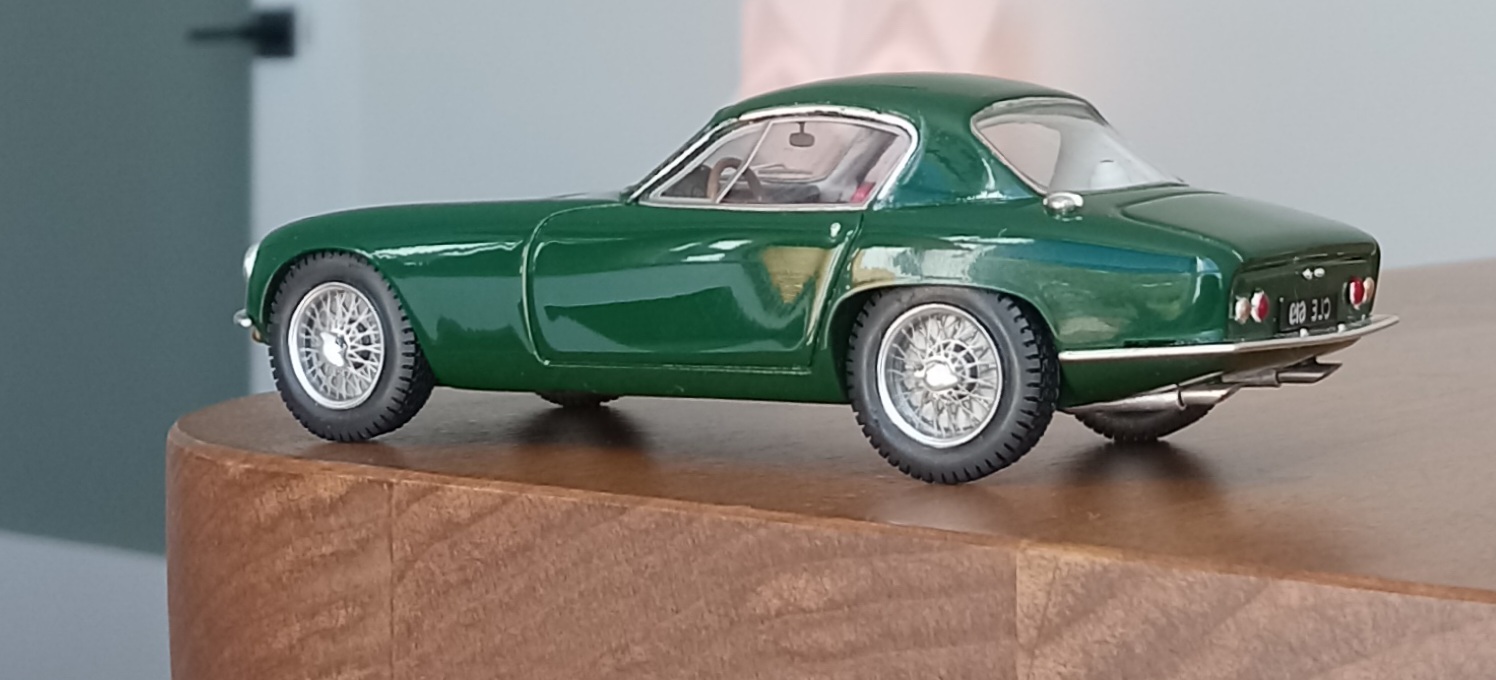
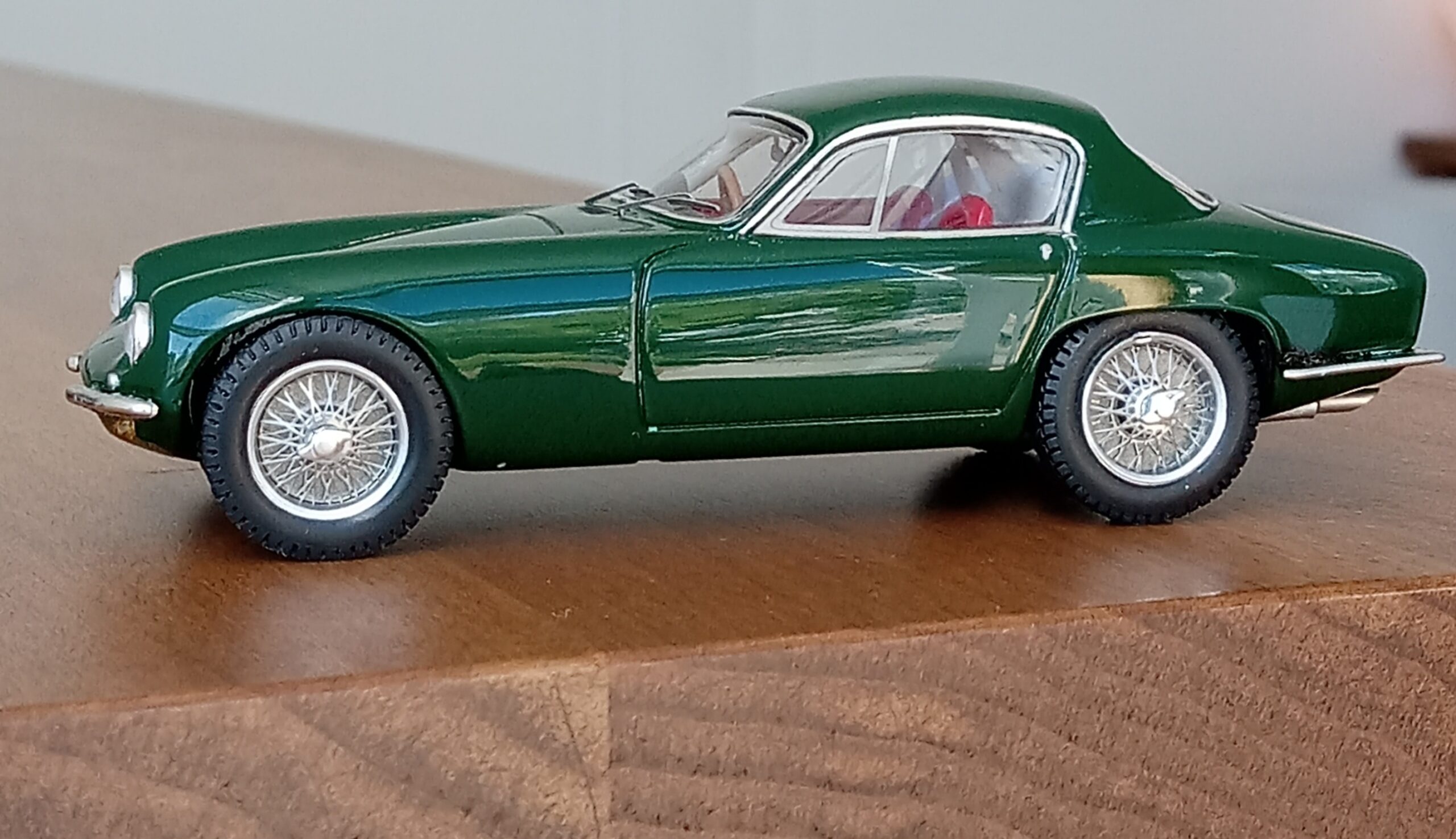
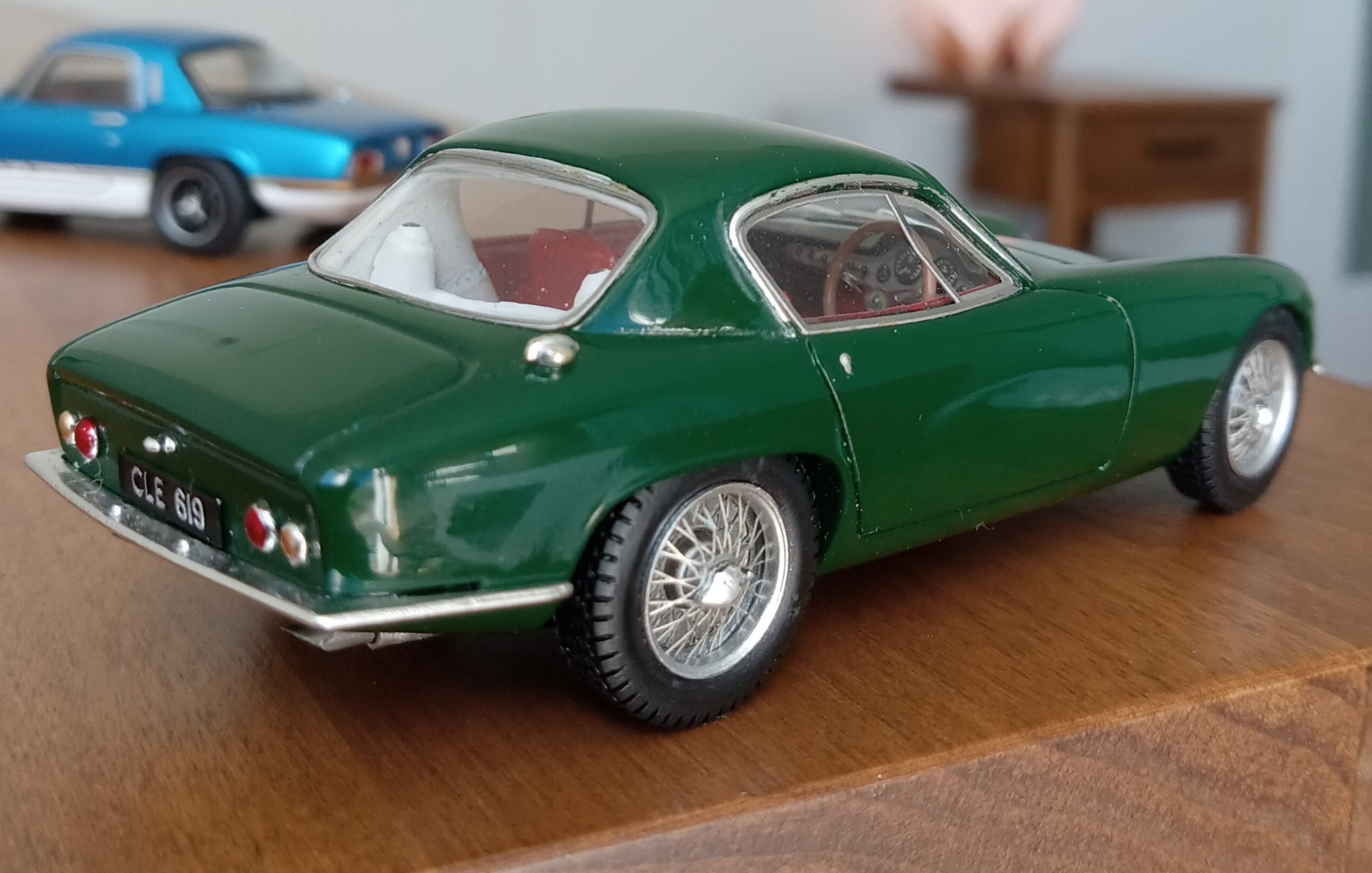
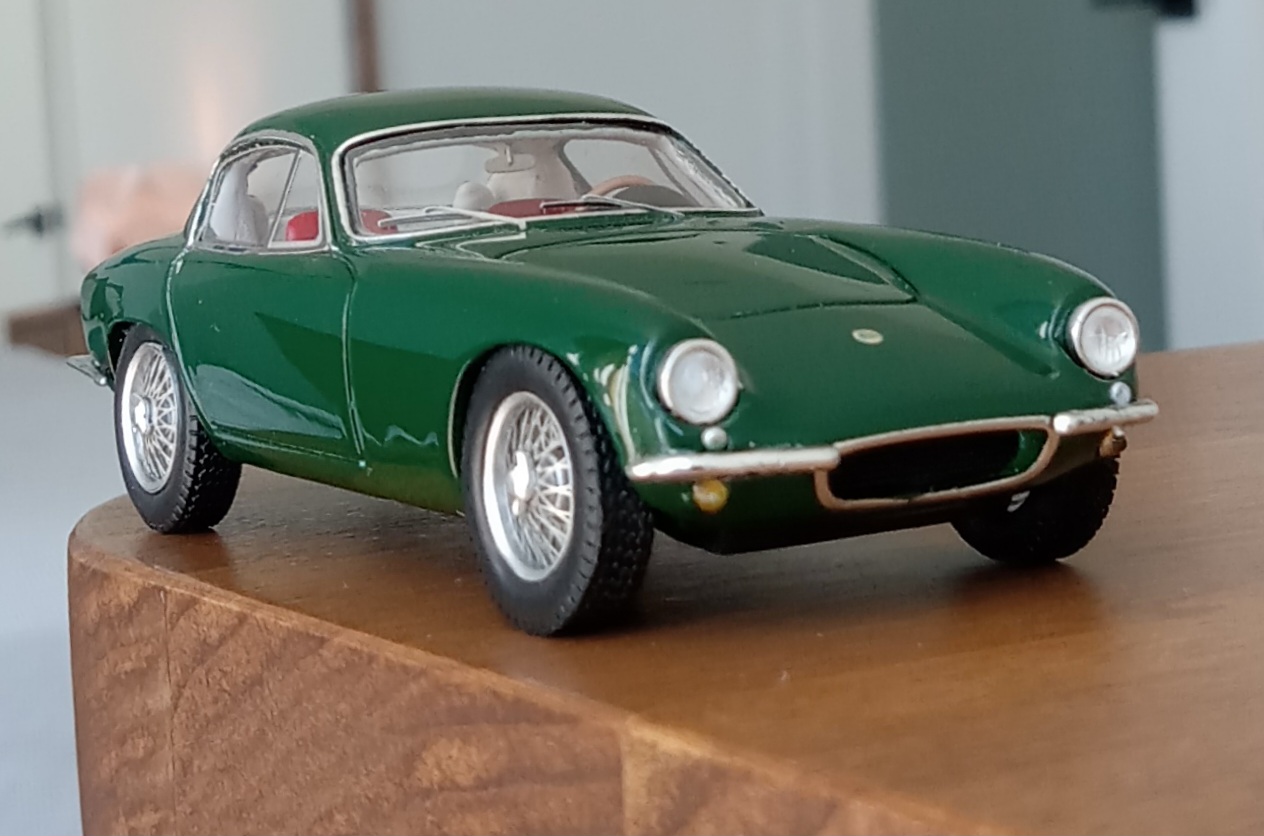
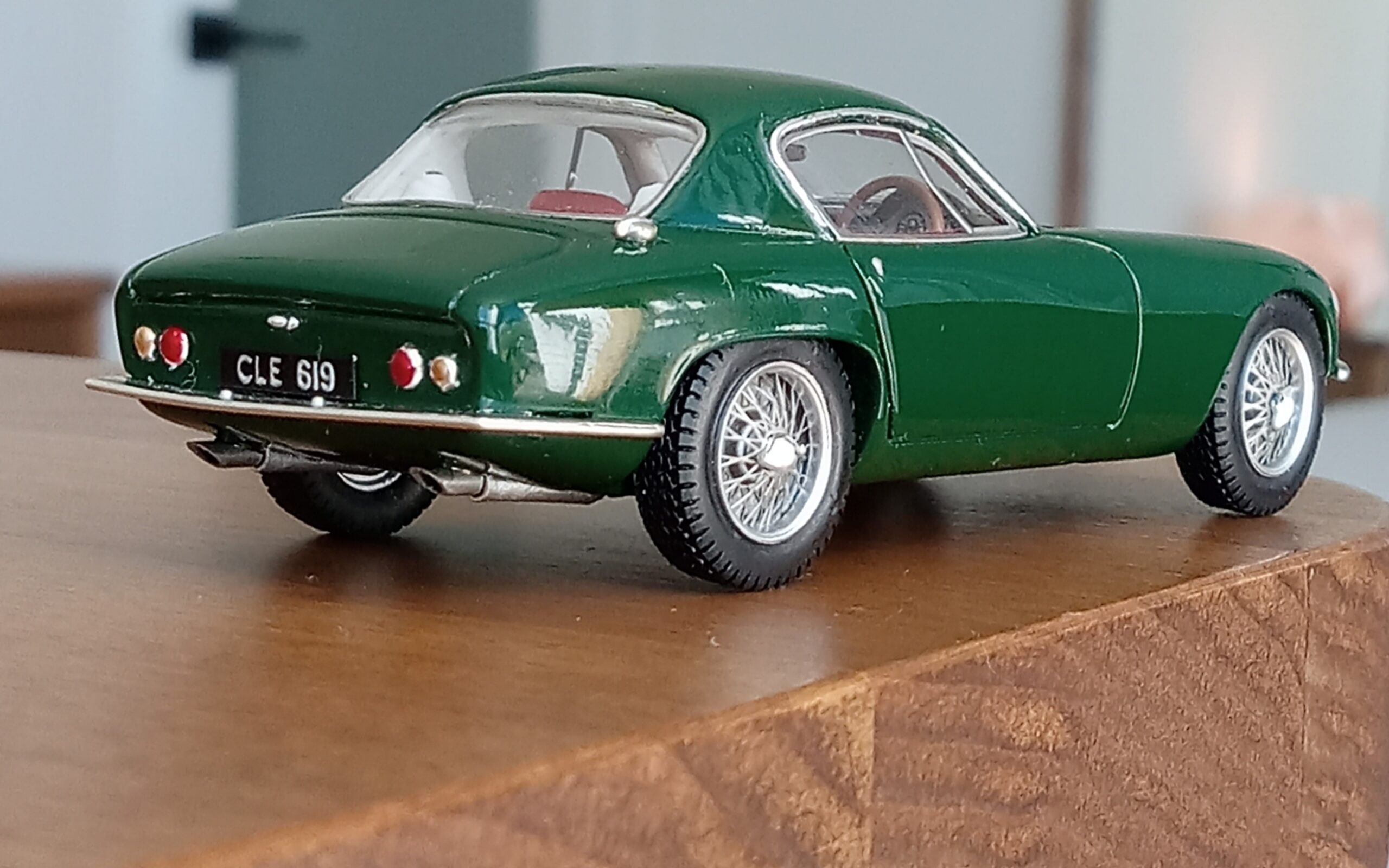
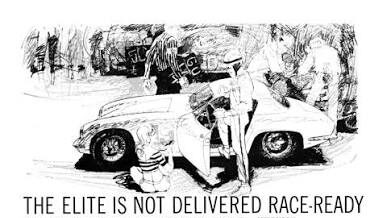
私が最もひかれやすいタイプが、
(自動車デザインのの中で、、、)
キャビンを思いっきり後ろに引っ張られて、
今にも前へ飛び出しそうな、、、
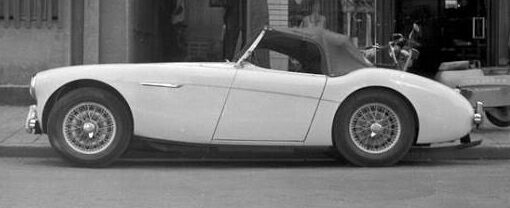
FRプロポーションのクルマなのですが、
このロータス・エリートは、その中でも、1位2位を争うほどに後ろに引っ張られています。
ちなみに、
リストにしてみますと、
1:オースチンヒーレー100/4 BN1
2:ロータス・エリート
3:ほぼすべての、戦前型FRスポーツカー
4:BMW 507
5:ダッジバイパー
6:メルセデス・ベンツ SLS AMG
7:トヨタ GR スープラ
8:トヨタ GR GT
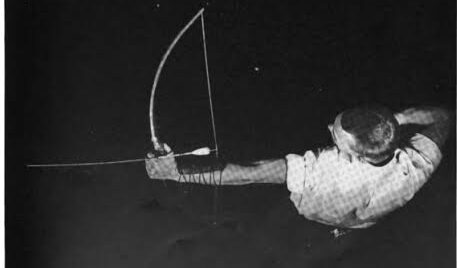
番外編:ビル・トーマス チータ(レースカー)
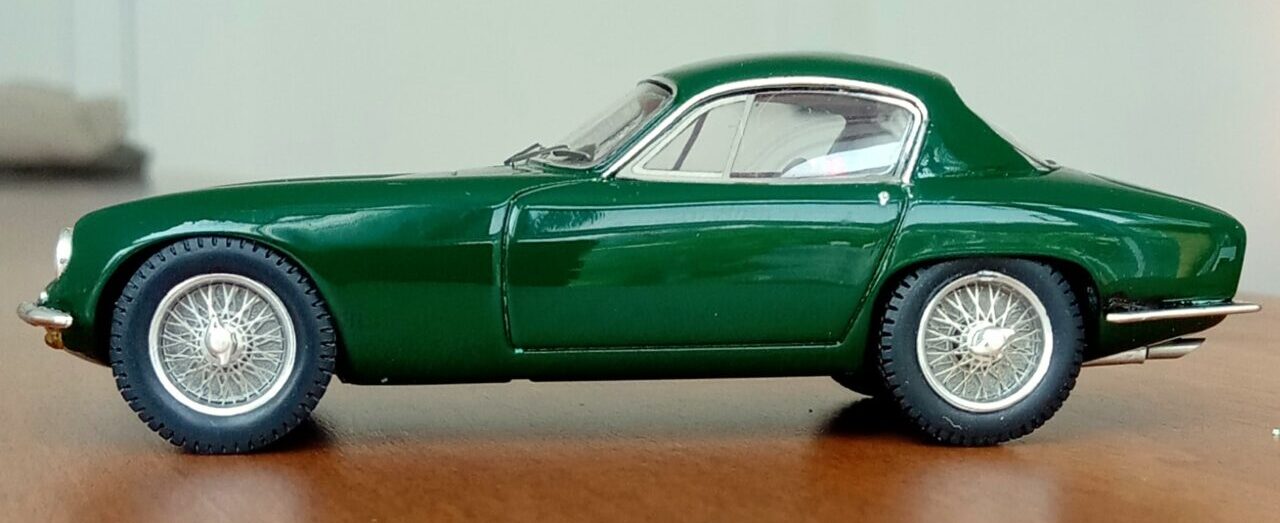
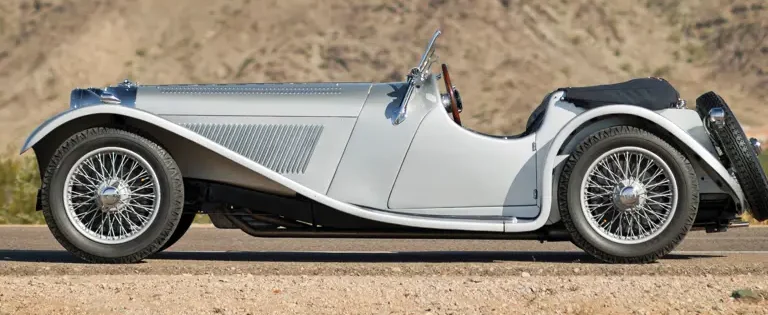
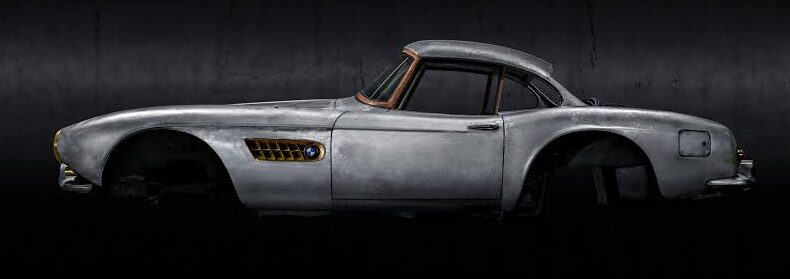
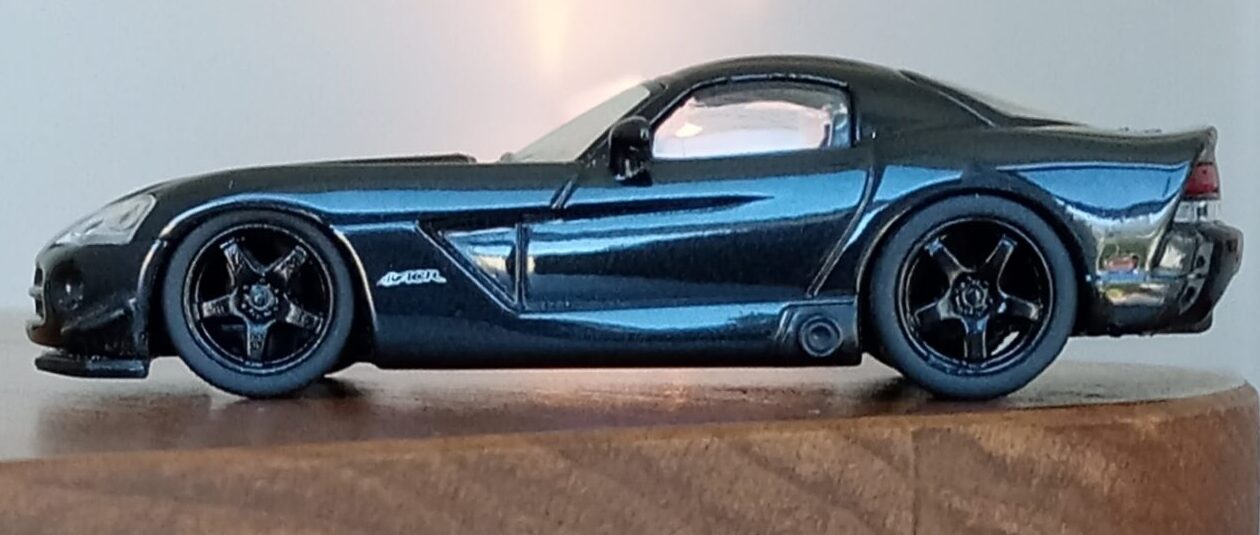
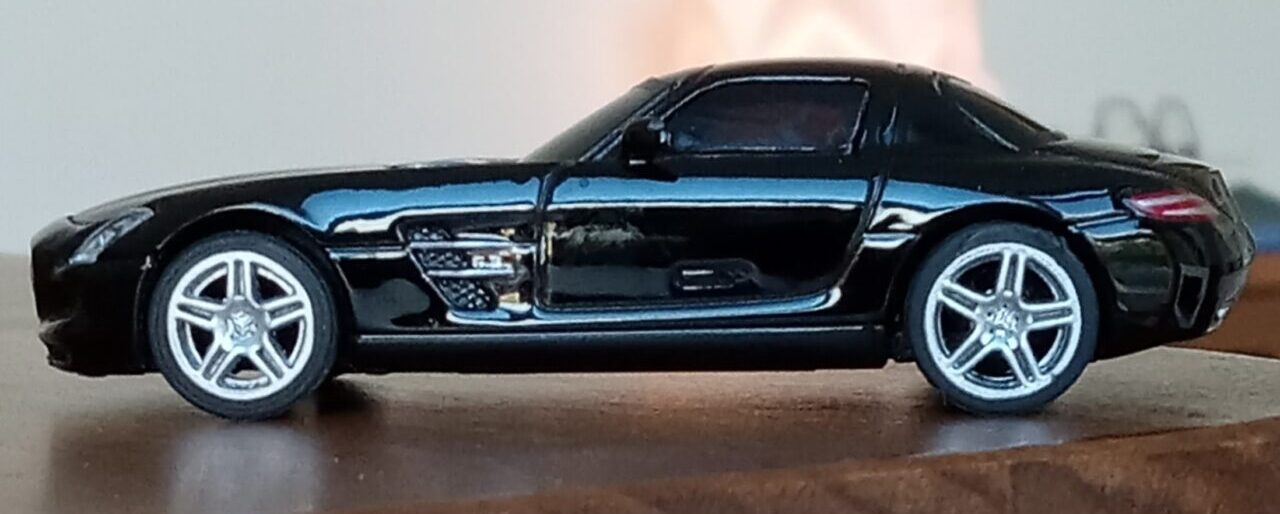
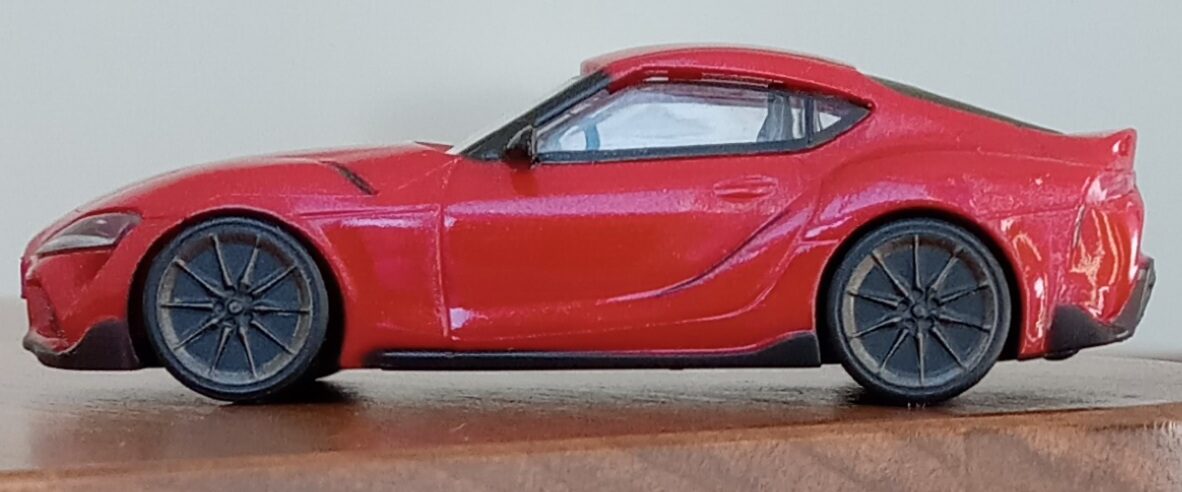
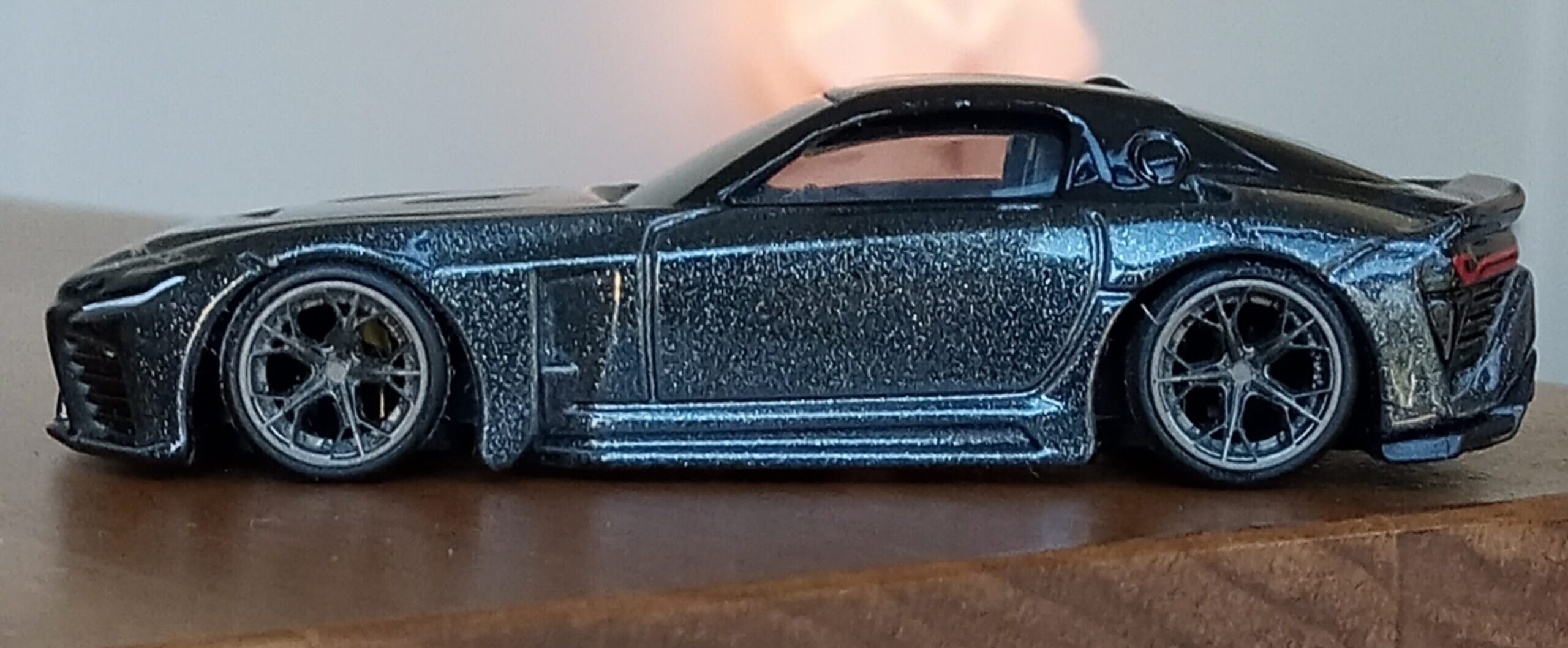
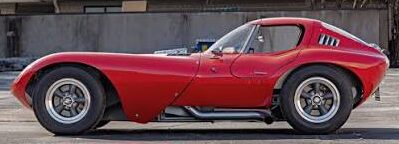
この中でも、チータの次位に、
引っ張られてます。
それでは、
後ろへ引き絞られた、スポーツカー
『初代ロータス・エリート』
の外観デザインの特徴を
5個上げてみたいです。
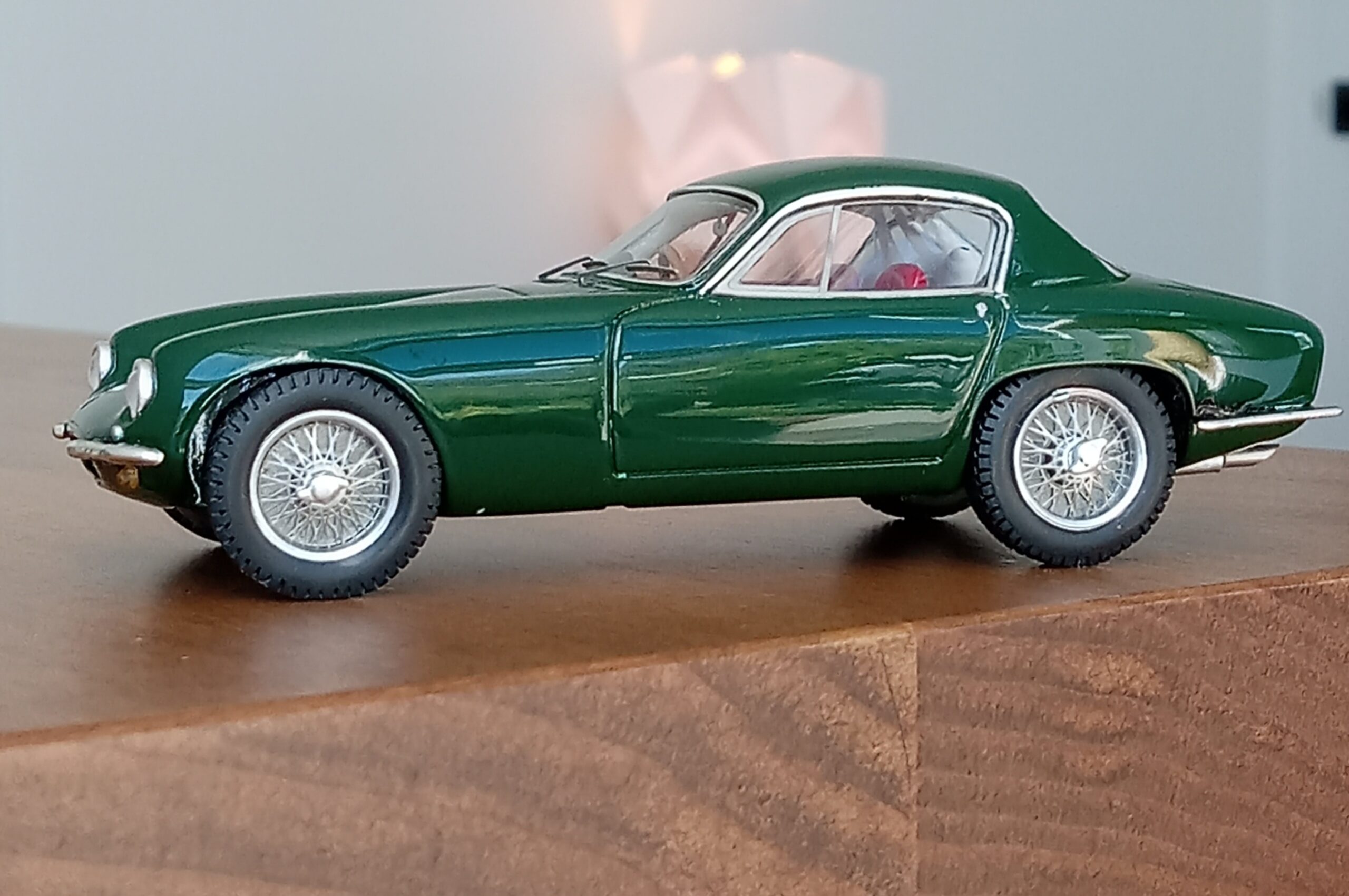
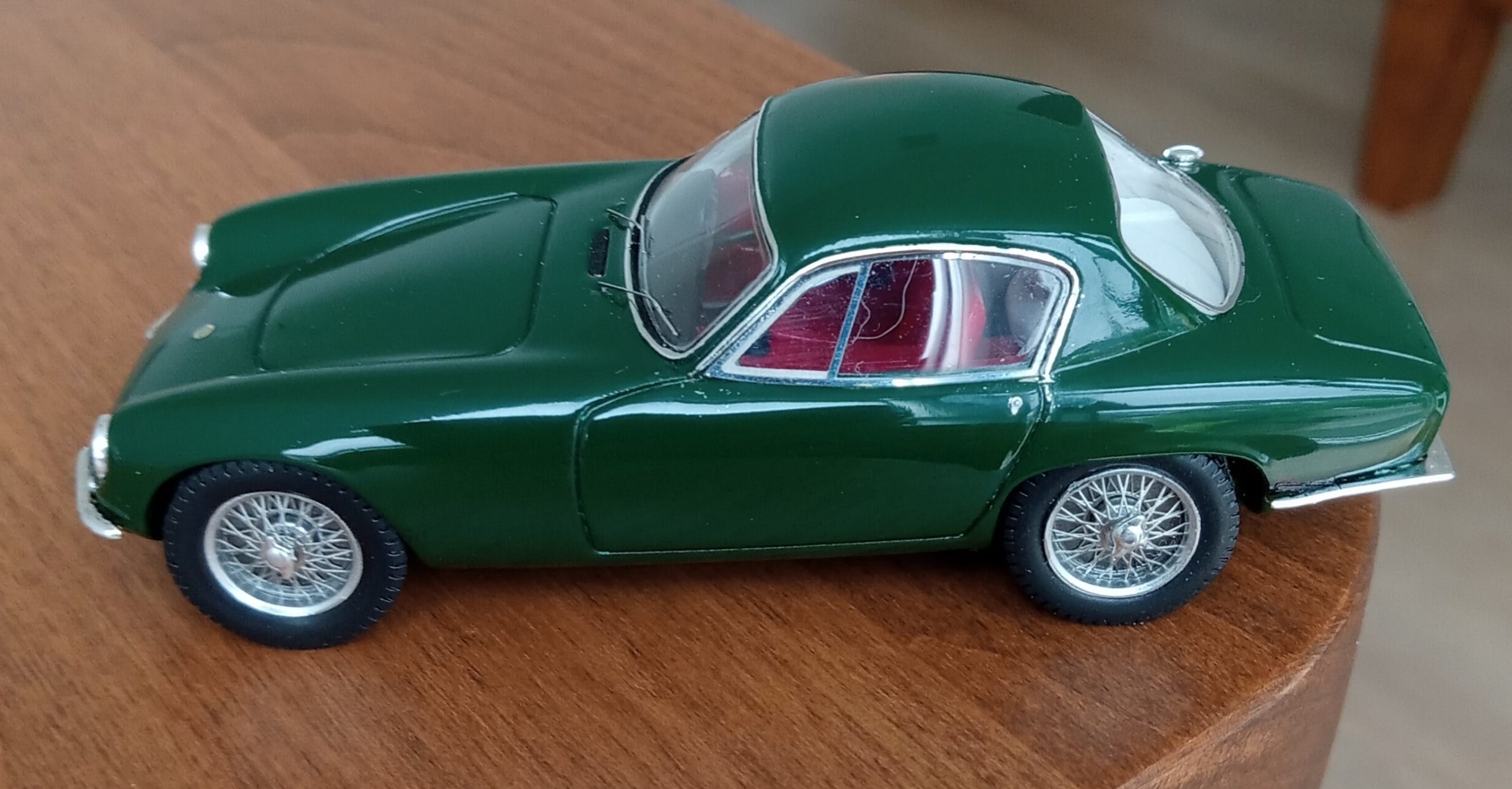
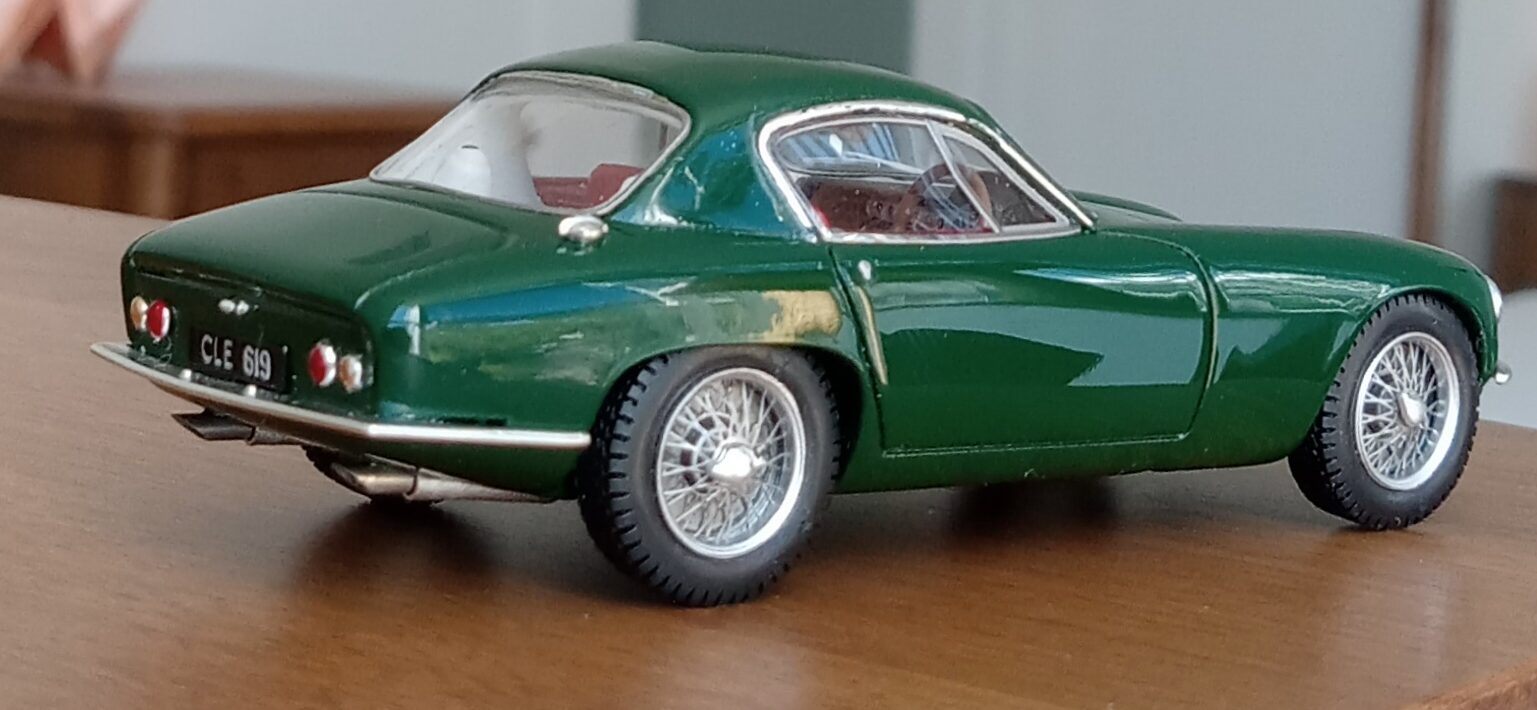
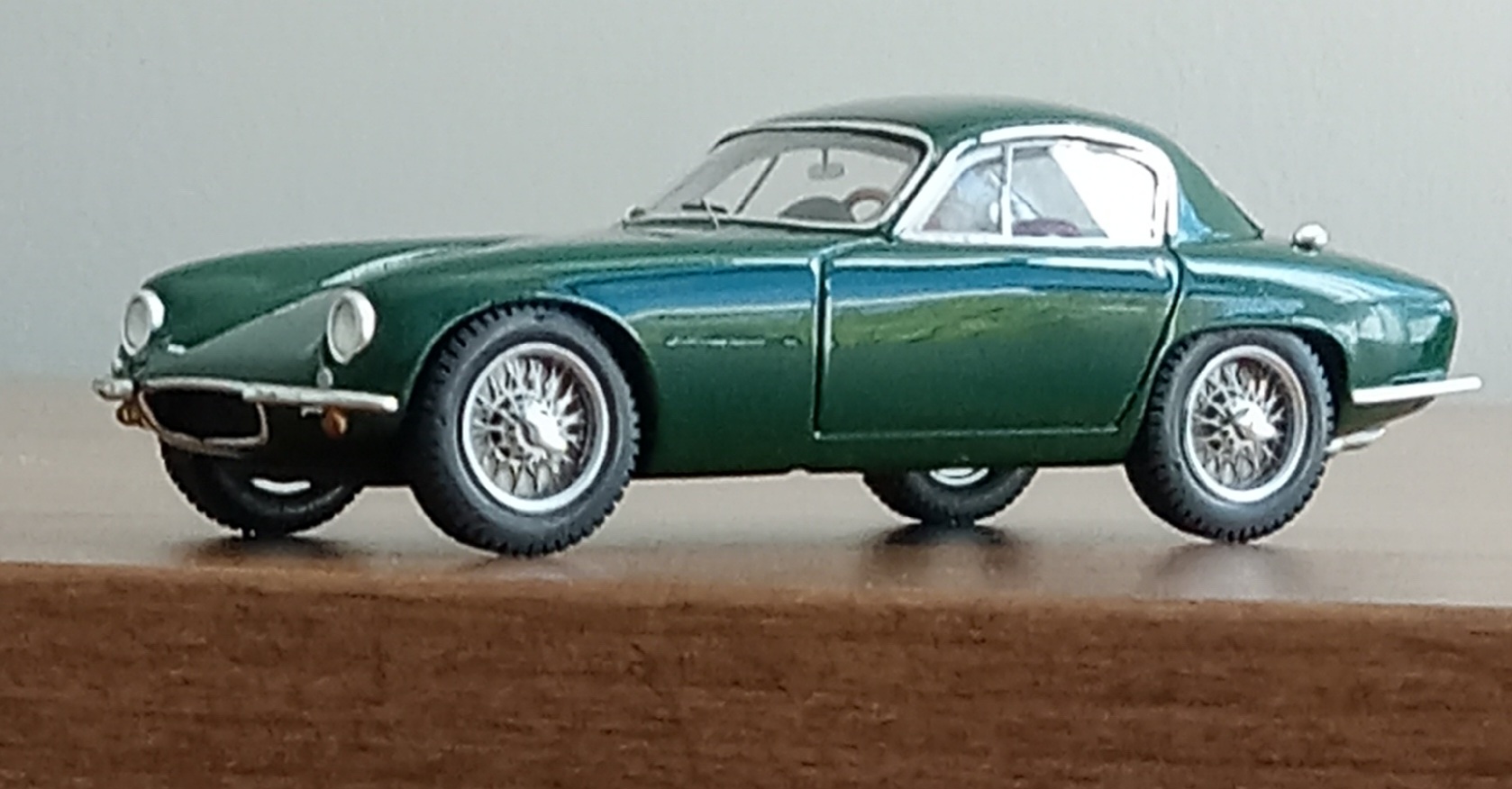
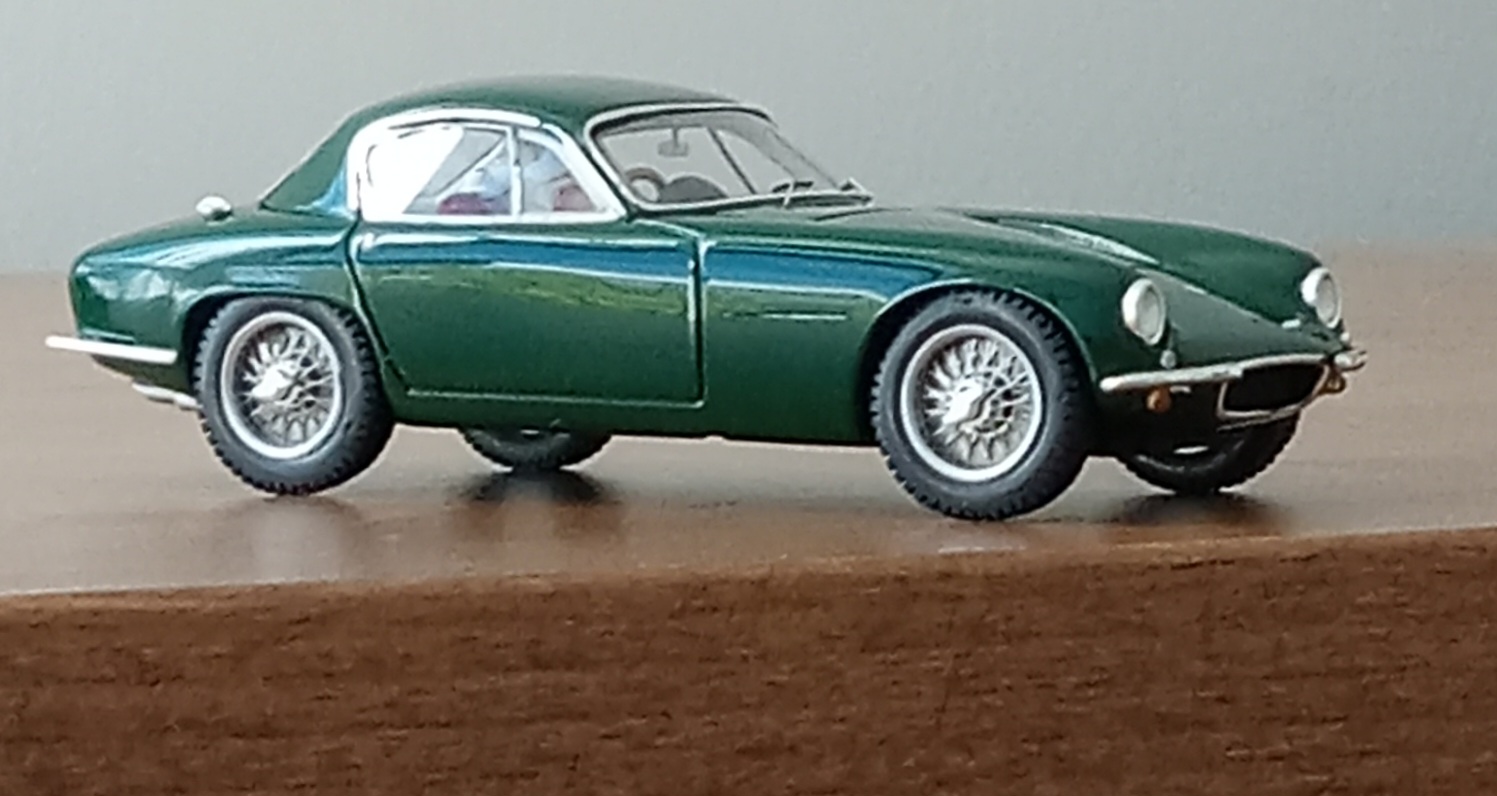
1:軽自動車並みの小型スペースの中で、これでもか!と、キャビンを後ろに引き絞った、キレキレに美しいFRプロポーションーーー>オースチンヒーレーBN1よりコンパクトにまとまったキャビン・デザイン
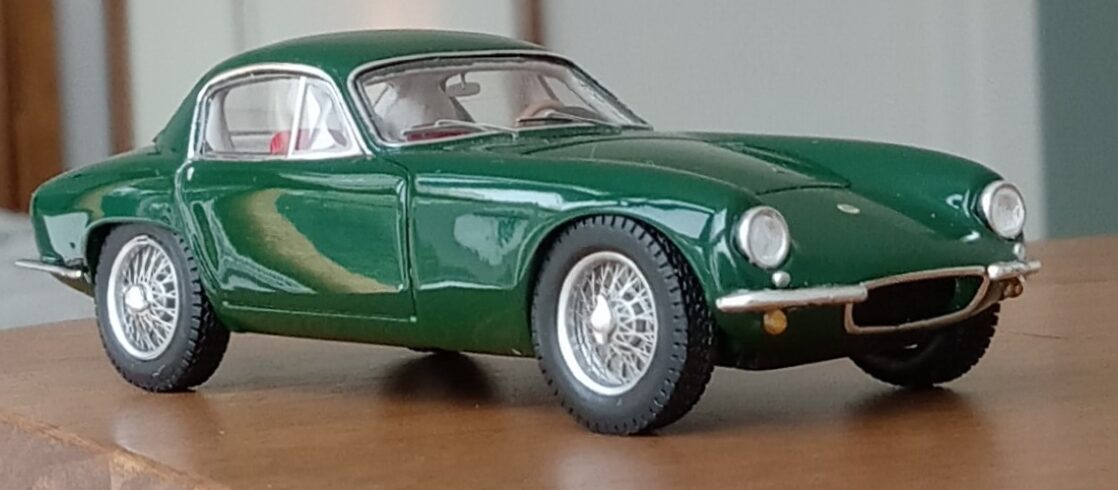
2:ファイバーグラス製のボディーを使い切るために偶然そうなったーーー>折り目やキャラクター来意の全くない、超絶オーガニックなボディー造形
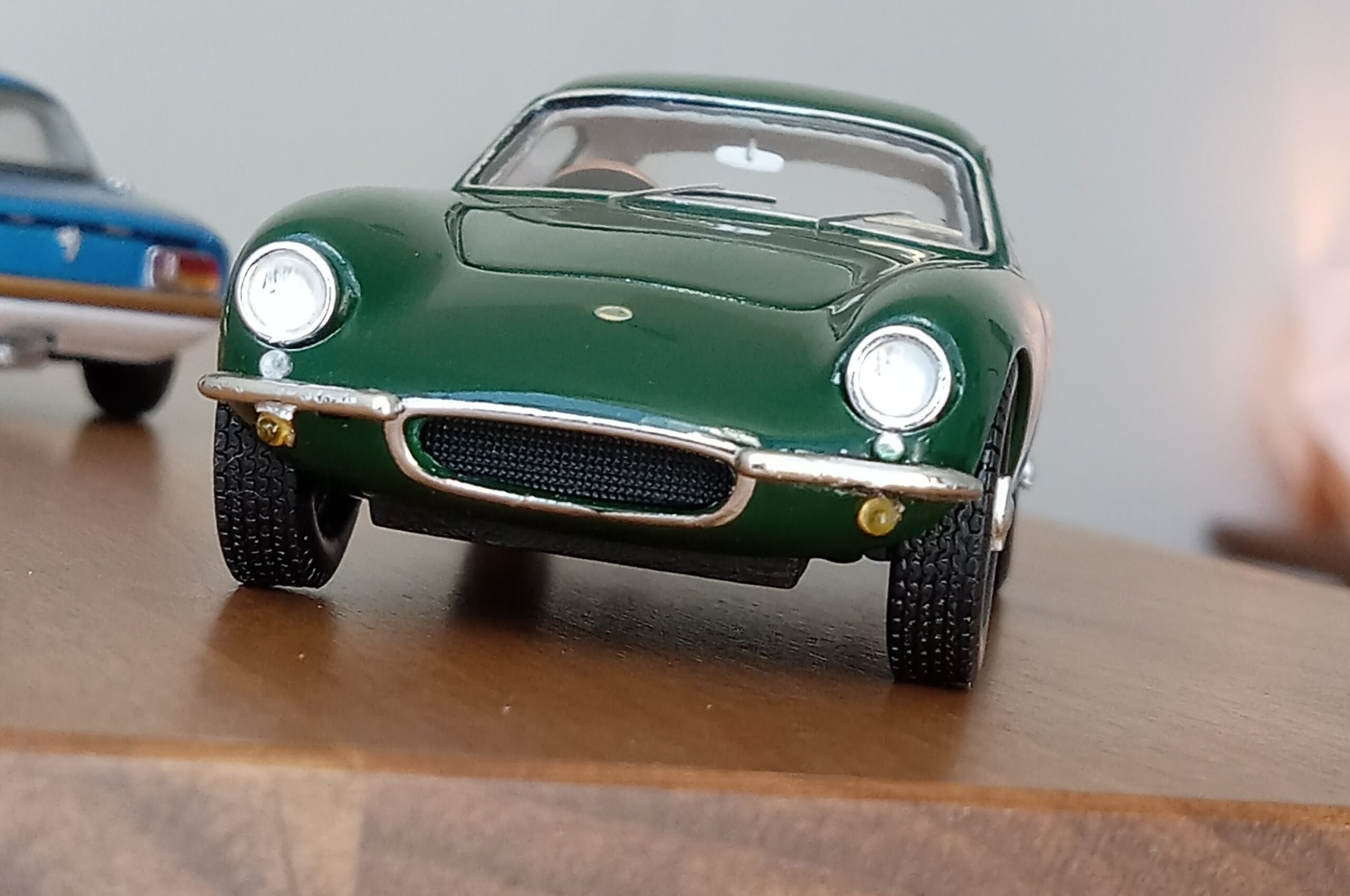
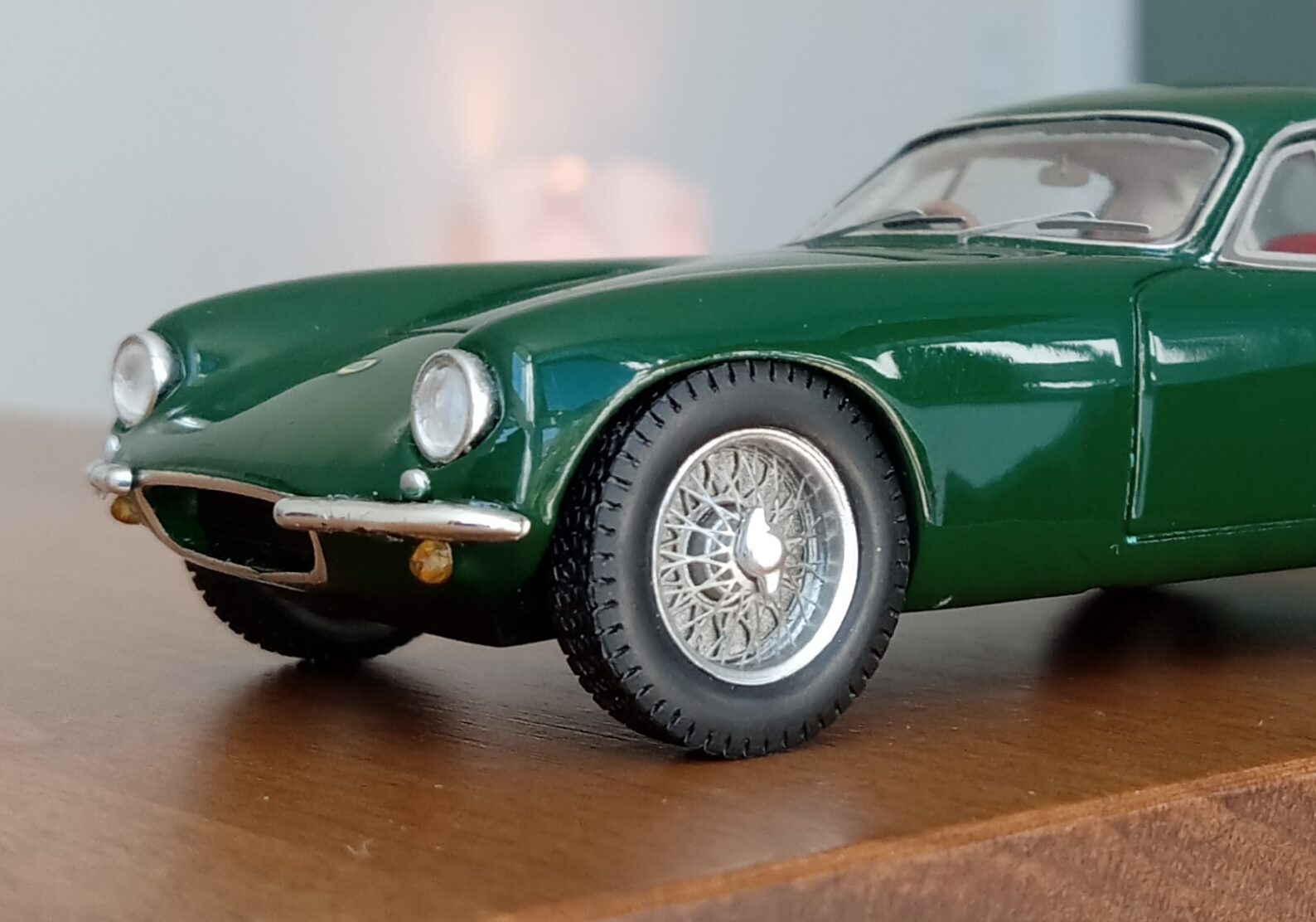
3:小さな直4エンジンをフロントミッドに積み込むことで可能になったーーー>極端に低いフロントエンドと、そこにチョコンとくっ付い【】た楕円形のラジエーターグリルのお茶目さ
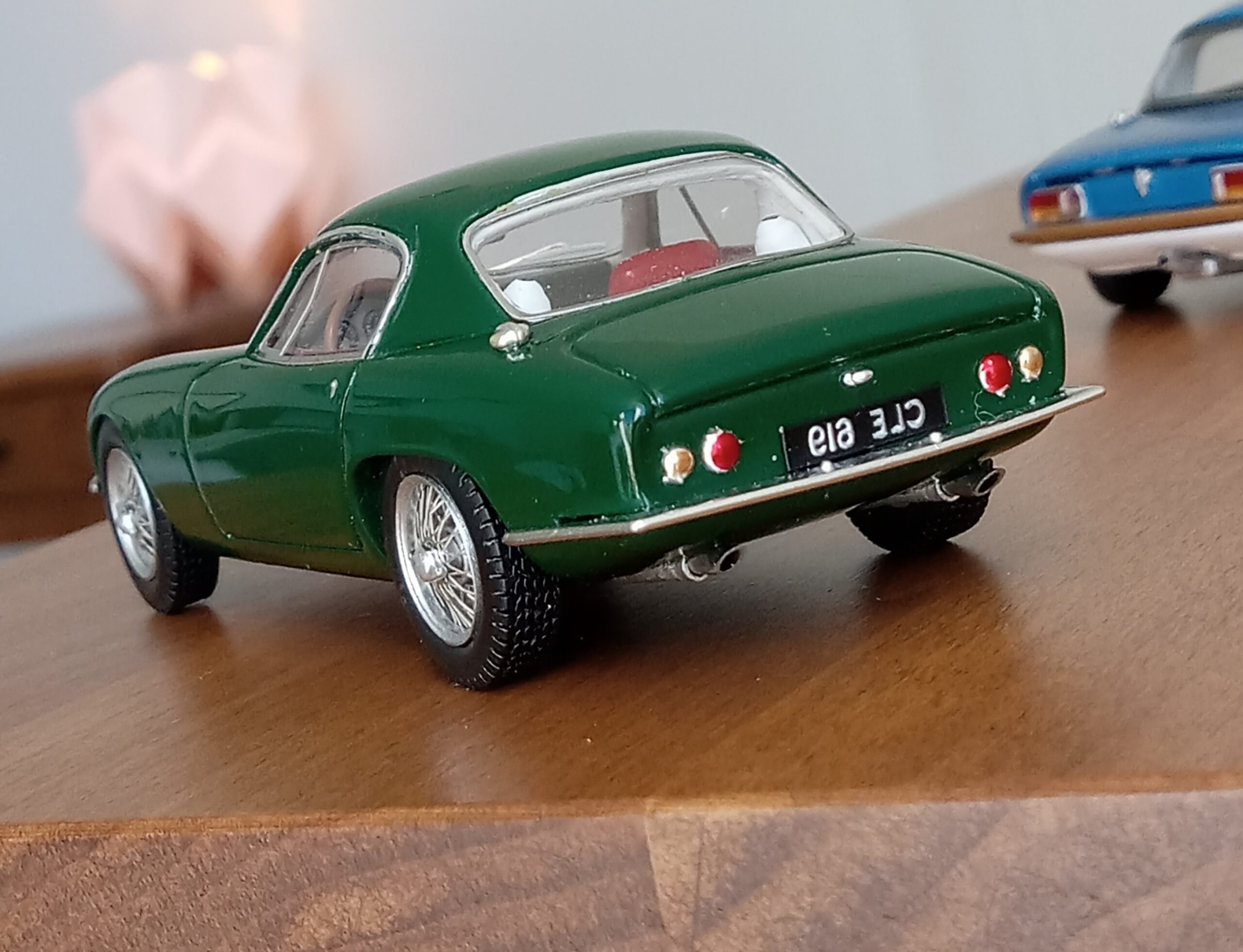
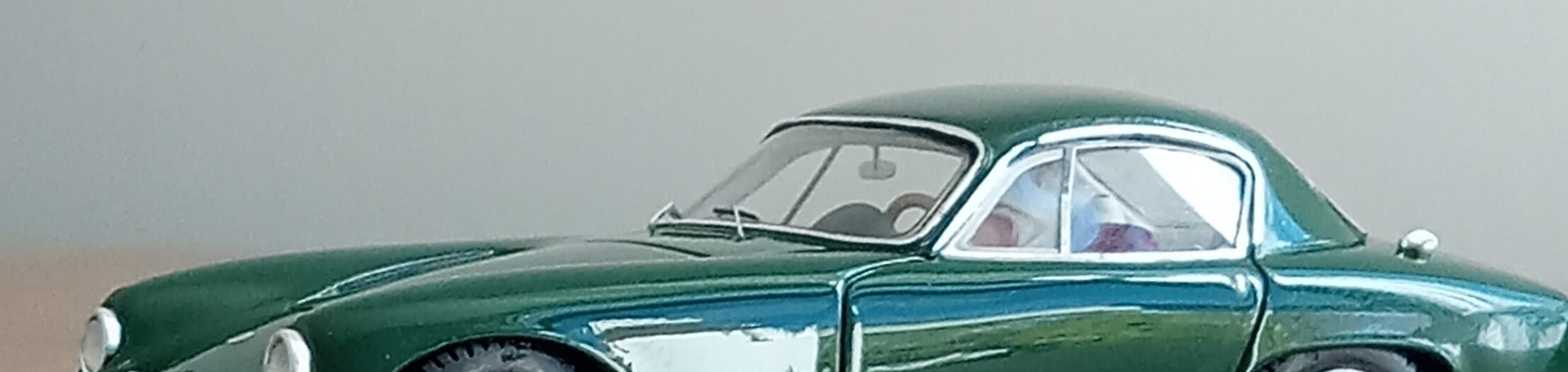
4:【1】の引き絞り感を一層強調するサイドウインドウ後端とボディー後端の後ろへの引っ張られ感ーーー>1/24位のミニカーのサイドウインドウ上端を指でつまんで、後ろへ引っ張る感覚、、、?
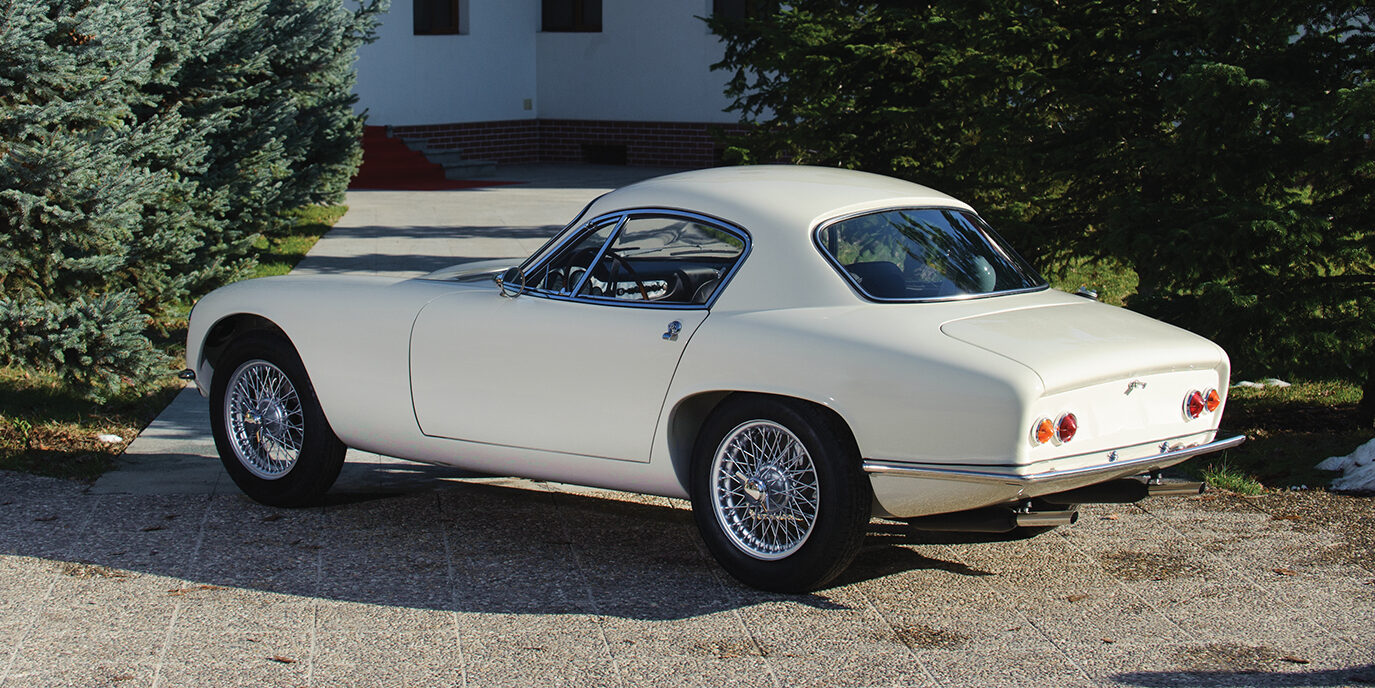
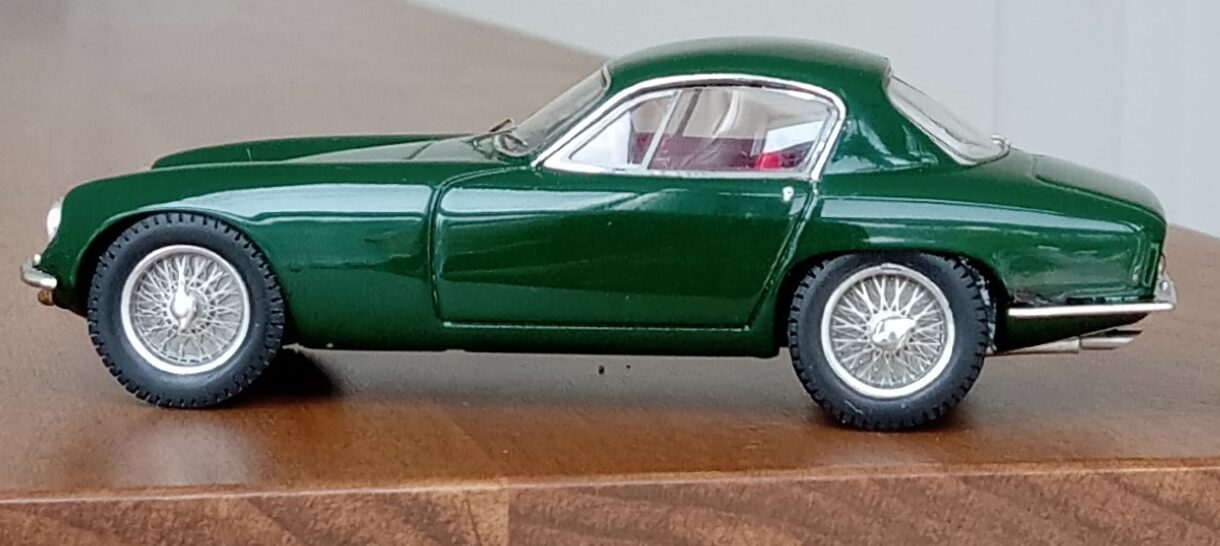
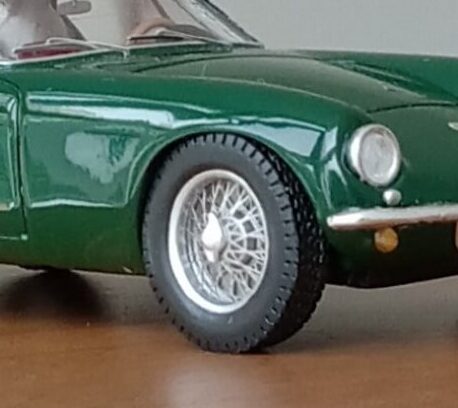
5:軽自動車サイズ【全長:3.6m】の四隅に大きく細いタイヤ【155 R 15】をはかせることで―ーー>素晴らしいスタンス感を演出!
それでは、
1つづつ写真入りで見て行きましょう!
1:軽自動車並みの小型スペースの中で、これでもか!と、キャビンを後ろに引き絞った、キレキレに美しいFRプロポーション
(個人移動の手段の歴史の中で、4頭立て馬車の時代に鞭をふるっていた御者のキャビン位置が真後ろにあったことを思い出しますね。)
ーーー>オースチンヒーレーBN1よりコンパクトにまとまったキャビン・デザイン
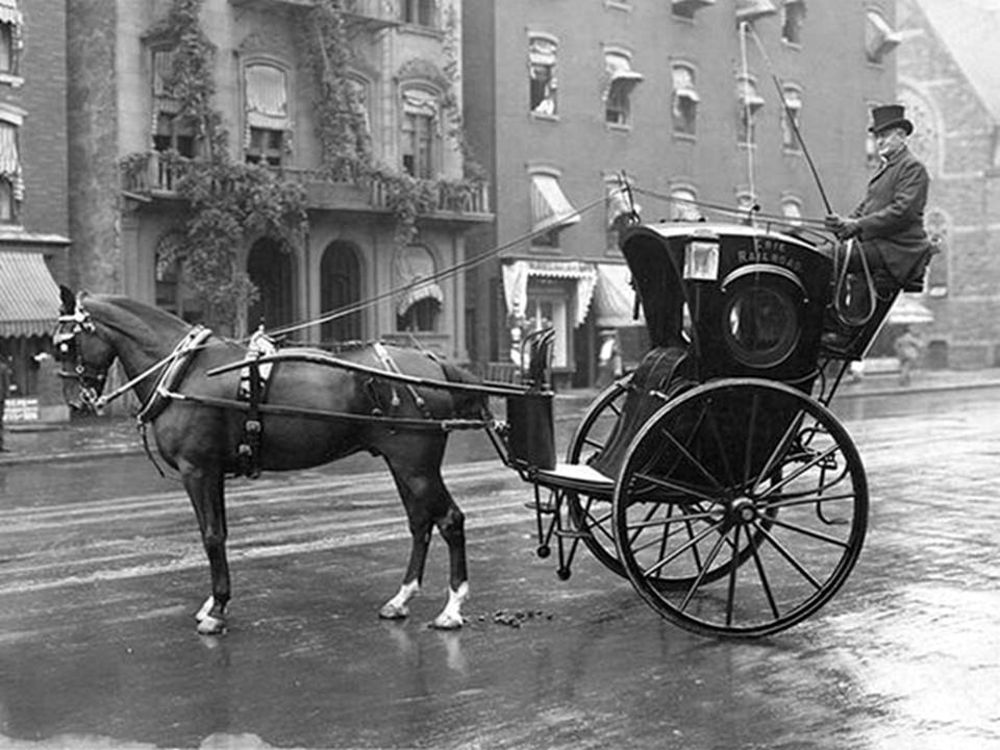
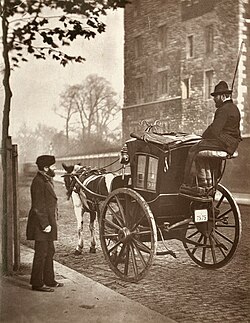
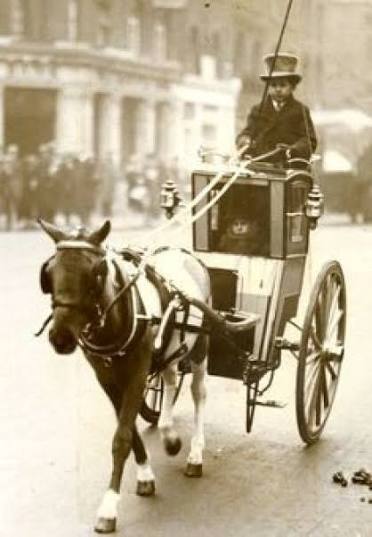
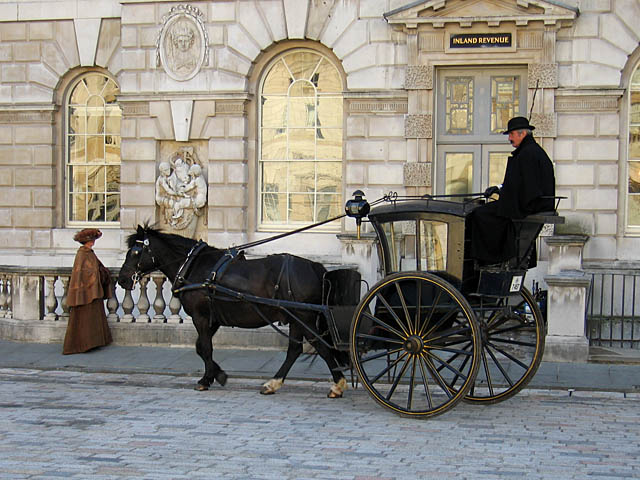
2:ファイバーグラス製のボディーを使い切るために偶然そうなった
(80年台の作為的な、有機面とは違い、材料や機能から直接生まれたぬめり感あふれる立体感)
ーーー>折り目やキャラクター来意の全くない、超絶オーガニックなボディー造形
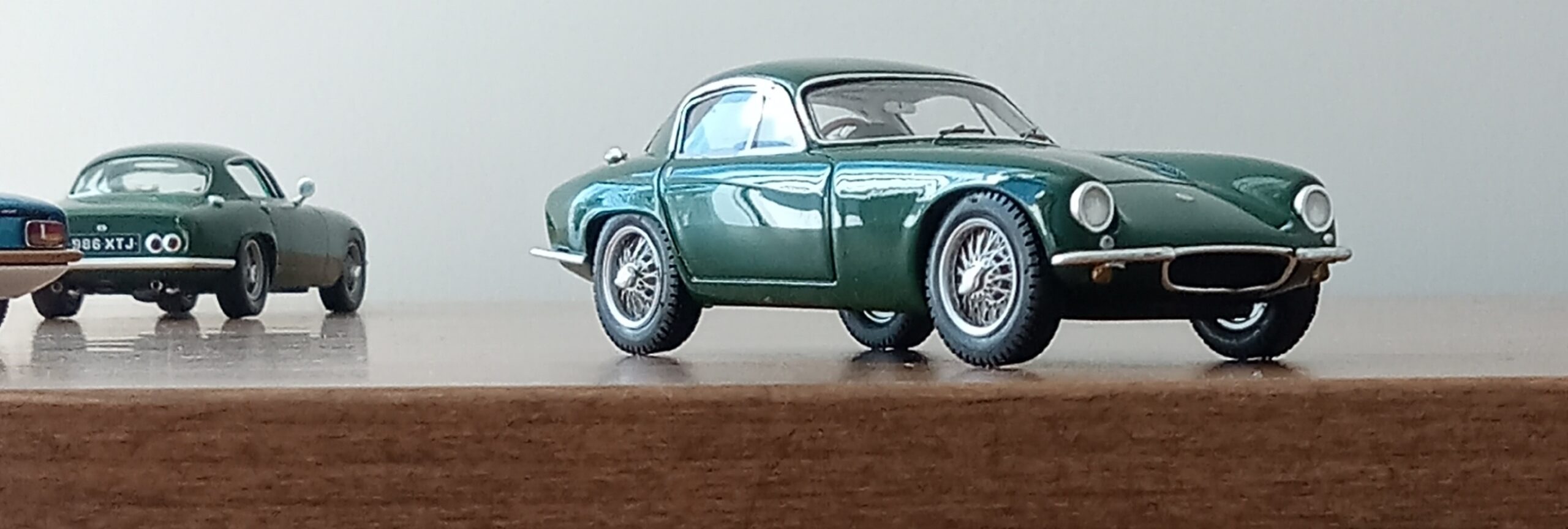
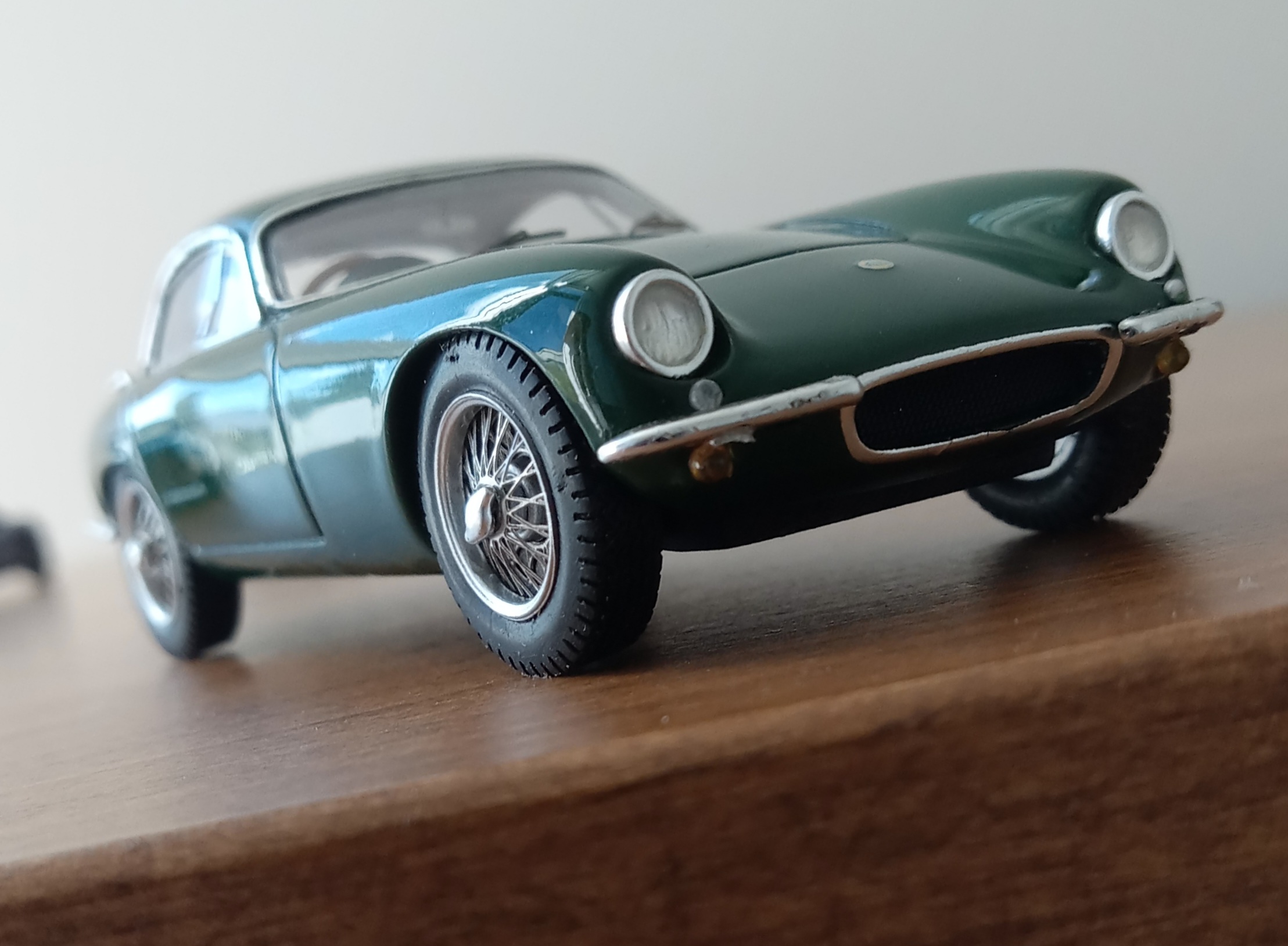
3:小さな直4エンジンをフロントミッドに積み込むことで可能になった
ーーー>極端に低いフロントエンドと、そこにチョコンとくっ付い【】た楕円形のラジエーターグリルのお茶目さ
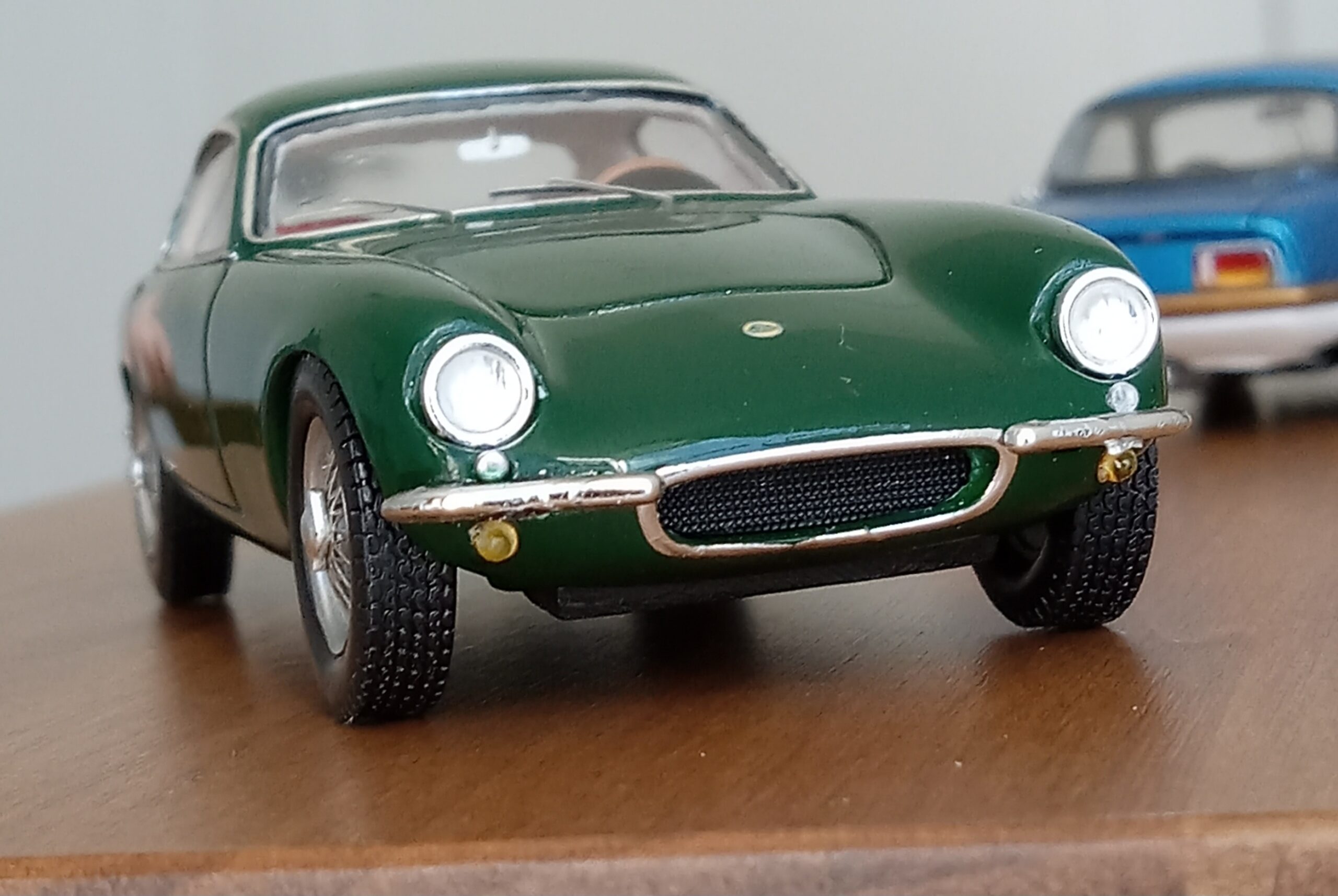
4:【1】の引き絞り感を一層強調するサイドウインドウ後端とボディー後端の後ろへの引っ張られ感
ーーー>1/24位のミニカーのサイドウインドウ上端を指でつまんで、後ろへ引っ張る感覚、、、?
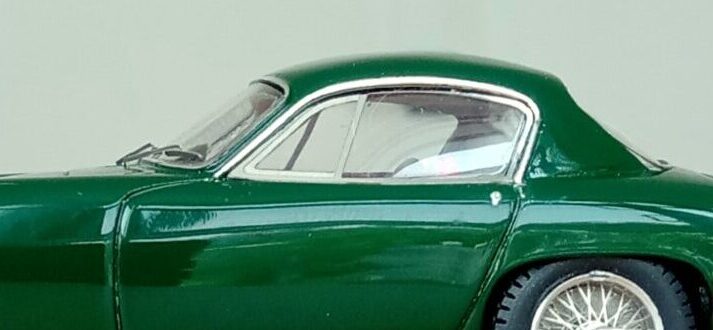
5:軽自動車サイズ【全長:3.6m】の四隅に大きく細いタイヤ【155 R 15】をはかせることで
―ーー>素晴らしいスタンス感を演出!
次は、
私の個人体験の時間です、、
*『私』とロータス・エリート:30年の関係、、、
私の『初代ロータス・エリート』
とのなれ染は、
二玄社から出ていた、
カー・グラフィック クラッシックの中で見た、
メタリックの濃い青にシルバーのキャビンの
単体の写真でした。

*形のすばらしさはすでに知っていたのですが、
*この特集で知った、15インチホイール―――>その異様な大きさ!
*立体感あるボディーをいい意味で引き締めるメタルの青色の絶妙な調合
*それを引き締める、シルバーのキャビン
*更にわくわく感が上がったのがーー>まっ黄色なシリンダーヘッド
その後30年以上に渡って、
その魅力の源泉/根源を見つけようと、
もがき苦しんできました。嬉
その後は、
*『コンコード・デ・エレガンス系』の自動車ショーや、
*クラッシックカー博物館、
*各国雑誌や、書籍など、
とともに、
1/43のミニカーを制作したり、愛でたりして、
【ロータス・エリート】の魅力の源泉
につて研究してきました、
#立体造形体験:
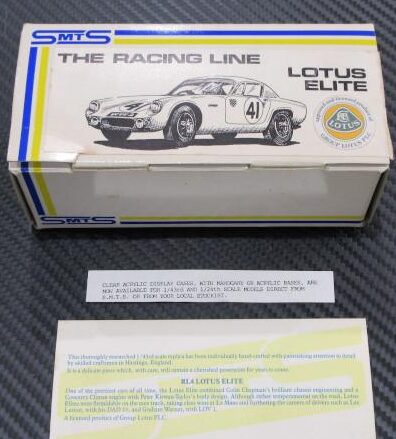
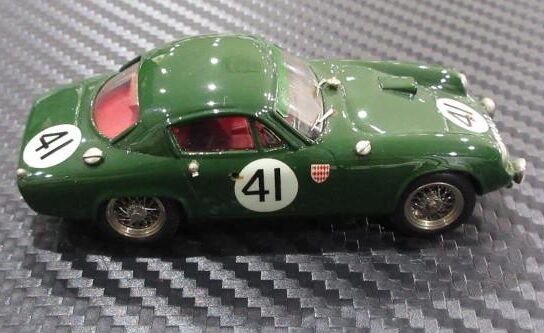
*SMTS社製1/43ホワイとメタル製キット、ロータス・エリート、1959
(老舗のキットメーカーからキット版と完成版が出てました、全体的に一体感とカタマリ感が強すぎて、ボディーにメリハリがなかったので納得できず、パテを盛りながらフロントフェンダーやボディーサイドのスイープ感の改修を半年ぐらい『あーでもない、こーでもない』と格闘した末、塗装前にギブアップして、立ち消え状態になりました、、、泣き)
ーーーー>この時の格闘が、後の立体造形の基礎になっている部分があります。
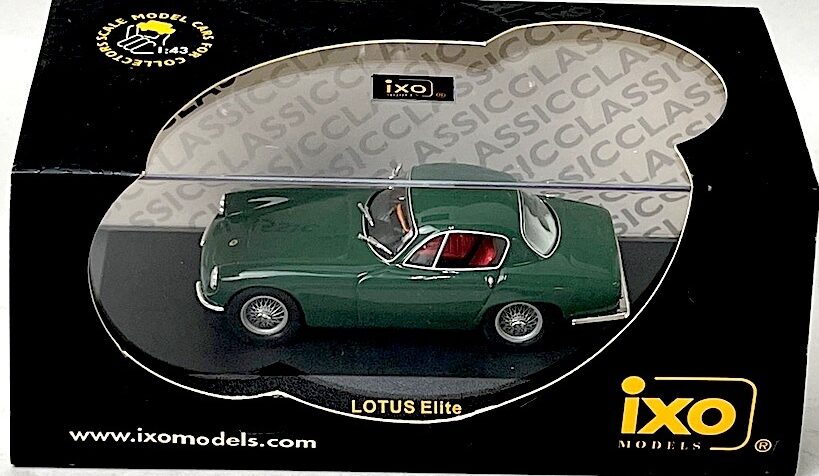
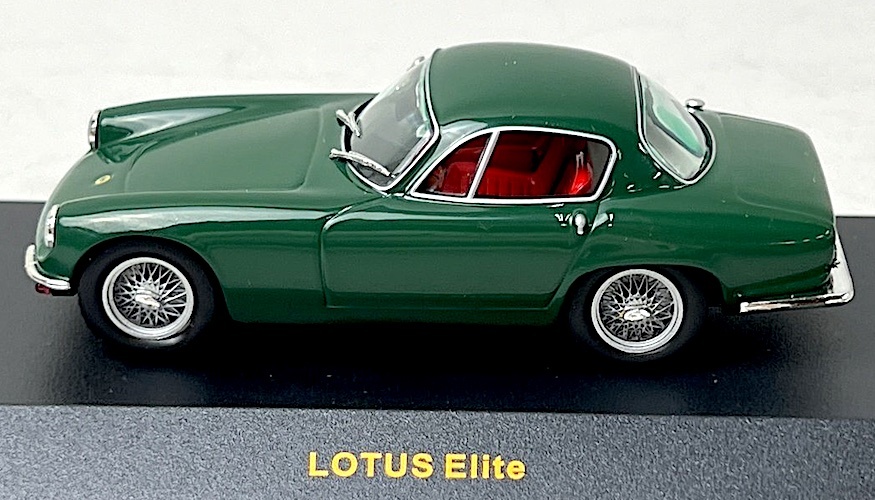
*IXO社製、1/43ダイキャスト完成品、ロータス・エリート(BR グリーン)
(かなりの年代物のキャスティングですが、エリートの豊満な部分をよくとらえています、逆に少し大柄な感じで、実物を見た時に少し驚きました。
ーーー>スパーク版を見るまでは、これで満足していました。)
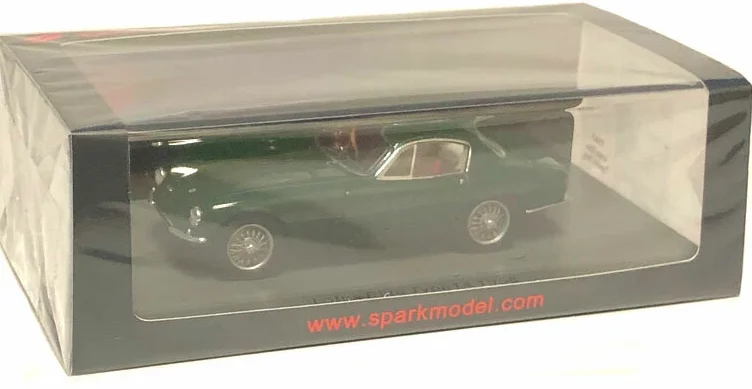
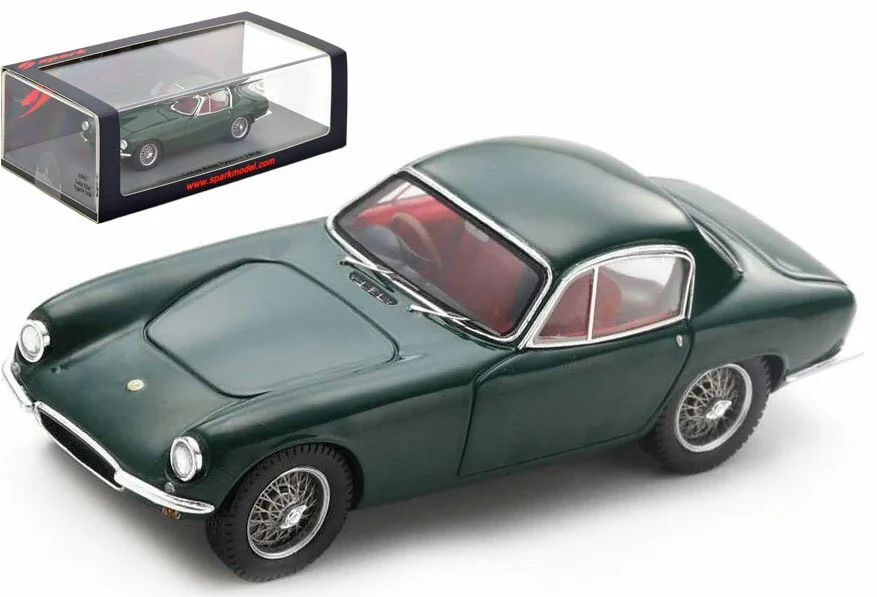
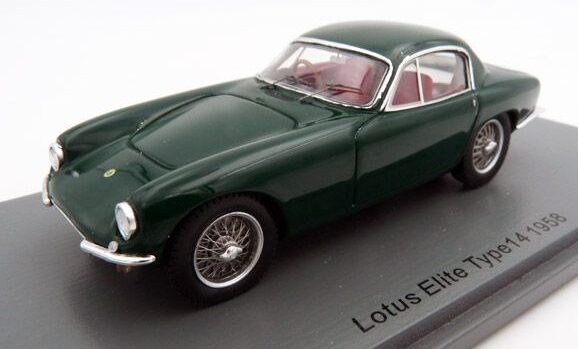
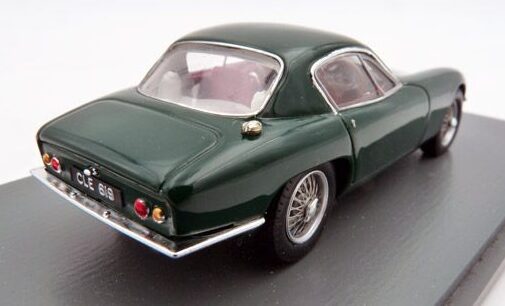
*スパーク社製、1/43レジン完成品、初代ロータス・エリート(BR グリーン)
(メルカリ産で適当な価格のものがあったため、買ってみてビックリ、自分が抱く実物のエリートが100%再現されており、更に最新完成品ということもあり、窓枠や内装の作りこみも十分で、
ーーーーーー>ここ20年ほどのレジン模型の進化を見せつけられる思いでした。)
ではいよいよお待ちかね、
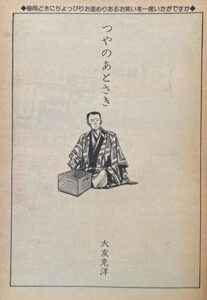
三題噺のお時間です!
*三題噺:トヨタ2000GT・有機曲面・超軽量


今回もこんな感じで、会場の皆様から
お題をいただきました。
#お題
*トヨタ2000GT
*有機曲面
*超軽量
#通底するテーマ:前人栽樹
(意味: 前の人が木を植えたから、後ろの人がその木陰で涼むことができる。)
プロンプト:
スポーツカー1958年型のロータス・エリートの機構と外観デザインにつての解説文を、実際のデザイナー目線で、産業革命時代のイギリスのメカ好きな工場主と、職人気質の機械技師の間の会話調の、三大噺の講談形式で、3000字以内で制作してください。最後はテーマを回収して、知的にウイットを聞かせて落としてください。通底するテーマは:前人栽樹(開拓者の苦労に力点を)、お題は: 超軽量・トヨタ2000GT・有機曲面 の3題です。
n
n
n
n
「旦那、驚くのはまだ早うございます。こいつはただの薄皮じゃありません。鉄のフレーム(骨組み)が、どこを探しても見当たらねえんです。なんと、ボディーそのものが構造体……、繊維強化プラスチック(FRP)の『モノコック構造』でできてやがります。我々がボイラーの圧力を支えるために、どれほど厚い鉄板とリベットを使ってきたか。それをこの車は、樹脂とガラス繊維だけでやってのけた。まさに『超軽量』。重量はわずか500キロ強、馬一頭が引く我が社の荷馬車の、半分以下の軽さでさぁ!」
このFRPモノコックだってそうだ。チャップマンの旦那も、最初はサスペンションの取り付け部がちぎれたり、エンジンの振動でボディーがひび割れたり、そりゃあ夜も眠れない大損害を出したはずだ。ノウハウのない荒野を開拓するってのは、蒸気機関の最初のボイラーを爆発させるような恐怖との戦いなんだからな」
「なるほどな。機械をただの道具じゃなく、生き物のように見せる。この有機曲面は、空気の壁を切り裂くための方策でもあるな。だがトマス、このデザインのDNAは、ただイギリスの霧の中に消えたわけじゃない。遠く東洋の島国、日本にまでこの種火は飛んだんだ。お前、『トヨタ2000GT』という未来の和製スポーツカーを知っているか?」
n
n
「まずは、我が社の誇る『超重量級・10馬力蒸気粉砕機』のカバーを、すべてこのエリートのような、滑らかなFRPの有機曲面で作るんだ!」
n
「おいおい、旦那。中身が10トンの鉄の塊じゃ、ガワだけエリート(エリート=選ばれし秀才)の真似事をしたって、重すぎて地面にめり込んじまいますよ。それじゃあ秀才どころか、ただの『重才(じゅうさい)』でございます」
n
n
n
n
n
n
n
n
n
n
n
◇
*その他の『英国製』の軽量スポーツカーたち、、、
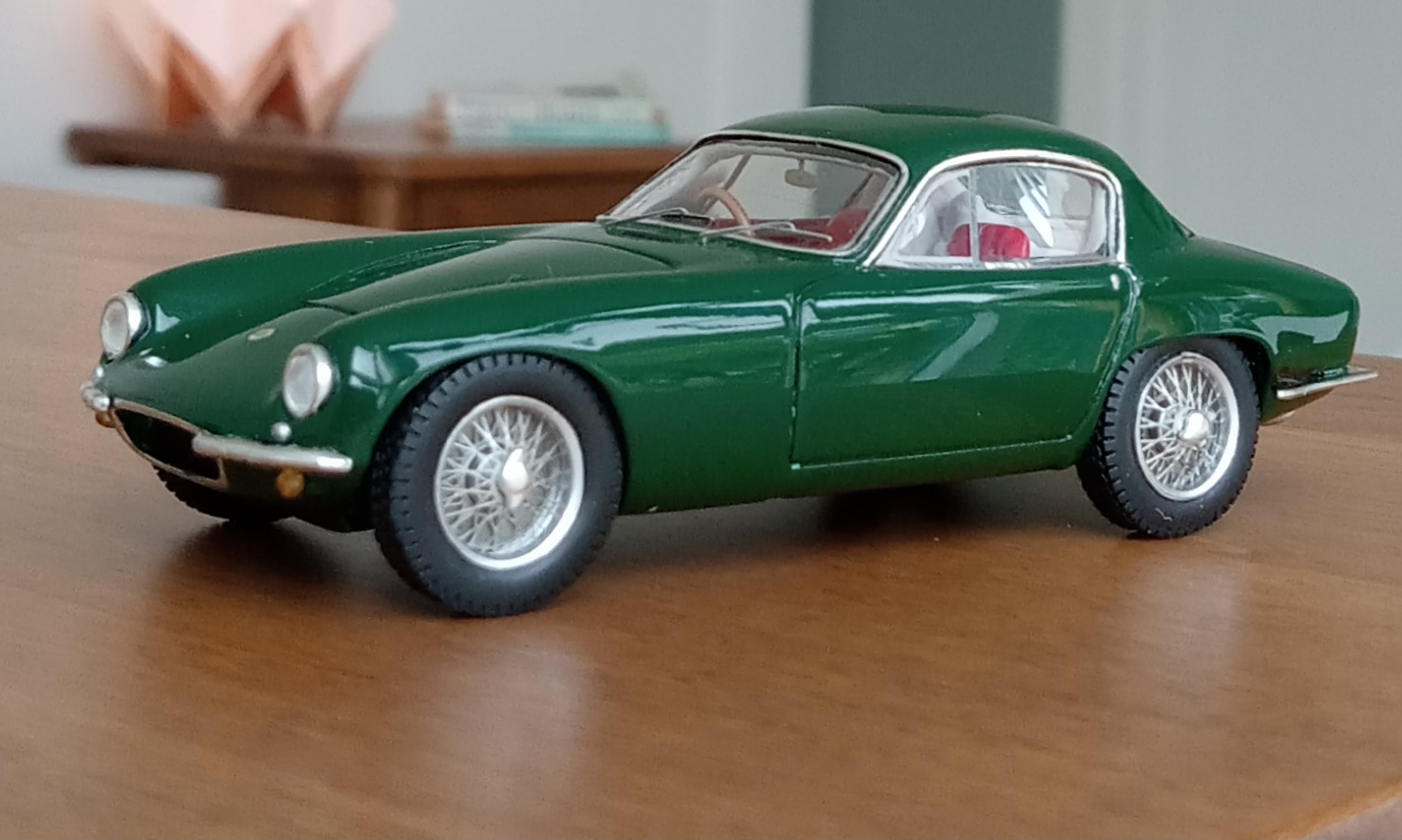
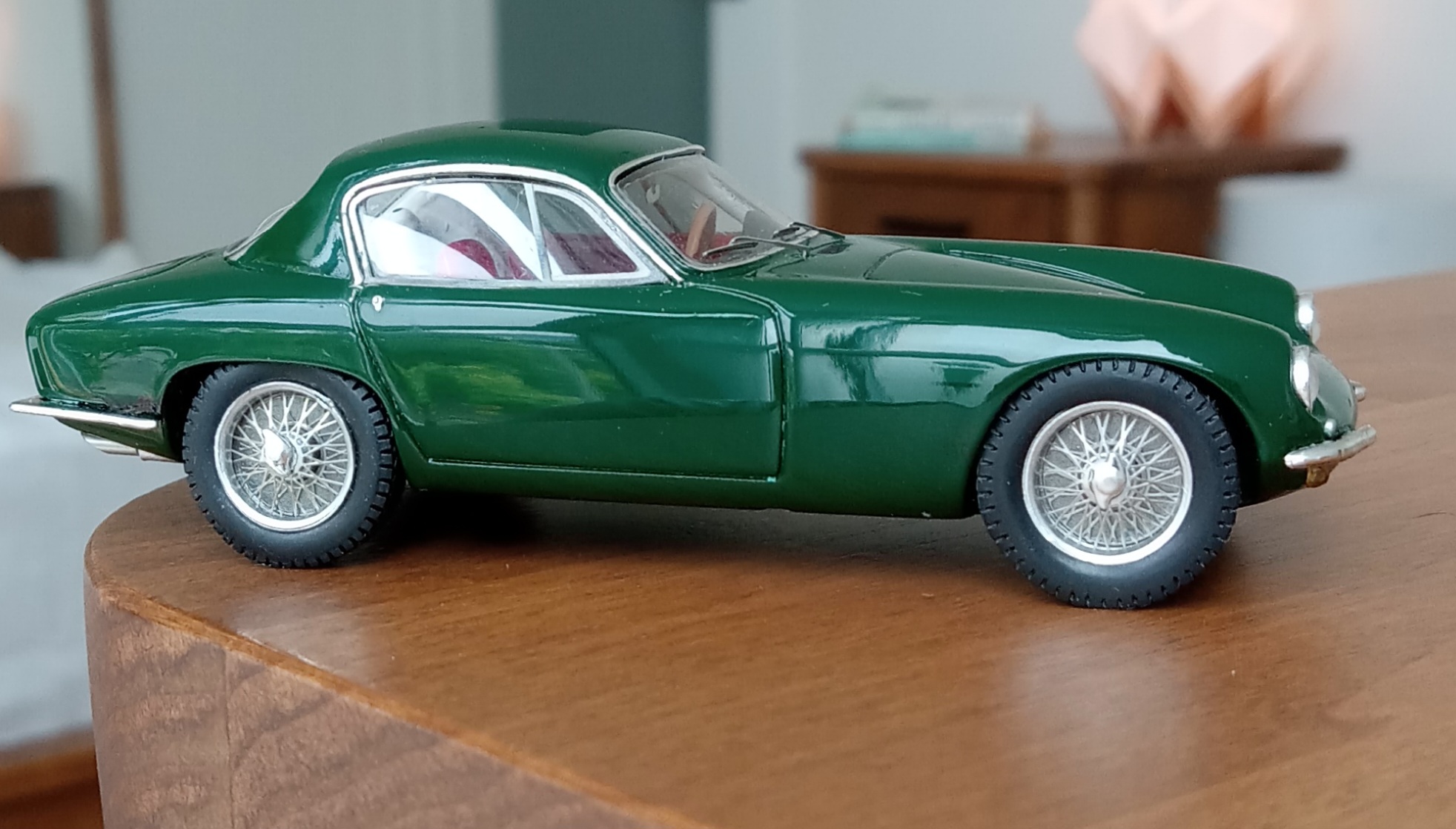
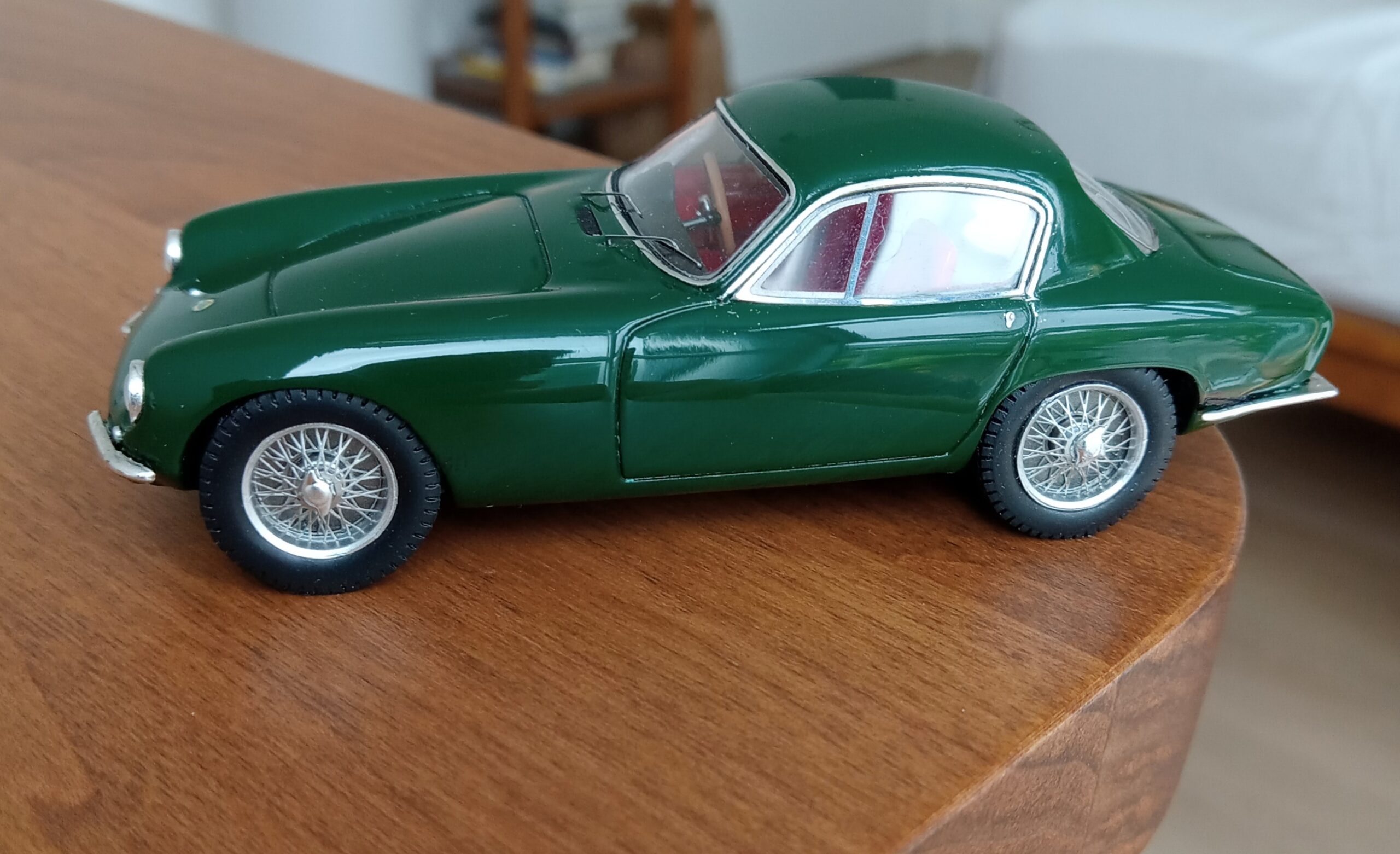
ロータス・エリート以前にも
英国製ロードスターはありましたが、
極限まで、軽量化に注力したスポーツカーの歴史は、
ここから始まりました。
『英国超軽量スポーツ・カーの始祖鳥』
初代ロータス・エリート
それでは、個人的に大好きな、
その他の英国軽量スポーツカーを上げてみたいです。
*ロータス・エリーゼ S1、1996(BR グリーン)
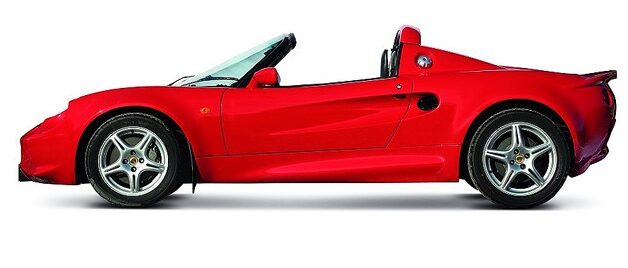
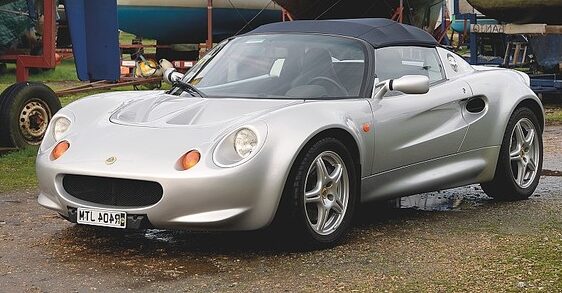 (航空機用接着剤で接合した革新的なアルミ押し出し材のバスタブシャシーに、FRP(繊維強化プラスチック)製のボディを組み合わせることで、圧倒的な軽量化を実現、姉妹車の、オペルスピードスターと共に私のヒーローたちです!
ーーーー>この初代型が、一番エリートの面影が強く感じます。
*ロングボウ、スピードスター/ ロードスター、2027?
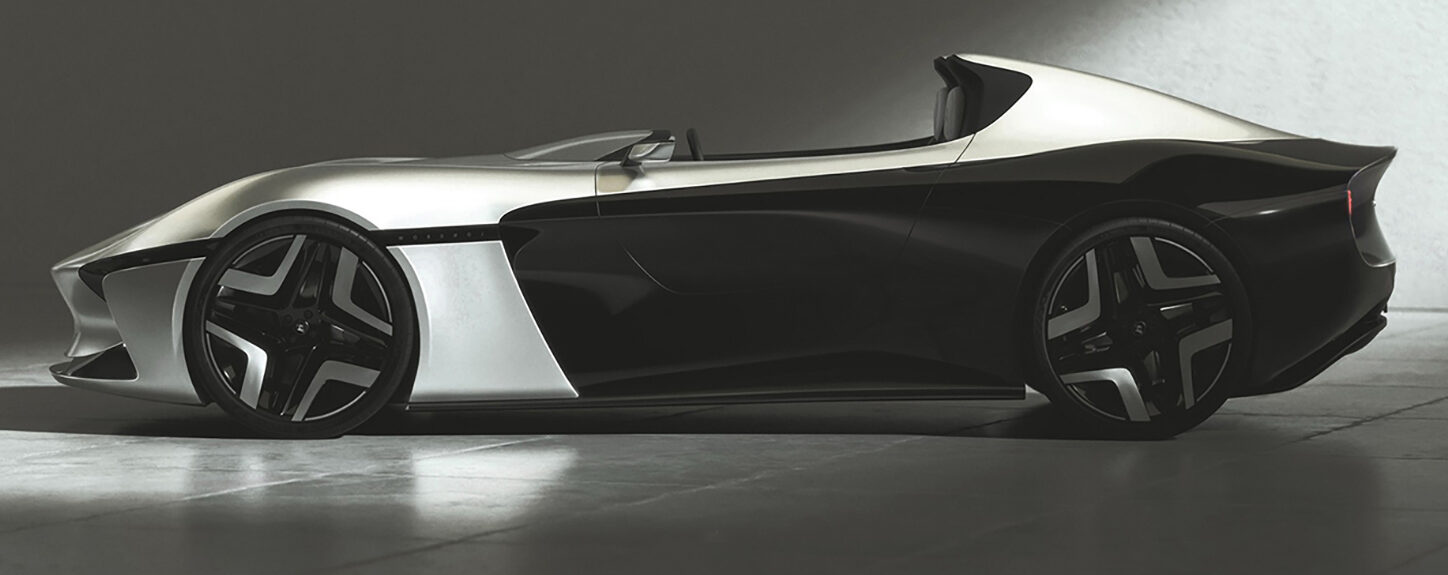
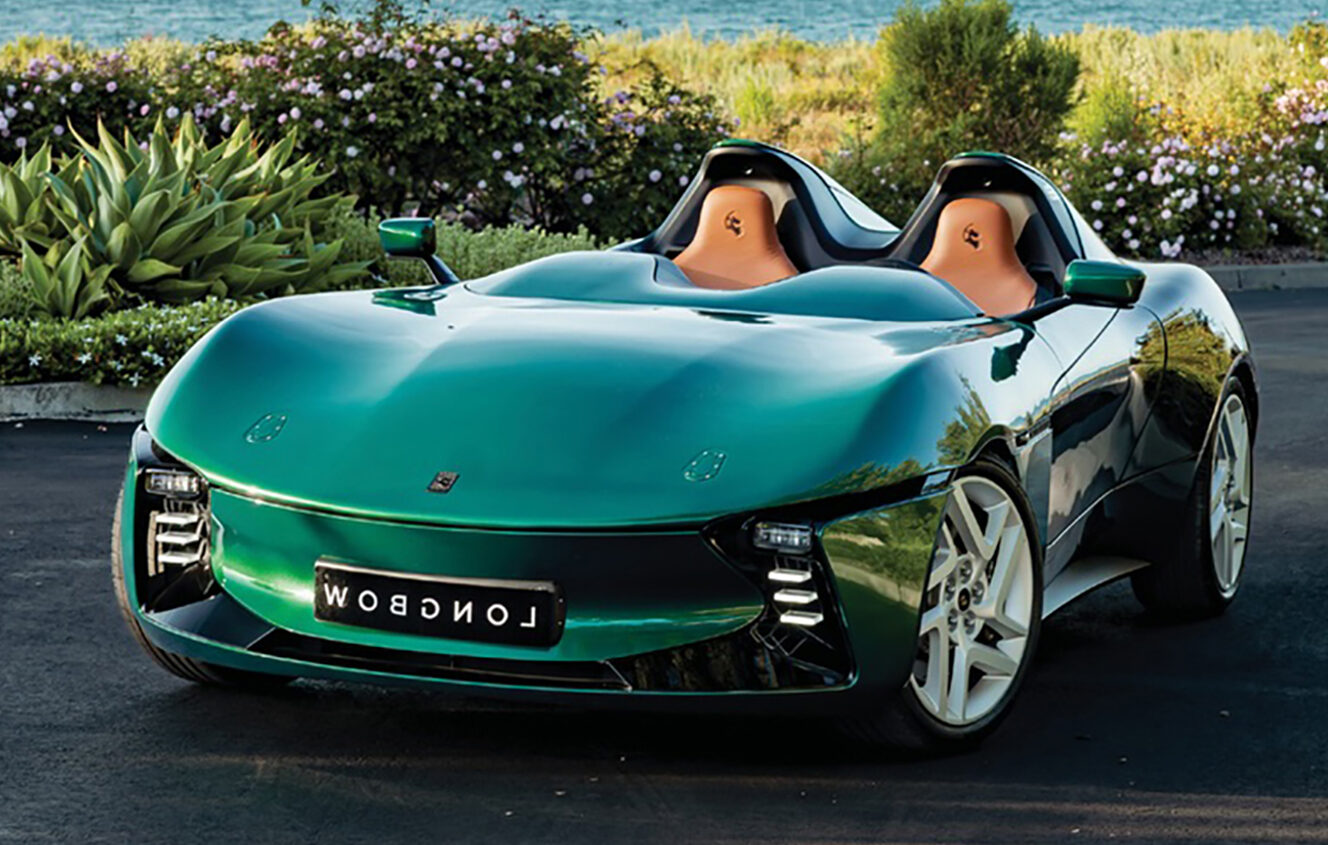
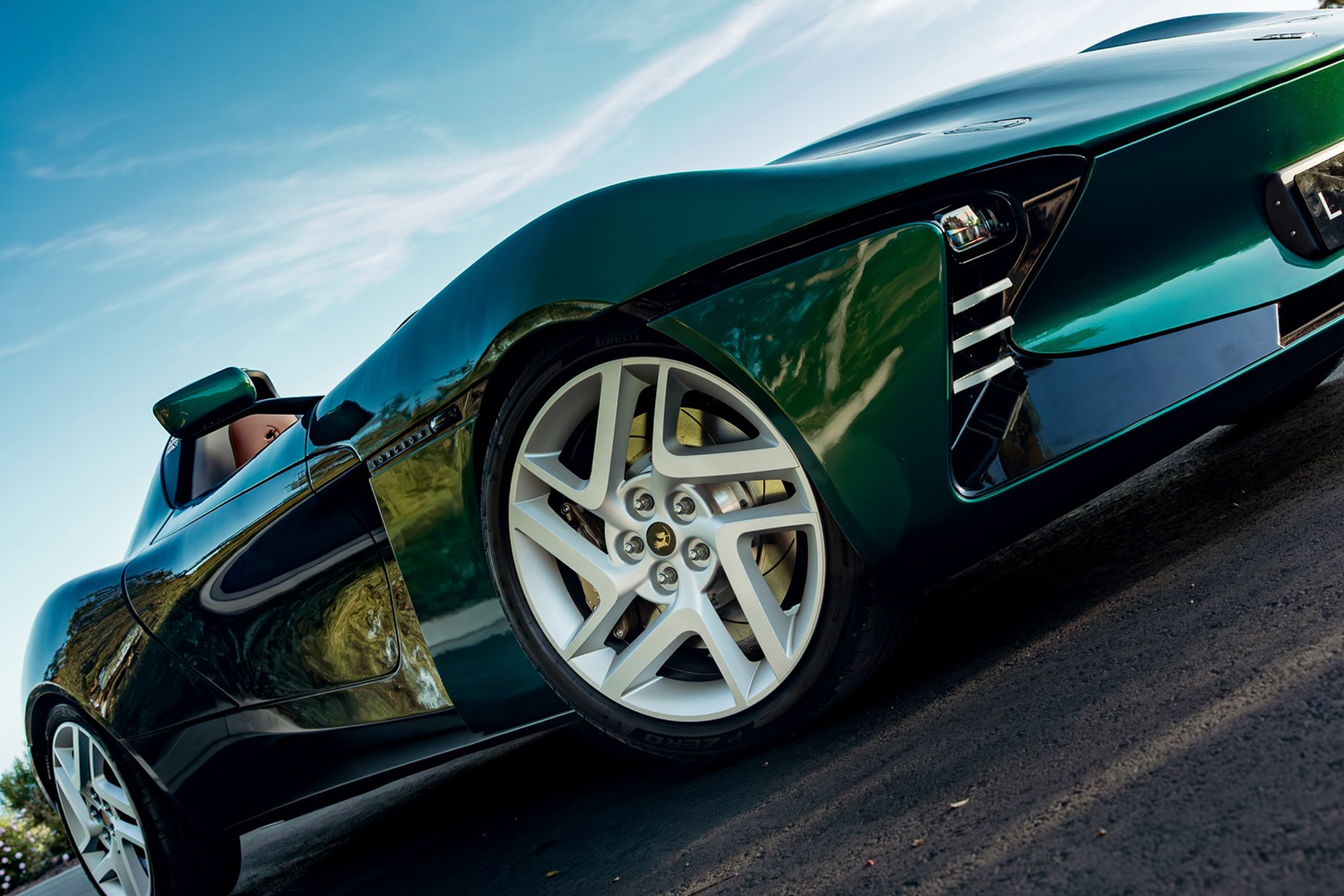
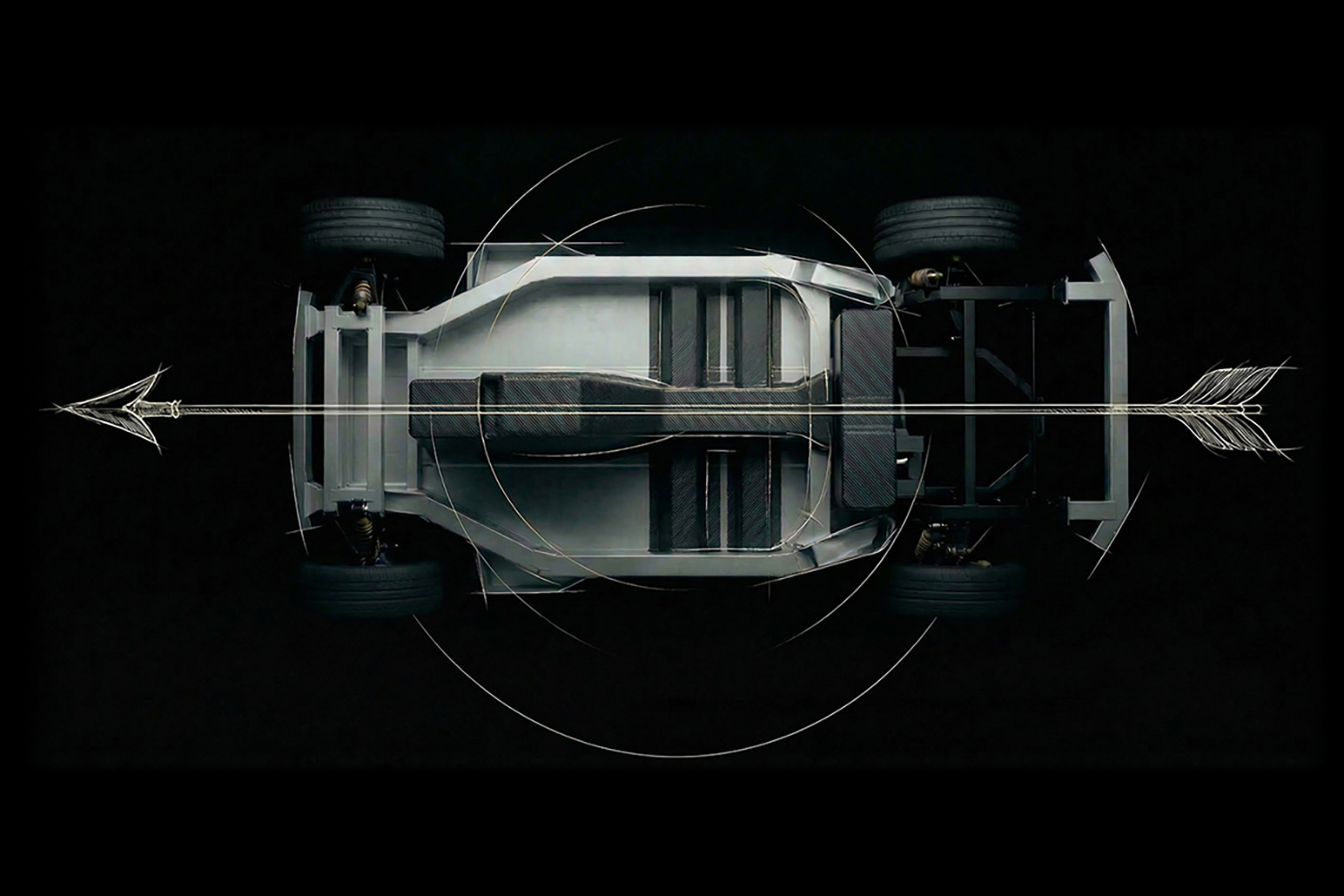 (元テスラの幹部が英国で立ち上げた、『軽さによる速さ』がテーマのピュアスポーツ、、、
ーーー>外観デザインが現在のロータスより、ロータスっぽいのがうれしいです)
*ジャナレリー『デザイン‐1』
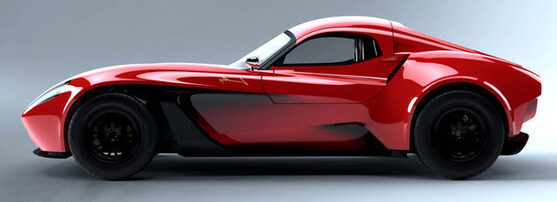
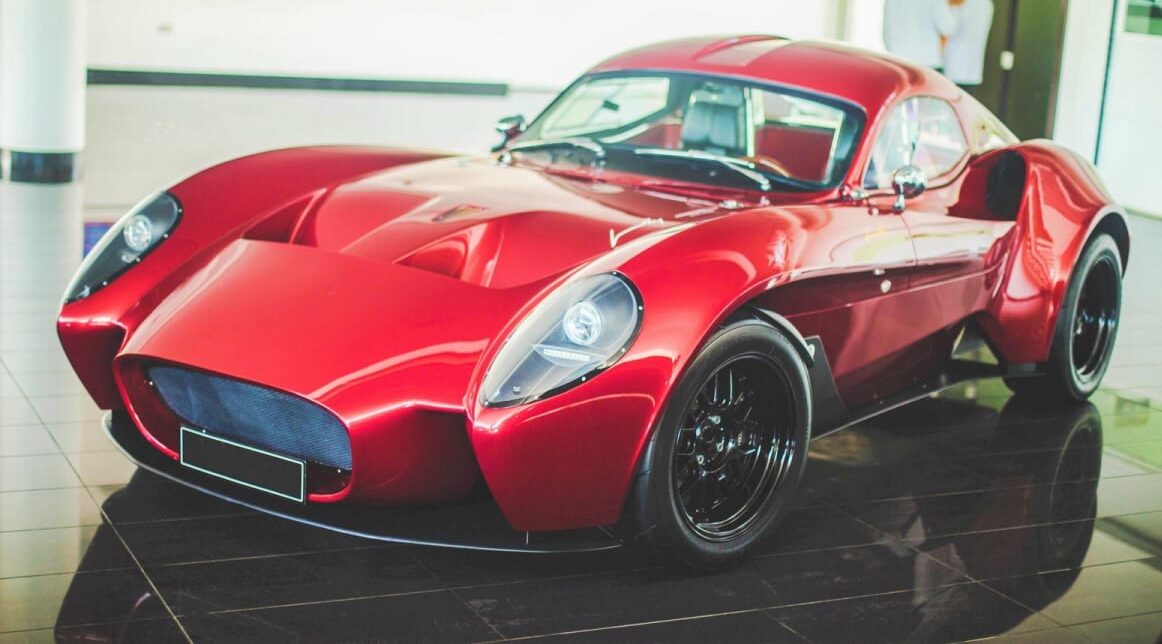
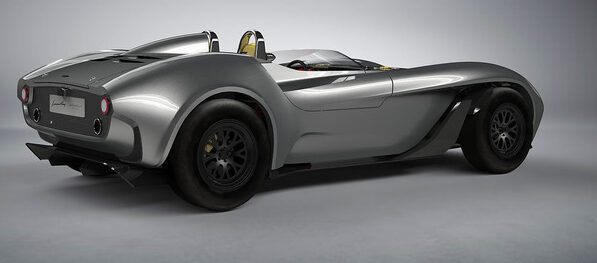 (中東発の軽量スポーツは、最近軽量スポーツEVへ方向転換、
ーーー>相変わらずフェラーリ250TR ポンツーンフェンダー版っぽい外観デザインが魅力的)
超軽量スポーツカーの歴史は
現在も連綿と受け継がれているようです!
EV御軽量化も計画されているようで、
今後もすごく楽しみです!
始祖鳥への敬意は
深まるばかりです!
 次回はロータスエランS4
スプリントに付いて、
考察してみたいです。
お楽しみに――
本ブログと記事内容につきまして:
ブログ記事を書くにあたり私の目標は、立体造形(料理も含めて)とのかかわりを通じて、私個人の特徴的(ネジ曲がり方も含めて)な評価軸を解明することで、「美しさ・美味しさ」に対する好奇心や、探求心を、どのように満足・充足させてきたのかを明記しておくことです。
従いまして、記事の中に出てくる、数字や年号、微細なデータなどには細心の注意を払っておりますが、時に大きな間違いや勘違いを犯していることも考えられます。特に自動車記事における主要諸元や、年号などには紛らわしいものも多く、あくまで参考程度に考えていただければ幸いです。
私としては、記事の中で個人的な外観デザインや味覚の評価、そこから広がる後半部分につなげるための、『流れ』を作るための客観的材料として年号やデータを挿入している感じです。あくまで重視したいのは、私個人の頭の中で起こる、記憶の錯そう的混沌から生まれる新たな『見方』や『情報の予想外のつながり』です。その勢いを作り出す、『流れ』の一環として、諸データが副次的に必要となるわけです。
話がそれますが、大好きな落語の世界に「三題噺」という、その場て会場から募った3つのお題を使って1つのお話に仕立てるといったお遊びがございますが、私はそれに近いことを立体造形の特徴や(料理のお味)をお題にして行っている感じがします。その中で頭の中に去来する数々の着想が、全く予想外で楽しく、次回からの記事内容を大幅に変えたり、新展開につながっています。
当ブロブの仕組み:
『好奇心の点と線 x 気まぐれ脳内回路=予想外の新展開』
こんな自分勝手なブログですが、今後ともよろしくお願いいたします。
追記:上記の『流れ』を作る為に必要な写真はできる限り、個人所有のミニカー・自前の料理などを使い撮影しておりますが、その他の必要最小限の図版や写真を他のブログ主様の記事や諸会社ホームページなどからお借りしております。(記事内容に合うよう加工させていただき、使用時は最小の解像度で載せております。)問題がある場合、ご連絡いただければ直ちに降ろさせていただきます。
追記2:当ブログ記事に掲載のミニカー写真等(個人撮影)は許可なしで、どのようにお使いいただいても結構です。私個人の創造性はこの世のもの、と言う認識の上で記事を製作しています。
!!!!!!!!!!!!!!!!!!!!!!!!!!!!!!!!!!!! Translated in English !!!!!!!!!!!!!!!!!!!!!!!!!!!!!!!!!!!!
(Miniature car used for photography #1: Spark, 1/43 scale resin model, First-generation Lotus Elan S1, 1958 (British Racing Green) —— Modifications: After correcting warping in the front and rear bumpers, the body was disassembled vertically to fine-tune the track width and axle positions of the tires and wheels; it took half a day to thoroughly recreate the distinctive stance of British cars from that era)
Favorite Car Designs: No. 53—The Lineage of Two-Door Coupes: No. 33 [British Cars ②] Lotus First-Generation Elite, 1958 (British Green) “Chapman’s Ultra-Lightweight Sports Car” Lotus Elite, 1959 (British Green) “Chapman’s Idealism”
#Modification Project:
Modification Process:
1: Remove the rear and front bumpers, reshape them, then reattach them;
2: Disassemble the upper and lower body sections and remove all glued-in axles,
3: Shave the front and rear body-side bearings down by 2–3 mm,
4: Remove the wheels and tires from the front and rear axles to maximize track width,
5: Repeat the process while fine-tuning the axle height to achieve the ideal forward-leaning stance,
6: Once the fit is perfect, reattach the upper and lower body sections
n
N
m
n
N
n
n
n
n
n
n
n
n
n
n
N
m
n
N
n
n
n
n
n
(Miniature car used for photography #2: Manufactured by IXO, 1/43 scale die-cast ready-to-display model, First-generation Lotus Elan S1, 1959 (British Racing Green) —— Modifications: The body was disassembled into upper and lower halves; the track width and axle positions of the tires and wheels were fine-tuned; it took half a day to thoroughly recreate the distinctive stance characteristic of British cars of that era)
(Miniature car used for photography #3: SPARK, 1/43 resin ready-to-display model, Lotus Elan S4 Sprint (Metallic Blue, White & Gold) —— Modifications: After separating the upper and lower sections, maximized the tire and wheel track width⁺ and fine-tuned the front and rear axle positions to achieve a slightly forward-leaning stance)
For this 53rd installment, titled “The Lineage of 2-Door Coupes, Part 33,” I’d like to discuss luxury 2-door (GT) coupes and roadsters, which strongly reflect the national characteristics and unique exterior design styles of various countries. [Note: Includes convertibles]
I’ll proceed as follows.
In this 33rd installment, we’ll finally move on to
[British Cars Part 2] No. 001,
the first-generation Lotus Elite (British Green),
released in 1958.
[The Lineage of 2-Door Coupes: Table of Contents]
[American Cars]
Part 1: Cadillac El Mirage, 2013 (Metallic Red)
Part 2: Lincoln Continental MK4, 1972 (Black)
Part 3: Mercury Cougar, 1967 (LT Metallic Green)
[German Cars]
Part 4: MB 500K Special Roadster, 1936 (Black)
Part 5: MB 300SL Roadster, 1957 (Silver)
Part 6: MB SLS AMR Gullwing, 2010 (Black)
[British Cars]
Part 7: McLaren F1, 1992 (Metallic Orange)
Episode 8: Jaguar XKSS Roadster, 1957 (Royal Blue)
Episode 9: Jaguar XKR Coupe, 1996 (Dark Metallic Green)
[Japanese Cars / Nissan Edition]
Episode 10: Nissan First-Generation Silvia, 1965 (Champagne Gold)
Episode 11: Nissan 5th-Generation Silvia, 1988 (LT Metallic Green)
[Italian Cars]
Episode 12: Ferrari 250TR Pontoon Fender, 1958 (Red)
Episode 13: Ferrari 250GTO, 1962 (Italian Red)
Episode 14: Lamborghini Concept S, 2005 (Pearl White)
[Japanese Cars: Mazda Edition]
Episode 15: Mazda Cosmo Sport, 1968 (Racing White)
Episode 16: Mazda Eunos Cosmo, Type-S (Two-Tone: Black & Gray)
[French Cars]
Episode 17: Bugatti Type 59, 1935 (French Blue)
Episode 18: Citroën SM, 1970 (Champagne Gold)
Episode 19: Bugatti La Voiture Noire, 2019 (Black)
[Japanese Cars: Toyota Edition]
Episode 20: Toyota/Yamaha 2000GT, 1967 (Ivory White)
Episode 21: Toyota 2nd-Generation Soarer, 1986 (Crystal White II)
Episode 22: Lexus LC500 [GWZ100], 2017 (MT Red)
[American Cars, Part 2]
Episode 23: Dodge Challenger, 1970 & Plymouth Barracuda, 1971
Episode 24: Dodge Viper SRT-10 ACR, 2008 (Black)
Episode 25: Ford Shelby GR-1 Concept, 2004 (Chrome)
【Japanese Cars: Mitsubishi Edition】
Episode 26: Mitsubishi Galant λ, 1976 (Brown Metallic)
Episode 27: Mitsubishi Eclipse [North American Spec], 2006 (Orange Metallic)
[German Cars Part 2]
Episode 28: BMW M635CSi, 1984 (Dark Metallic Blue)
Episode 29: Mercedes-Benz 560SEC AMG 6.0 Widebody, 1989 (Black)
Episode 30: BMW M2 with Genuine Performance Parts, 2025 (Neon Lime)
Episode 31: First-Generation Audi TT, 1998 (Lake Silver Metallic)
[Japanese Cars: Subaru Edition]
Episode 32: Subaru Crosstrek XV, 2012 (Lime Green Metallic)
[British Cars Part 2]
Episode 33: Lotus First-Generation Elite, 1958 (British Green)
Episode 34: Lotus Elan S4 Sprint (2-Tone: Blue, White & Gold)
Episode 35: Jaguar E-Type Roadster (Light Blue Metallic)
[Japanese Cars: Honda (Lightweight Sports Cars)]
Episode 36: Honda S800, 1966 (Red)
Episode 37: Honda First-Generation CR-X 1.5i, 1983 (Blue & Silver Two-Tone)
Episode 38: Honda Beat, 1991 (Samba Yellow)
[Italian Cars Part 2]
Episode 39: Lancia Gamma Coupe, 1976 (Grigio Argent (Silver))
Episode 40: Maserati Merak SS, 1975 (Blu Sera Metallizzato)
Episode 41: Ferrari LaFerrari, 2013 (Rosso Corsa (Red))
[Japanese Cars: Toyota Part 2]
Episode 39: Toyota Corona Hardtop 1800GT-TR, 1982 (Red)
Episode 40: Toyota GR Supra [DB Series, A90/A91] (Silver)
Episode 41: Toyota GR GT, 2027 [Planned] (Gunmetal)
[American Cars Part 3: Special Edition]: The Corvette Lineage
Episode 1: 1967 Stingray [C2] Convertible (Hardtop, Metallic Blue)
Episode 2: 1972 Corvette [C3] Convertible (Metallic Blue)
Episode 3: 1984 Corvette [C4] Coupe (Bright Red)
Part 4: Corvette Indy, 1986 [Mid-Ship Prototype] (Silver)
Part 5: Stingray Concept [Prototype], 2009 (Blue Metallic)
#Colin Chapman’s Dream: The Original British Lightweight Sports Car!
n
N
N
N
N
N
N
N
N
N
N
N
n
N
N
N
N
N
N
N
N
N
N
N
n
N
N
N
N
N
N
N
N
N
N
N
n
As a self-proclaimed “3D design fetishist,” this is the car I’ve spent the longest time
trying to unravel the “secret of its beauty,”
* through white metal kits,
* classic car museums,
* Concours d’Elegance [vintage car shows],
* illustrated books, and photos scattered across the internet and websites,
through all kinds of media,
I’ve been muttering to myself, “Maybe this, maybe that,”
as I’ve researched this car. (lol)
Now, at long last,
I’m finally able to dive into this car,
and I’m trembling with excitement. Yay!
So then,
here’s how I’d like to structure this article
on the “ultra-lightweight coupe”—
the masterpiece of the genius designer Colin Chapman:
* Real-Car Analysis: Fiberglass Construction ——> “The Pinnacle of Beauty”
* Exterior Design Features: The Ultimate Pursuit of Aerodynamics ——> Organic Surfaces
* “Me” and the First-Generation Lotus Elite: 30 Years of a Close-Yet-Distant Relationship
* Three-Theme Story: Ultra-Lightweight, Toyota 2000GT, Organic Surfaces
* Other British “Lightweight Sports Cars”…
* Car Overview: Fiberglass Construction → “The Pinnacle of Beauty”
Overview:
n
n
The first-generation Lotus Elite (1959) is the great progenitor of lightweight rear-engine sports cars, embodying to the utmost the philosophy of genius engineer Colin Chapman: “Lightness is justice.”
n
In this article, we will explore this masterpiece—which still shines brilliantly in automotive history—from a designer’s perspective, examining the innovation of its mechanics, the aesthetics of its exterior design, and the immeasurable influence it had on legendary cars that followed.
n
n
n
N
N
N
N
N
N
N
N
N
N
N
n
N
N
N
N
N
N
N
N
N
N
N
n
N
N
N
N
N
N
N
N
N
N
N
n
N
N
N
N
N
N
N
N
N
N
Nn
N
N
N
N
N
N
N
N
N
N
Nn
N
N
N
N
N
N
N
N
N
N
N
n
n
n
n
N
n
n
1. Innovation in Mechanism: An Ultra-Lightweight Approach as Structural Beauty
n
When viewing the Elite’s mechanism from a designer’s perspective, the most remarkable feature is the world’s first monocoque structure made entirely of FRP (fiber-reinforced plastic) monocoque structure. Rather than mounting the body on a metal chassis like a conventional car, the body itself was designed to serve as the structural framework (monocoque).
n
Integration of Structure and Function: With the exception of the front suspension mounting points and a very small portion of the engine mounts—where steel subframes are embedded—nearly all load-bearing structural components are made of FRP. This represents the pinnacle of Chapman’s minimalist philosophy of “assigning multiple roles to a single component,” and as a result, the car achieved an astonishingly light curb weight of just over 500 kg.
The Power-to-Weight Ratio Philosophy: The Coventry Climax 1.2L inline-four “FWE” engine initially delivered a modest 75 horsepower (though a high-performance version was later introduced). However, thanks to its overwhelmingly light weight, it possessed agility sufficient to outmaneuver the large-displacement sports cars of the era on the racetrack, along with superb handling performance.
The mechanical design itself defined the car’s character—lightweight, pure, and agile—and the process of stripping away all unnecessary elements can be described as industrial design at its finest.
n
n
n
n
2. Exterior Design: An Organic Form Merging Aerodynamics and Emotion
n
n
n
n
The exterior of the first-generation Elite was initially sketched by Peter Kilwan Taylor (an accountant by profession but possessing extraordinary artistic sensibility), and later refined by the renowned cost engineer Frank Costin (an aerodynamics specialist) and his team. Its form boasts proportions so perfect that even modern designers would find them flawless.
n
Sleek FR Proportions: While embodying the classic “long nose, short deck” design of FR sports cars, the overall volume is surprisingly compact. It is composed of athletic, organic curves—free of any unnecessary bulk—that take full advantage of the design flexibility offered by FRP molding.
Outstanding Aerodynamic Management: Front openings are kept to a minimum, guiding airflow from the low, smooth hood to the beautifully sloping windshield. From the roof to the rear end, it features a flowing fastback style. It achieves an astonishing aerodynamic performance with a Cd value (drag coefficient) of 0.29—a figure that rivals even the latest eco-friendly cars of today.
Refined Details: It eschews “decoration for decoration’s sake”—such as excessive chrome trim on the bumpers—and relies solely on its sculptural beauty. Due to the nature of FRP, the number of panel dividing lines (parting lines) was kept to a minimum, further emphasizing the car’s sense of unity and clean, elegant beauty.
n
N
n
3. Its Status as the Pioneer of Lightweight FR Sports Cars and Its Influence on Future Generations
n
The Lotus Elite is an absolute landmark that overturned the prevailing concept of sports cars—which had been defined by “brute force driven by heavy, large-displacement engines”—and established the theory of lightweight FR sports cars that continues to this day: “maneuvering a lightweight, compact body with superior handling.” This philosophy and design language became deeply ingrained in the DNA of subsequent FR sports cars.
n
n
① The Legacy Passed Down to the Lotus Elan
n
Taking into account the commercial lessons learned from the Elite—such as the manufacturing costs of the FRP monocoque and issues with vibration and noise—the Lotus Elan, introduced in 1962, evolved to a design featuring a steel backbone chassis covered by an FRP body. However, it fully inherited the essence pioneered by the Elite—namely, “overwhelming lightness and exceptional handling”—and, in a form better suited for mass production, cemented the boom in lightweight sports cars.
N
n
② Aesthetic Influence on the Toyota 2000GT
n
n
n
N
N
N
N
N
N
N
N
N
N
Nn
N
N
N
N
N
N
n
n
n
The Lotus Elite was undoubtedly a major source of inspiration during the process of exploring the design sketches and proportions of the Toyota 2000GT—Japan’s pride and joy, a super sports car unveiled in 1967.
n
The hood lowered to its absolute limit, the “coke bottle” line that flows smoothly from the front fenders to the doors and then to the rear fenders, the compact, tapered cabin, and the fastback rear end. From a designer’s perspective, the essence of this “emotional and refined beauty” embodied by the Toyota 2000GT represents Japan’s finest response to the fusion of aerodynamics and aesthetics pioneered by the Elite.
n
N
N:
Summary:
n
The 1959 Lotus Elite—the first generation—is not merely a beautiful classic car of the past. It is a living textbook that proves the essence of industrial design: “True beauty can only be found at the very end of the pursuit of function.”
Its taut proportions and ultra-lightweight packaging have been passed down through the ages—to the Elan, the Toyota 2000GT, and later the Eunos Roadster—and it remains the origin of rear-wheel-drive sports car design worldwide.
n
N
#Side Note:
n
When discussing the first-generation Lotus Elite, the unvarnished fact that “challenges in FRP manufacturing (technical limitations) ultimately gave rise to a uniquely refined design” is the most exciting story for any designer.
Unlike today’s carbon fiber and advanced injection molding, FRP (fiber-reinforced plastic) at that time was primarily produced using the extremely primitive “hand-layup method,” in which resin was layered by hand. I will explain the challenges brought about by this technical immaturity and the decisive impact it had on the design from three perspectives.
n
n
1. The Beauty of Sensual Curves Born from the Need for “Stress Distribution”
n
The greatest weakness of FRP at the time was its susceptibility to cracking when sharp edges or flat surfaces were subjected to heavy loads, as well as its inability to maintain structural rigidity—it would flex and sag. Since the Elite featured a monocoque structure (where the entire outer shell provides structural strength), this weakness could have been fatal.
N
Impact on Design:
Designers and engineers eliminated all “sharp edges” and “wide flat surfaces” from the body. To evenly distribute stress and enhance the rigidity of the surfaces, they constructed every panel using taut, organic three-dimensional curved surfaces (double curves).
The tight, sensuous “coke bottle” line flowing from the front fenders to the doors and rear, as well as the bulged hood, were not created merely for aesthetic reasons but were born out of “structural necessity to make the FRP less prone to cracking and to provide strength.”
n
N
2. A Sculptural Sense of Unity Born from Concealed Joints (Parting Lines)
N
The Elite’s monocoque was constructed by literally bonding massive FRP structural components—broadly categorized as the “upper section,” “lower section,” and “inner frame”—together with adhesive (epoxy resin), much like a “monaka” wafer sandwich. Due to the nature of this molding process, seams (parting lines) between parts were inevitable. With a conventional metal body, this could be resolved by dividing the panels to create gaps (chill), but this is not possible with a monocoque.
N
Impact on Design:
Rather than hiding these seams, the designers elevated them to become the focal point of the design (character lines). The thin, press-line-like contours running horizontally along the body sides are actually the result of smoothly trimming away the lip (flange) that formed when the upper and lower FRP molds were joined.
As a result, a sculptural sense of unity—a “seamless look”—emerged, as if carved from a single block, completely distinct from the “mechanical appearance of multiple assembled panels” found in modern cars.
n
N
n
3. Pure Proportions Free of Undercuts, Born from Molding Constraints
n
In FRP molding, after resin is poured into the female mold and cured, the product must be “ejected” from the mold. Therefore, it is absolutely impossible to create shapes that would snag on the mold and prevent removal (undercuts).
n
Impact on Design:
The reason the lower body of the Elite (around the side sills) and the front and rear ends do not curve inward excessively but instead converge beautifully and smoothly downward is that the “draft angle” required for smooth removal from the mold has been meticulously calculated.
This constraint makes it physically impossible to create unnecessary irregularities or complex steps, and as a result, it inevitably leads to an extremely clean, flowing silhouette that catches the eye from every angle.
n
N
n
Summary: Design Excellence That Transformed Constraints into a Classic (Timeless Masterpiece)
n
Modern designers can create “any shape” by making full use of computers and a wide range of materials. However, the first-generation Elite faced a triple challenge: “FRP is weak on flat surfaces, its edges crack easily, and it is difficult to remove from the mold.”
Rather than trying to hide these weaknesses, the development team—led by Peter Kilwan Taylor—honestly embraced the material’s capricious properties. The result was that maddeningly beautiful, taut, and sensual form. In that “the limitations of technology (constraints) are precisely what perfected a timeless aesthetic of subtraction,” the Elite can be called the ultimate underdog story in the history of automotive design.
n
n
#Three-View Photos:
#Key Specifications:
Model: Coventry Climax FWE
Total Displacement: 1,261 cc (inline-6 DOHC)
Fuel System: SU carburetor (standard: single or twin)
Maximum Power: 72 hp (75 PS) / 6,100 rpm
(*Standard specification. Varies depending on tuning; later SE models, etc., produced 85–95 hp)
Maximum Torque: 104 Nm (10.6 kgm) / 3,750 rpm
Drivetrain: FR (front-engine, rear-wheel drive)
Seating Capacity: 2 passengers
Body Style: 2-door fixed-roof coupe (2-seater)
Drag Coefficient (Cd): 0.29
Top Speed: 180 km/h (112 mph)
Wheelbase: 2,235 mm
Overall Length: 3,708 mm
Overall Width: 1,499 mm
Overall Height: 1,168 mm
Curb Weight:
Approx. 504 kg – 506 kg
* Exterior Design Features: Beautiful, organic surfaces born from the pursuit of aerodynamics
The type of car that attracts me the most is
(among automotive designs…)
one where the cabin is pulled way back,
as if it’s about to burst forward at any moment…
It’s a car with FR proportions,
and among them, this Lotus Elite is pulled back so far that it rivals the top two.
By the way,
if I were to make a list,
1: Austin-Healey 100/4 BN1
2: Lotus Elite
3: Virtually all pre-war FR sports cars
4: BMW 507
5: Dodge Viper
6: Mercedes-Benz SLS AMG
7: Toyota GR Supra
8: Toyota GR GT
Honorable Mention: Bill Thomas Cheetah (race car)
Among these, I’m particularly drawn to
the one right after the Cheetah.
So,
I’d like to list
five design features of the
“First-Generation Lotus Elite,”
a sports car with a cabin
tucked far back.
1: Within a compact space comparable to a kei car, the cabin is pushed as far back as possible—resulting in razor-sharp, beautiful FR proportions—> A cabin design even more compact than the Austin-Healey BN1
2: This shape emerged naturally as a result of making full use of the fiberglass body—> An incredibly organic body shape with absolutely no creases or artificial character lines
3: Made possible by mounting a small inline-four engine in a front-mid position—> An extremely low front end and the playful look of the oval radiator grille perched right there [ ]
4: The sense that the rear edges of the side windows and the body are being pulled backward, further emphasizing the taut, drawn-in look from  —> It’s like pinching the top edge of a 1/24-scale die-cast model’s side window with your finger and pulling it backward…?
5: By fitting large, narrow tires [155 R 15] to the four corners of a kei car-sized vehicle [Overall Length: 3.6 m]—> This creates a fantastic sense of stance!
Now then,
let’s take a look at each point one by one with photos!
1: Within a compact space comparable to a kei car, the cabin has been pulled back as far as possible—resulting in razor-sharp, beautiful FR proportions.
(This reminds me of the history of personal transportation, specifically the era of four-horse carriages, when the coachman’s cabin was positioned directly behind the horses.)
――> A cabin design even more compact than that of the Austin-Healey BN1
2: It happened by chance as a result of making full use of the fiberglass body
(Unlike the contrived, organic surfaces of the ’80s, this three-dimensionality—rich with a smooth, flowing quality—arose directly from the materials and function)
――> An incredibly organic body design, completely devoid of creases or any character-specific intent
3: Made possible by mounting a small inline-four engine in a front-mid position
――> An extremely low front end and the playful touch of the oval radiator grille perched right there [ ]
4: The sense that the rear edges of the side windows and the body are being pulled backward, further emphasizing the taut, drawn-in look from
――> It’s like pinching the top edge of a 1/24-scale die-cast model’s side window with your finger and pulling it backward…?
5: By fitting large, narrow tires [155 R 15] to the four corners of a kei car-sized vehicle [Overall Length: 3.6 m],
――> It creates a fantastic sense of stance!
Next,
it’s time for my personal story…
* “Me” and the Lotus Elite: A 30-Year Relationship…
My “First-Generation Lotus Elite”—
My connection with it began
a single photo I saw in
*Car Graphic Classic*, published by Nigensha,
of a deep metallic blue body with a silver cabin.
*I already knew how beautiful the shape was,
*but what I learned from this feature was the 15-inch wheels―――> their extraordinary size!
* The exquisite blend of metallic blue that beautifully accentuates the three-dimensional body
* The silver cabin that complements it perfectly
* And what really got my heart racing—> the bright yellow cylinder head
For over 30 years since then,
I’ve been struggling to find
the source and root of its charm. I’m so happy
Since then,
*I’ve attended “Concord d’Elegance”-style auto shows,
*visited classic car museums,
*and explored magazines and books from around the world,
all while
building and admiring 1/43-scale model cars,
I’ve been researching
the source of the [Lotus Elite]’s charm,
#Sculpting Experience:
*SMTS 1/43 White Metal Kit, Lotus Elite, 1959
(Both a kit version and a finished model were released by this long-established kit manufacturer. However, the overall design felt too monolithic and lacked definition—the body lacked contrast—so I wasn’t satisfied. I spent about half a year struggling with it, applying putty to refine the sweep of the front fenders and the body sides, going back and forth with “this doesn’t work, that doesn’t work.” In the end, I gave up before painting, and the project was shelved… *sob*)
ーーーー>In some ways, that struggle laid the foundation for my later work in three-dimensional modeling.
*IXO, 1/43 scale die-cast ready-to-display model, Lotus Elite (BR Green)
(It’s a fairly old casting, but it captures the Elite’s voluptuous curves well. On the other hand, it feels a bit on the large side, which surprised me a little when I saw the real thing.
――>I was satisfied with this one until I saw the Spark version.)
* Spark, 1/43 resin ready-to-display model, First-generation Lotus Elite (BR Green)
(I found one on Mercari at a reasonable price, so I decided to buy it—and was amazed. It perfectly recreated the Elite I’d imagined, and since it’s the latest ready-to-display model, the detailing on the window frames and interior was also excellent.
—————> It really drove home just how much resin models have evolved over the past 20 years or so.)
Now, finally, the moment you’ve all been waiting for—
it’s time for the “Three-Theme Story”!
*Three-Theme Story: Toyota 2000GT, Organic Curves, Ultra-Lightweight
Just like last time, I received
the themes from everyone in the audience.
#Topics
* Toyota 2000GT
* Organic Curves
* Ultra-Lightweight
#Underlying Theme: “Those Who Come After Reap the Benefits of Those Who Came Before”
(Meaning: Because those who came before planted trees, those who come after can enjoy the cool shade.)
Prompt:
Please write an explanatory text (within 3,000 characters) about the mechanical structure and exterior design of the 1958 Lotus Elite sports car from the perspective of an actual designer. Structure it as a conversation between a British factory owner—a mechanical enthusiast from the Industrial Revolution era—and a craftsman-like mechanical engineer, in the style of a traditional “San-dai-banashi” storytelling format. Conclude by tying back to the theme with an intellectually witty closing remark. The underlying theme is: “Pioneering the Path” (emphasizing the hardships of pioneers). The three specific topics are: ultra-lightweight construction, the Toyota 2000GT, and organic curves.
N
“The Aesthetics of Subtraction That Cuts Through Even Iron: A Side Story of the 1958 Lotus Elite, or the Encounter Between the Steam Engine and Carbon Fiber”
n
I hope you’ll bear with me for a moment.
(The sound of a fan being snapped open: pan, pan, papan)
n
Yes, the setting is the mist-shrouded land, the birthplace of industry—the British Empire. The time is the nineteenth century, in the midst of the Industrial Revolution… or so I’d like to say, but today I’d like to wind the screws of time and space back—or perhaps forward—a bit, and guide you all under the eaves of a mysterious small town workshop.
n
There, two men stand side by side. One is Jeremiah, a factory owner who looks every bit the stubborn type, raised on the lullabies of steam engine pistons and gears. The other is Thomas, a craftsman-like mechanical engineer who, when given an oil-stained wrench—not a shuriken—is second to none.
n
These two take pride in having weathered the stormy waves of modernization, but now, faced with “a certain vehicle that seems to have come straight from the future,” they stand with their arms crossed, grumbling. That vehicle is none other than the “Lotus Elite (Series 1),” a miraculous masterpiece released in 1958 by Lotus, led by Colin Chapman.
n
Now then, let’s have these two “mechanical enthusiasts” describe this crystallization of British spirit—which seems to mock even Henry Ford’s mass production—from the perspective of us professional designers.
n
n
◇
“Hey, Thomas. Take a look at this hunk of iron… no, wait, it’s not iron. Look at this eggshell-like body. While we’ve been working our butts off machining cast-iron flywheels, what on earth has become of the British people of the future?”
M
Jeremiah, the factory owner, said this while fiddling with a brass bolt instead of his pipe. Thomas, the engineer, ran his fingers over the body’s smooth curves and let out a sigh of admiration.
n
n
“Sir, it’s too soon to be surprised. This isn’t just a thin shell. I can’t find an iron frame anywhere I look. Believe it or not, the body itself is the structural framework… it’s made of a ‘monocoque structure’ using fiber-reinforced plastic (FRP). Think of how thick the steel plates and how many rivets we’ve had to use to support the boiler’s pressure. This car has pulled it off using nothing but resin and glass fiber. It’s truly ‘ultra-lightweight.’ It weighs just over 500 kilograms—less than half the weight of our company’s horse-drawn cart, which is pulled by a single horse!”
n
“Ultra-lightweight, you say? They often say ‘lightness is justice,’ but Thomas, don’t forget the hardships of ‘pioneers’ like us. Being the very first to bring new technology to life is literally like ‘planting a tree for future generations’—they say the predecessors plant the tree so that those who come after can enjoy its shade, but the one planting that tree gets thorns in his fingers and has to swallow muddy water.
This FRP monocoque is no exception. I’m sure Mr. Chapman, too, suffered major setbacks at first—suspension mounts snapping off, the body cracking from engine vibrations—the kind of damage that would keep you up at night. Pioneering uncharted territory without established know-how is a battle against fear, just like blowing up the very first boiler of a steam engine.”
n
“Wow, as expected of you, sir—you really see right through it. Rumor has it that this elite designer, Peter Kilwan Taylor, wasn’t actually a professional car designer—he was an accountant. But that’s precisely why he wasn’t bound by existing ‘ironclad theories.’ However, there’s a steel box quietly embedded right in the part that bears the suspension load. The traces of the cold sweat shed by that pioneer are firmly etched into the underside of this FRP, you see.”
n
Still brimming with excitement, Thomas walked around the car, moving from the front to the rear.
n
“And sir, just look at this design. The steam locomotives we build are a combination of straight lines and cylinders—in short, disciplined masses of machinery. But what do you make of this Elite’s exterior? It’s an ‘organic curve’—smooth, with not a single sharp edge, as if the Wind God had caressed it with his fingertips. From the front fender to the doors, and all the way to the rear tail end, it flows as if a single life were coursing through it. This is a terrifyingly keen aesthetic sense, an attempt to bring machinery closer to the harmony of nature.”
n
Jeremiah nodded with a “Hmm” and narrowed his eyes.
n
“I see. Making a machine look not just like a tool, but like a living creature. These organic curves are also a strategy for slicing through the wall of air. But Thomas, the DNA of this design didn’t just vanish into the British fog. That spark flew all the way to a distant island nation in the East—Japan. Do you know about the ‘Toyota 2000GT,’ a futuristic Japanese sports car?”
n
“Oh, sir, are you talking about Japan?”
n
“That’s right. The beautiful proportions of that Toyota 2000GT—with its long nose and short deck—and the sleek, ground-hugging curves of the cockpit… When I saw it, I had an intuition: there must have been an afterimage of this ‘Lotus Elite’ in the minds of those Japanese designers (including Narumi Nozaki). The seedling planted by the Elite—‘lightweight construction using FRP and organic curves pushed to the limit’—bloomed in Japan a few years later into a towering tree of Oriental beauty that shook the world. Isn’t this precisely the grand tale of ‘planting a tree for future generations,’ where a tree planted by a British pioneer bore fruit across the sea?”
n
“I see. That’s quite a stylish story. So, this Elite is the great pioneer who took the design of sports cars around the world to the next level, isn’t it?”
n
◇
(Bang, bang, bam!)
Now, the discussion between these two car enthusiasts is finally heading toward its climax and grand finale.
n
Jeremiah gazed one last time at the Lotus Elite’s beautiful, ephemeral, yet powerful presence, then grinned at Thomas.
n
“Thomas, starting tomorrow, let’s stop just machining brass and iron at our factory and incorporate a little of this ‘organic beauty,’ shall we?”
n
“Wow, boss, that’s a brilliant idea! So, what exactly are we going to make?”
Jeremiah said proudly.
n
“First off, we’re going to make all the covers for our company’s pride and joy—the ‘Super Heavyweight 10-Horsepower Steam Crusher’—out of smooth, organic FRP curves just like this Elite!”
n
n
Thomas stumbled backward, looking utterly dumbfounded.
n
n
n
n
“Hey, hey, sir. If the inside is just a 10-metric-ton chunk of iron, even if you try to pretend to be an ‘elite’ (an elite being a chosen genius) on the outside, it’s too heavy and will just sink into the ground. In that case, far from being a genius, you’d just be a ‘heavy-weight’.”
n
n
n
And with that, the curtain falls.
(Bang, bang, bam. Curtain falls) n
n
n
n
n
n
n
n
n
n
n
n
n
n
n
n
◇
n
*Other “British-made” lightweight sports cars…
Although there were British roadsters
even before the Lotus Elite,
the history of sports cars focused on weight reduction to the absolute limit
began here.
“The Archaeopteryx of British Ultra-Lightweight Sports Cars”
The First-Generation Lotus Elite
Now, I’d like to list some of my personal favorites
among other British lightweight sports cars.
* Lotus Elise S1, 1996 (BR Green)
(By combining an innovative aluminum extrusion tub chassis—bonded with aircraft-grade adhesive—with a FRP (fiber-reinforced plastic) body, it achieved an overwhelmingly low weight. Along with its sister car, the Opel Speedster, these are my heroes!
——> This first-generation model is the one that most strongly evokes the spirit of the Elise.
* Longbow, Speedster/Roadster, 2027?
(A pure sports car launched in the UK by a former Tesla executive, with the theme of “speed through lightness”…
――>I’m glad the exterior design looks more “Lotus-like” than current Lotus models do.)
* Gianarelli “Design-1”
(This lightweight sports car from the Middle East has recently shifted its focus to lightweight electric sports cars,
――> As always, the exterior design—which resembles a Ferrari 250TR with pontoon fenders—is captivating)
The history of ultra-lightweight sports cars
seems to be continuing uninterrupted even today!
It appears plans are in the works to make EVs lighter as well,
so I’m really looking forward to what’s to come!
My respect for the Archaeopteryx
only continues to grow!
Next time, I’d like to
take a closer look at
the Lotus Elan S4 Sprint.
Stay tuned――
Regarding this blog and its content:
My goal in writing these blog posts is to clarify my personal, distinctive criteria for evaluation—including my somewhat unconventional perspectives—through my involvement with three-dimensional art (including cooking), and to document how I have satisfied and fulfilled my curiosity and spirit of inquiry regarding “beauty” and “deliciousness.”
Consequently, while I pay the utmost attention to the numbers, dates, and detailed data that appear in my articles, it is possible that I may occasionally make significant errors or misunderstandings. In particular, key specifications and dates in automotive articles can often be confusing, so I would appreciate it if you treated them as general references only.
For my part, I feel as though I’m inserting dates and data into the articles as objective material to create a “flow” that connects my personal assessments of exterior design and taste to the broader themes explored in the latter half of the piece. What I ultimately prioritize are the new “perspectives” and “unexpected connections between pieces of information” that emerge from the chaotic jumble of memories in my own mind. The various data points are needed secondarily as part of that “flow” to generate that momentum.
As a slight digression, in the world of rakugo—which I love—there’s a playful format called “sandaibana,” where a performer weaves a single story using three topics solicited on the spot from the audience. I feel like I’m doing something similar here, using the characteristics of three-dimensional sculptures and (the flavors of dishes) as my prompts. The countless ideas that flit through my mind during this process are completely unexpected and delightful; they often drastically change the content of future articles or lead to new developments.
How This Blog Works:
“Spots and Lines of Curiosity x Whimsical Mental Circuits = Unexpected New Developments”
This blog may be a bit self-indulgent, but I hope you’ll continue to follow along.
Note: To create the “flow” described above, I take as many of the necessary photos as possible using my own miniature cars and home-cooked meals. However, I do borrow the absolute minimum of other illustrations and photos from other bloggers’ posts and company websites. (I edit them to fit the article’s content and post them at the lowest possible resolution.) If there are any issues, please contact me, and I will remove them immediately.
Addendum 2: You are free to use the photos of die-cast cars and other images (taken by me) featured in this blog’s posts in any way you like without permission. I create these posts with the understanding that my personal creativity is my own.
Translated with DeepL.com

これはCTAサンプルです。
内容を編集するか削除してください。