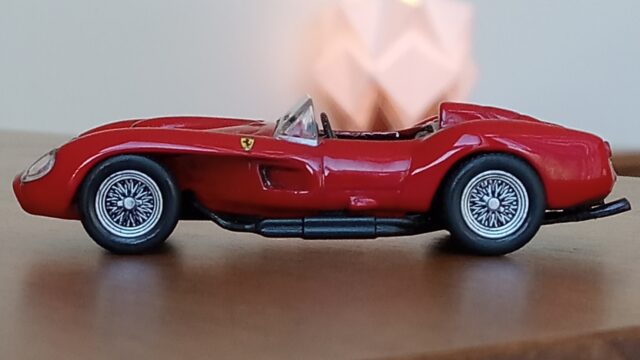
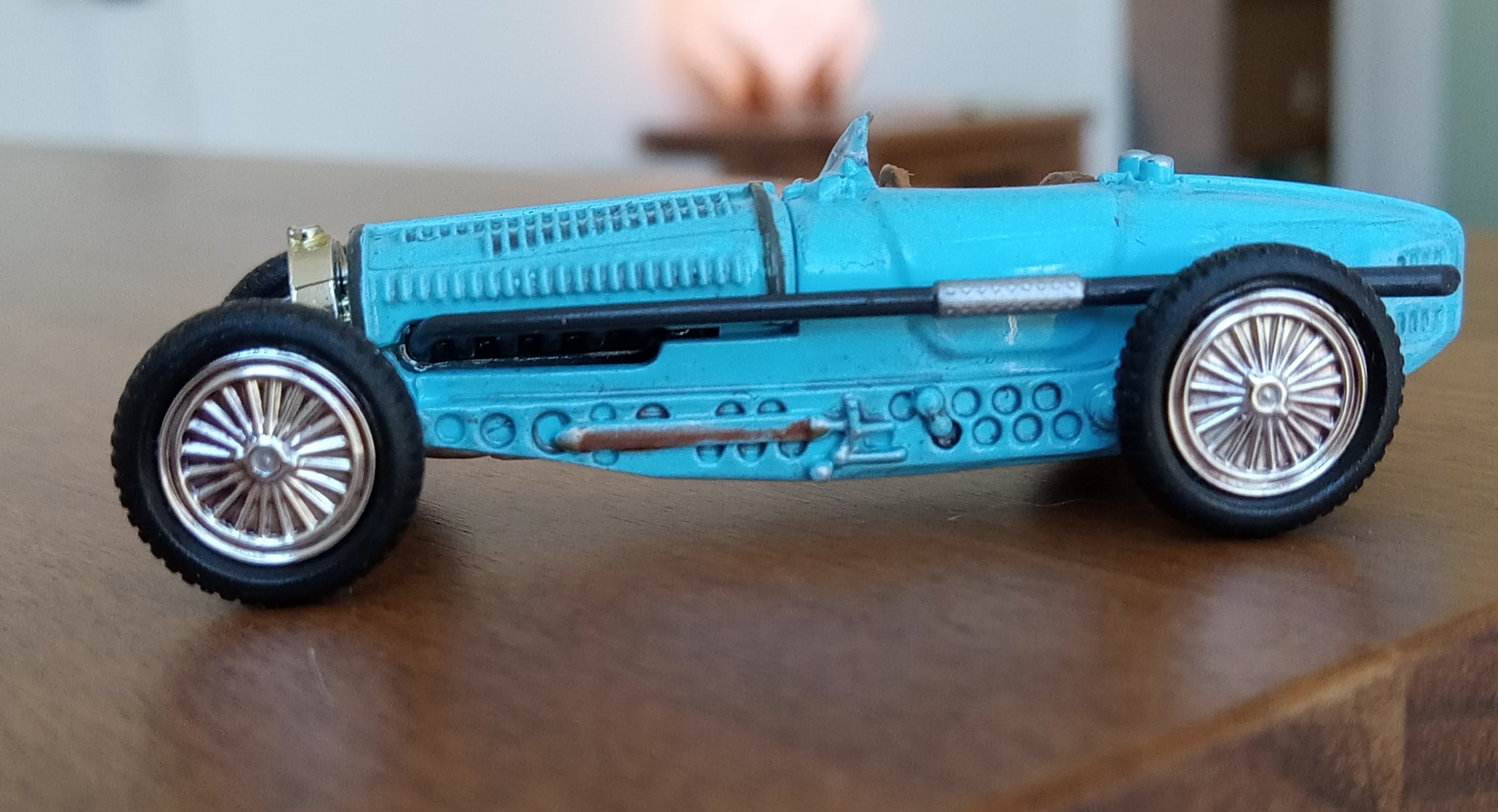
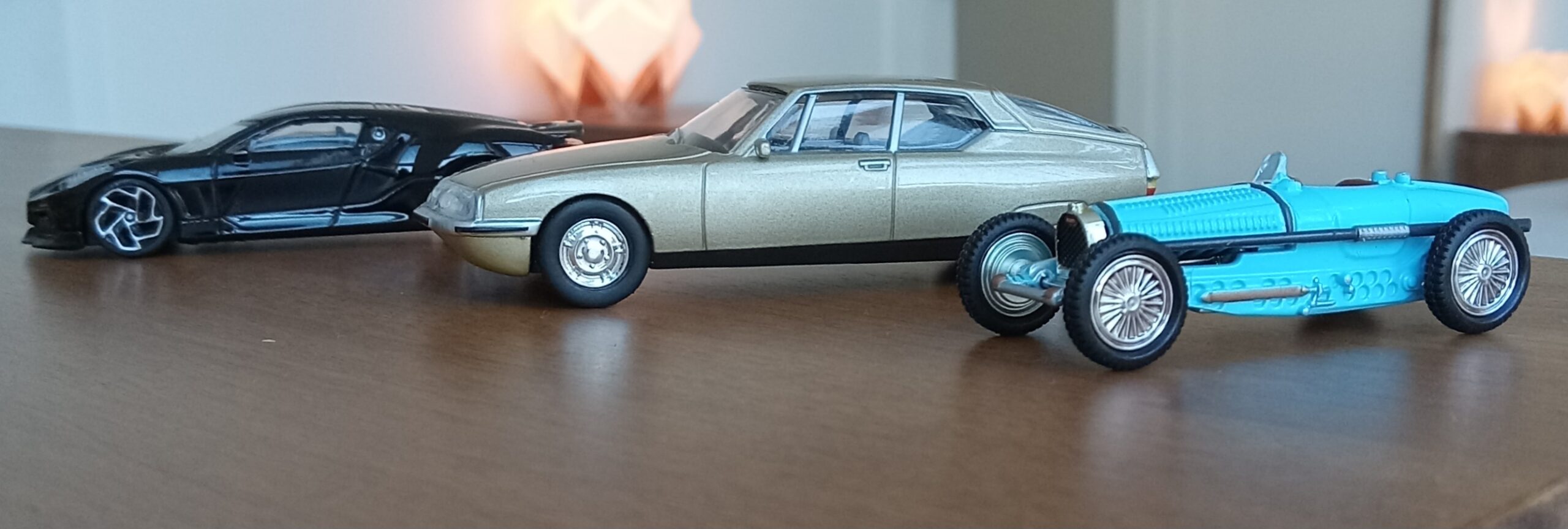
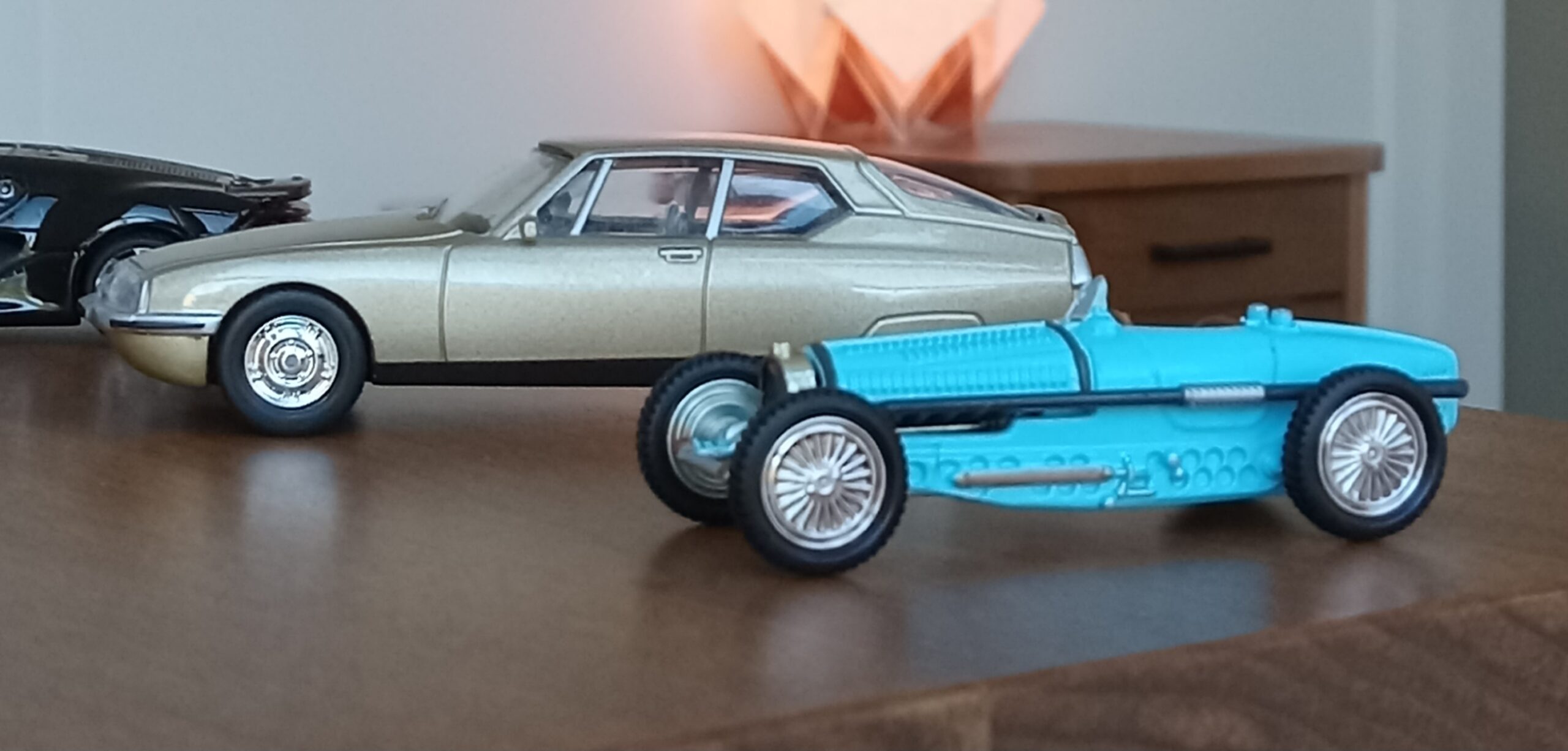
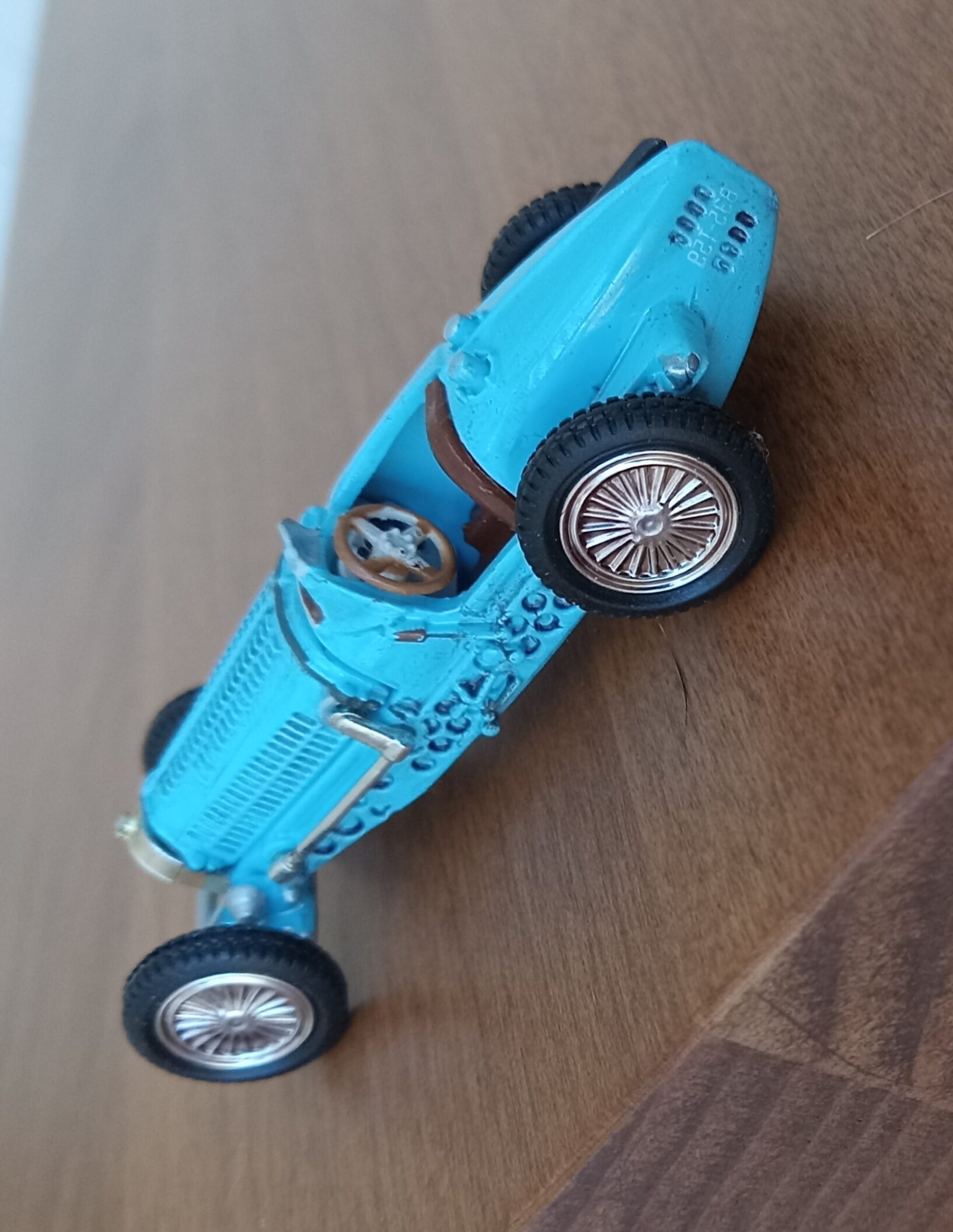
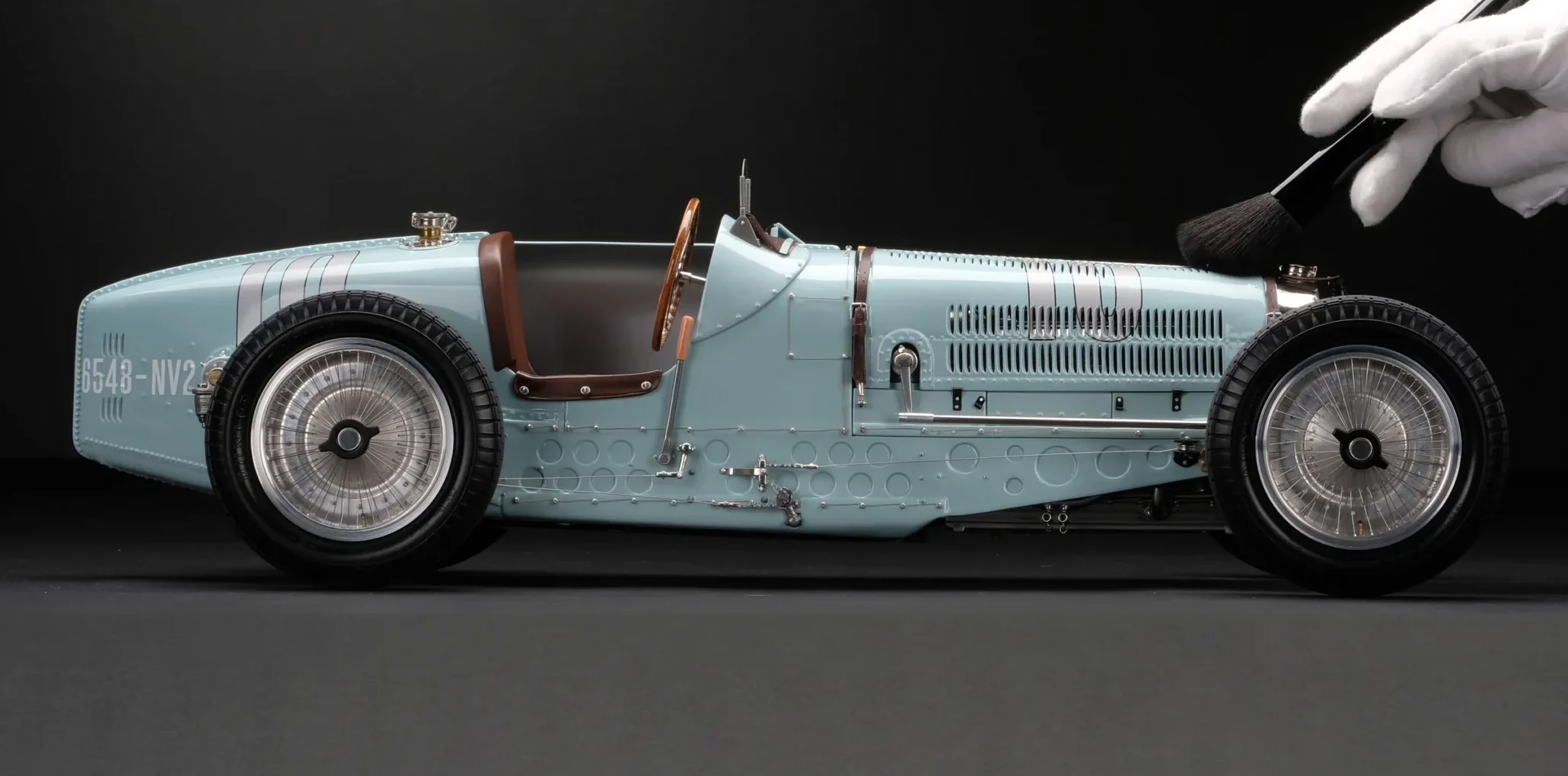
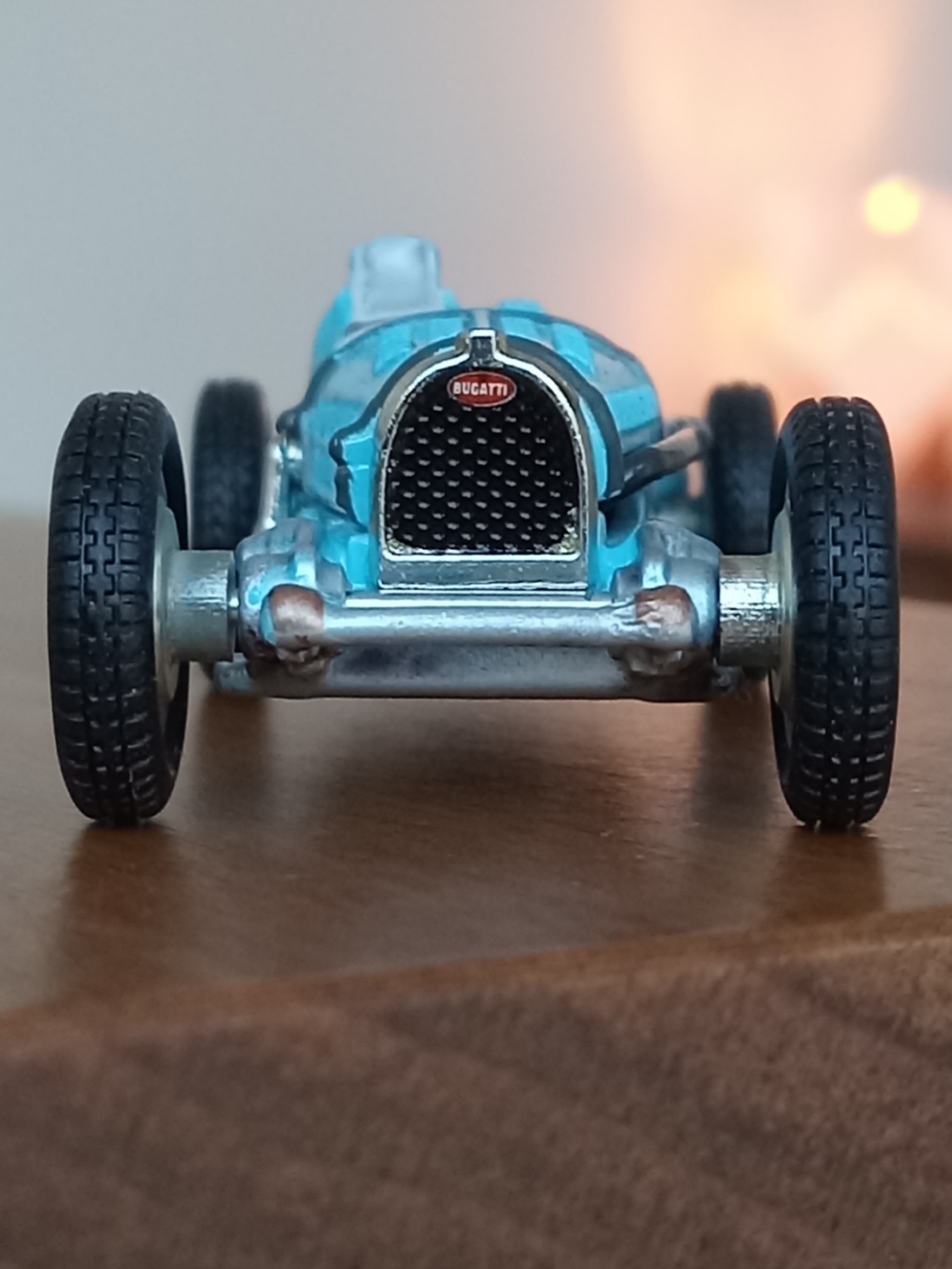
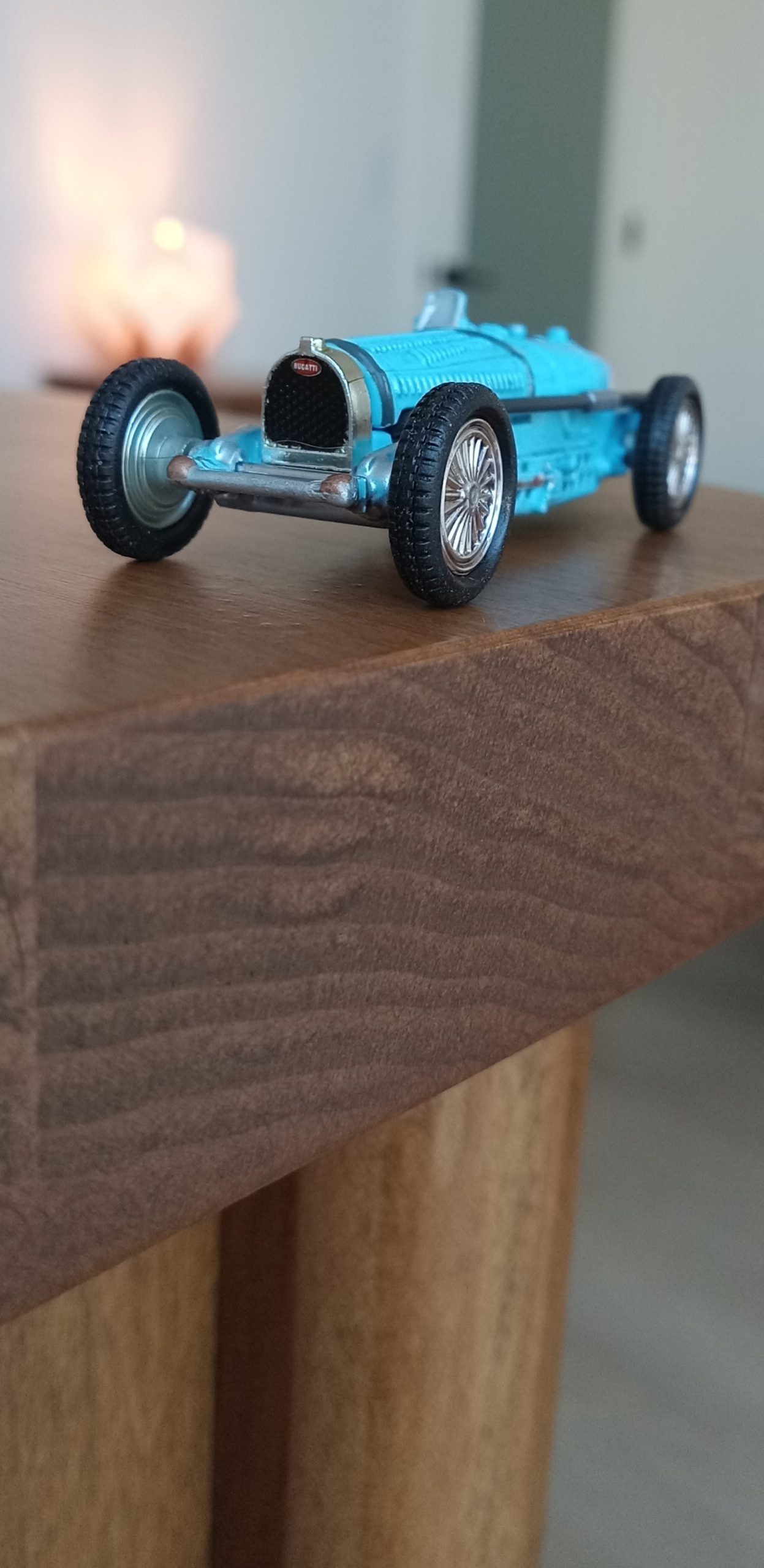
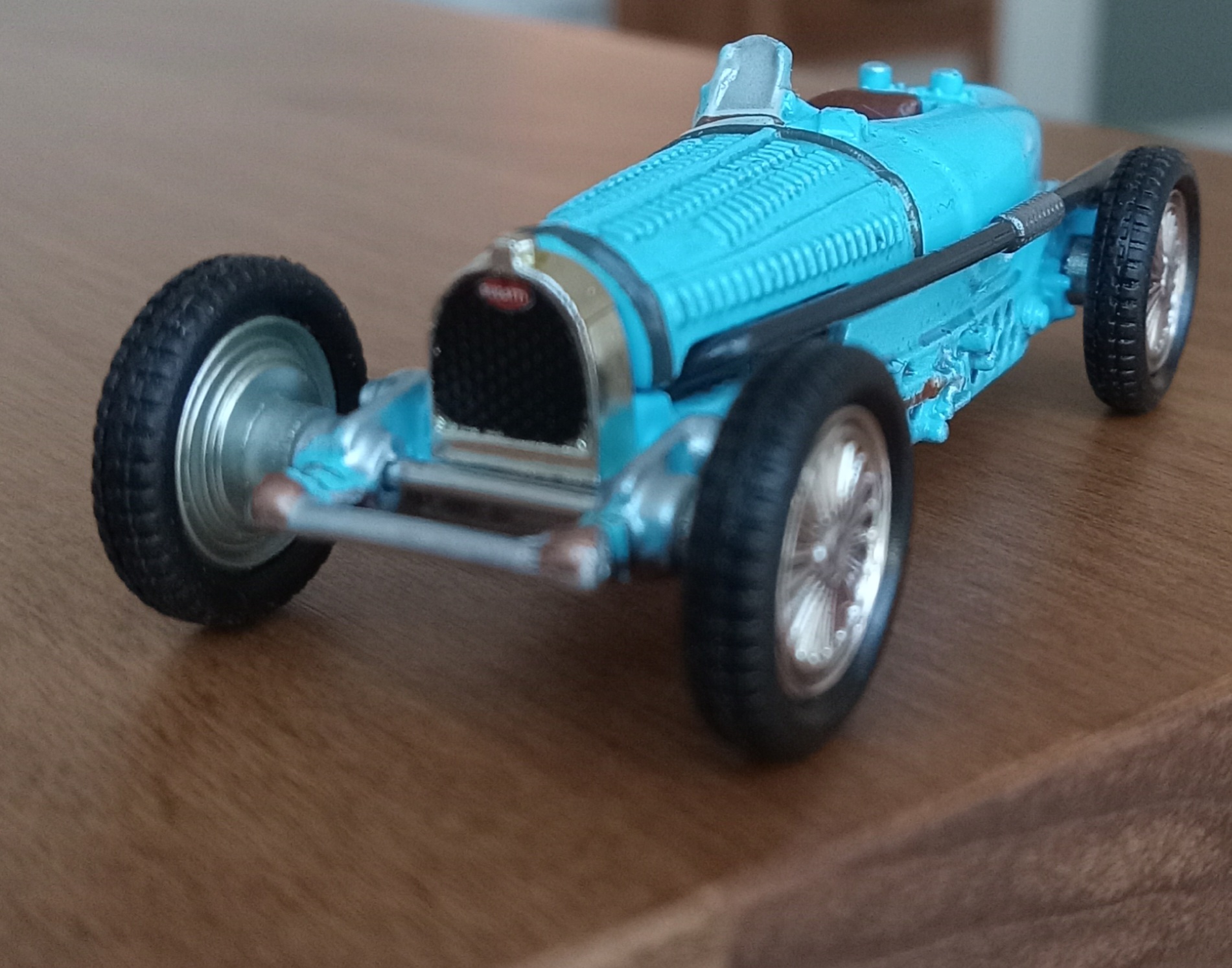
(マテル社製、ホットホイール・エリート64, 1/64 ブガッティ・タイプ59(フレンチ・ブルー)ーーーーーー>改造箇所:タイヤ&ホイールに位置を微調整、ボディー細部にウオーム・グレーで墨入れ、汚しを入れる)
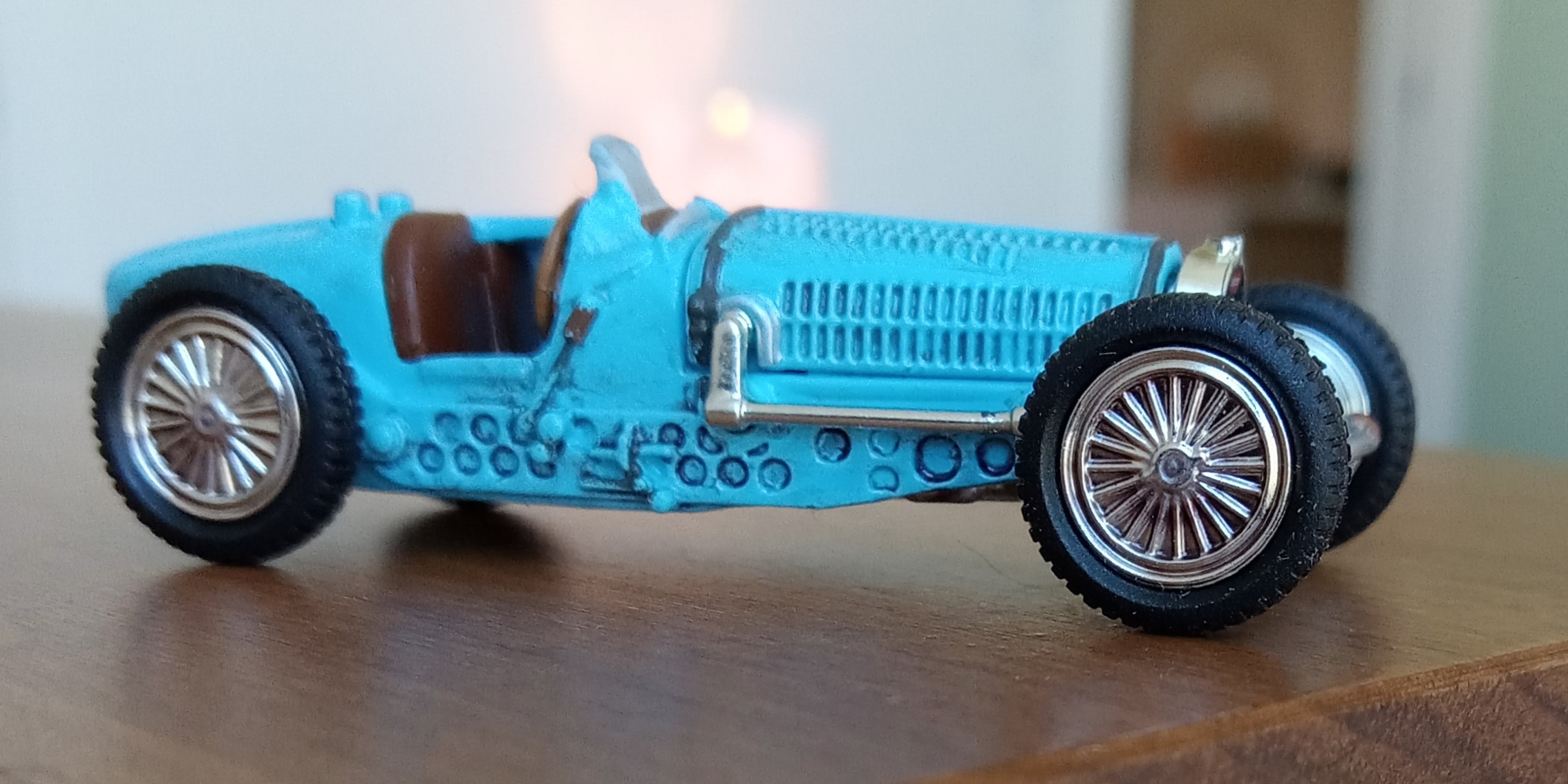
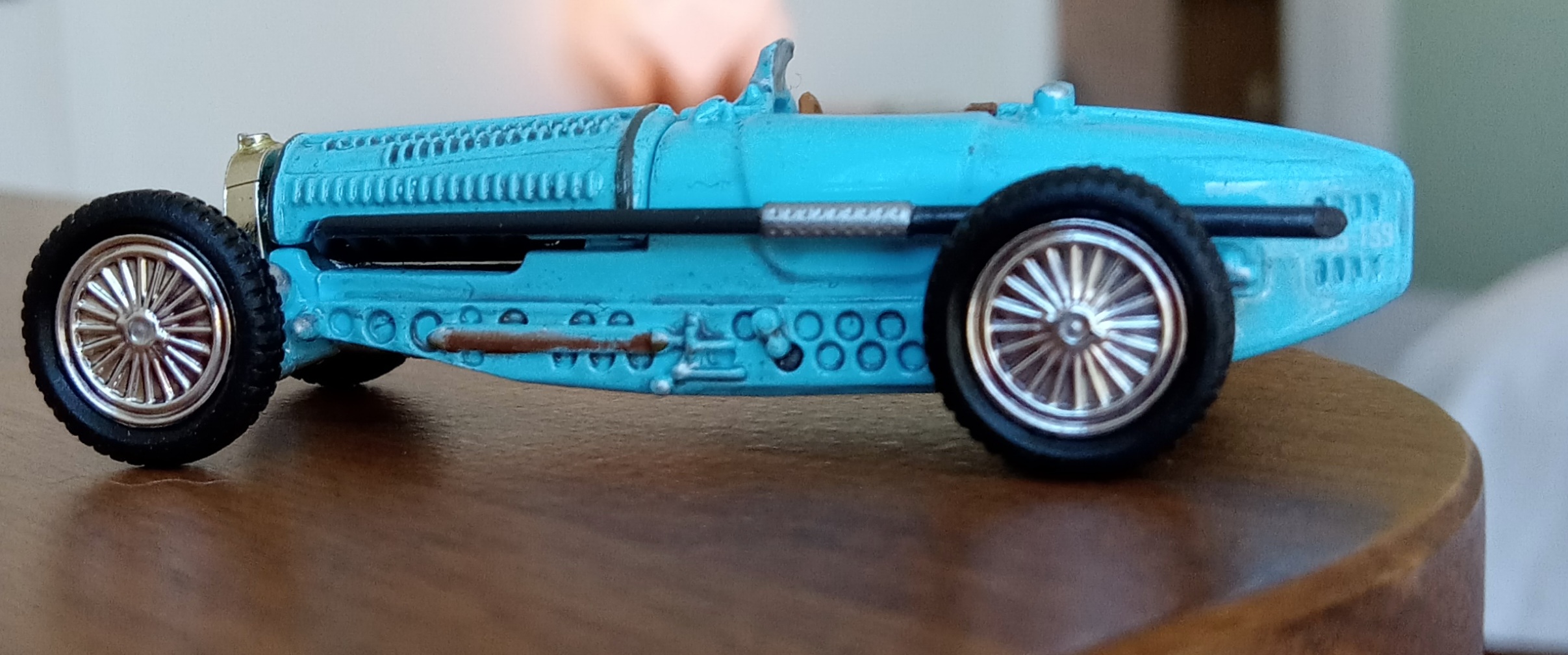
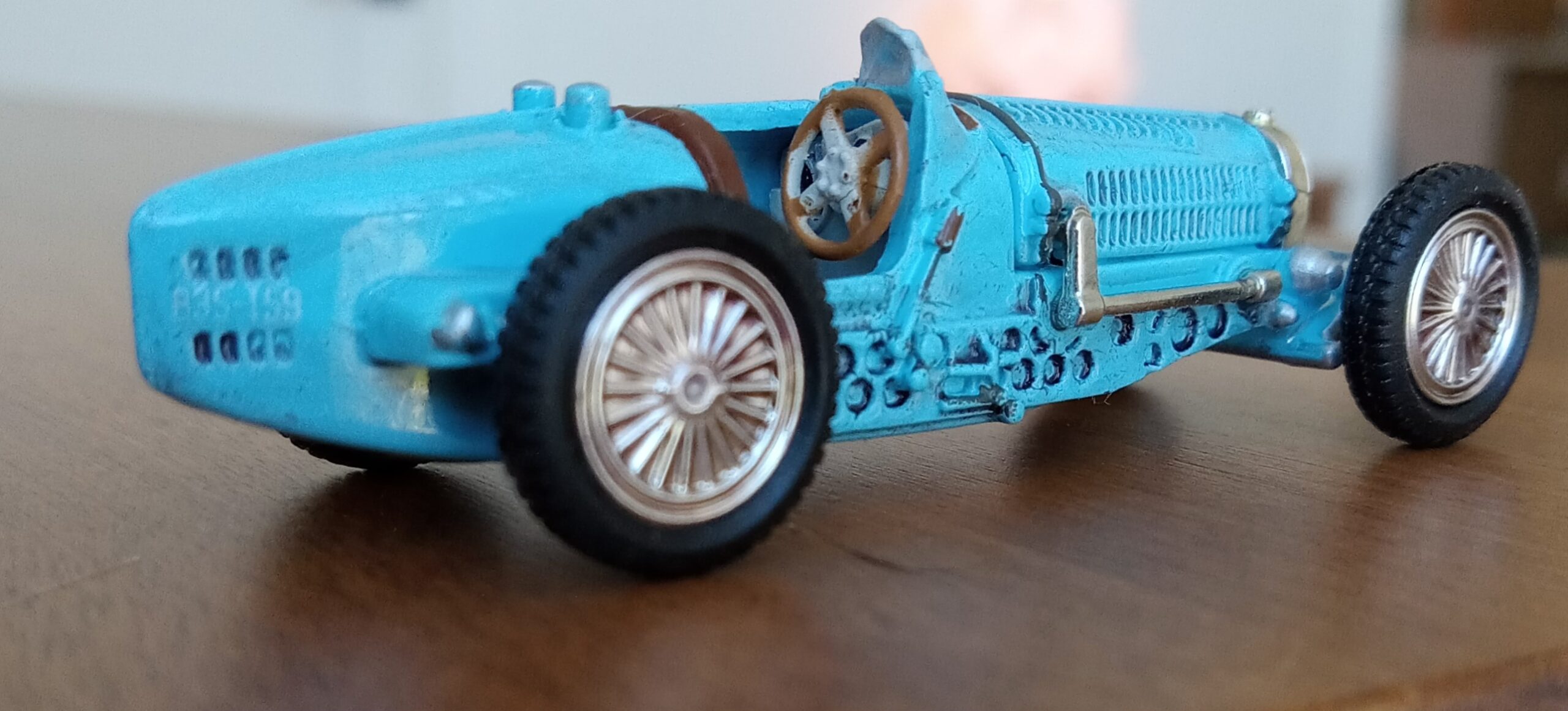
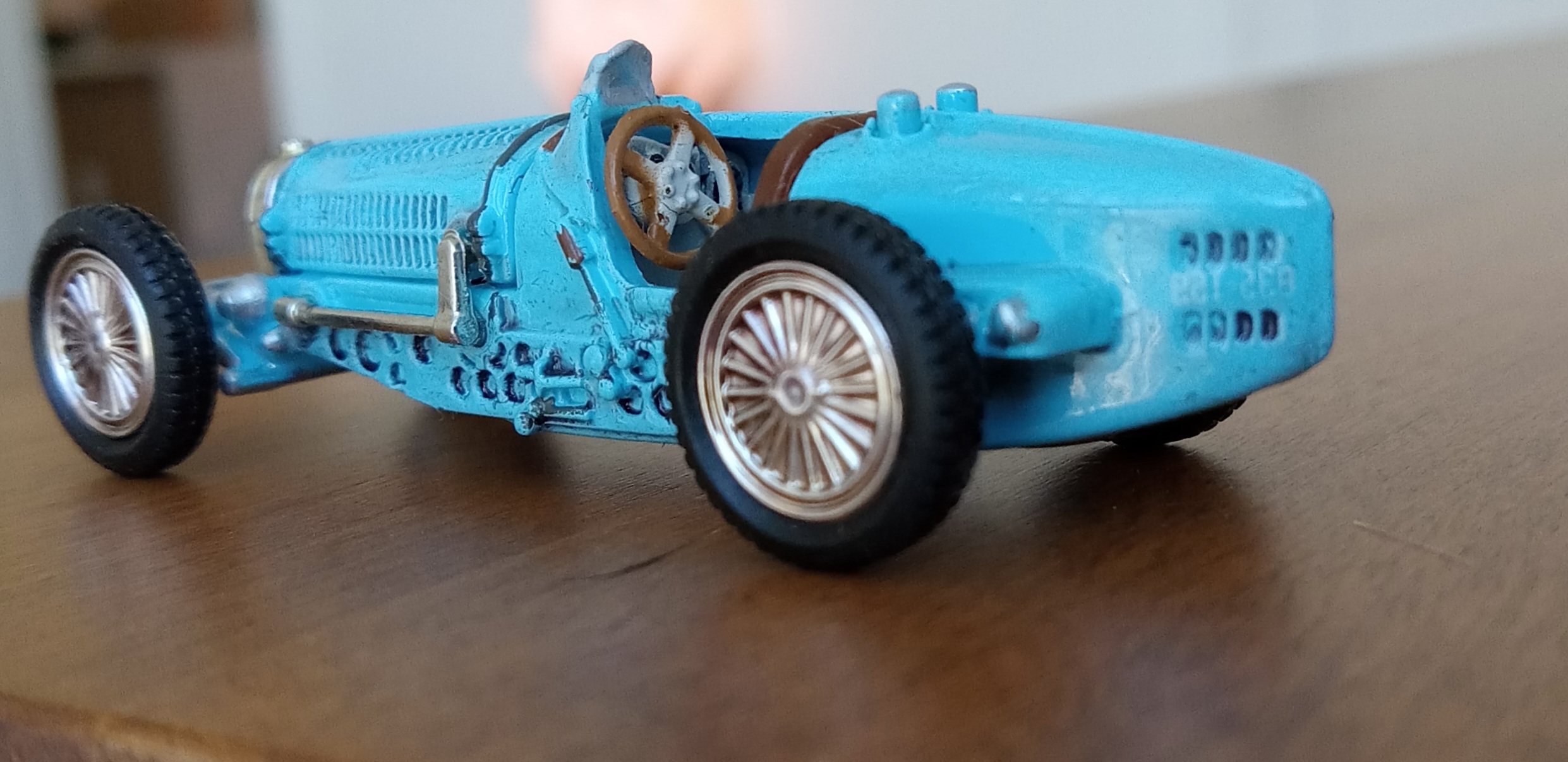
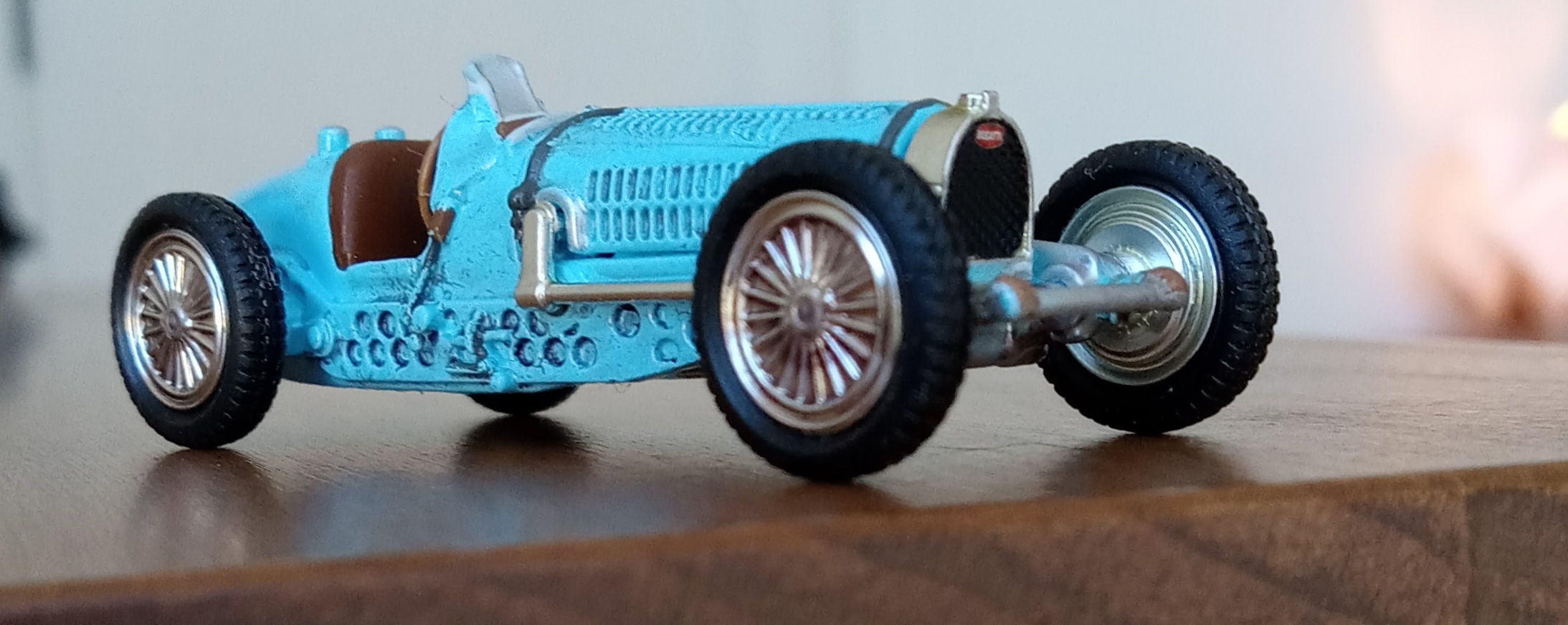
第37回ーー2ドア・クーペ(バルケッタ)の系譜: 第17回【フランス車編】 ブガッティ・タイプ59、1935(フレンチ・ブルー)『エットーレ作:走る芸術品』 Bugatti Type 59, 1935 『A Moving Sculpture by Ettore』
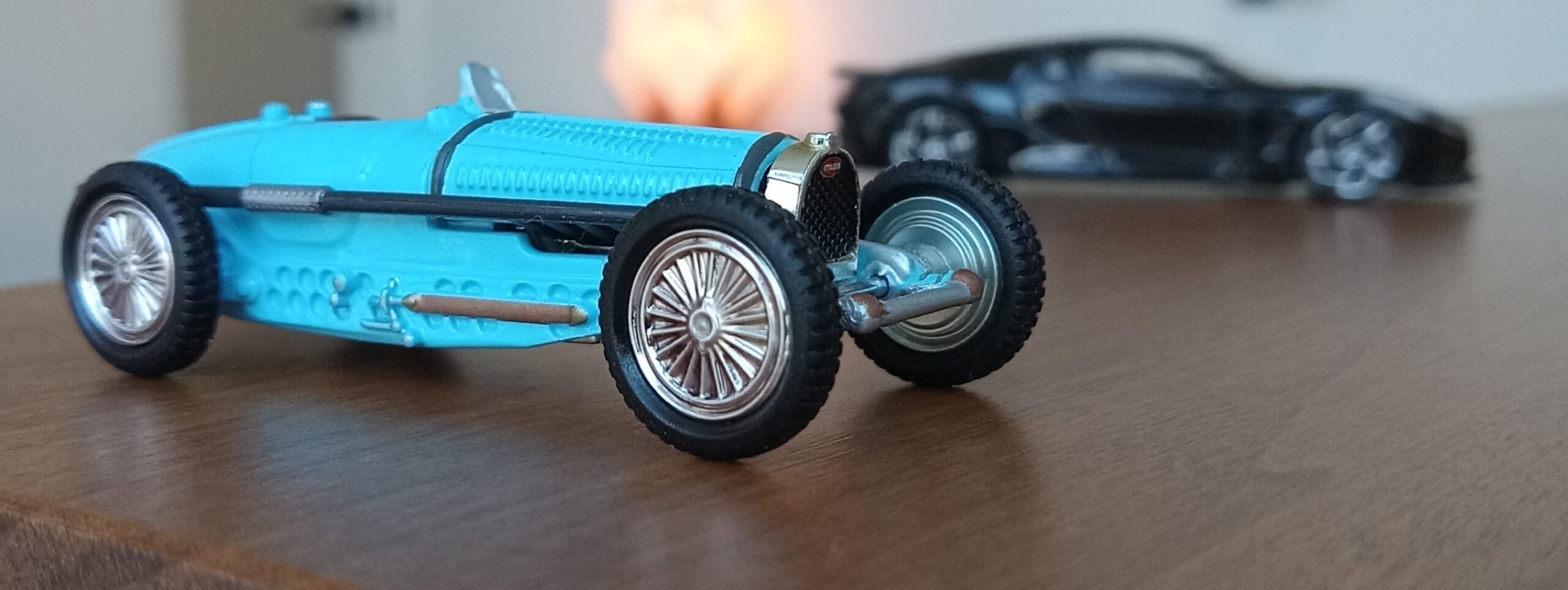
#好みの自動車デザインーー2ドア・クーペの系譜:
第37回目の今回は、『2ドアクーペの系譜、第16回』と題しまして、各国のお国柄や、外観デザインの個性が強く表れる、高級2ドア(GT)クーペ / ロードスターについてお話ししてみたいです。【注意:オープンカーを含む】
以下の要領で進めていきます。
第17回の今回は【フランス車編】
1935年発表の
ブガッティ タイプ 59、1935(フレンチ・ブルー)
についてのお話です。
【2ドア・クーペの系譜:目次】
【米国車編】
第1回:キャデラック・エルミラージュ、2013(メタリック・レッド)
第2回:リンカーン・コンチネンタル MK4、1972(ブラック)
第3回:マーキュリー・クーガー, 1967(LTメタリック・グリーン)
【ドイツ車編】
第4回:MB 500K スペシャル・ロードスター、1936(ブラック)
第5回:MB 300SL ロードスター、1957(シルバー)
第6回:MB SLS AMR ガルウイング、2010(ブラック)
【英国車編】
第7回:マクラーレン・F1、1992(メタリック・オレンジ)
第8回:ジャガー・XKSS ロードスター、1957(ロイヤル・ブルー)
第9回:ジャガー XKR クーペ、1996(ダークメタリック・グリーン)
【日本車・ニッサン編】
第10回:ニッサン 初代シルビア、1965(シャンペン・ゴールド)
第11回:ニッサン 5代目シルビア、1988(LTメタリック・グリーン)
【イタリア車編】
第12回:フェラーリ 250TR ポンツーンフェンダー、1958(赤)
第13回:フェラーリ 250GTO、1962(イタリアン・レッド)
第14回:ランボルギーニ・コンセプトS、2005(パール・ホワイト)
【日本車・マツダ編】
第15回:マツダ コスモ・スポーツ、1968(レーシング・ホワイト)
第16回:マツダ ユーノス・コスモ、タイプ‐S(2トン:黒&グレー)
【フランス車編】
第17回:ブガッティ・タイプ59、1935(フレンチ・ブルー)
第18回:シトロエン・SM、1970(シャンペーン・ゴールド)
第19回:ブガッティ・ラ・ヴォワチュール・ノワール、2019(黒)
【日本車・トヨタ編】
第20回:トヨタ/ヤマハ・2000GT、1967(アイボリー・ホワイト)
第21回:トヨタ・2代目ソアラ、1986 (2トン:黒&グレー)
第22回:レクサス LC【GWZ100型】、2017(メタリック・レッド)
【米国車編②】
第23回:ダッジ・チャレンジャー&プリムス・バラクーダ、1971
第24回:ダッジ・ヴァイパー SRT‐10 ACR、 2008(ブラック)
第25回:フォード・シェルビーGR-1 コンセプト、2004(クローム)
【日本車・ミツビシ編】
第26回:ミツビシ・ギャラン λ、1976(ブラウン・メタリック)
第27回:ミツビシ・エクリプス【北米仕様】、2006(オレンジ・メタ)
【ドイツ車編②】
第28回:BMW M635CSi、1984 (ダーク・メタリックブルー))
第29回:MB 560SEC AMG 6.0 ワイドボディー、1989(黒)
第30回:BMW M2 純正パフォーマンス・パーツ仕様、2025(ネオン・ライム)
【日本車・スバル編】
第31回:スバル・クロストレック XV, 2012(ライムグリーン・メタリック)
コルベットの系譜:(番外編)
第1回:1967年型 スティングレー【C2】コンバーチブル(ハードトップ・メタ青)
第2回:1972年型 コルベット 【C3】コンバーチブル(メタリック・ブルー)
第3回:1984年型 コルベット クーペ【C4】(ブライト・レッド)
第4回:スティングレー・コンセプト【先行開発車】、2009(プルー・メタリック)
#1935年:葉巻型レーシングカーの美的ひな形の出現
1950年代から60年代にかけて、
一世を風靡することになる
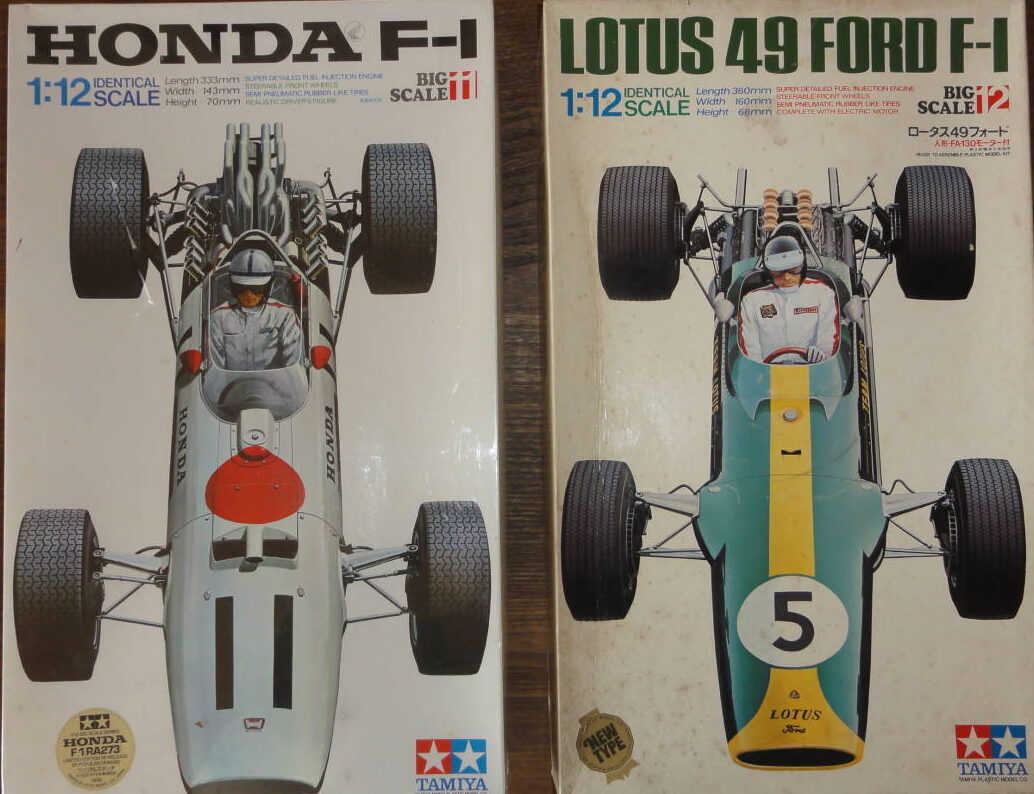
『葉巻型レーシングカー』
の原型となる、
シャーシレイアウトをすでに
1935年時点で実現したモデルがあります。
それが、
エットーレ・ブガッティ―とジャン・ブガッティ―が設計した
『ブガッティ タイプ59』
です。
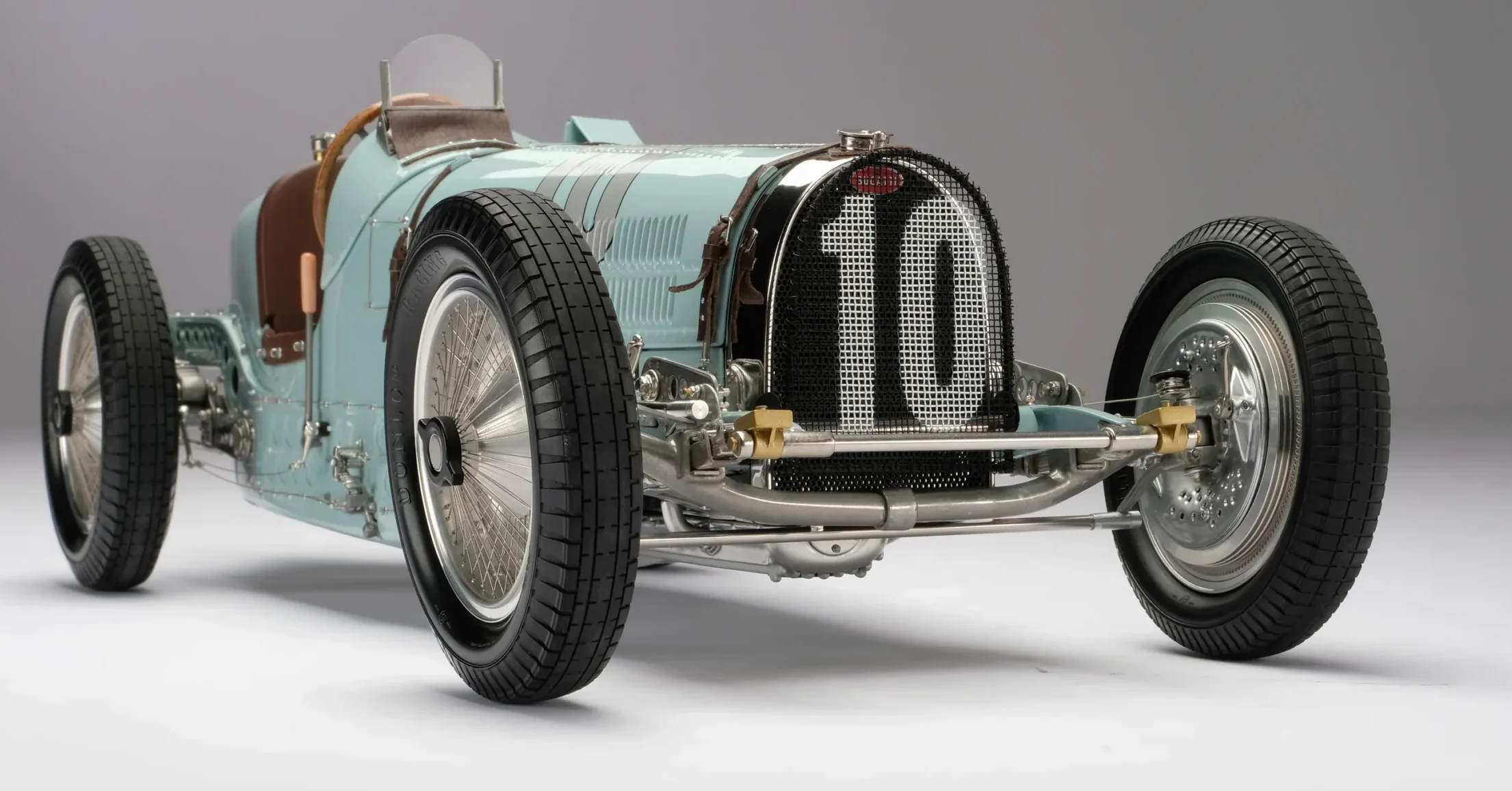
私的には、
*地を這うような全高の低さ、
*全身にちりばめられた、
*宝石のようなディテールの数々
『ダイムラーベンツ 500K』が当時の高級クーペの究極だとすれば、
同時期のレースカーの究極がこの
『タイプ59』です!
『今でこそこんな感じで、
大好きな一台なのですが、
ここに至るまでには、紆余曲折がございまして、
自分の嗜好の変遷を露呈してしまう記事になりそうです、、、』
それでは、
こんな感じで進めていきたいです。
*実車解説:
*外観デザインの特徴:
*『私』とタイプ59
*三題噺:禁煙車問題・狂人・ピアノ線
*その他の『葉巻車』たち、、、
*実車解説:天才アーチストの作品
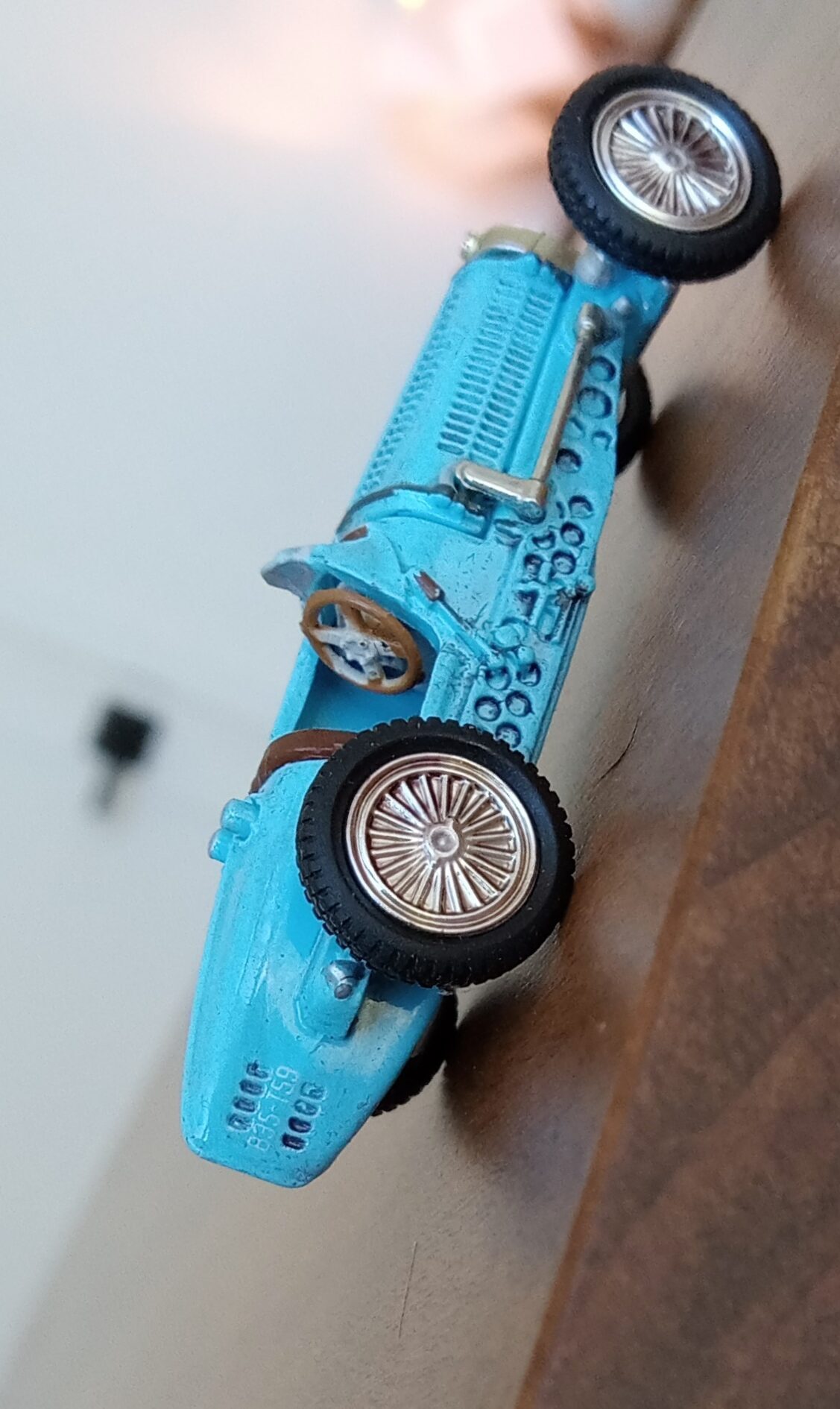
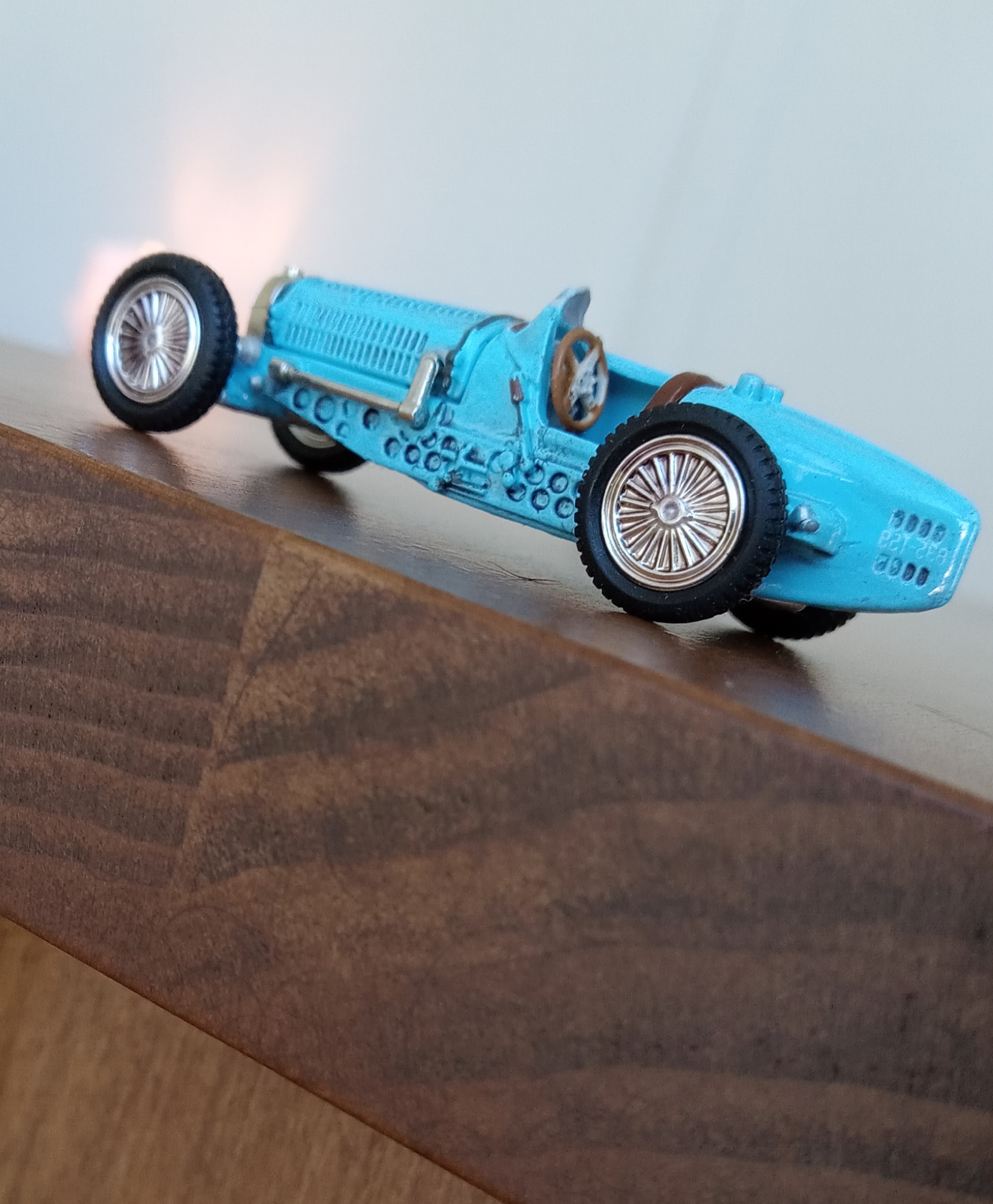
概要:
N
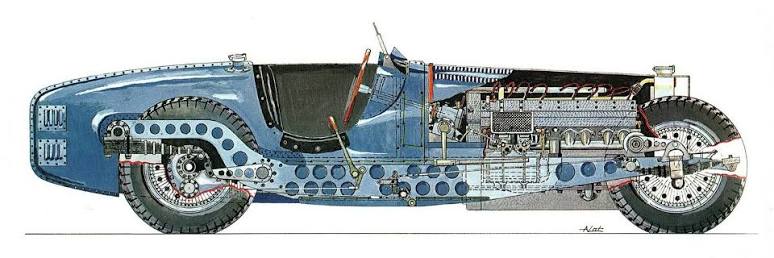
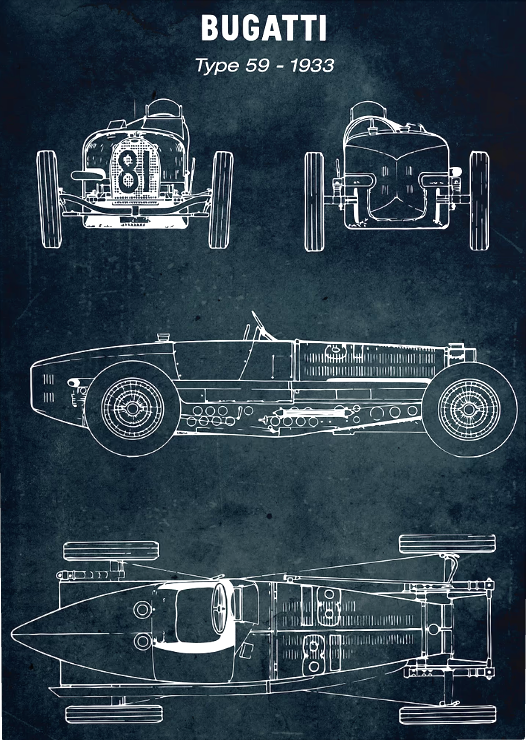
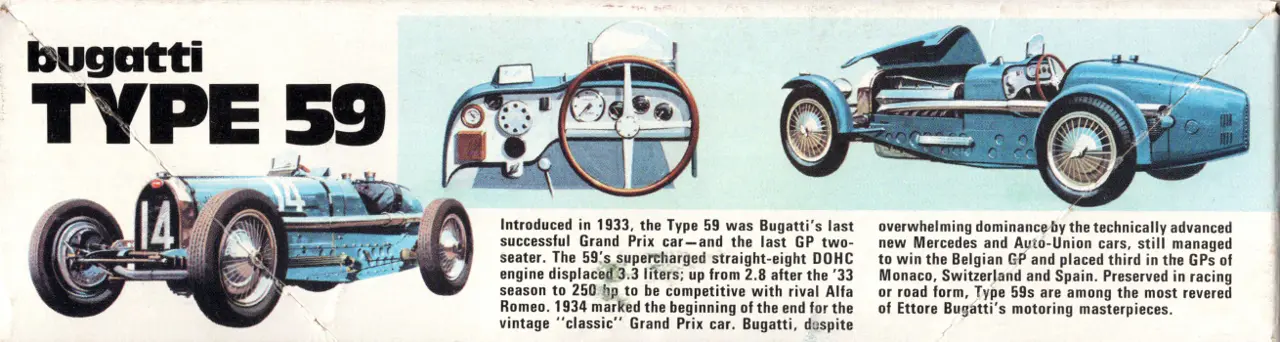
戦前グランプリレースで活躍した伝説的なレーシングカーです。3.3リッター直列8気筒スーパーチャージャーエンジンを搭載し、エットーレとジャン・ブガッティ共作の流麗で美しいアーチを描くフェンダーやボディライン、独創的なピアノ線ホイールを特徴とする、戦前GPレースの傑作です。シングルシーター全盛期において最後の2シーター・レーシングマシンとしても知られ、工芸品のような気品を放っています。
N
n
n
N
N
n
n
M
主な外観デザインの特徴:
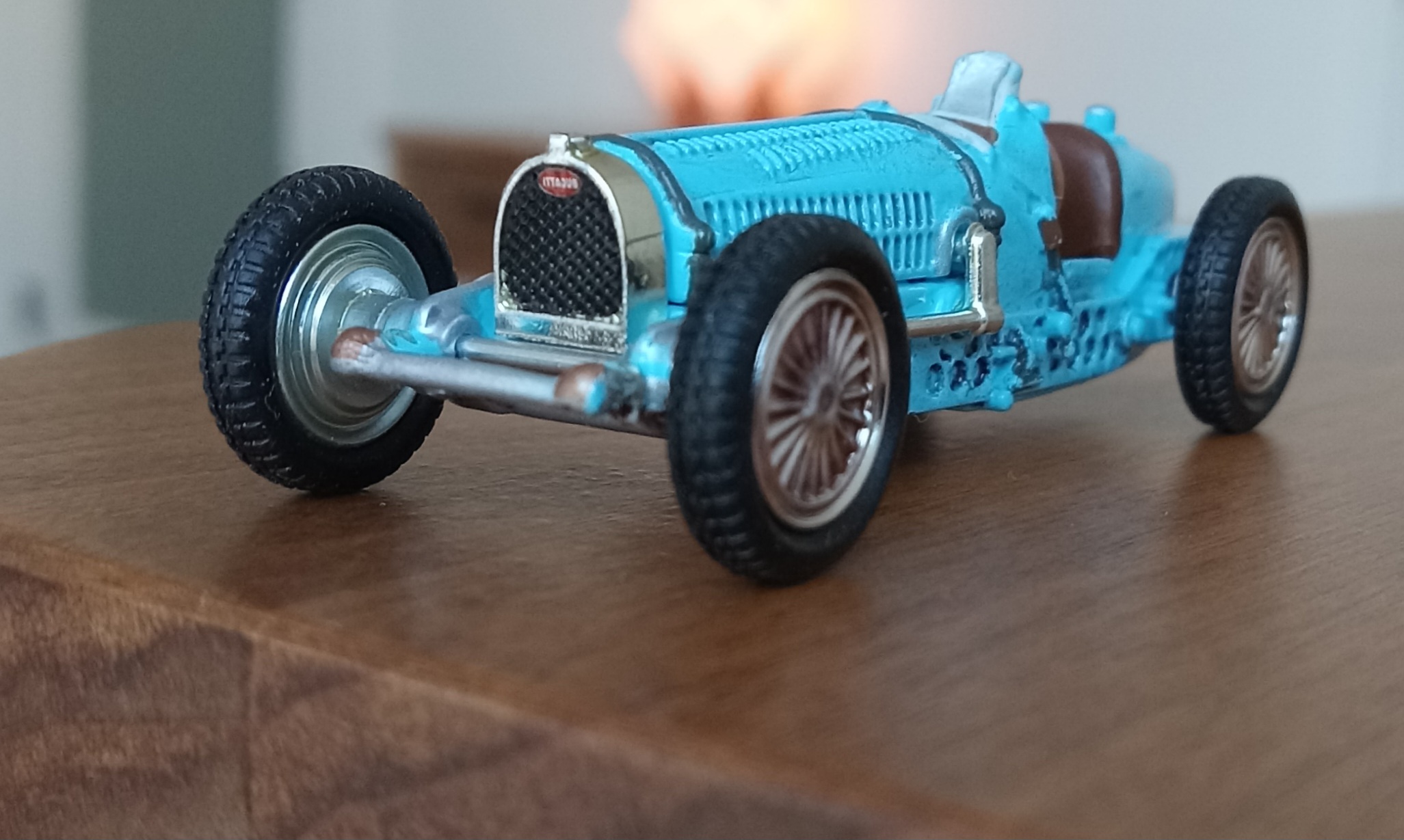
*ティアドロップ・ノーズとホースシューグリル: ブガッティの象徴である馬蹄形のラジエーターグリルをフロントに配置。そこから滑らかに後方へ向かって絞り込まれていく涙滴(ティアドロップ)型のノーズは、空力と美しさを高度に両立しています。
*ピアノ線(ワイヤー)スポークホイール: 美しさと軽量化を追求した特殊なホイールデザインです。駆動・制動用の細いディスクと、縦・横方向の荷重を支える細い放射状のワイヤー(ピアノ線)を組み合わせた構造で、芸術品のような仕上がりを見せます。
n
*低く構えたコクピット: レーシングスピードでの空気抵抗を極限まで減らすために車高が低く設計されており、乗員を包み込むようなコンパクトな2シーターコクピットが特徴です。
N
n
n
n
主なレース活動と歴史:
*ベルギーGP(スパ・フランコルシャン): 7月14日、ジャン=ピエール・ウィミーユがドライブし、オープニングラップで2位に浮上する好走を見せましたが、エンジントラブルにより7周でリタイアを喫しました。
*市販化と改修: エットーレ・ブガッティはその後グランプリレースから一時撤退し、数台のタイプ59がイギリスのエンスージアストに売却されました。これらはロードレース仕様やスポーツカー仕様へと改造され、イギリス国内のレースで戦い続けました。
n
#主要諸元:
- 型式: Type 57
- 総排気量:3,257 cc
- エンジン型式: 水冷直列8気筒 DOHC 2バルブ
(ルーツ式スーパーチャージャー + ゼニス製キャブレター2基)
- 最高出力 : 250 bhp (186 kW) / 5,000 rpm
- トルクの傾向:過給機付きの3.3L直列8気筒エンジンであるため、当時の技術水準(同系統のブガッティ直8エンジン等)から推測すると、およそ 250〜350 Nm(約 25〜35 kgm)前後の最大トルクを発揮していたと考えられます。
- 最高速度:250 km/h (155 mph)
- 駆動方式:FR(フロントエンジン・後輪駆動)
- 定員:1名
- 車体形式:1ドア・ロードスター
- ホイールベース:2,598mm(102.3インチ)
- 全長:3,744mm
- 全幅: 約1,630mm〜1,650mm(海外データ:64.17インチ)
- 全高:823 mm
- 車両重量:
約 748kg (1,653 lbs) 〜 900 kg (1,980 lbs) ※仕様による
*外観デザインの特徴:『地を這う葉巻』?
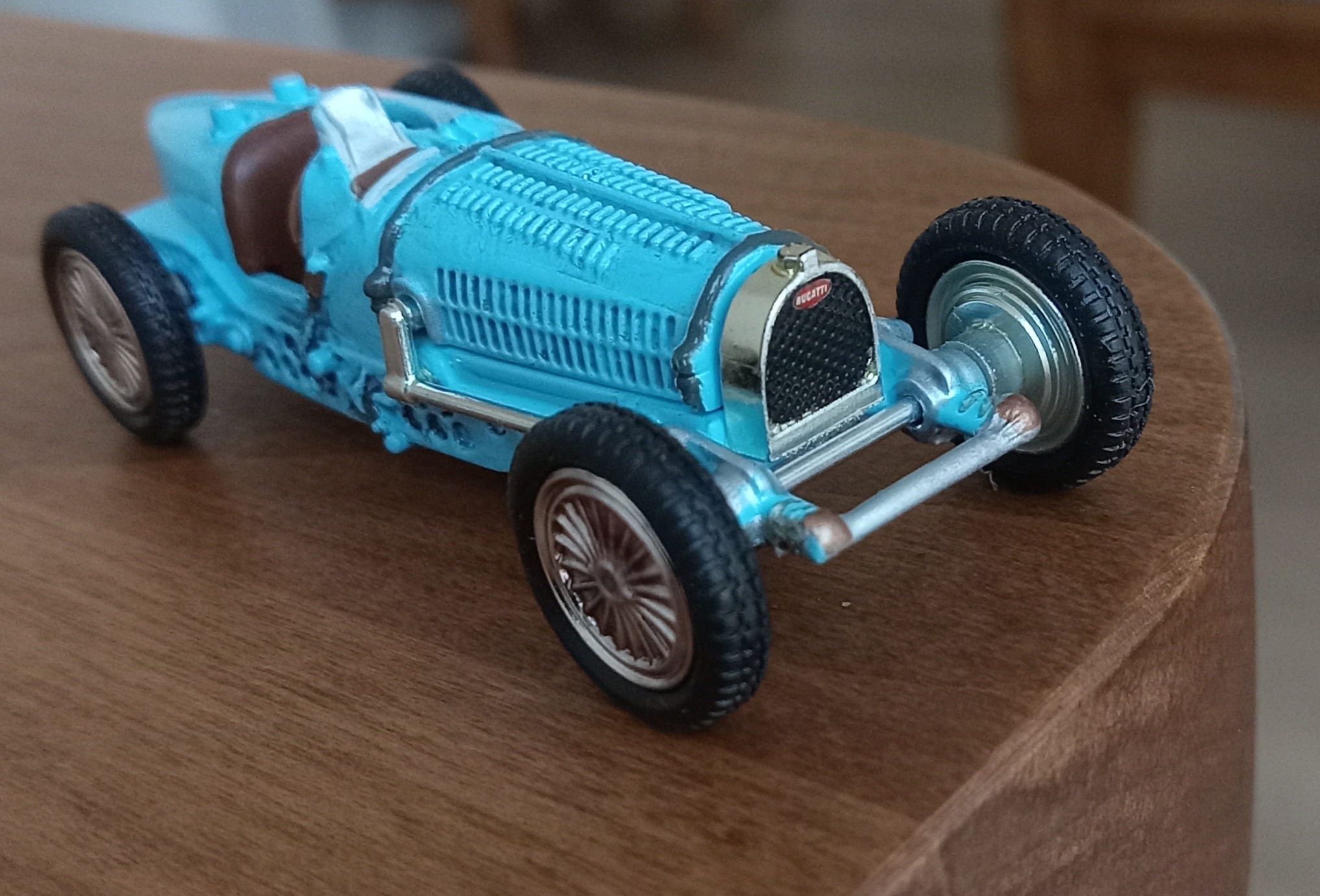
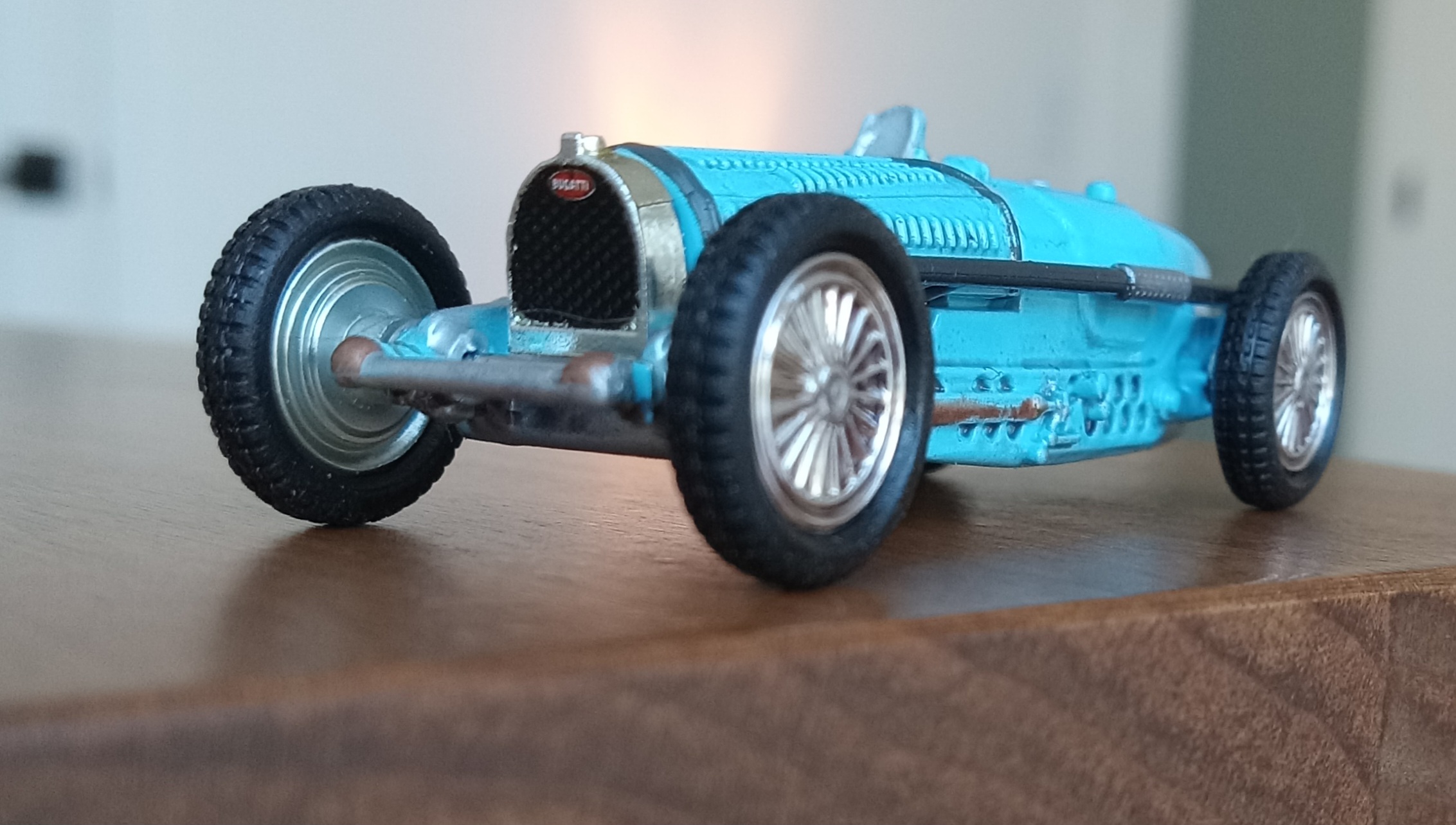
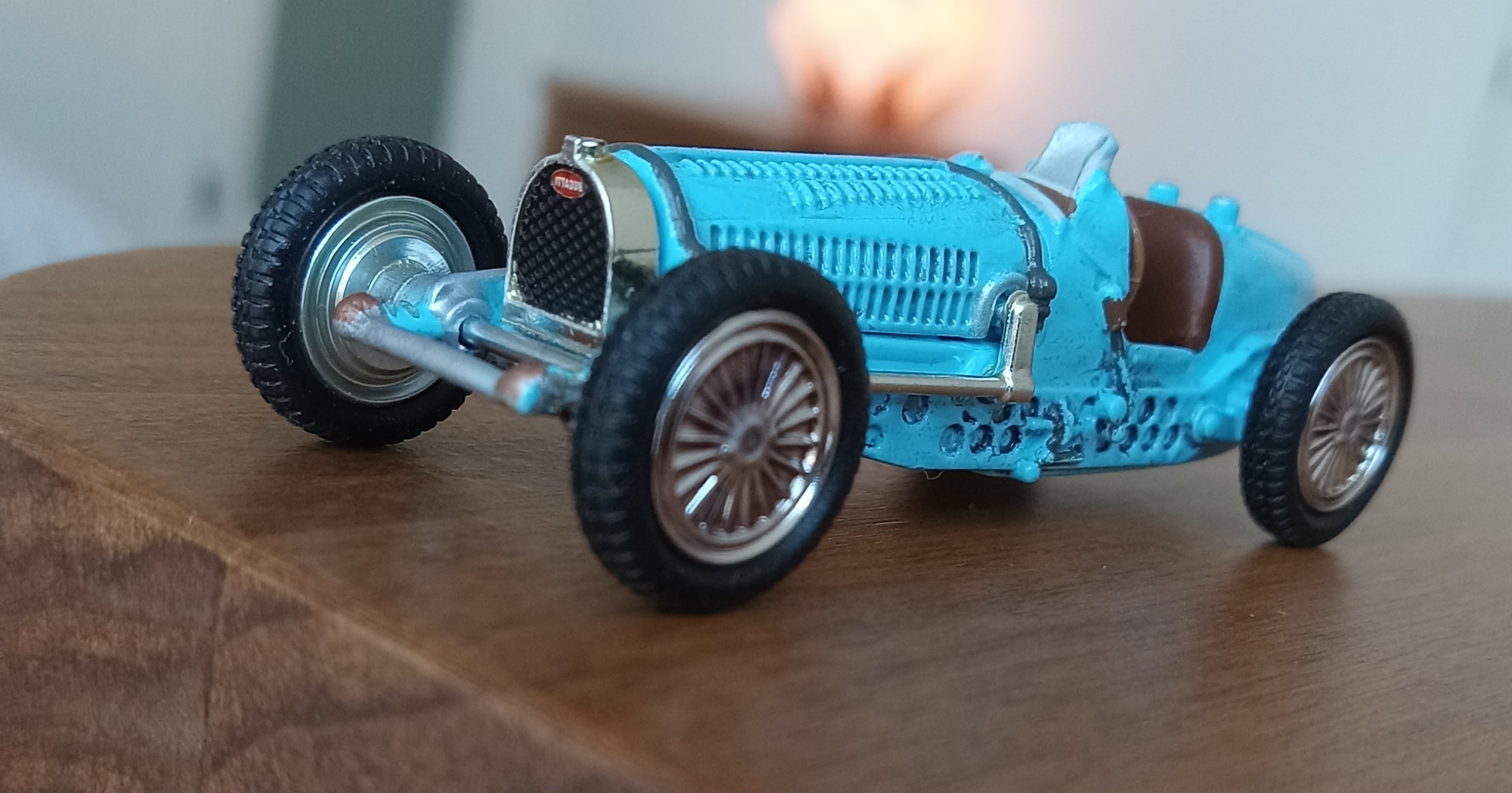
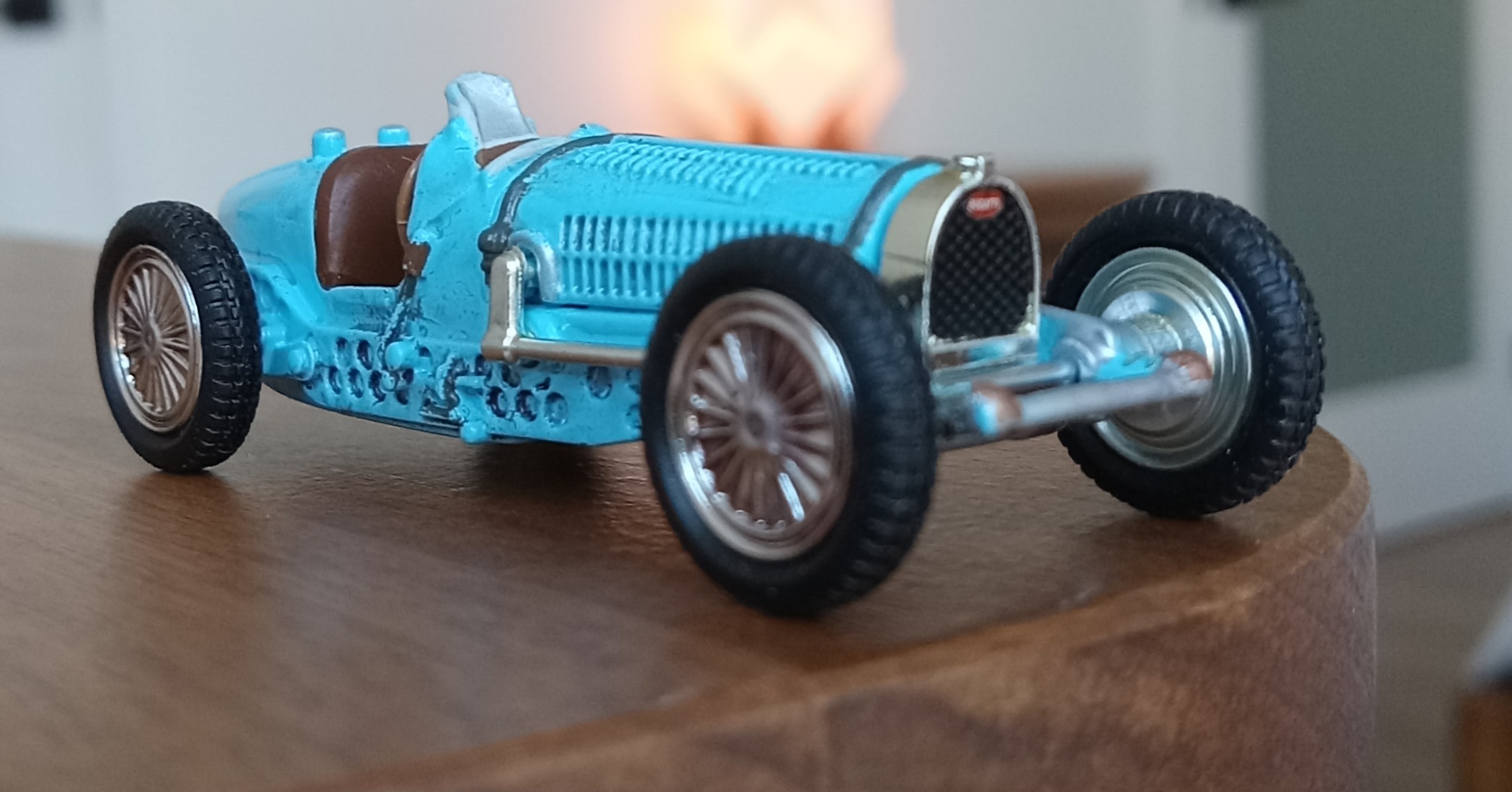
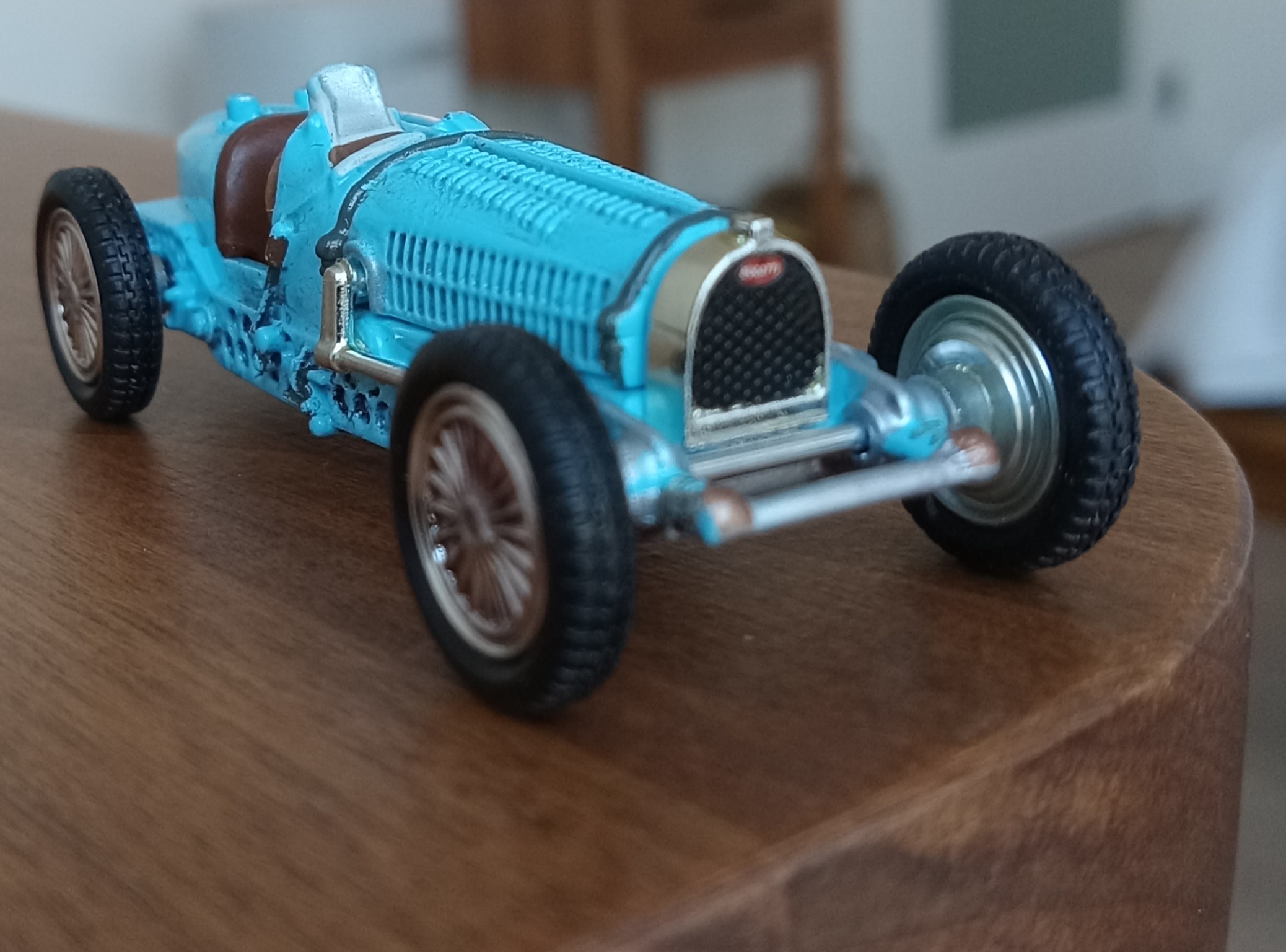
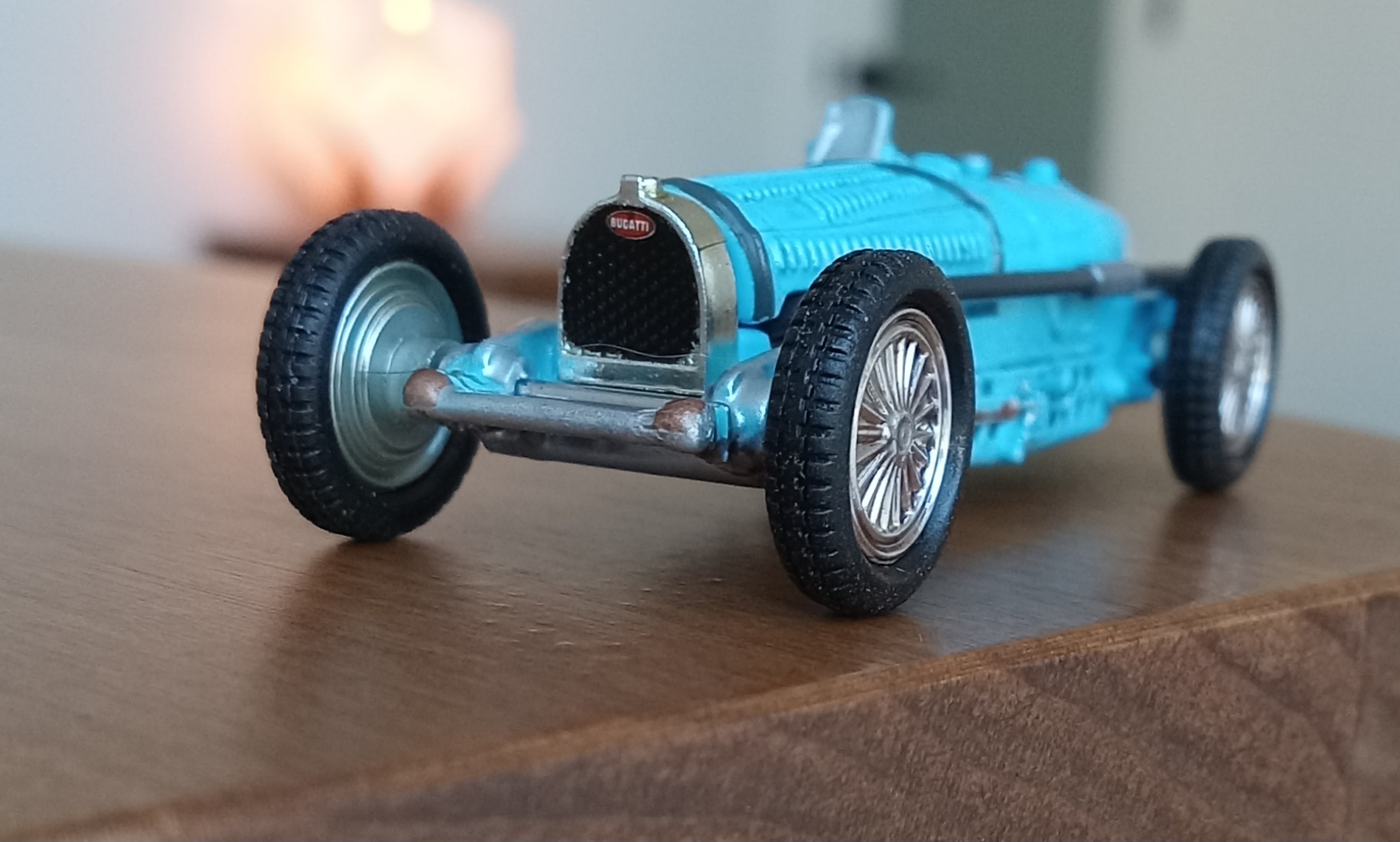
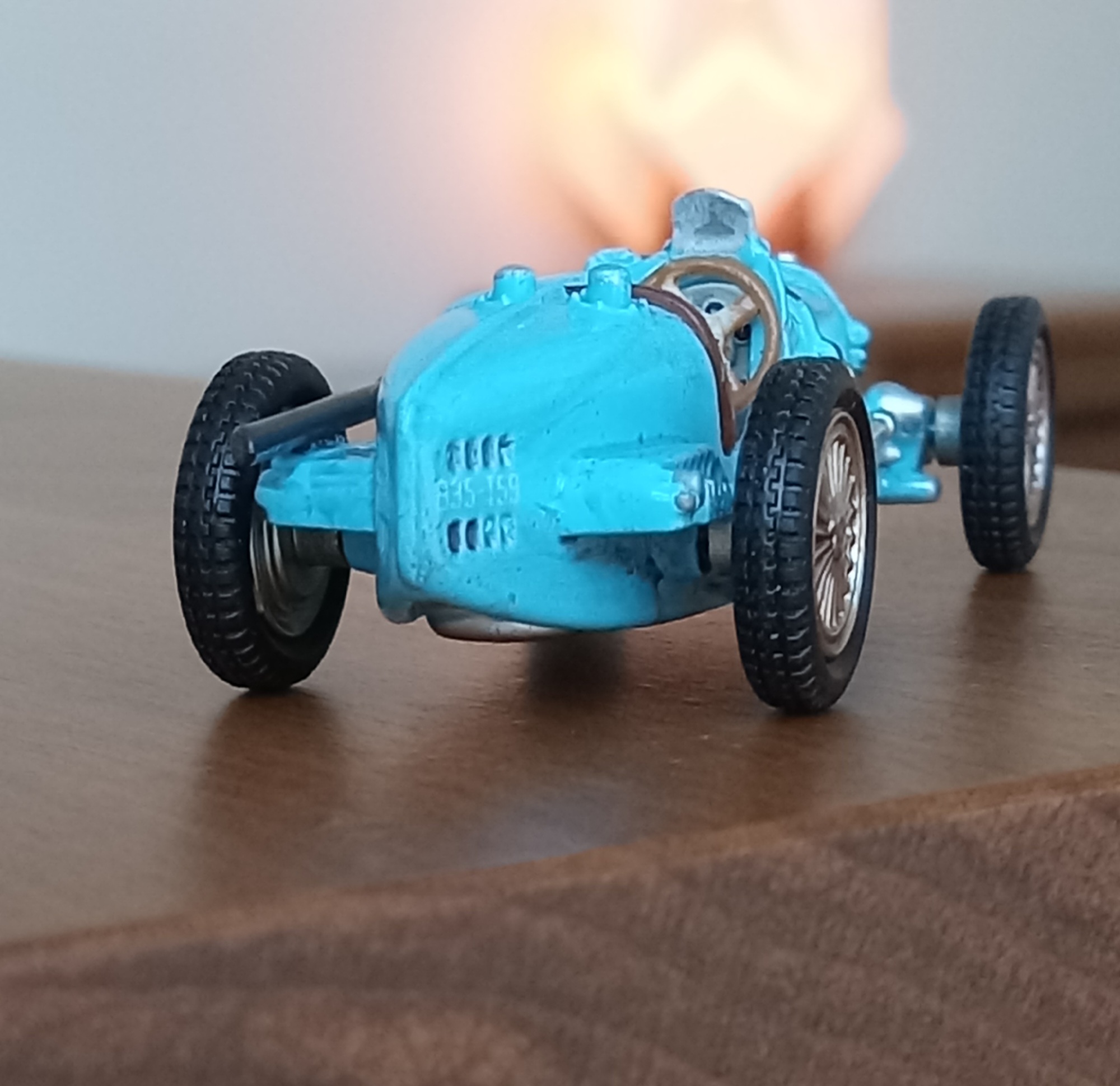
空前絶後の美しさを誇る、
『ブガッティ・タイプ59』についての、
外観デザイン上の特徴を、
個人的なひらめきに頼って5個見つけてみました。
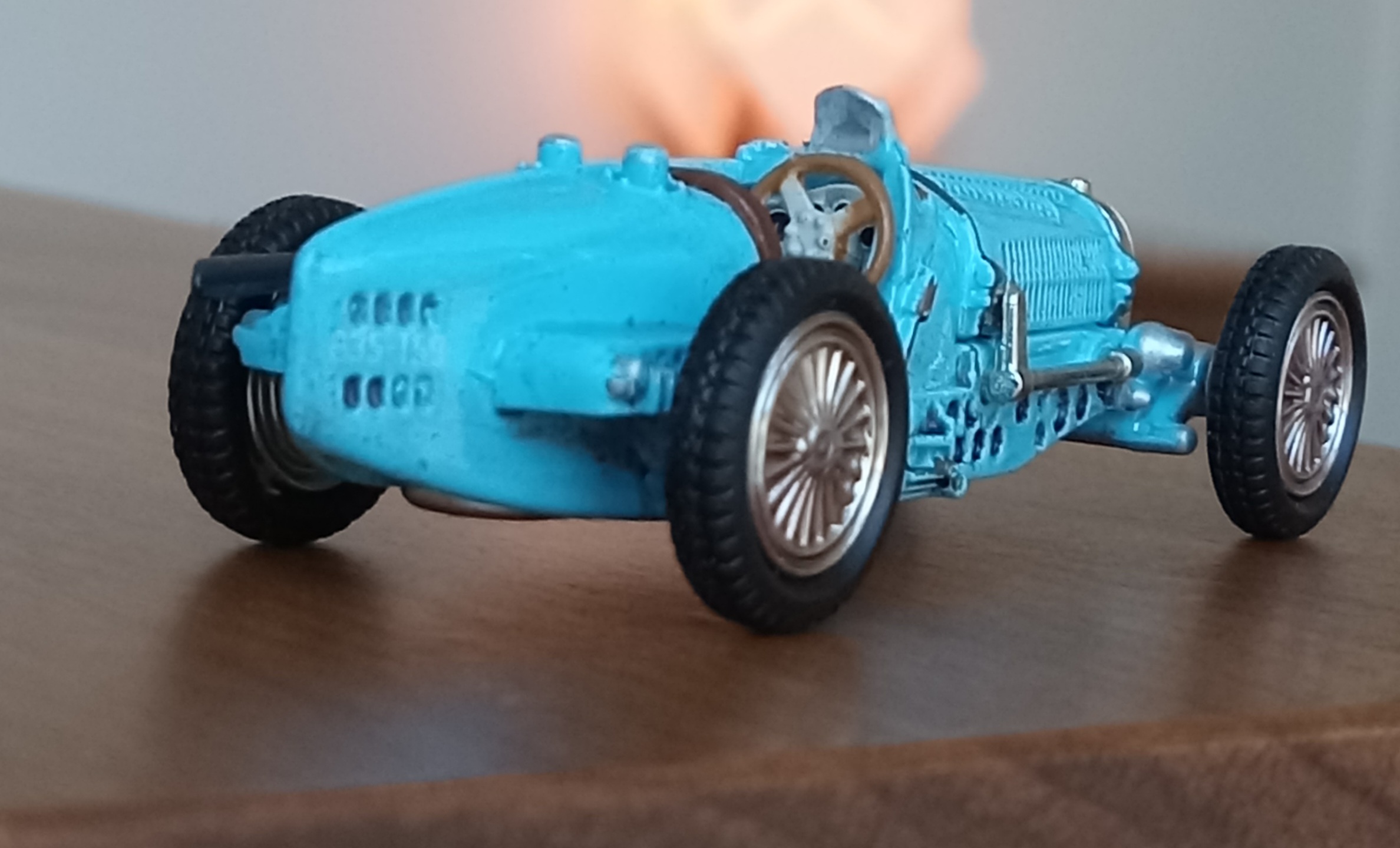
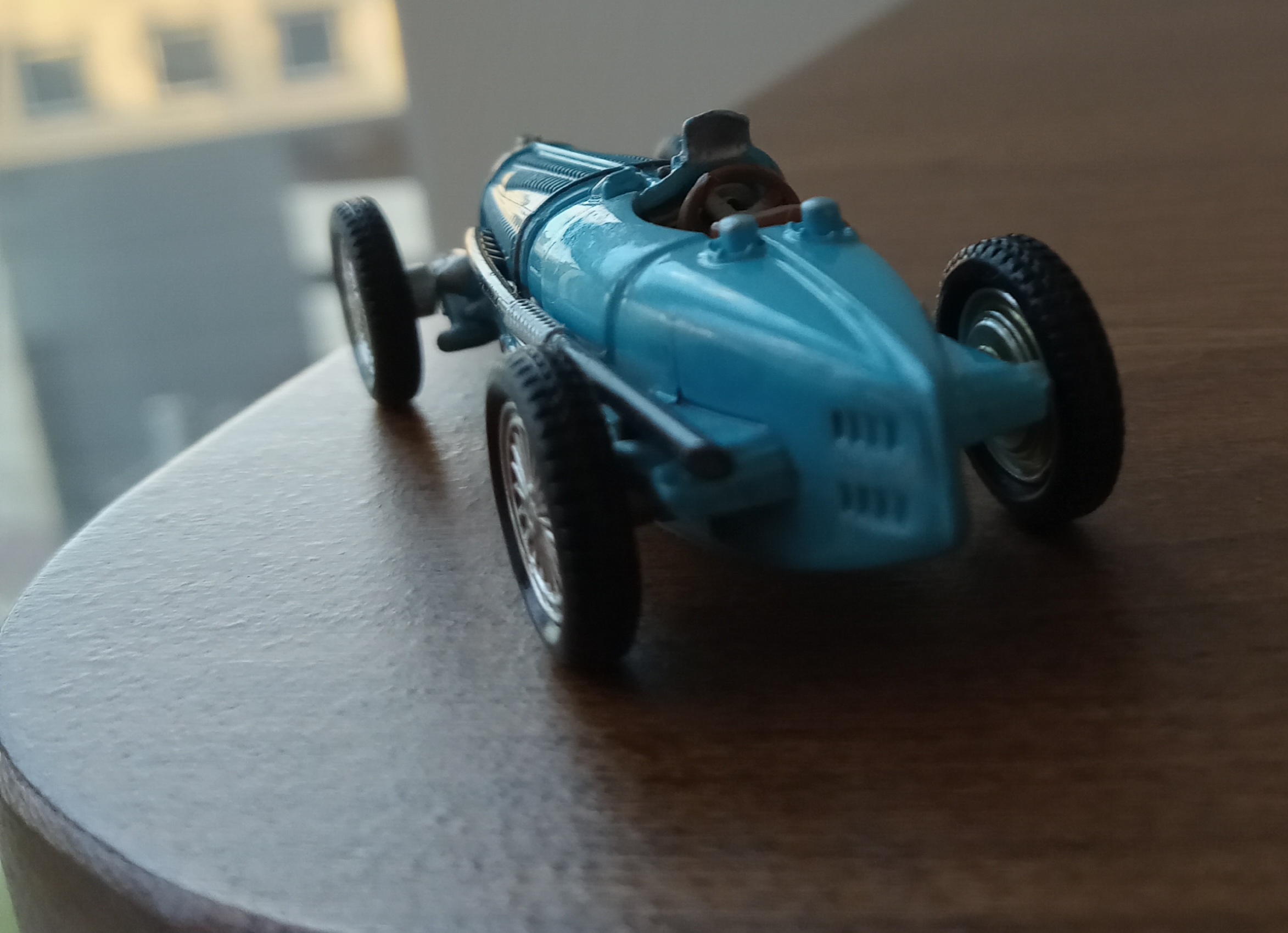
1:葉巻を後端に行くに従ってつぶしたりしながら、美しい背びれを作り、下側を船底のようにスイープさせた、得も言われないほどの車体造形の芸術性
ーーーーーー>それまでのレースカーが『タダの樽』のように見えます!
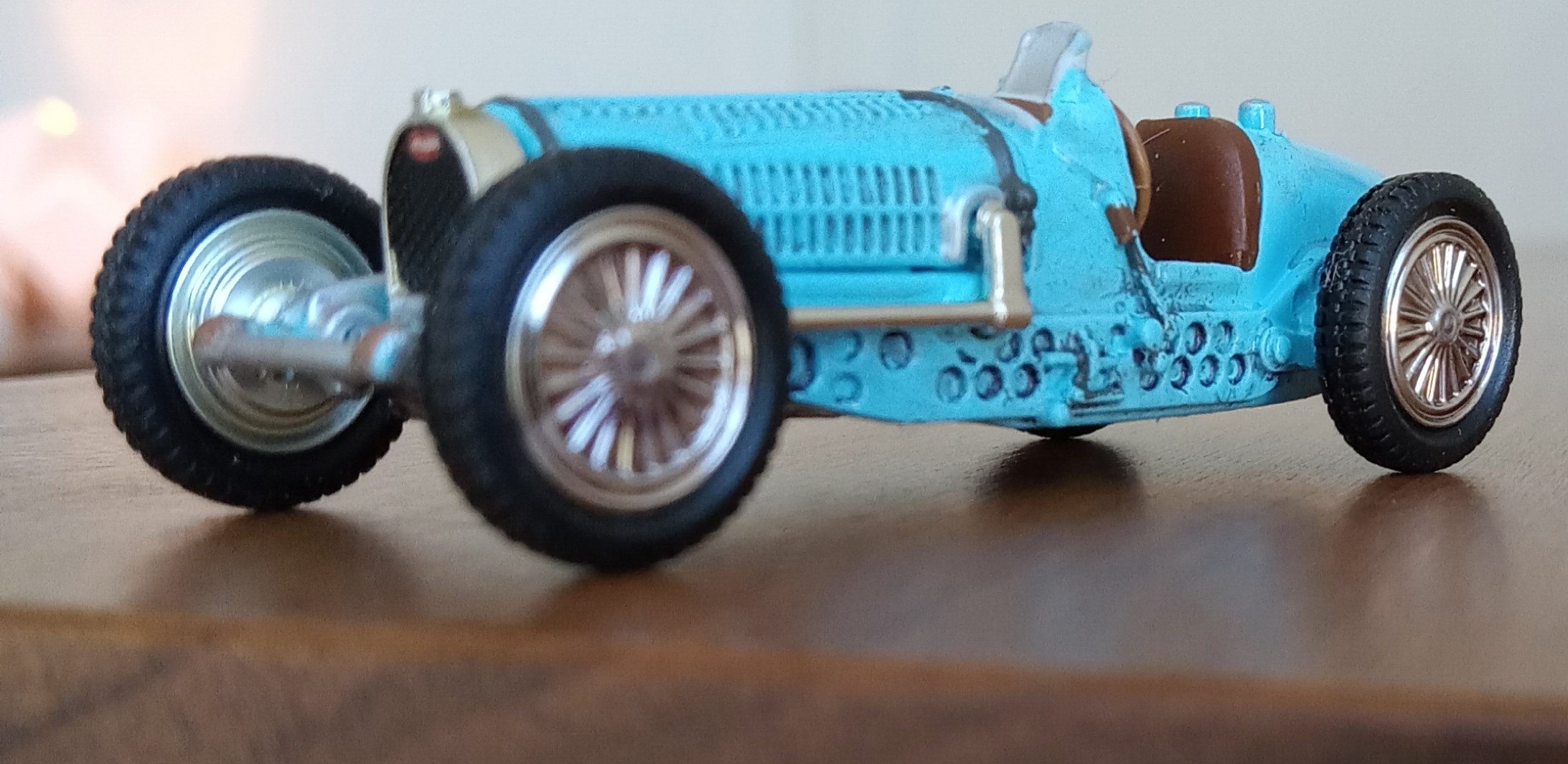
2:後輪へエンジンからのトルクが理想的に行き渡るように『セット・バック配置』された、『FRスポーツカーのメートル原器』のような前、後輪の車軸位置
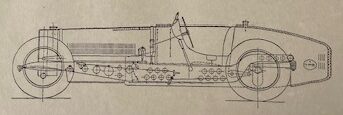
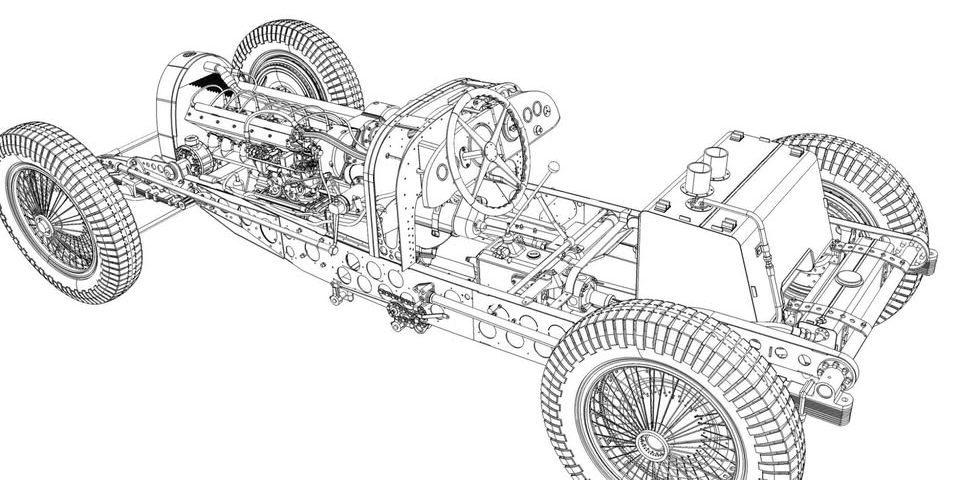
3:車高をできる限り下げるために編み出された、シャーシ・ラダーフレームの複雑なスイープ形状
ーーーー>軽量化のために沢山開けられた穴も素晴らしいアクセントに!!
4:フロントに逆ハの字(ポジティブキャンバー)、リアはその逆の角度の付いたタイヤ&ホイール角度の奏でるリズムの躍動感あふれる楽しさ!
ーーーー>ワイヤー式のホイールのキラキラした美しさがそれをさらに強調します。
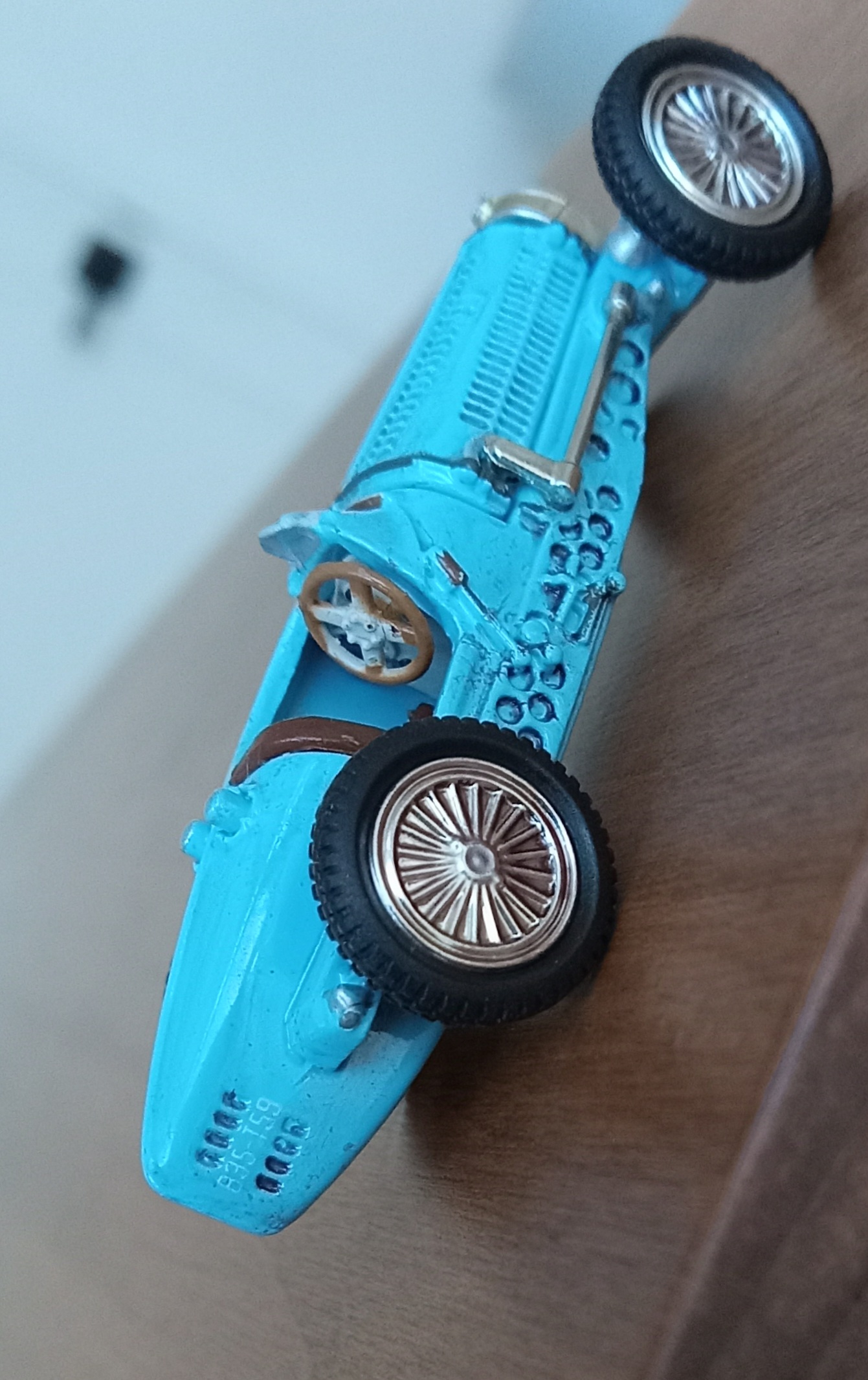
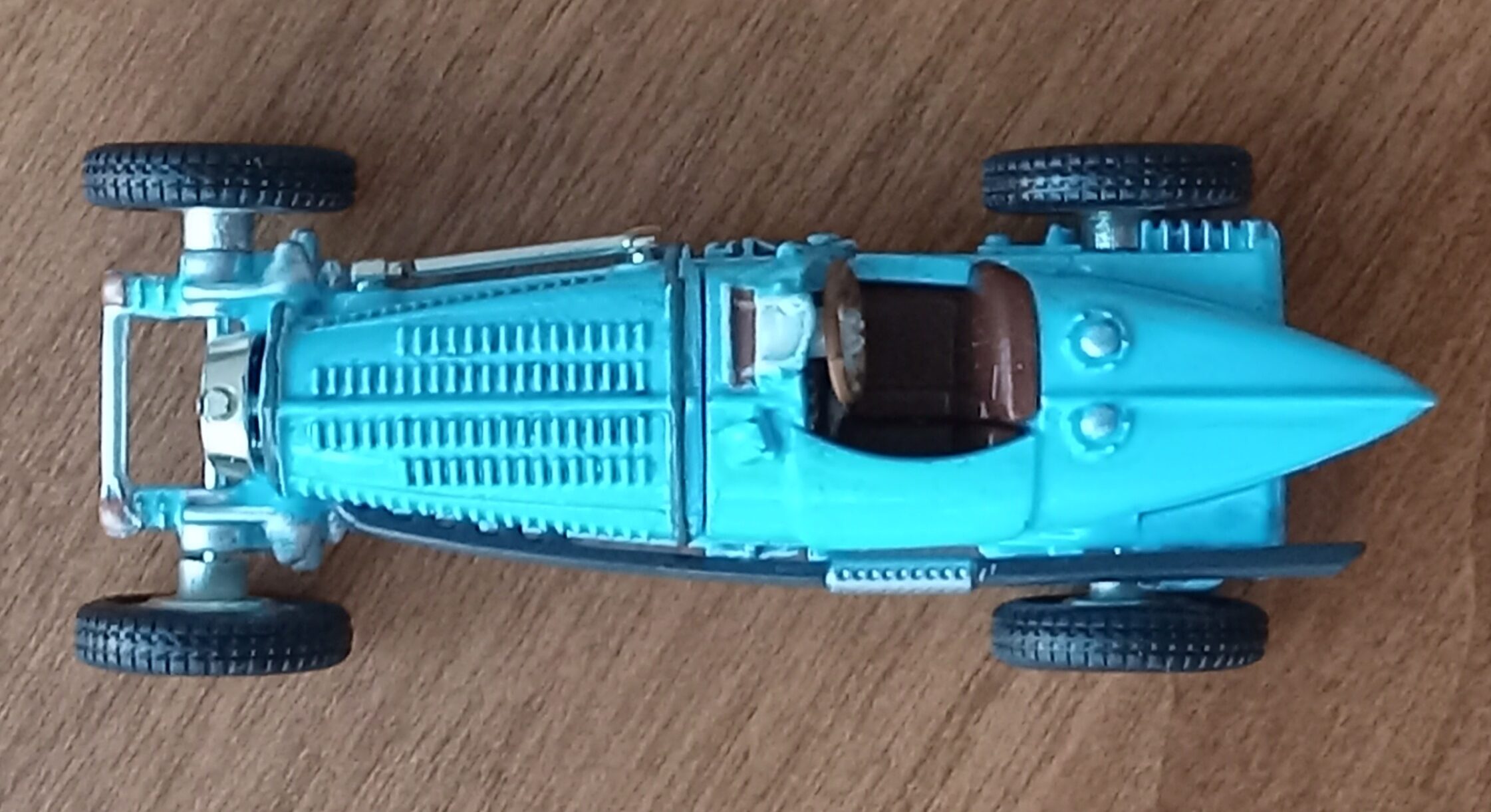
5:左右で違ったデザインの運転席空間と左側に突き出したマフラーがレース車両としての緊張感を演出
ーーーー>図らずも?左右の視覚的、空間的な均衡がとれ、デザインのまとまりに大貢献
それでは1つづつ
詳しく見て行きましょう!
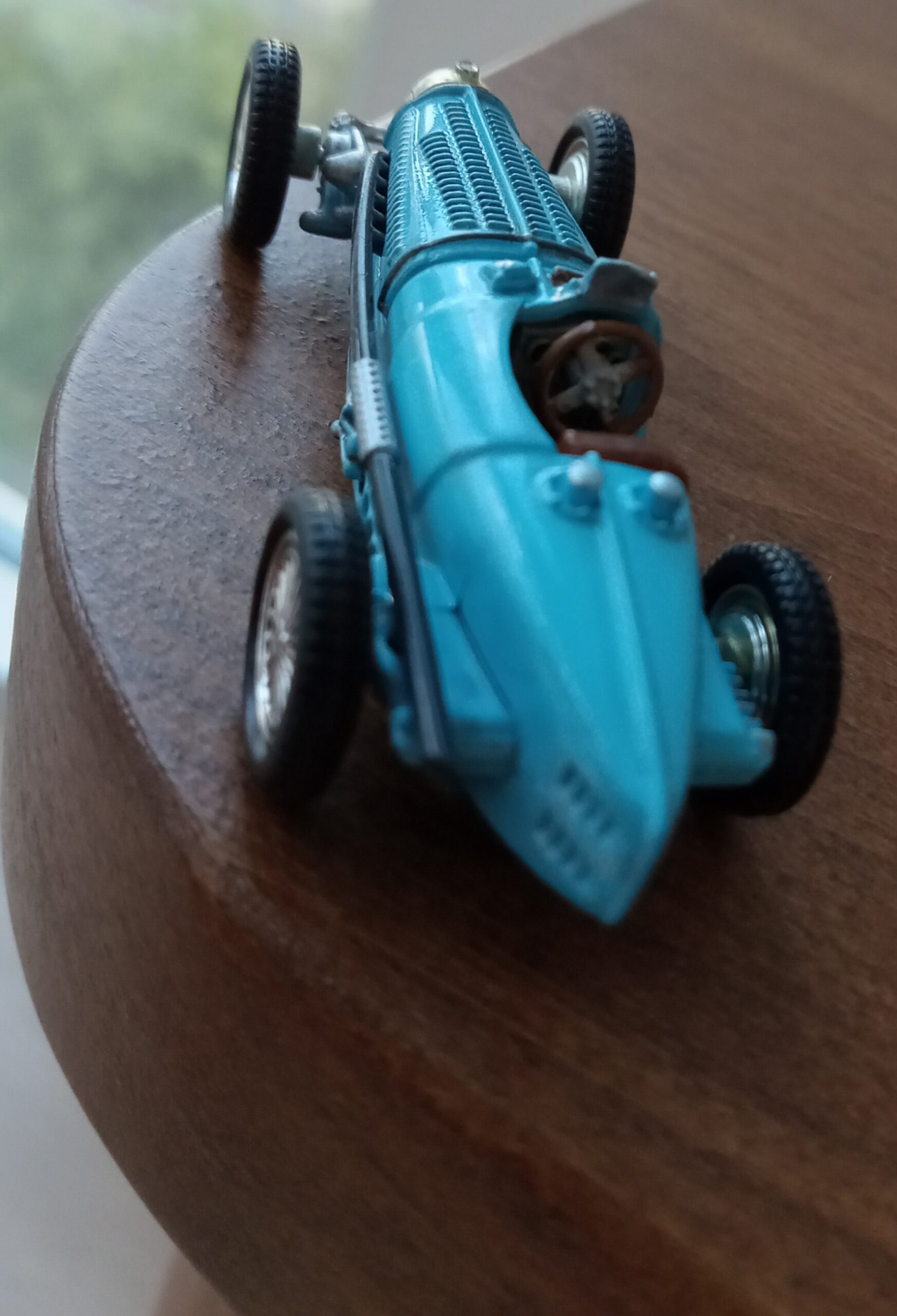
1:葉巻を後端に行くに従ってつぶしたりしながら、美しい背びれを作り、下側を船底のようにスイープさせた、得も言われないほどの車体造形の芸術性
(どの角度から見ても動感あふれる美しい立体!芸術家エットーレの、資質がはっきり表われています。その後のレーシング化世界に対する影響な計り知れないです。)
ーーーーーー>それまでのレースカーが『タダの樽』のように見えます!
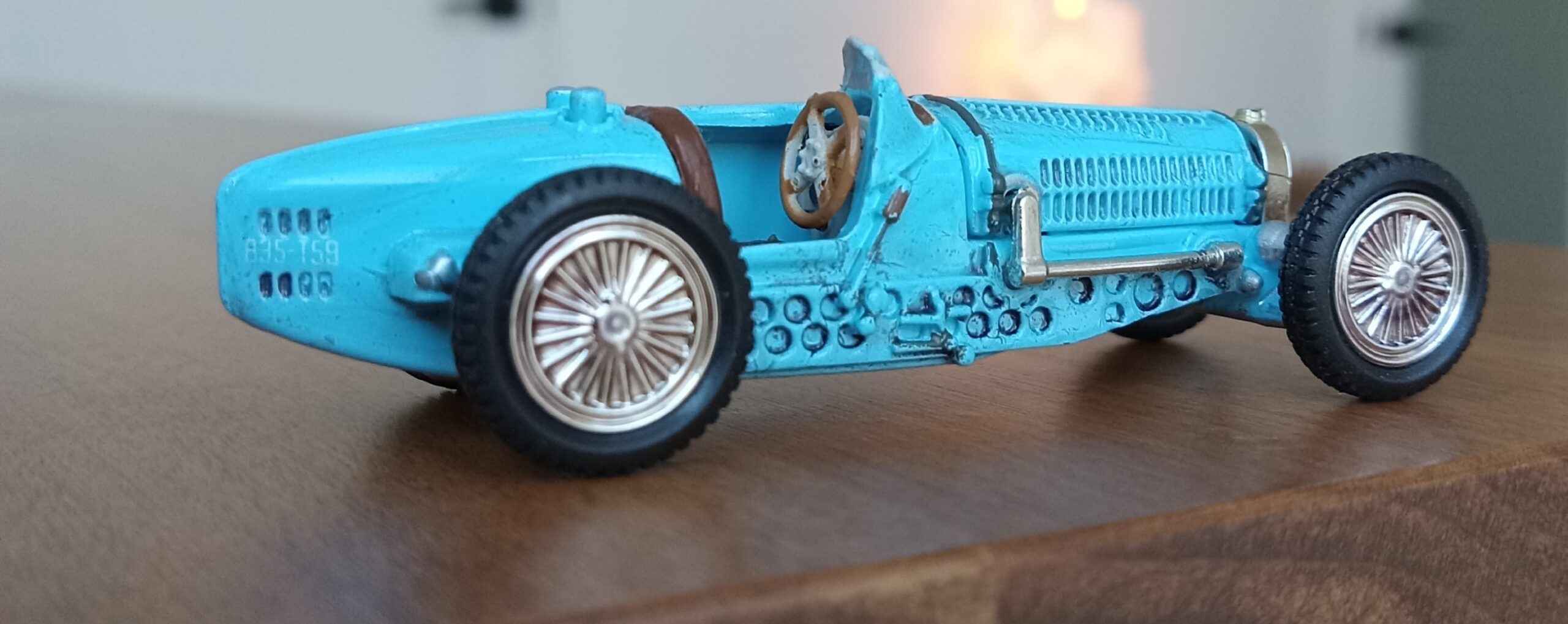
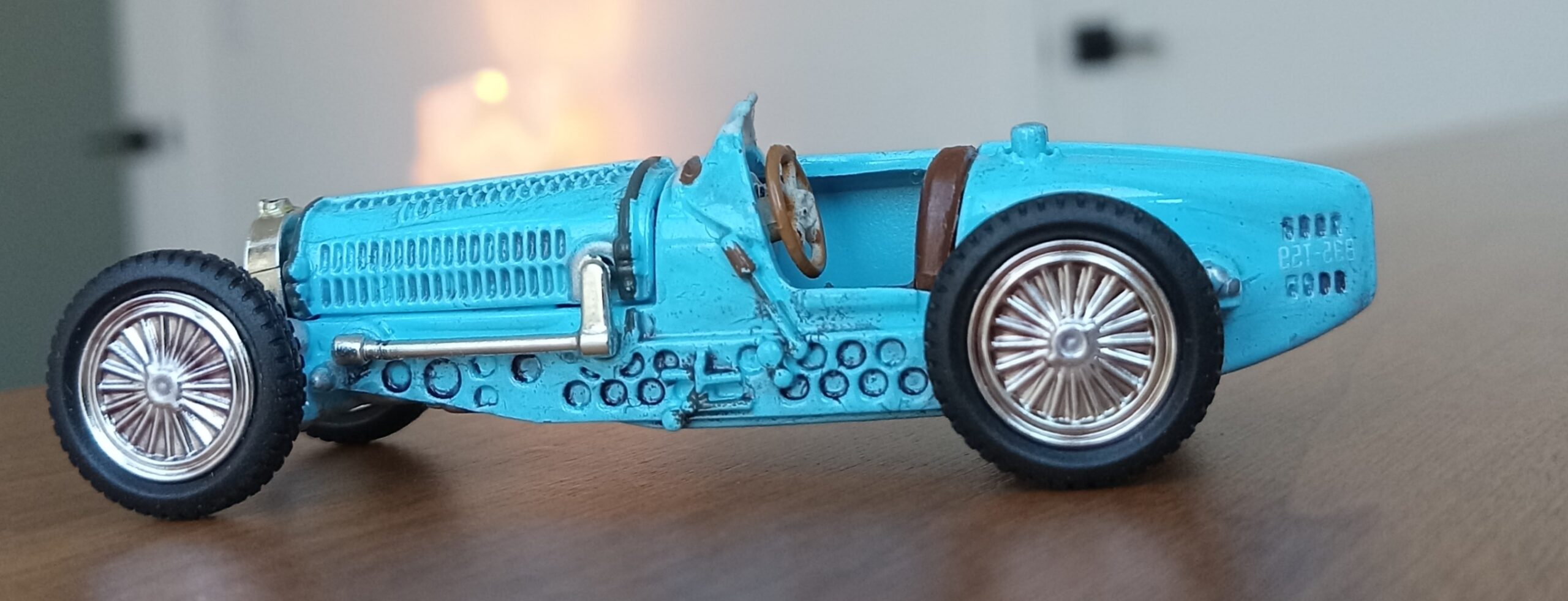
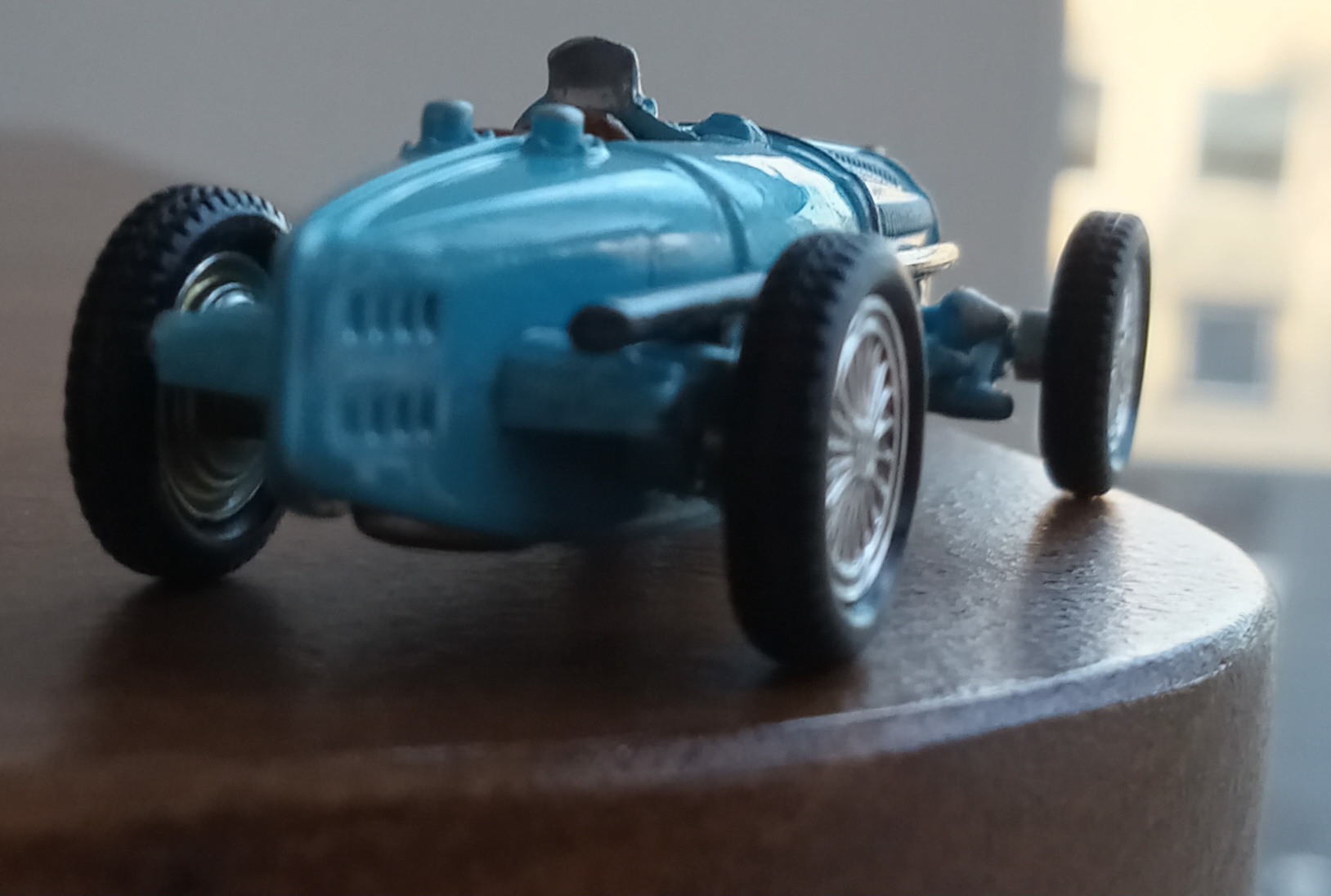
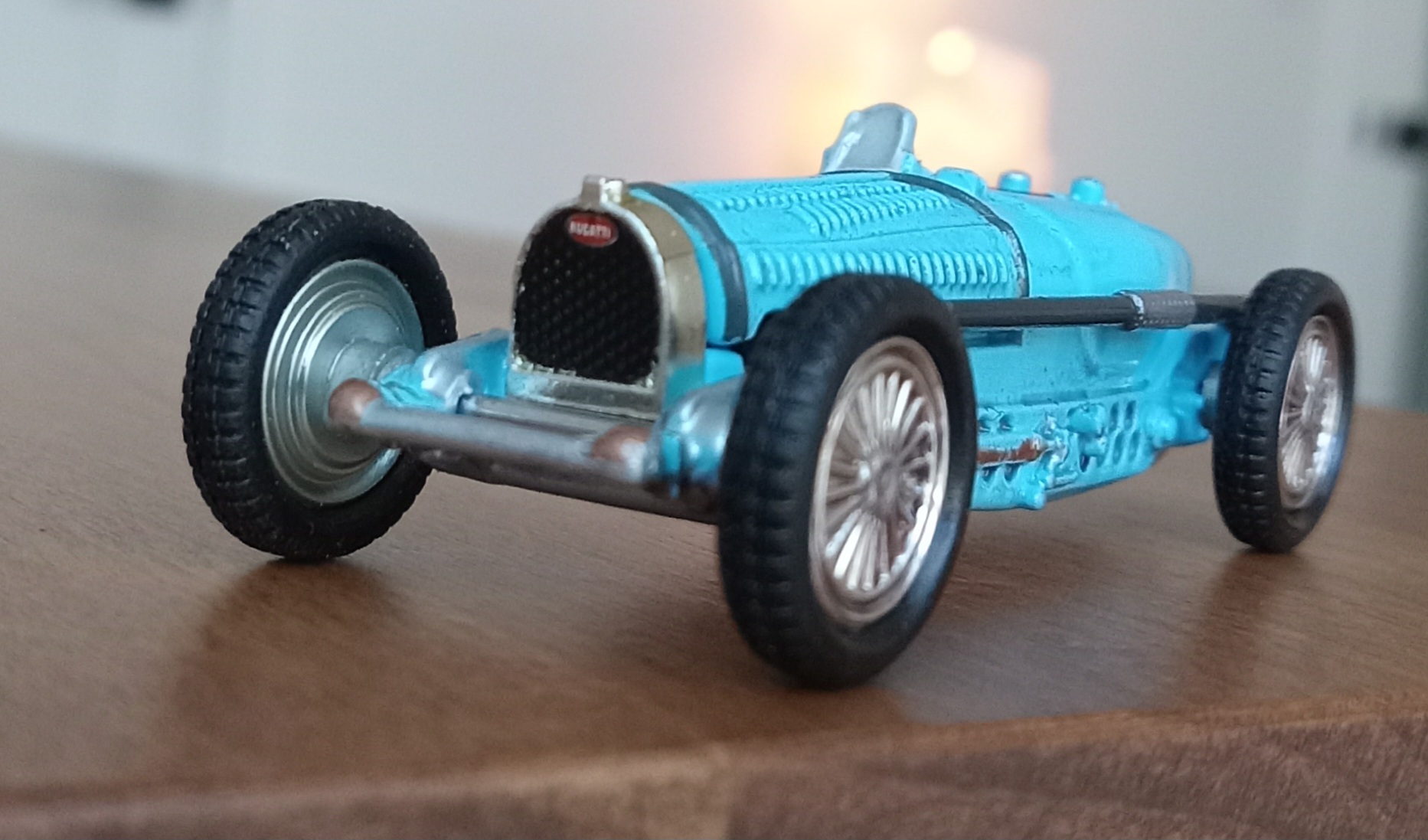
2:後輪へエンジンからのトルクが理想的に行き渡るように『セット・バック配置』された、
ーーーーー>『FRスポーツカーのメートル原器』のような前、後輪の車軸位置
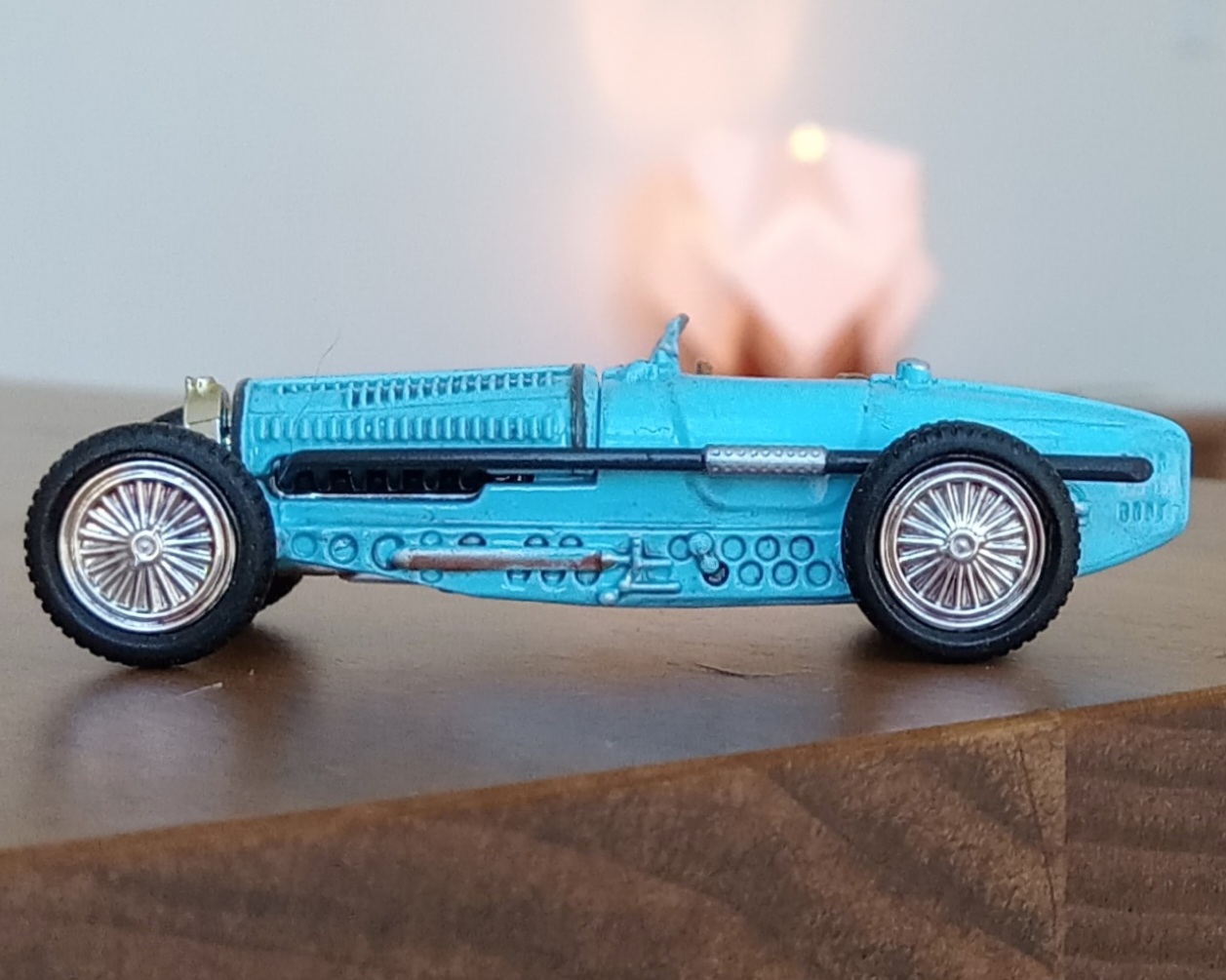
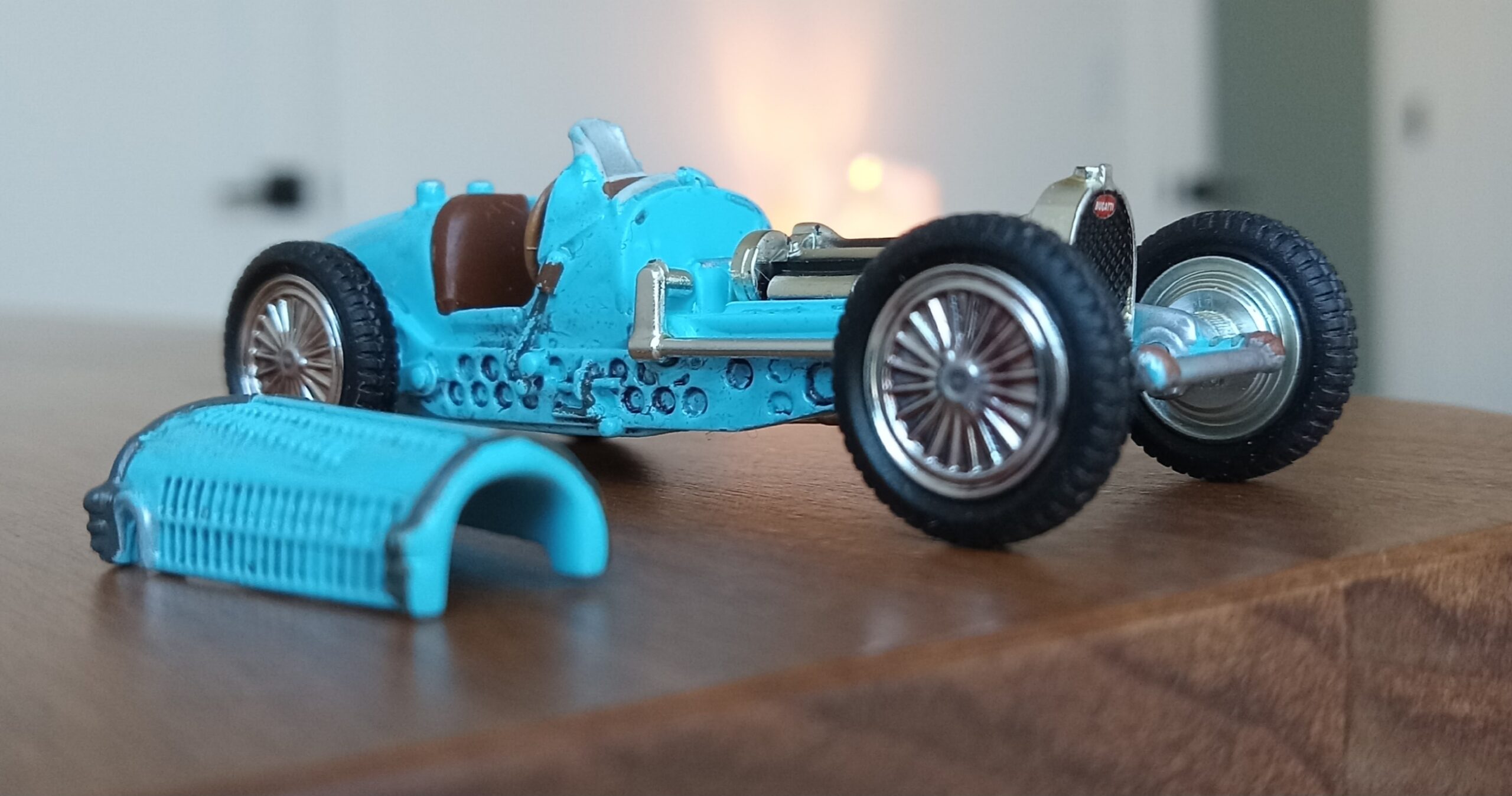
3:車高をできる限り下げるために編み出された、シャーシ・ラダーフレームの複雑なスイープ形状
ーーーー>軽量化のために沢山開けられた穴も素晴らしいアクセントに!!
4:フロントに逆ハの字()、リアはその逆の角度の付いたタイヤ&ホイール角度の奏でるリズムの躍動感あふれる楽しさ!
ーーーー>ワイヤー式のホイールのキラキラした美しさがそれをさらに強
調します。
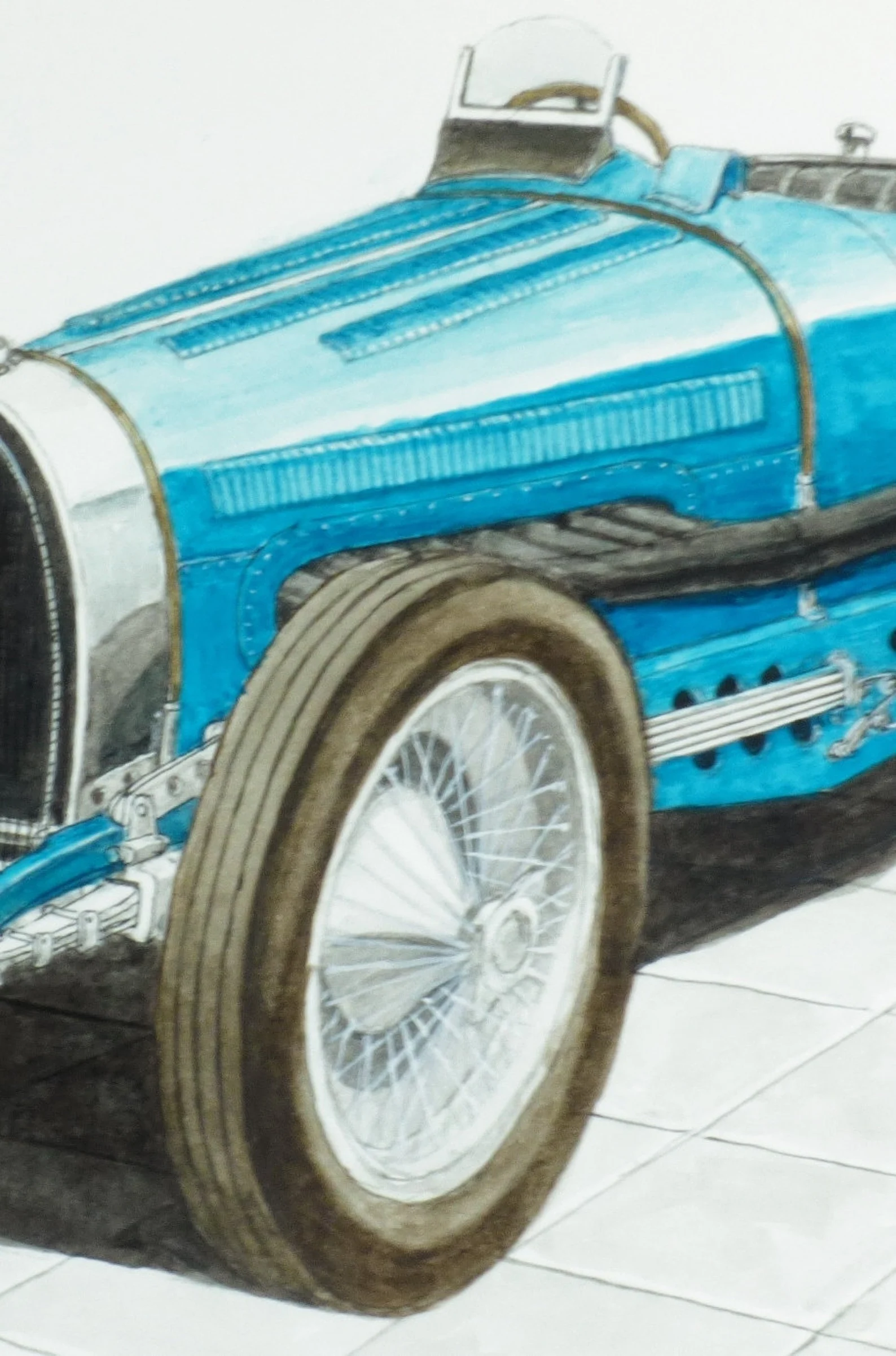
5:左右で違ったデザインの運転席空間と左側に突き出したマフラーがレース車両としての緊張感を演出
ーーーー>図らずも?左右の視覚的、空間的な均衡がとれ、デザインのまとまりに大貢献
*『私』とブガッティ・タイプ59:エットーレのコダワリ
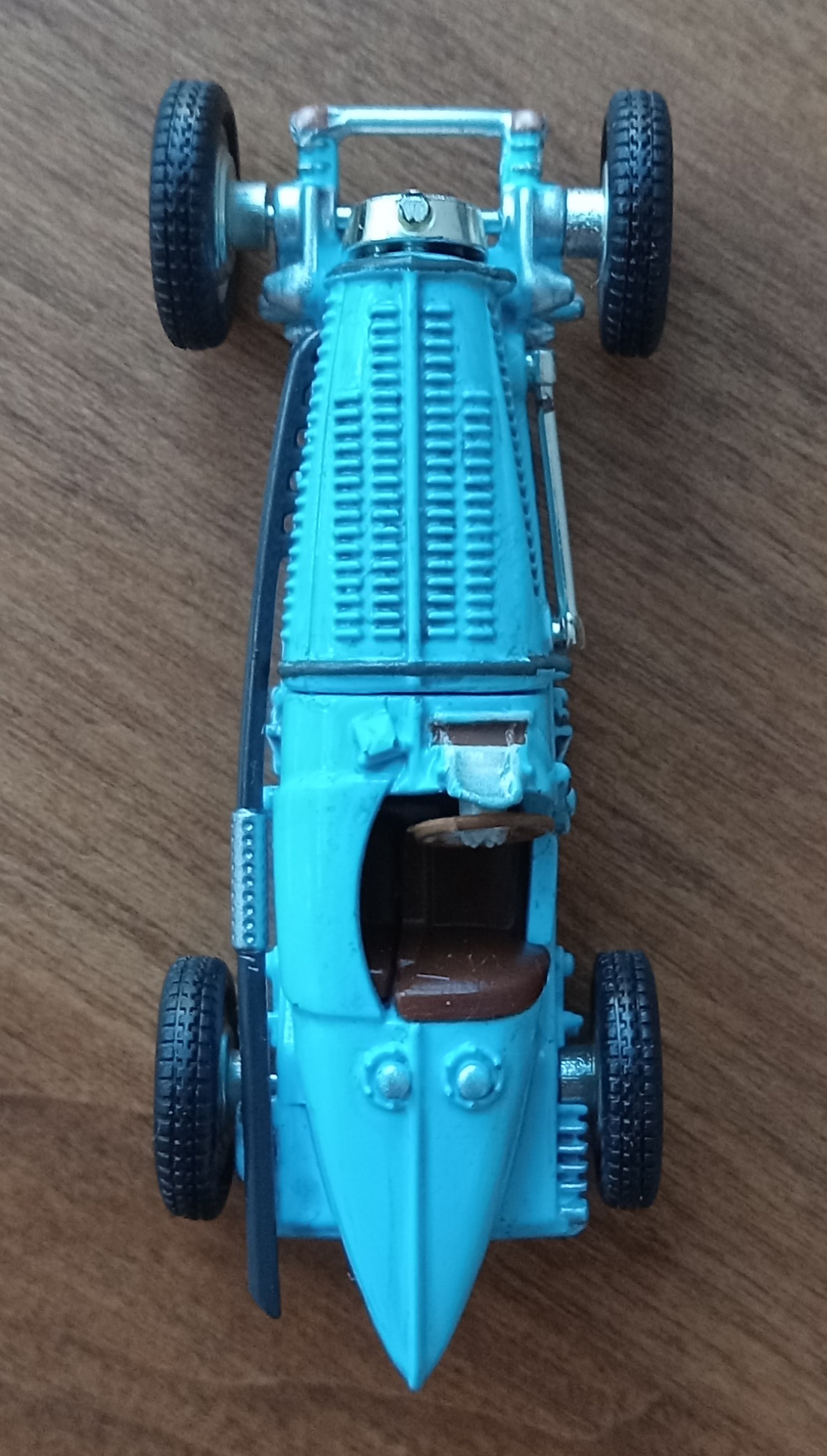
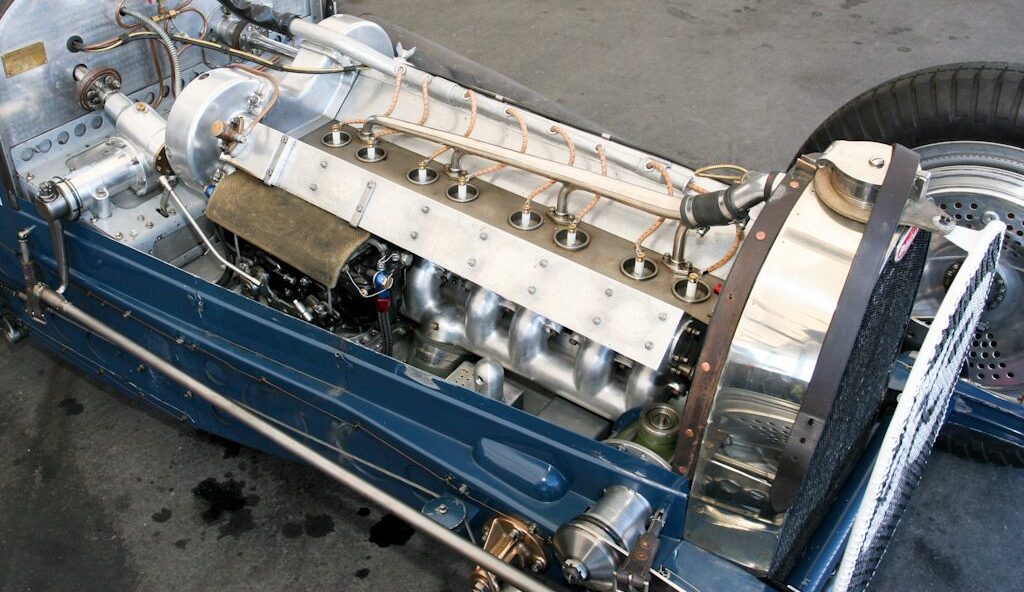
(今回使用したホット・ホイールELITE64モデルは、ボンネットが取り外し可能で、内部のエンジンを観察できるようになっています)
私にとってのブガッティという車とその設計者は
あまりにも純粋な芸術家の香りが強く、
*理屈臭くて、
*理想主義過ぎて、
鼻に付く存在でした。
高校生の時に、自動車好きの
父からイタリア製のポケールの1/8の精密スケールの
クラシックカーを何か一つ作ってみないか?
と言われたとき、
*アルファ・ロメオ 8C 2600ミレ・ミリア仕様
*ブガッティ 50T 1933
*ロールスロイス ファントムll クーペ
以上の候補に挙がった3つのうち、
外観的にはどれも好みの3台だったのですが、
ボンネット内のエンジンや補器類の配列や機械独自の美観や精密感の印象から、
ブガッティの
*あまりにも整理され、
*完全に直方体のエンジンブロックや、
*アルミ材の表面を飾る、独特の表面処理、
などが、自分の求めていた、
*エンジンの複雑な表面処理、
*絡み合った配線や、
*ごつごつした質感と
ことごとく真逆だったため、
なんとも言えない嫌悪感を感じ、
それ以来、ブガッティのボンネットを開けずに、
つまり、ブガッティに対して、
嫌悪感を持っていた時期が続いていました。
そんな中、
渡米後、自動車のレジンモデル収集と制作に熱中していたころ、
フランスのプロヴァンス・モラージュ社製のブガッティ・デザインの美しい飛行機
『ブガッティ100P』のユニークなカタチに魅了され、
再びブガッティの自動車デザインにも目を向け始めました。
「ブガッティ 100P」は、
自動車メーカーのブガッティが1930年代にフランス政府の依頼で開発した、幻のエアレーサー(レース用飛行機)です。当時の自動車技術を応用した革新的な流線型デザインと二重反転プロペラを備えていましたが、第二次世界大戦の開戦により未完成のまま終わりました。

n
n
- 革新的な設計: 航空機エンジニアのルイ・ドゥ・モンジュと共同開発。空気抵抗を極限まで減らした流線型の機体や、引き込み式の降着装置(車輪)を採用しました。
- 二重反転プロペラ: 機首に同軸で逆回転する2枚のプロペラを配置し、エンジンを胴体中央に2基並列で搭載するユニークな構造でした。
- 幻の結末: オリジナルの実機は第二次世界大戦のドイツ軍侵攻を避けるために分解・隠蔽され、当時の飛行は実現しませんでした。
- 現代のレプリカ: 2010年代に入り、アメリカの愛好家チームがオリジナル図面をもとに飛行可能な実物大レプリカを製作し、2015年に初飛行を成功させました。
n
n
n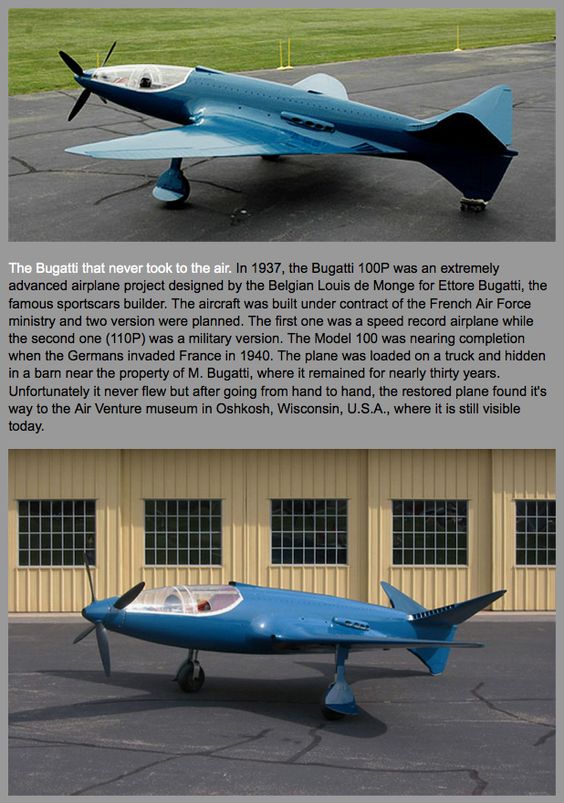
 n
n
nN
nNnN
n
n
n
n
ブガッティにつての新たな興味を抱いた私は、
こんな感じで、
立体を通じてブガッティのデザイン哲学に触れてきました。
n
*マイスト社製、1/18ダイキャスト完成品、ブガッティ・タイプ59 サイクルフェンダー付き(フレンチ・ブルー)
 (近所のホビーショップで手軽に入手可能なモデルで、サイクルフェンダー付きなところが気にいりました。
ーーーーー>ワイヤーホイールが大味だったり、交渉の間違いもありましたが、気に入ってました)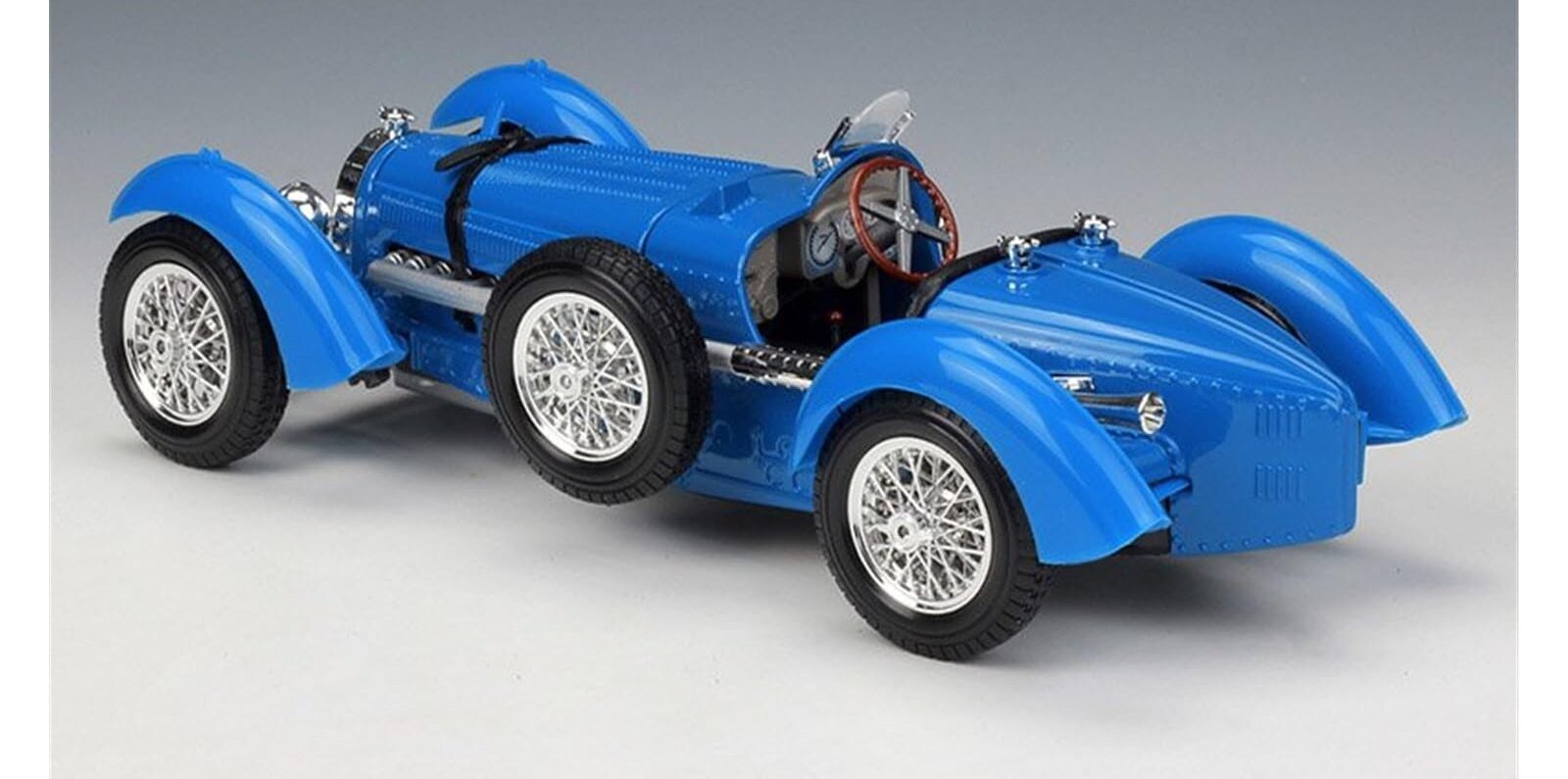
*エリゴール社製、1/43ダイキャスト完成品、ブガッティ・タイプ35 サイクルフェンダー付き(レッド)
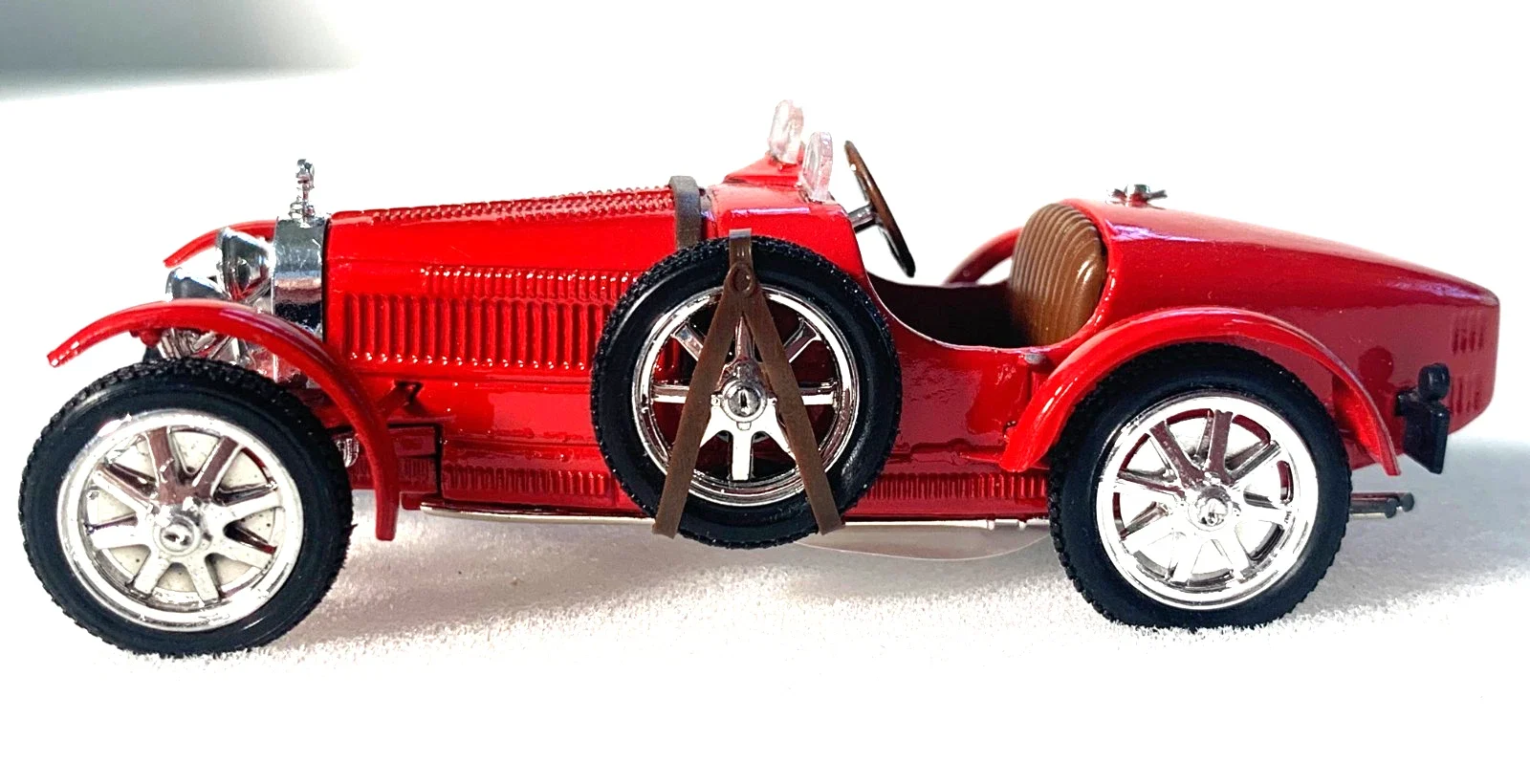
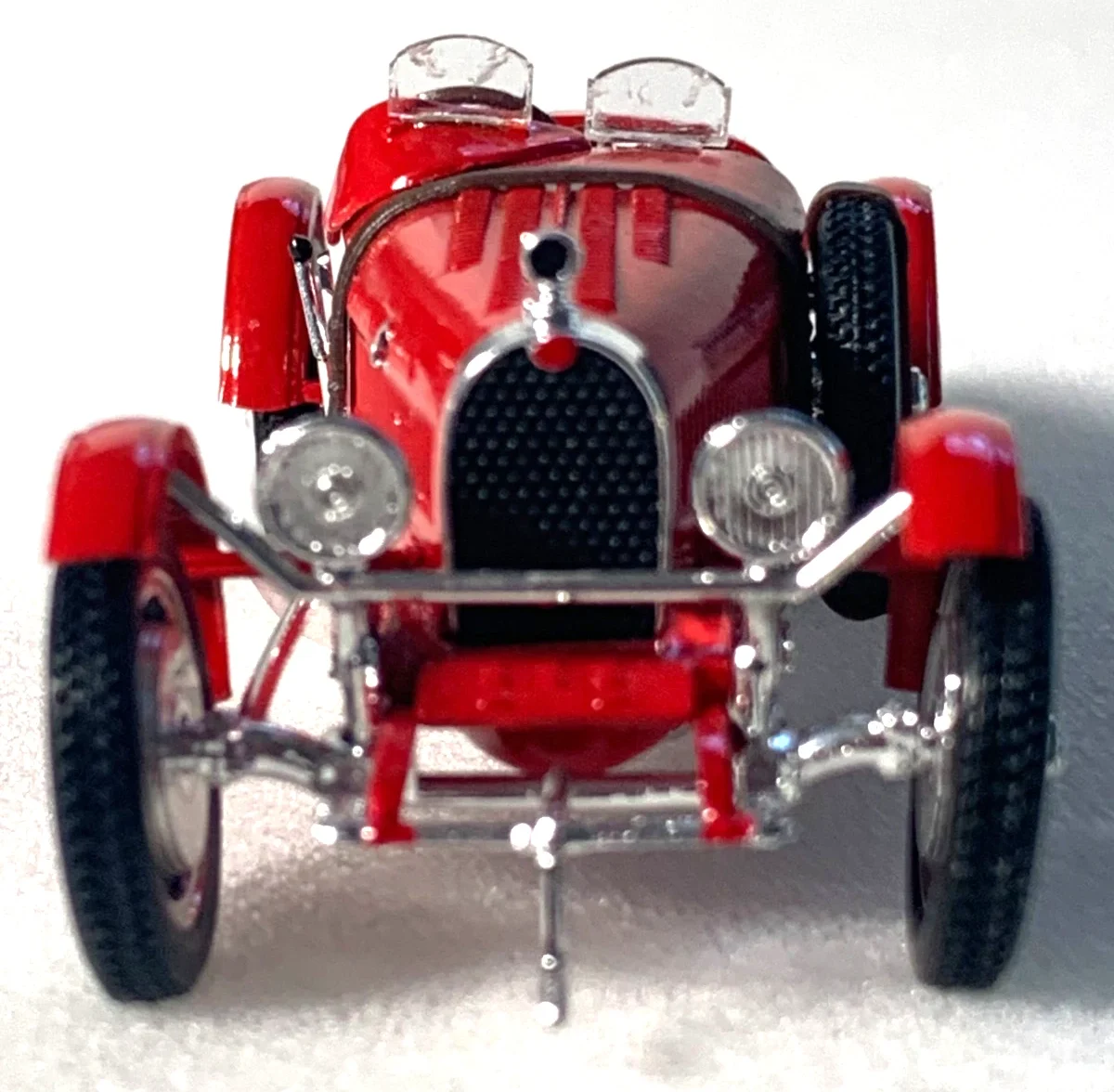 (車種は違いますが、やはりコレクターにより、市街地用に改装されたサイクルフェンダー使用が目を引きました
ーーー>『寸詰まり』ながら、すでにタイプ59の原型が出来上がっています。)
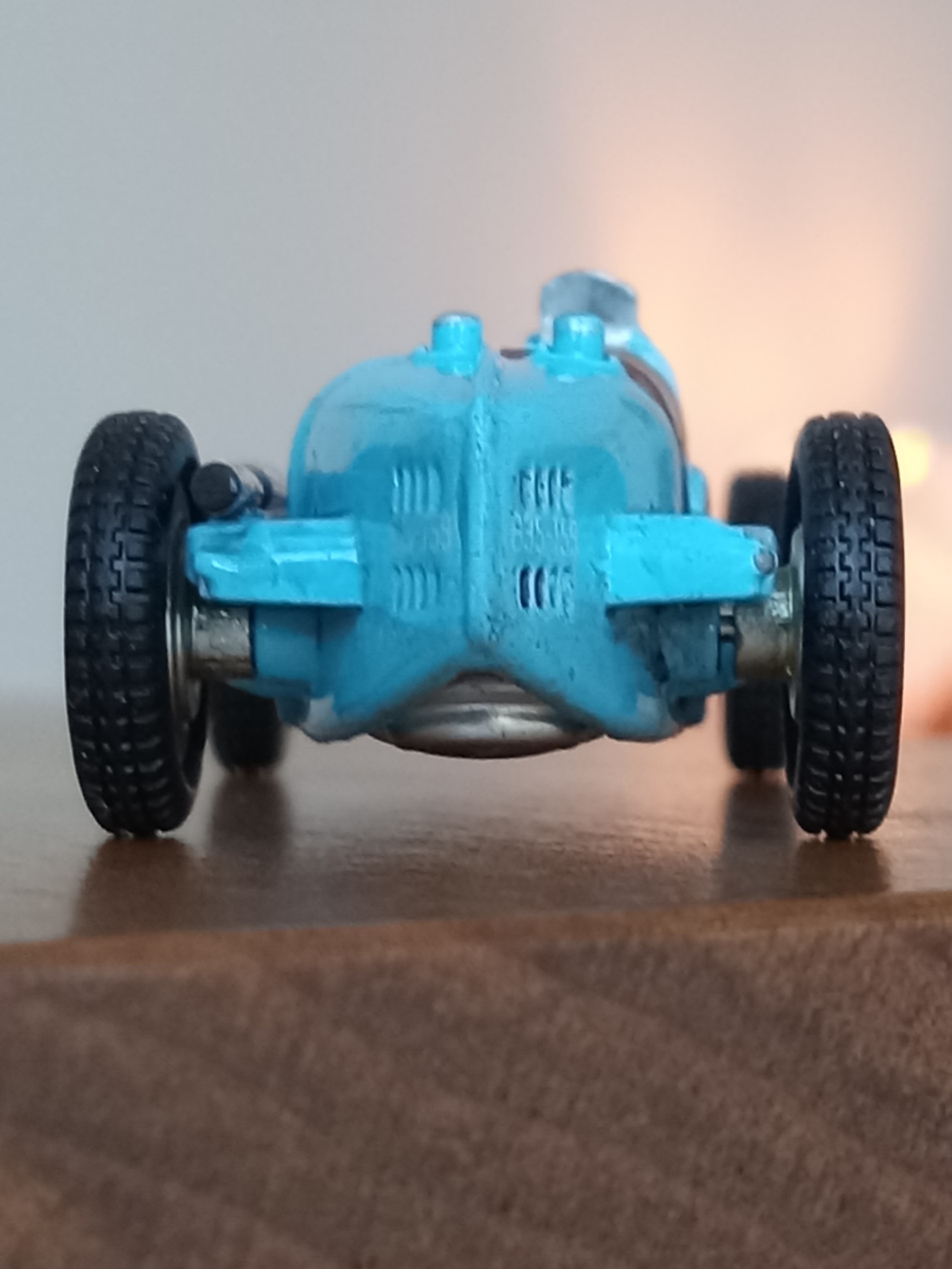
*マテル社製、1/64ダイキャスト完成品、ホットホイール【エリート64】シリーズ、ブガッティ・タイプ59(フレンチ・ブルー)

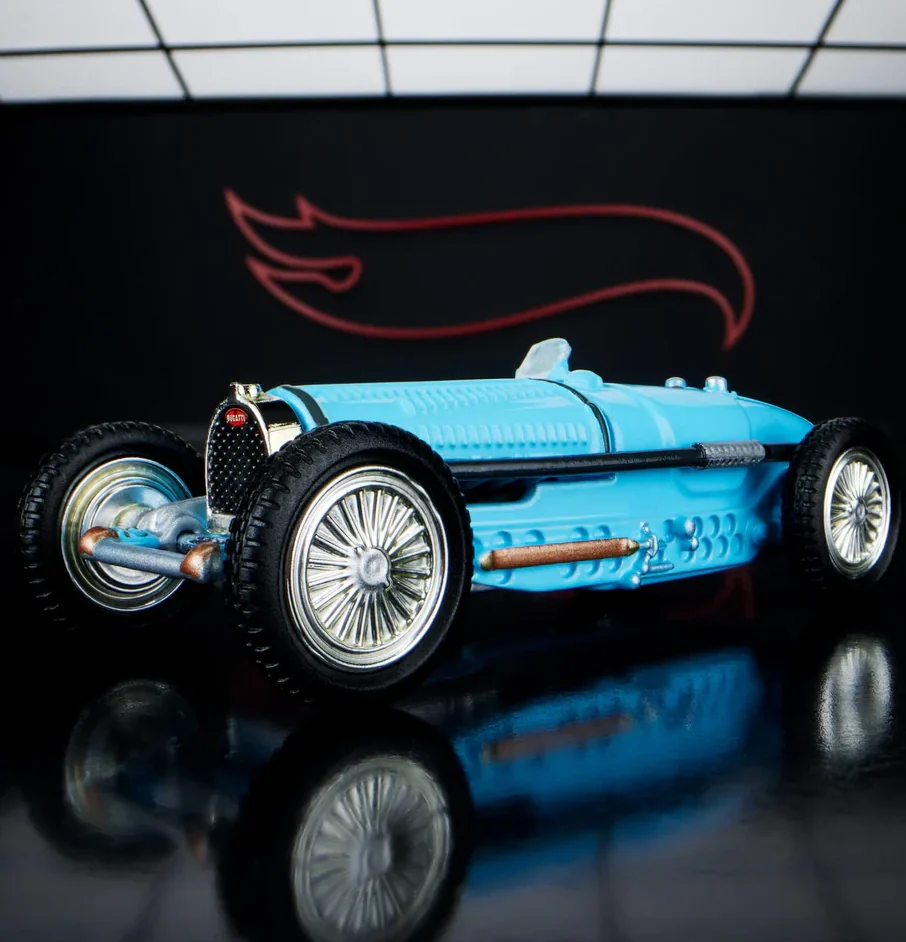
(大味になりがちなスケールですが、キチンと繊細な彫刻と、ボンネットがオープン可能になっています。
---→全体のプロポーションとタイヤのサイズ感など完璧です。)
では【鬼才:エットーレ・ブガッティ】につての解説に続いて、
『三題噺』のお時間です!
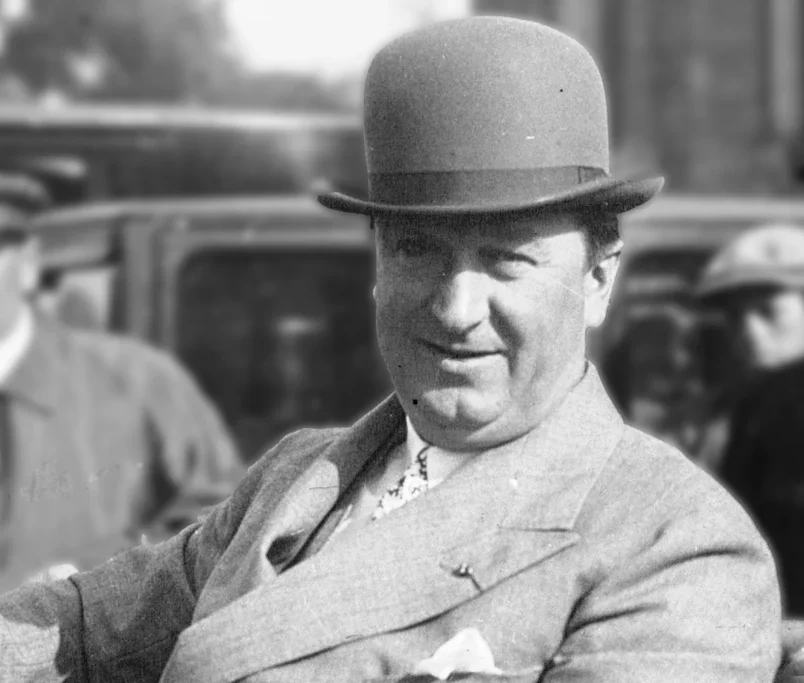
エットーレ・ブガッティ(Ettore Bugatti, 1881年–1947年)は、
n
フランスの超高級自動車メーカー「ブガッティ」の創業者であり、天才的な自動車エンジニア・デザイナーです。イタリアのミラノに生まれ、後にフランスのアルザス地方モルスハイムに拠点を移して独創的な名車を数多く世に送り出しました。
n
代表的な偉業と名車:
*タイプ35: 1920年代のレースを席巻し、1,000勝以上を挙げた史上最も成功したレーシングカーです。
*タイプ41「ロワイヤル」: 王侯貴族向けに作られた、全長6メートルを超える究極の超高級車です。
*飛行機コンセプト『100P』:1930年代にフランス政府の依頼で開発した、幻のエアレーサー(レース用飛行機)です。
*頑固な哲学: ブレーキの効きを顧客に批判された際、「私は車を走らせるために作っている。止めるためではない」と言い放った逸話が有名です。
n
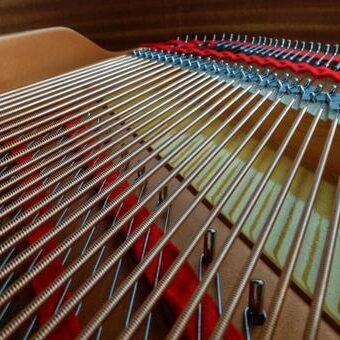
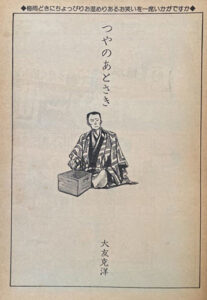
*三題噺:禁煙車問題・狂人・ピアノ線

それでは、
三題噺行ってみましょう!
*禁煙車問題
*狂人
*ピアノ線
今回も会場の皆様方から、
トンデモナイお題をいただきまして、
いつも以上にどうなることやら
見当もつきません。(笑)
『エ~一席
おつきあいの程を願っておきますが、、
最近耳にした言葉に、
『禁煙車問題』というのがございまして、
なんでも、レンタカーなんかでタバコを吸うと
咎められたり罰金を払わなくてはいけないそうですが、、
また、自家用車のオーナーさんなんかでも、
運転中に喫煙すると、今度下取りに出すときの査定に影響するので、
泣く泣く、禁煙者にするとか、、、
喫煙者にとってはますます肩身狭い世の中になりました、、、、
(30年前まで、ヘビースモーカー【一日2箱】だった私は、
未だ未喫煙者をのけ者にする風潮にはなじめませんが。)
肩身が狭いといいますと、
いつの時代も芸術肌な人は世間、家族などからいろいろ「鼻つまみもの扱い」されますね。
エ~今回の主人公、イタリア系のフランス人、伝説的な自動車会社を起こした
エットーレ・ブガッティさん、家族の鼻つまみ者だったかは不明ですが、
これまた相当の変人でして、自動車の機能よりその形の美しさを
第一に考えた生粋の芸術家でした。
彼の傑作、
レーシング・カー:『ブガッティ・タイプ59』には、
*カヌーやゴンドラのようにカーブした葉巻型のボディ、
*直線で構成され、表面を磨き上げられたアルミ製エンジン本体、
*ピアノ線を美しく配置したホイール、などなど
彼の芸術家としての理想が詰め込まれておりました。
彼の芸術的なデザイン嗜好は、工芸的で、完璧主義的でありまして、
当時のデカダンな、
映画スターや富裕層の顧客に愛され、
その結果、当時の熱狂的で頽廃的な文化を象徴する、
アーティファクトとしての機能も、図らずして有しています。
彼はこののちも数々の名車をデザインプロデュースしました。
中にはフランス空軍からの注文で、
飛行速度を競う、国際レース用の飛行機のデザインまでこなしました。
この飛行機がとんでもない代物で、
なんと、
*自動車のエンジンんを機体の真ん中に2台搭載して、
*そこから動力をコックピットの横からプロペラに伝達、
*2台のエンジンが2組のプロペラを逆回転させ推力を生む、
といった空前絶後の代物でした。
その形の異様さと、美しさにうっとりとした私は、
一時的に毛嫌いしていたエットーレブガッティ・デザインの魅力を再発見、
以降は今日に至るまで、
わたしのなかで、尊敬するクリエイターの一人です。
芸術肌な私は、他の芸術家や変人的な人たちに好意を持ったり、
友人として受け入れる傾向があります。
しかしながら、今回のブガッティを毛嫌いした過去は、
自分の『変なもん好き』の限界を感じずにはいられませんでした、、、
つまりは、
私が心の広い、多様性を重んじ、変わった人や芸術家を理解したいのは、
とりもなおさず、
*世の中を多様性に富んだ、
*先鋭的な芸術を受け入れることが出来る寛容な場所になって、と願うことで、
*自分の偏屈で変人的な部分を受け入れてもらいたい、または
*自分の中で、最低限「変な自分を肯定できる」ロジックを
組んでいるだけでは?
と感じています。
いつの間にか、
エットーレ・ブガッティの自動車デザインに置いての
極度に芸術的なアプローチに批判的になってしまいました。
「禁煙車」を強要する世の中と同じような自分に気付きました、、、
情けないですが、
こんな感じです、、、苦笑
考えてみますと、
『芸術家が伸び伸びと、個性的に創作に打ち込める世界』
というのも想像しにくいですが、、、
逆境があっての、
心の叫び、、、ですから。
このお話、いつまででも続けられます、、
(桂米朝師匠の「明石飛脚」を思い出します。)
キリがありませんので、
この辺でお後がよろしいようで。
ペンペン』
*その他の『葉巻型レーサー』たち、、、
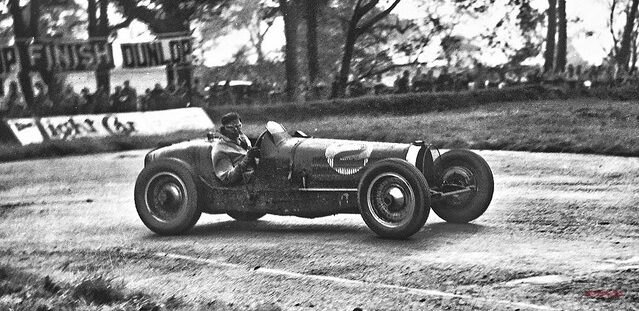
ブガティ・タイプ59の活躍で、
その後の定番スタイルとなった『葉巻型レーサー』ですが、
ブガティ以外に
どんなものがあったのでしょうか?
私の独断と偏見で選んでみます!
*ロータス 25、1962(グリーン&イエロー)
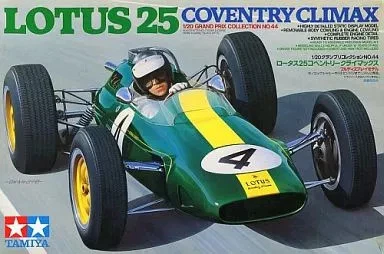
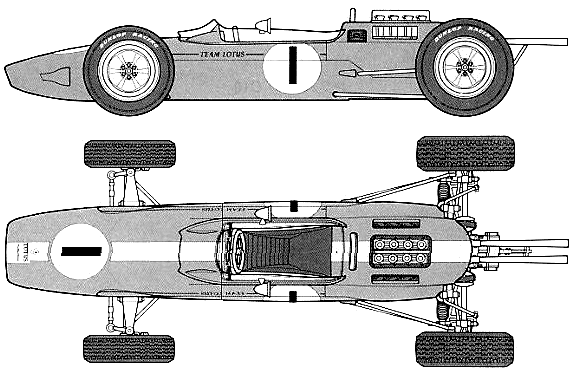
(葉巻部分のシンプルさと、タイヤ位置と全体のバランス具合いが完成の域に達しています。)
ーーーーーー>コーリンチャプマンのロジック溢れる美意識がにじみ出ています。
*ロータス 49、1967(グリーン&イエロー)
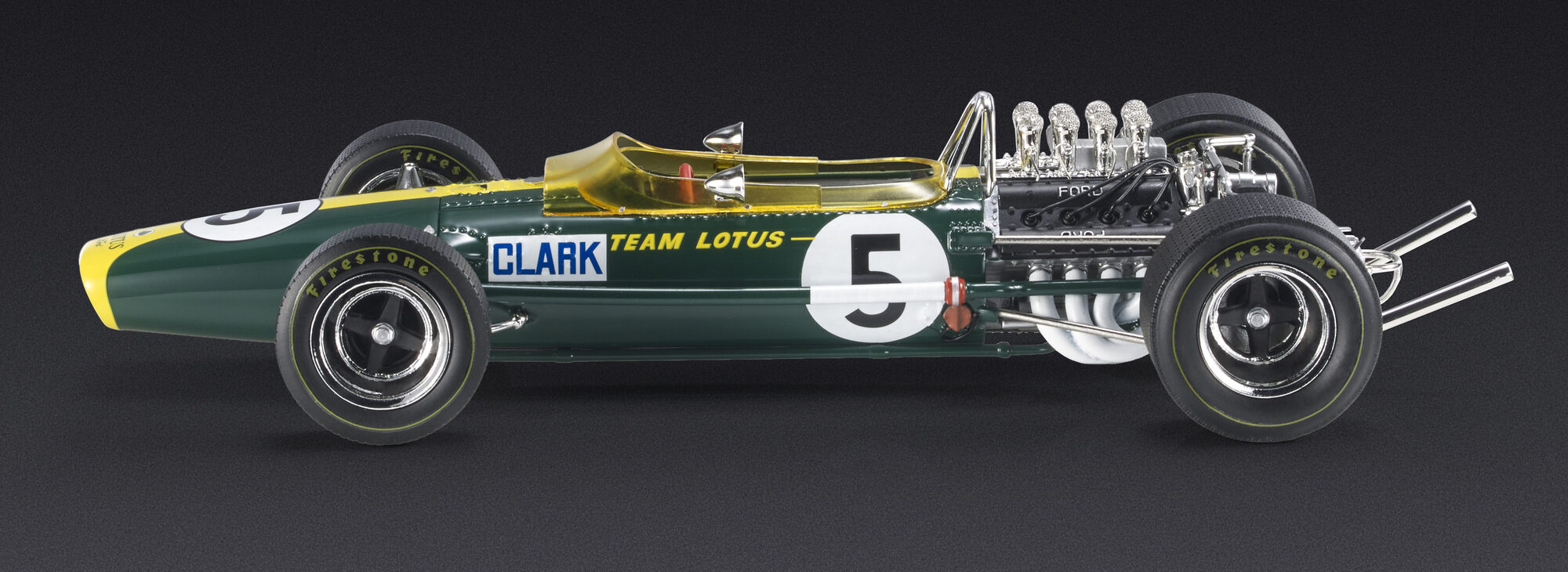

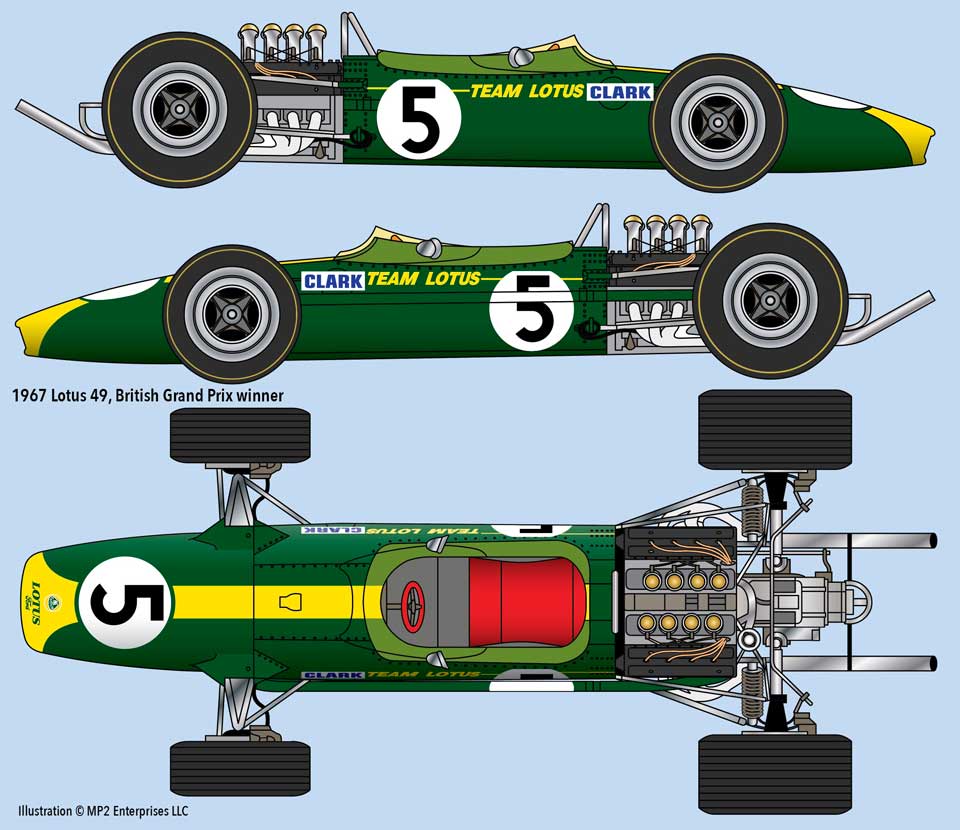
(エンジンが大型化され、それに合わせて大柄化、しかしながら全体のまとまりとプロポーションのすばらしさは健在です。)
ーーーー>葉巻型F1の終着駅でしょうか?
*イーグル MK1、1967(メタリック・ブルー&ホワイト)

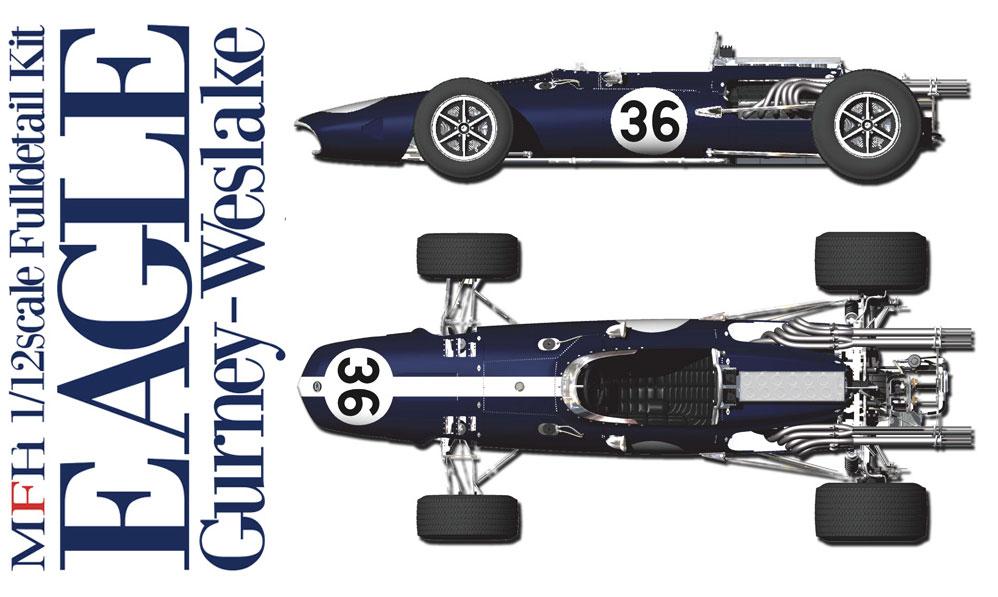
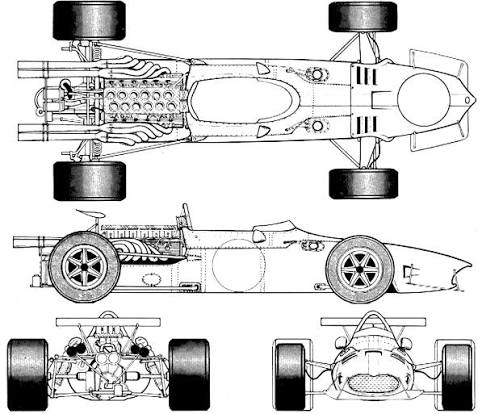
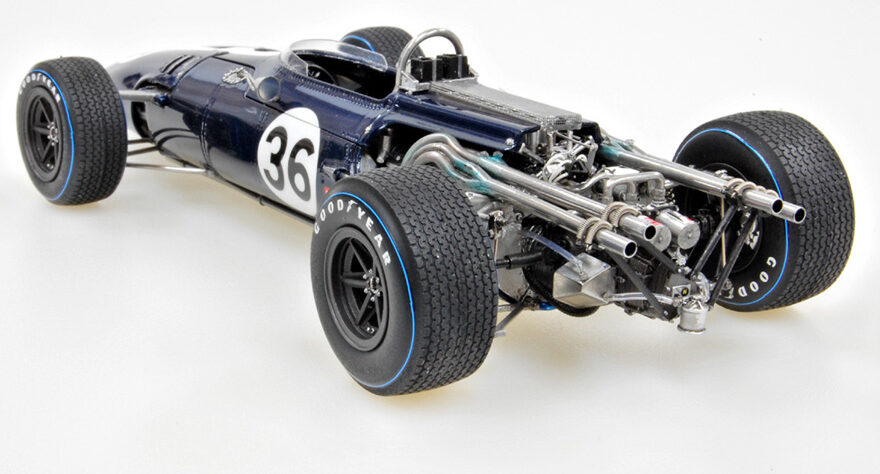 (くちばし型のフロントエンドとメタリックブルーのボディーが、アメリカ製F1を象徴しています。まさにlotus49の英国趣味に対局するにふさわしいいで立ちです。)
ーーーー>大柄のv12エンジンを収めるボディーの抑揚がおおらかなアメ車のそれを連想させます。
*フェラーリ312B、1970(イタリアン・レッド)
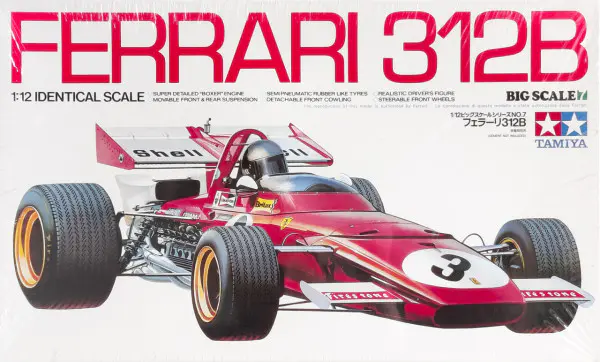
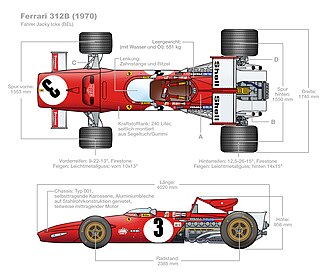
(葉巻型からウイング一体型ボディーへの移行期の傑作!リアエンジンの真上に鎮座するウイングが圧倒的!)
ーーーーー>ロータスとフェラーリの間で繰り広げられた技術バトルがしのばれます。
 天才と鬼才が同居する感じの、
エットーレの傑作、「タイプ59」でした。
長々とお付き合い、
感謝いたします。
次回は、
フランス2ドア クーペの第2回、
「シトロエンSM」について
お話ししてみたいです。
お楽しみに――
本ブログと記事内容につきまして:
ブログ記事を書くにあたり私の目標は、立体造形(料理も含めて)とのかかわりを通じて、私個人の特徴的(ネジ曲がり方も含めて)な評価軸を解明することで、「美しさ・美味しさ」に対する好奇心や、探求心を、どのように満足・充足させてきたのかを明記しておくことです。
従いまして、記事の中に出てくる、数字や年号、微細なデータなどには細心の注意を払っておりますが、時に大きな間違いや勘違いを犯していることも考えられます。特に自動車記事における主要諸元や、年号などには紛らわしいものも多く、あくまで参考程度に考えていただければ幸いです。
私としては、記事の中で個人的な外観デザインや味覚の評価、そこから広がる後半部分につなげるための、『流れ』を作るための客観的材料として年号やデータを挿入している感じです。あくまで重視したいのは、私個人の頭の中で起こる、記憶の錯そう的混沌から生まれる新たな『見方』や『情報の予想外のつながり』です。その勢いを作り出す、『流れ』の一環として、諸データが副次的に必要となるわけです。
話がそれますが、大好きな落語の世界に「三題噺」という、その場て会場から募った3つのお題を使って1つのお話に仕立てるといったお遊びがございますが、私はそれに近いことを立体造形の特徴や(料理のお味)をお題にして行っている感じがします。その中で頭の中に去来する数々の着想が、全く予想外で楽しく、次回からの記事内容を大幅に変えたり、新展開につながっています。
当ブロブの仕組み:
『好奇心の点と線 x 気まぐれ脳内回路=予想外の新展開』
こんな自分勝手なブログですが、今後ともよろしくお願いいたします。
追記:上記の『流れ』を作る為に必要な写真はできる限り、個人所有のミニカー・自前の料理などを使い撮影しておりますが、その他の必要最小限の図版や写真を他のブログ主様の記事や諸会社ホームページなどからお借りしております。(記事内容に合うよう加工させていただき、使用時は最小の解像度で載せております。)問題がある場合、ご連絡いただければ直ちに降ろさせていただきます。
追記2:当ブログ記事に掲載のミニカー写真等(個人撮影)は許可なしで、どのようにお使いいただいても結構です。私個人の創造性はこの世のもの、と言う認識の上で記事を製作しています。
!!!!!!!!!!!!!!!!!!!!!!!!!!!!!!!!! Translation in English !!!!!!!!!!!!!!!!!!!!!!!!!!!!!!!!!!!!!!
(Mattel, Hot Wheels Elite 64, 1/64 Bugatti Type 59 (French Blue) ーーーーーー> Modifications: Slightly adjusted the position of the tires and wheels; applied wash and weathering in Warm Gray to fine details on the body)
Episode 37—The Lineage of 2-Door Coupes (Barchetta): Episode 17 [French Cars] Bugatti Type 59, 1935 (French Blue) “A Moving Sculpture by Ettore”
#Favorite Car Designs—The Lineage of the 2-Door Coupe:
For this 37th installment, titled “The Lineage of the 2-Door Coupe, Part 16,” I’d like to discuss luxury 2-door (GT) coupes and roadsters, which strongly reflect the national character and unique exterior design styles of various countries. [Note: Includes convertibles]
We’ll proceed as follows.
For this 17th installment, we’ll focus on [French Cars]
We’ll be discussing the
Bugatti Type 59, 1935 (French Blue),
unveiled in 1935.
[2-Door Coupe Lineage: Table of Contents]
[American Cars Edition]
Part 1: Cadillac El Mirage, 2013 (Metallic Red)
Part 2: Lincoln Continental MK4, 1972 (Black)
Part 3: Mercury Cougar, 1967 (LT Metallic Green)
[German Cars]
Part 4: MB 500K Special Roadster, 1936 (Black)
Part 5: MB 300SL Roadster, 1957 (Silver)
Part 6: MB SLS AMR Gullwing, 2010 (Black)
[British Cars]
Part 7: McLaren F1, 1992 (Metallic Orange)
Part 8: Jaguar XKSS Roadster, 1957 (Royal Blue)
Part 9: Jaguar XKR Coupe, 1996 (Dark Metallic Green)
[Japanese Cars / Nissan]
Episode 10: Nissan First-Generation Silvia, 1965 (Champagne Gold)
Episode 11: Nissan Fifth-Generation Silvia, 1988 (LT Metallic Green)
[Italian Cars]
Episode 12: Ferrari 250TR Pontoon Fender, 1958 (Red)
Episode 13: Ferrari 250GTO, 1962 (Italian Red)
Episode 14: Lamborghini Concept S, 2005 (Pearl White)
[Japanese Cars: Mazda Edition]
Episode 15: Mazda Cosmo Sport, 1968 (Racing White)
Episode 16: Mazda Eunos Cosmo, Type-S (Two-Tone: Black & Gray)
[French Cars]
Episode 17: Bugatti Type 59, 1935 (French Blue)
Episode 18: Citroën SM, 1970 (Champagne Gold)
Episode 19: Bugatti La Voiture Noire, 2019 (Black)
[Japanese Cars: Toyota Edition]
Episode 20: Toyota/Yamaha 2000GT, 1967 (Ivory White)
Episode 21: Toyota 2nd-Generation Soarer, 1986 (Two-Tone: Black & Gray)
Episode 22: Lexus LC [GWZ100], 2017 (Metallic Red)
[American Cars Part 2]
Episode 23: Dodge Challenger & Plymouth Barracuda, 1971
Episode 24: Dodge Viper SRT-10 ACR, 2008 (Black)
Episode 25: Ford Shelby GR-1 Concept, 2004 (Chrome)
[Japanese Cars: Mitsubishi Edition]
Episode 26: Mitsubishi Galant λ, 1976 (Brown Metallic)
Episode 27: Mitsubishi Eclipse [North American Spec], 2006 (Orange Metallic)
[German Cars Part 2]
Episode 28: BMW M635CSi, 1984 (Dark Metallic Blue)
Episode 29: Mercedes-Benz 560SEC AMG 6.0 Widebody, 1989 (Black)
Episode 30: BMW M2 with Genuine Performance Parts, 2025 (Neon Lime)
[Japanese Cars: Subaru Edition]
Episode 31: Subaru Crosstrek XV, 2012 (Lime Green Metallic)
The Corvette Lineage: (Special Edition)
Episode 1: 1967 Stingray [C2] Convertible (Hardtop, Metallic Blue)
Episode 2: 1972 Corvette [C3] Convertible (Metallic Blue)
Episode 3: 1984 Corvette Coupe [C4] (Bright Red)
Episode 4: Stingray Concept [Pre-production Prototype], 2009 (Metallic Blue)
#1935: The Emergence of the Aesthetic Prototype for Cigar-Shaped Racing Cars
From the 1950s through the 1960s,
the
“cigar-shaped racing car”
that would take the world by storm
had its prototype—
a model that had already realized this chassis layout
as early as 1935.
That model is the
“Bugatti Type 59,”
designed by
Ettore Bugatti and Jean Bugatti.
Personally,
Personally,
* Its incredibly low profile, almost skimming the ground,
* The numerous, jewel-like details
scattered throughout its body
If the “Daimler-Benz 500K” was the ultimate luxury coupe of its time,
then the ultimate race car of that era was this
“Type 59”!
“While I absolutely love this car now,
there were quite a few twists and turns along the way,
so this article might end up laying bare the evolution of my tastes…”
With that said,
here’s how I’d like to proceed.
* Car Overview:
* Exterior Design Features:
* “Me” and the Type 59
* Three-Topic Story: The No-Smoking Car Issue, The Madman, and Piano Wire
* Other “Cigar Cars”…
* Car Overview: The Work of a Genius Artist
Overview:
n
N
N
The Bugatti Type 59 (1935 model) is
a legendary racing car that excelled in pre-war Grand Prix races. Equipped with a 3.3-liter supercharged inline-8 engine, it is a masterpiece of pre-war GP racing, featuring fenders and body lines that form a graceful, beautiful arch—a collaboration between Ettore and Jean Bugatti—as well as unique piano-wire wheels. It is also known as the last two-seater racing machine during the heyday of single-seaters and exudes an elegance reminiscent of a work of art.
n
N
n
n
n
n
n
N
N
n
n
M
Key exterior design features:
* Teardrop nose and horseshoe grille: The horseshoe-shaped radiator grille—an iconic Bugatti symbol—is positioned at the front. The teardrop-shaped nose, which tapers smoothly toward the rear from there, achieves a perfect balance between aerodynamics and beauty.
* Elegant cycle fenders: Designed to follow the movement of the tires, these distinctive fenders are independent of the body, creating a unique beauty through their contrast with the exposed suspension and mechanical structures.
n
* Piano wire spoke wheels: A special wheel design that pursues both beauty and lightweight construction. Its structure combines thin discs for drive and braking with thin radial wires (piano wire) that support both longitudinal and lateral loads, resulting in a finish reminiscent of a work of art.
n
* Low-slung cockpit: Designed with a low ride height to minimize aerodynamic drag at racing speeds, it features a compact two-seater cockpit that envelops the occupants.
N
N
This design, which fuses traditional aesthetics with functionality, is still highly regarded today as one of the “most beautiful racing machines in history.”
n
n
n
n
n
n
n
n
n
n
n
n
n
n
n
n
Major Racing Activities and History:
During the 1935 season, the Type 59 competed in major Grand Prix races in France, Belgium, and other countries.
n
* Belgian Grand Prix (Spa-Francorchamps): On July 14, driven by Jean-Pierre Wimille, the car performed well, moving up to second place on the opening lap, but was forced to retire after seven laps due to engine trouble.
* Production and Modifications: Ettore Bugatti subsequently withdrew from Grand Prix racing for a time, and several Type 59s were sold to British enthusiasts. These were converted into road race or sports car specifications and continued to compete in races throughout the United Kingdom.
n
n
n
n
n
n
Major Related Models and Links:
Its elegant design is still highly regarded today, and intricate model cars and other items are being produced.
* Amalgam Collection: The 1935 Belgian Grand Prix specification car driven by Jean-Pierre Wimille has been recreated as an exquisitely detailed Type 59 model in the Amalgam Collection.
n
N
N
* Heritage Details: The official Bugatti Newsroom provides a detailed explanation of this car’s valuable racing history and background in pre-war motorsports. (English site)
n
#Key Specifications:
Model: Type 57
Total Displacement: 3,257 cc
Engine Type: Water-cooled inline-8 DOHC 2-valve
(Roots-type supercharger + 2 Zenith carburetors)
Maximum Power: 250 bhp (186 kW) / 5,000 rpm
Torque Characteristics: As this was a supercharged 3.3L inline-8 engine, it is estimated that it produced maximum torque of approximately 250–350 Nm (approx. 25–35 kgm), based on the technical standards of the time (such as similar Bugatti inline-8 engines).
Top Speed: 250 km/h (155 mph)
Drivetrain: FR (front-engine, rear-wheel drive)
Seating capacity: 1 person
Body style: 1-door roadster
Wheelbase: 2,598 mm (102.3 inches)
Overall length: 3,744 mm
Overall width: Approx. 1,630 mm–1,650 mm (Overseas data: 64.17 inches)
Overall height: 823 mm
Curb Weight:
Approx. 748 kg (1,653 lbs) – 900 kg (1,980 lbs) *Depending on specifications
*Exterior Design Features: “A Cigar Crawling Along the Ground”?
Boasting unparalleled beauty,
here are
five exterior design features of the
“Bugatti Type 59” that I’ve identified
based on my own personal insights.
1: The indescribable artistic beauty of the body shape—where the “cigar” is gradually flattened toward the rear to form a beautiful dorsal fin, with the underside swept like a ship’s hull
—————> Previous race cars look like “mere barrels” in comparison!
2: The front and rear axle positions—set back to ensure torque from the engine is ideally distributed to the rear wheels—make this the “gold standard of FR sports cars.”
3: The complex, swept shape of the ladder-frame chassis, devised to lower the ride height as much as possible.
ーーーー>The numerous holes drilled for weight reduction also serve as wonderful accents!!
4: The dynamic, exhilarating rhythm created by the tire and wheel angles—with positive camber (reverse V-shape) at the front and the opposite angle at the rear!
ーーーー>The sparkling beauty of the wire-spoke wheels further emphasizes this.
5: The driver’s cockpit, with its asymmetrical left-and-right design, and the exhaust pipe protruding from the left side create a sense of tension befitting a race car
ーーーー>Unintentionally? The visual and spatial balance between the left and right sides contributes greatly to the design’s cohesion
Now, let’s take a closer look
at each one in detail!
1: The indescribable artistic beauty of the body design—the beautiful dorsal fin created by tapering the “cigar” shape toward the rear, with the underside swept like a ship’s hull
(A beautiful, dynamic three-dimensional form from every angle! The talent of the artist Ettore is clearly evident. Its subsequent influence on the world of racing is immeasurable.)
—————> It makes previous race cars look like “mere barrels”!
2: The “set-back layout” ensures that torque from the engine is ideally distributed to the rear wheels,
ーーーーー> The front and rear axle positions are like the “gold standard for FR sports cars”
3: The complex swept shape of the ladder-frame chassis, devised to lower the ride height as much as possible
ーーーー>The numerous holes drilled for weight reduction also serve as wonderful accents!!
4: The dynamic, exhilarating rhythm created by the front tires and wheels set at an inverted V-angle (), and the rear set at the opposite angle!
——> The sparkling beauty of the wire-spoke wheels further
emphasizes this.
5: The driver’s cockpit, with its asymmetrical left-and-right design, and the exhaust pipe protruding from the left side create a sense of tension befitting a race car
ーーーー>Unintentionally? The visual and spatial balance between the left and right sides contributes greatly to the design’s cohesion
*“Me” and the Bugatti Type 59: Ettore’s Attention to Detail
(The Hot Wheels ELITE 64 model used here features a removable hood, allowing you to view the engine inside)
For me, the Bugatti car and its designer
had such a strong aura of pure artistry that
*they seemed too intellectual,
*too idealistic,
and were a bit off-putting.
When I was in high school, my car-loving
father asked me, “Why don’t you try building one of these
1/8-scale precision-model classic cars made by the Italian company Pocheur?”
At that time,
* Alfa Romeo 8C 2600 Mille Miglia specification
* Bugatti 50T 1933
* Rolls-Royce Phantom II Coupe
Of the three candidates listed above,
I liked the appearance of all three, but
based on the layout of the engine and auxiliary components under the hood, as well as the unique aesthetic and sense of precision inherent to the machinery,
the Bugatti’s
*excessively organized,
*perfectly cuboid engine block, and
*the distinctive surface finish adorning the aluminum,
were completely at odds with what I was seeking:
*the complex surface finish of the engine,
* the tangled wiring, and
* the rugged texture—
were the exact opposite of what I was looking for,
I felt an indescribable aversion to it,
and ever since then, I never opened the hood of a Bugatti;
in other words, I went through a period
where I harbored an aversion toward Bugatti.
Amidst all this,
after moving to the United States, while I was engrossed in collecting and crafting resin car models,
I was captivated by the unique shape of the beautiful “Bugatti 100P” airplane—
a Bugatti-designed aircraft manufactured by Provence-Morage in France—
and began to take a fresh look at Bugatti’s automotive design once again.
The “Bugatti 100P” is
a legendary air racer (racing aircraft) developed by the automaker Bugatti in the 1930s at the request of the French government. It featured an innovative streamlined design that applied automotive technology of the time, along with a counter-rotating propeller, but the project was left unfinished due to the outbreak of World War II.
n
n
n
n
n
n
[Key Features]
Innovative Design: Developed in collaboration with aeronautical engineer Louis de Montjoux. It featured a streamlined fuselage that minimized air resistance to the absolute limit, as well as retractable landing gear.
Twin Counter-Rotating Propellers: It had a unique configuration with two coaxial propellers mounted at the nose, rotating in opposite directions, and two engines mounted in parallel at the center of the fuselage.
A Fated End: The original aircraft was dismantled and hidden to avoid capture by the German military during World War II, and it never took to the skies as intended.
Modern Replica: In the 2010s, a team of American enthusiasts built a full-scale, airworthy replica based on the original blueprints and successfully completed its maiden flight in 2015.
n
n
n
n
nN
nNnN
n
n
n
n
n
n
n
n
n
n
n
Having developed a newfound interest in Bugatti,
this is how I’ve
come to experience Bugatti’s design philosophy through three-dimensional models.
n
n
n
n
* Meister, 1/18 scale die-cast ready-to-display model, Bugatti Type 59 with cycle fenders (French Blue)
(This model was readily available at a local hobby shop, and I really liked that it came with cycle fenders.
ーーーーー> Although the wire wheels were a bit rough and there was a mix-up during the transaction, I still really liked it.)
* Erigol, 1/43 die-cast ready-to-display model, Bugatti Type 35 with cycle fenders (Red)
(Although it’s a different model, the fact that a collector had modified it for city driving by adding cycle fenders really caught my eye.
——> Even though it’s a bit “stunted,” the basic form of the Type 59 is already there.)
* Manufactured by Mattel, 1/64 die-cast ready-to-display model, Hot Wheels [Elite 64] series, Bugatti Type 59 (French Blue)
(Although this scale tends to look rough, it features precise, delicate detailing and an opening hood.
---→ The overall proportions and the sense of scale for the tires are perfect.)
Now, following the commentary on [Genius: Ettore Bugatti],
it’s time for “Three-Theme Story”!
n
Ettore Bugatti (1881–1947) was
n
the founder of the French ultra-luxury automaker “Bugatti” and a genius automotive engineer and designer. Born in Milan, Italy, he later moved his base to Molsheim in the Alsace region of France, where he brought numerous iconic and innovative cars to the world.
n
The Fusion of Art and Engineering:
n
Ettore came from a family of artists; his father was a renowned furniture designer. Thanks to this heritage, the cars he created were described not merely as machines, but as “rolling works of art” that pursued beauty down to the finest detail. The horseshoe-shaped front grille—the symbol of Bugatti—has become his trademark.
n
n
Notable Achievements and Iconic Cars:
* Type 35: The most successful racing car in history, it dominated races in the 1920s and racked up over 1,000 victories.
* Type 41 “Royal”: The ultimate ultra-luxury car, measuring over 6 meters in length, built for royalty and the aristocracy.
* “100P” Aircraft Concept: A legendary air racer (racing aircraft) developed in the 1930s at the request of the French government.
* Uncompromising Philosophy: He is famously quoted as saying, “I build cars to drive, not to stop,” when criticized by customers for the car’s braking performance.
n
* Three Themes : The Non-Smoking Car Issue, The Madman, Piano Wire
Well then,
let’s get started with the “Three-Theme Story”!
* The Non-Smoking Car Issue
* The Madman
* Piano Wire
Once again, I’ve received some
absolutely outrageous topics from the audience here,
so more than ever,
I have absolutely no idea how this is going to turn out. (Laughs)
“Well… I hope you’ll bear with me for a bit,
but…
There’s a term I’ve been hearing lately:
‘The Non-Smoking Car Problem.’
Apparently, if you smoke in a rental car,
you can get in trouble or have to pay a fine…
Also, even owners of private cars
are said to have to reluctantly give up smoking while driving—
since it affects the appraisal value when they trade in their car later—
so they end up becoming non-smokers, much to their chagrin…
It’s become an even more uncomfortable world for smokers…
(As someone who was a heavy smoker [two packs a day] until 30 years ago,
I still can’t get used to this trend of ostracizing non-smokers.)
Speaking of feeling like an outsider,
artistic types have always been treated as “black sheep” by society and their families, haven’t they?
Well… the protagonist of this story, the Italian-born Frenchman who founded the legendary automobile company,
Ettore Bugatti—it’s unclear whether he was a thorn in his family’s side, but
he was quite the eccentric himself, a true artist who prioritized the beauty of a car’s form
over its functionality.
His masterpiece,
the racing car “Bugatti Type 59,” featured
* a cigar-shaped body curved like a canoe or gondola,
* an aluminum engine block composed of straight lines with a highly polished surface,
* wheels with piano wire beautifully arranged, and so on—
all packed with his artistic ideals.
His artistic design sensibilities were artisanal and perfectionist,
and were adored by the decadent
movie stars and wealthy clients of the time.
As a result, his work unintentionally serves as an artifact
symbolizing the frenetic and decadent culture of that era.
He went on to design and produce numerous legendary cars.
Among them was a commission from the French Air Force
to design an airplane for international speed races.
This aircraft was an extraordinary creation;
believe it or not,
* it was equipped with two automobile engines mounted in the center of the fuselage,
* power was transmitted from there to the propellers via the sides of the cockpit,
* and the two engines drove two sets of propellers in opposite directions to generate thrust—
it was a truly unprecedented and unparalleled machine.
Enchanted by its bizarre yet beautiful form,
I rediscovered the appeal of Ettore Bugatti’s designs, which I had temporarily grown to dislike,
and ever since then, right up to the present day,
he has remained one of the creators I most admire.
As someone with an artistic streak, I tend to take a liking to other artists and eccentric individuals,
and accept them as friends.
However, recalling how I once disliked this Bugatti,
I couldn’t help but feel the limits of my own “fondness for the unusual”…
In other words,
my desire to be open-minded, value diversity, and understand eccentric people and artists
is, in essence,
* a hope that the world will become a place rich in diversity
* and tolerant enough to accept avant-garde art,
* so that my own stubborn and eccentric side will be accepted, or
* simply a way to construct a logic within myself
that allows me to at least “affirm my own eccentricity.”
That’s how I feel.
Before I knew it,
I had become critical of
Ettore Bugatti’s extremely artistic approach to automobile design.
I realized I had become just like the society that
enforces “smoke-free cars”…
It’s embarrassing, but
that’s how it is… (wry smile)
Come to think of it,
it’s hard to imagine a world where
“artists can freely and uniquely devote themselves to their creative work”…
But it’s a cry from the heart
born of adversity…
I could go on about this forever…
(It reminds me of Master Katsura Beicho’s “Akashi Hikyaku.”)
Since there’s no end to it,
I think I’ll wrap it up here.
Penpen’
*Other “Cigar-Shaped Racers”…
Thanks to the success of the Bugatti Type 59,
the “cigar-shaped racer” became a standard style thereafter,
but aside from Bugatti,
what other examples were there?
I’ll select a few based on my own personal preferences and biases!
* Lotus 25, 1962 (Green & Yellow)
(The simplicity of the “cigar” section, the tire placement, and the overall balance have reached perfection.)
ーーーーーー>Colin Chapman’s logic-driven aesthetic sensibility shines through.
* Lotus 25, 1962 (Green & Yellow)
(The engine was enlarged, leading to a larger overall design, yet the car’s cohesion and superb proportions remain intact.)
ーーーー>Could this be the final stop for the cigar-shaped F1 cars?
* Eagle MK1, 1967 (Metallic Blue & White)
(The beak-shaped front end and metallic blue body epitomize American-made F1 cars. It’s a look that perfectly contrasts with the British aesthetic of the Lotus 49.)
——> The sweeping lines of the body, which houses a large V12 engine, are reminiscent of those of American cars.
* Ferrari 312B, 1970 (Italian Red)
(A masterpiece from the transitional period between cigar-shaped and integrated-wing body designs! The wing perched directly above the rear engine is simply overwhelming!)
ーーーーー>It brings to mind the technical battle that unfolded between Lotus and Ferrari.
It was Ettore’s masterpiece, the “Type 59,”
which feels like a blend of genius and maverick.
Thank you very much
for sticking with me through this lengthy post.
Next time,
for Part 2 of the French 2-Door Coupes series,
I’d like to talk about
the “Citroën SM.”
Stay tuned――
Regarding this blog and its content:
My goal in writing these blog posts is to clarify my personal, distinctive criteria for evaluation—including my own quirks—through my involvement with three-dimensional art (including cooking), and to document how I have satisfied and fulfilled my curiosity and desire to explore “beauty and deliciousness.”
Consequently, while I pay the utmost attention to the numbers, years, and detailed data that appear in my articles, it’s possible that I may occasionally make significant errors or misunderstandings. In particular, key specifications and model years in automotive articles can often be confusing, so I would appreciate it if you treated them as general references only.
For my part, I feel that I’m inserting dates and data into the articles as objective material to create a “flow” that connects my personal assessments of exterior design and taste to the broader themes explored in the latter half of the piece. What I ultimately prioritize are the new “perspectives” and “unexpected connections between pieces of information” that emerge from the chaotic jumble of memories in my own mind. The various data points are needed secondarily as part of that “flow” to generate that momentum.
As a slight digression, in the world of rakugo—which I love—there’s a playful format called “san-dai-banashi,” where a performer weaves a single story using three topics solicited on the spot from the audience. I feel like I’m doing something similar, using the characteristics of three-dimensional sculptures and (the flavors of dishes) as my prompts. The countless ideas that flit through my mind during this process are completely unexpected and delightful; they often drastically change the content of future articles or lead to new developments.
How This Blog Works:
“Spots and Lines of Curiosity x Whimsical Mental Circuits = Unexpected New Developments”
This blog may be a bit self-indulgent, but I hope you’ll continue to follow along.
Note: To create the “flow” described above, I take as many photos as possible using my own die-cast cars and home-cooked meals. However, I do borrow the absolute minimum necessary illustrations and photos from other bloggers’ posts and company websites. (I edit them to fit the article’s content and post them at the lowest possible resolution.) If there are any issues, please contact me and I will remove them immediately.
Addendum 2: You are free to use the photos of die-cast cars and other images (taken by me) featured in this blog’s posts in any way you like without permission. I create these posts with the understanding that my personal creativity belongs to me alone.
Translated with DeepL.com

これはCTAサンプルです。
内容を編集するか削除してください。