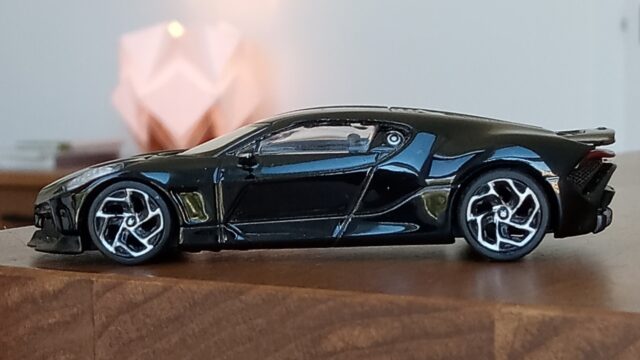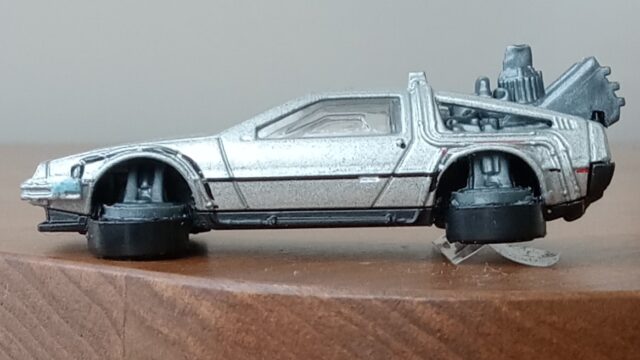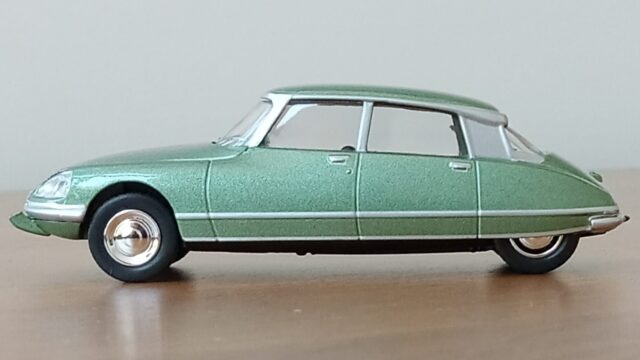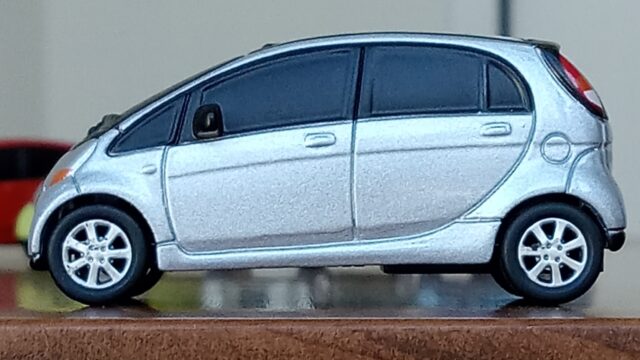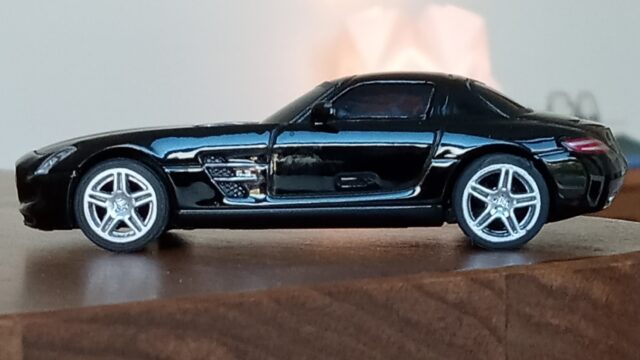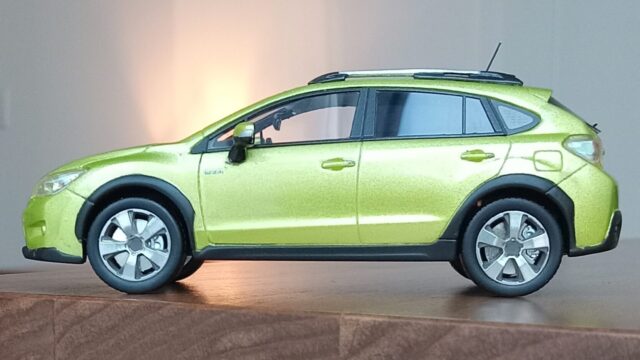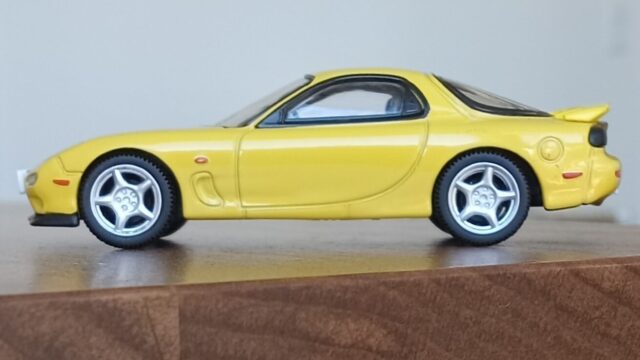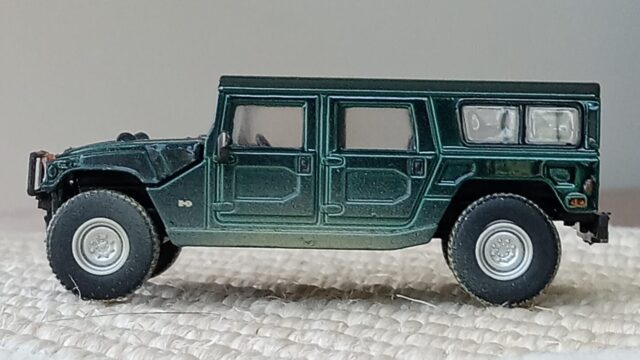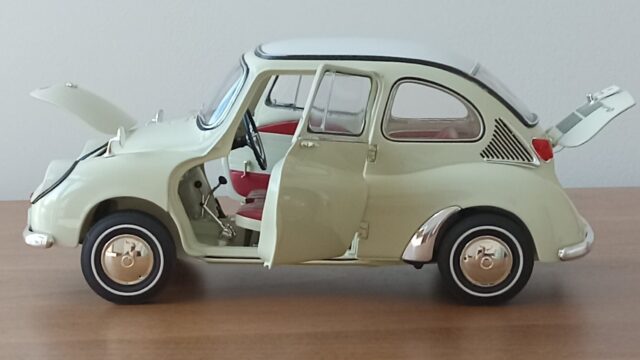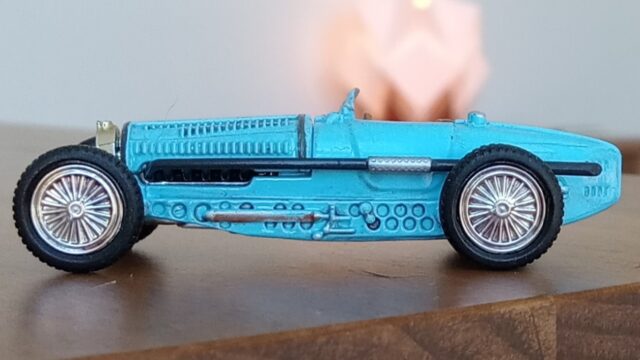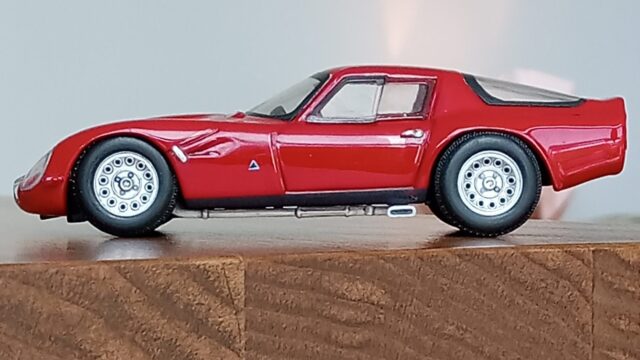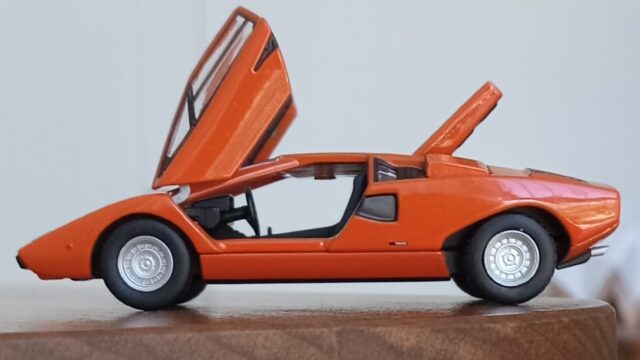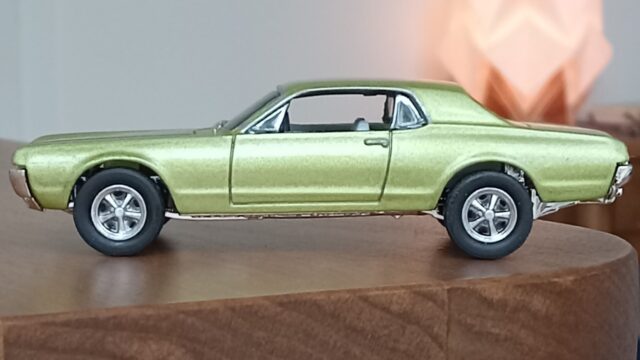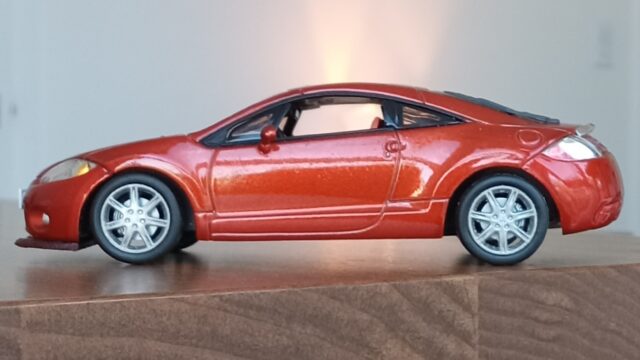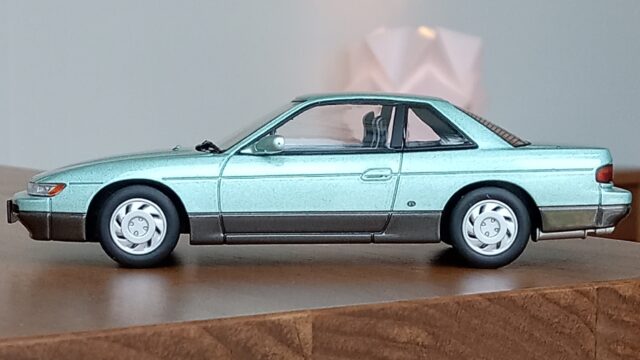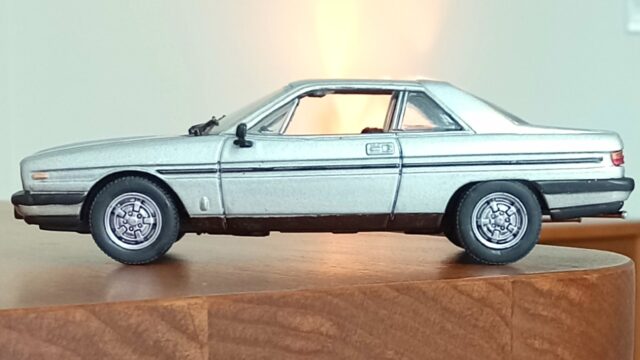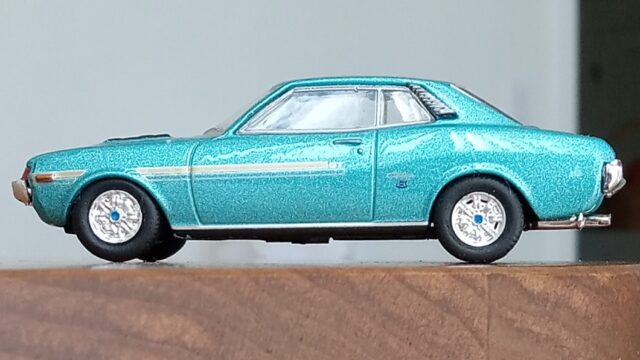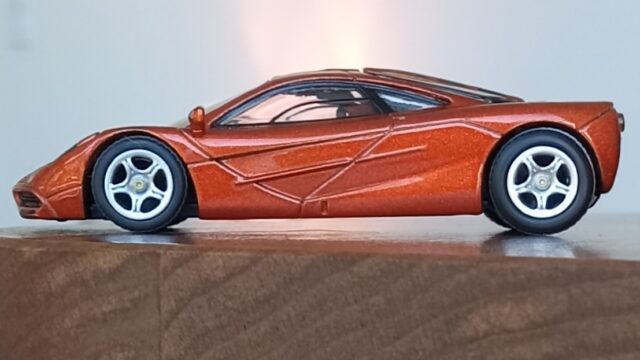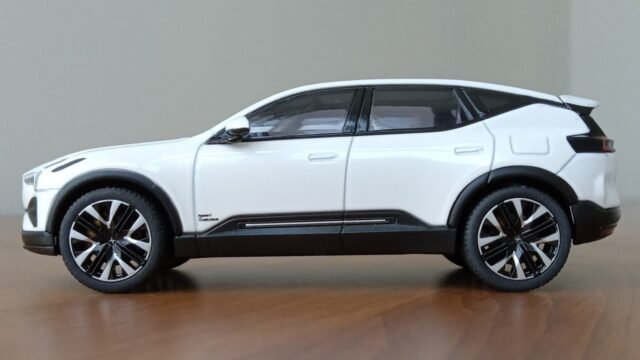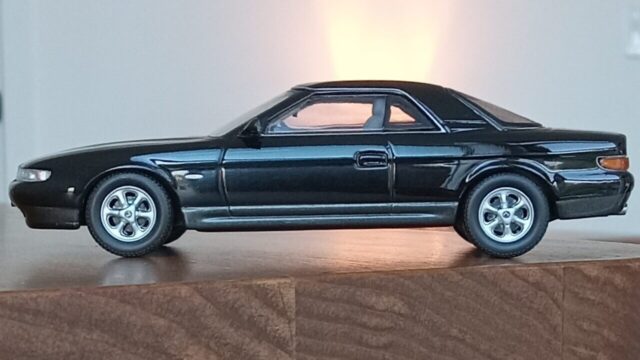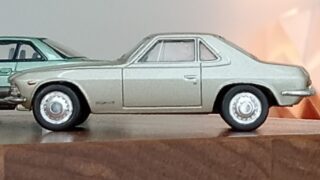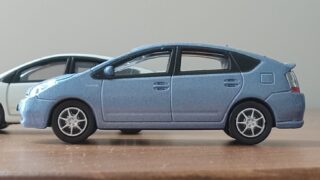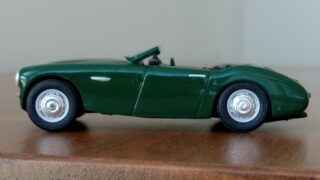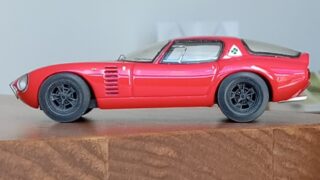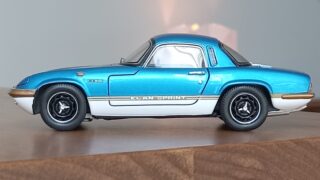
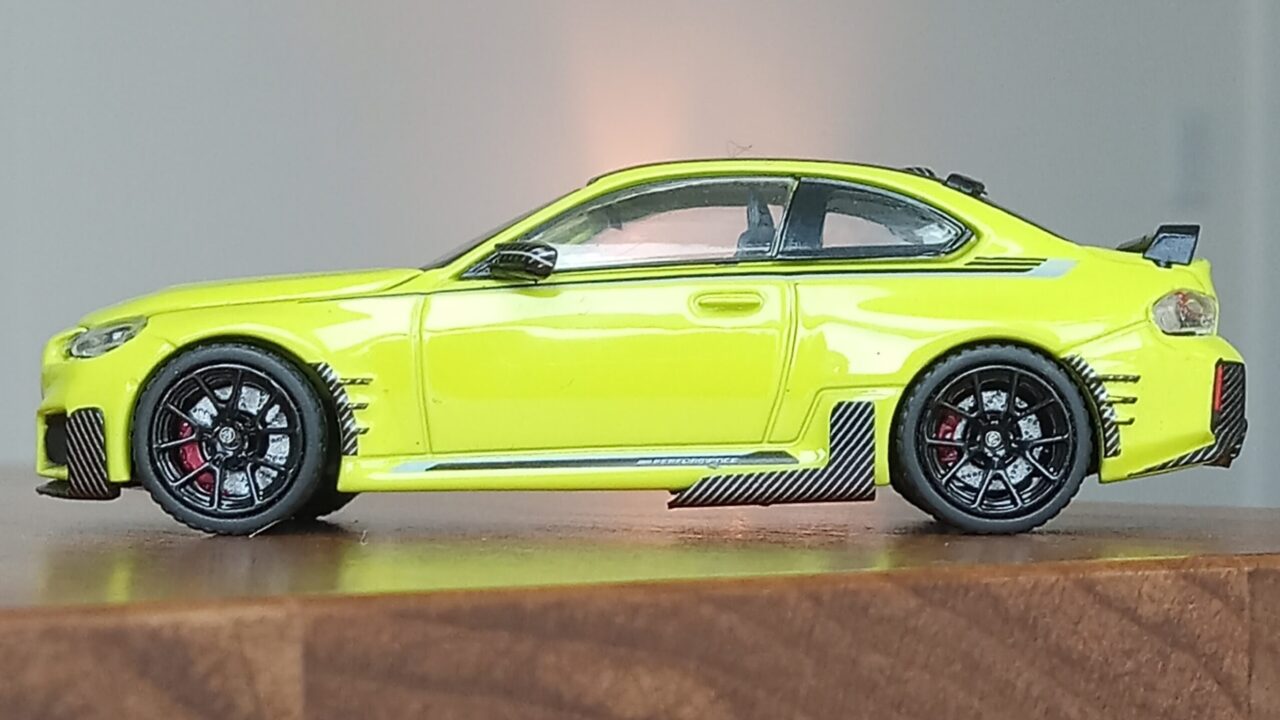
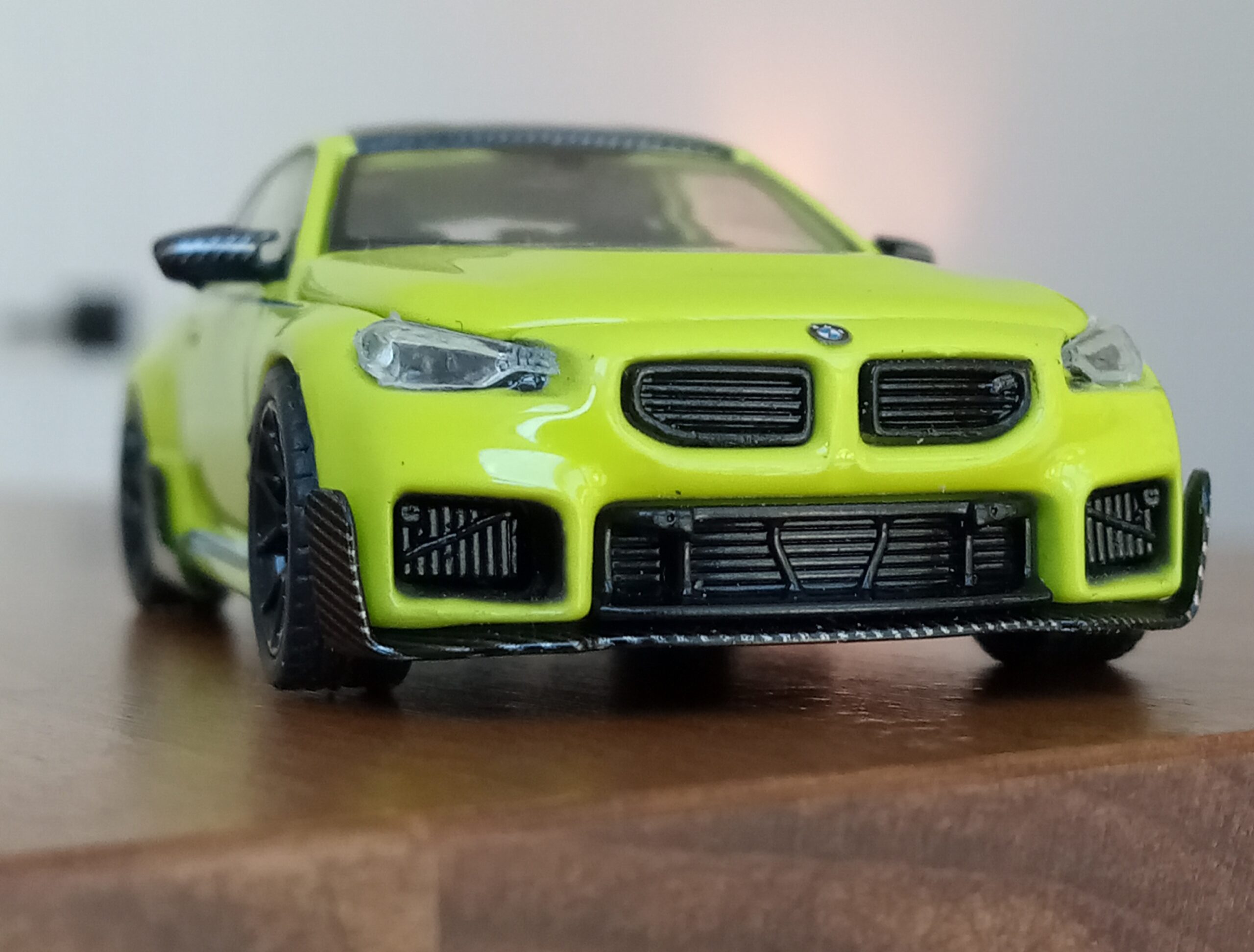
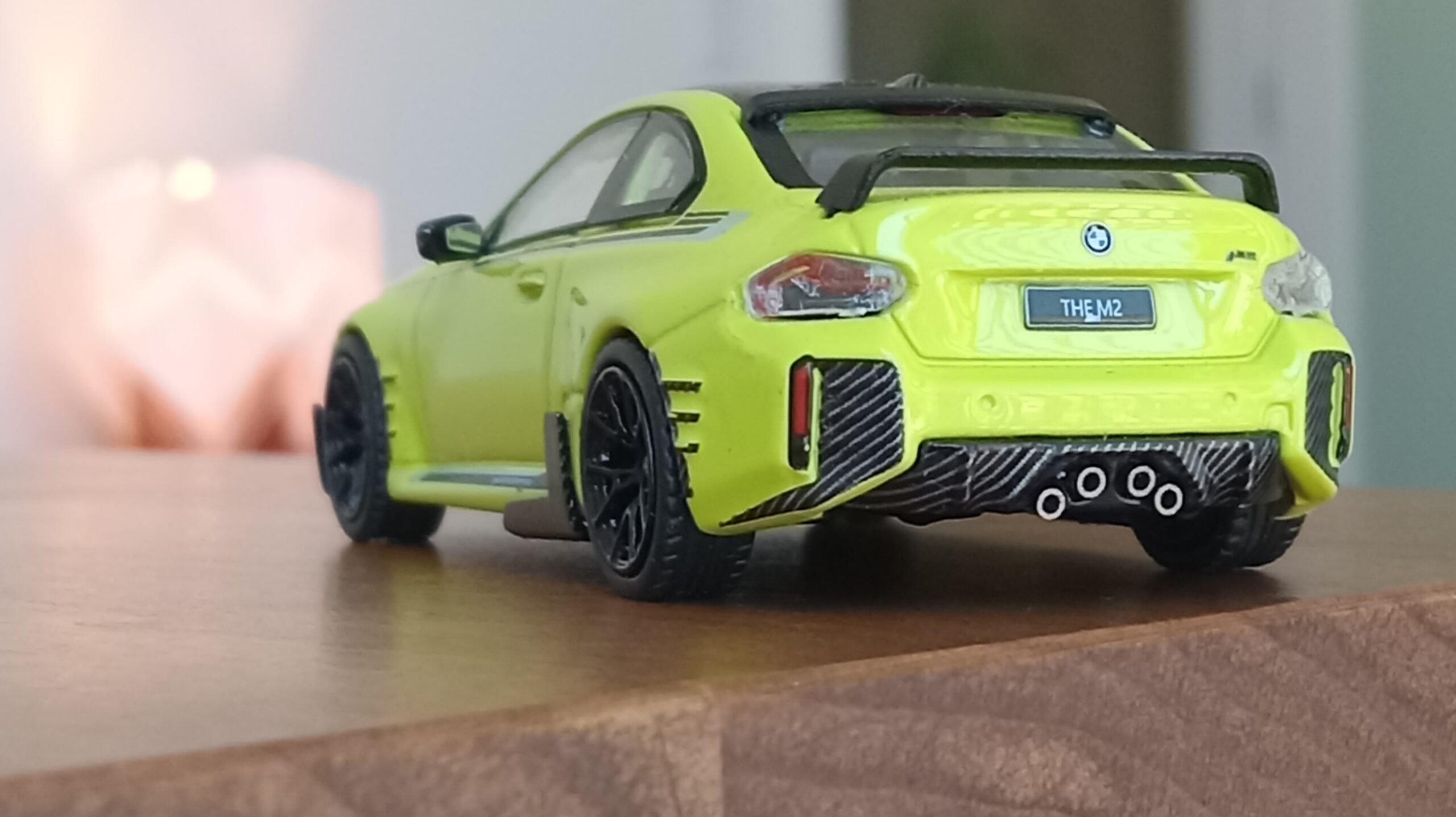
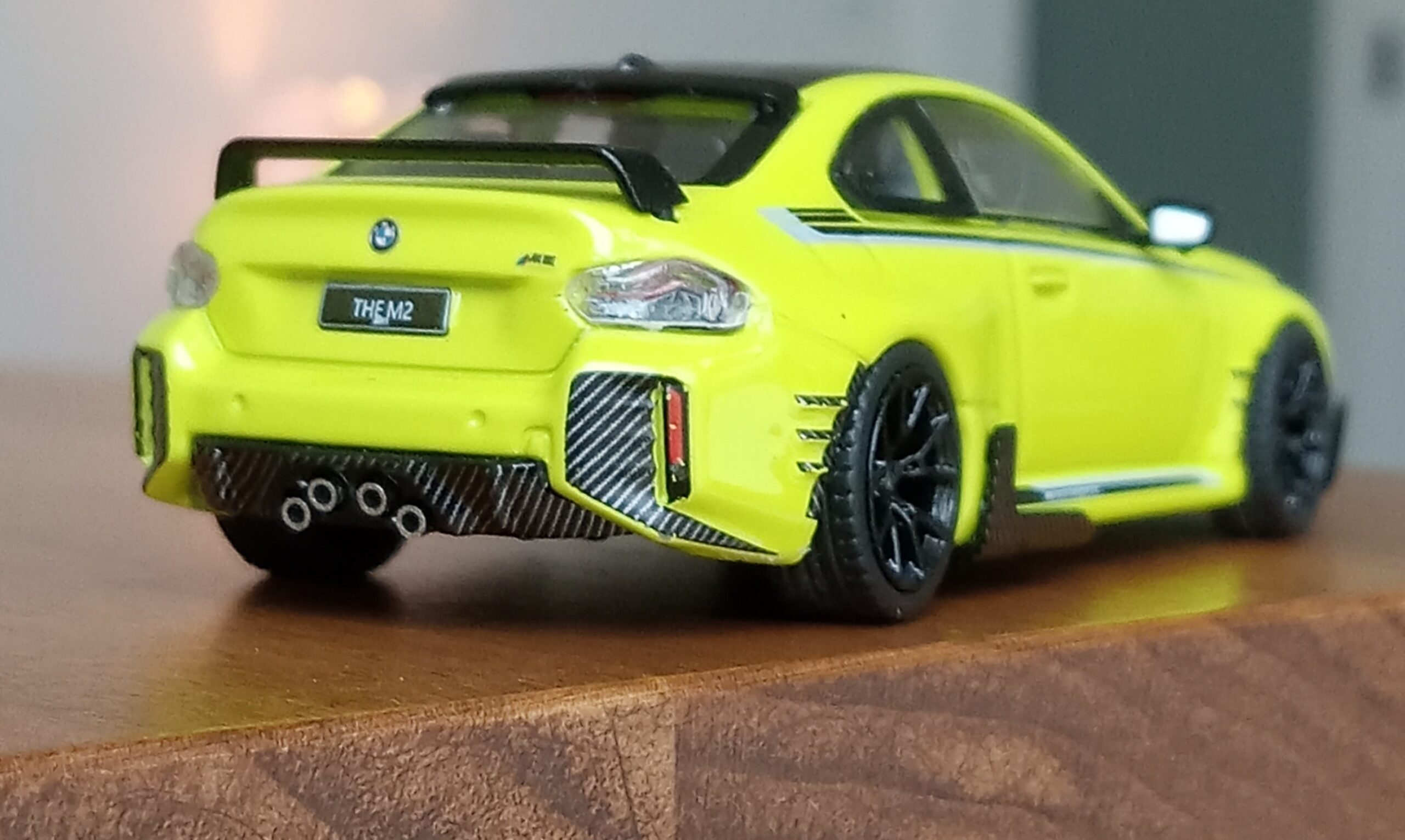
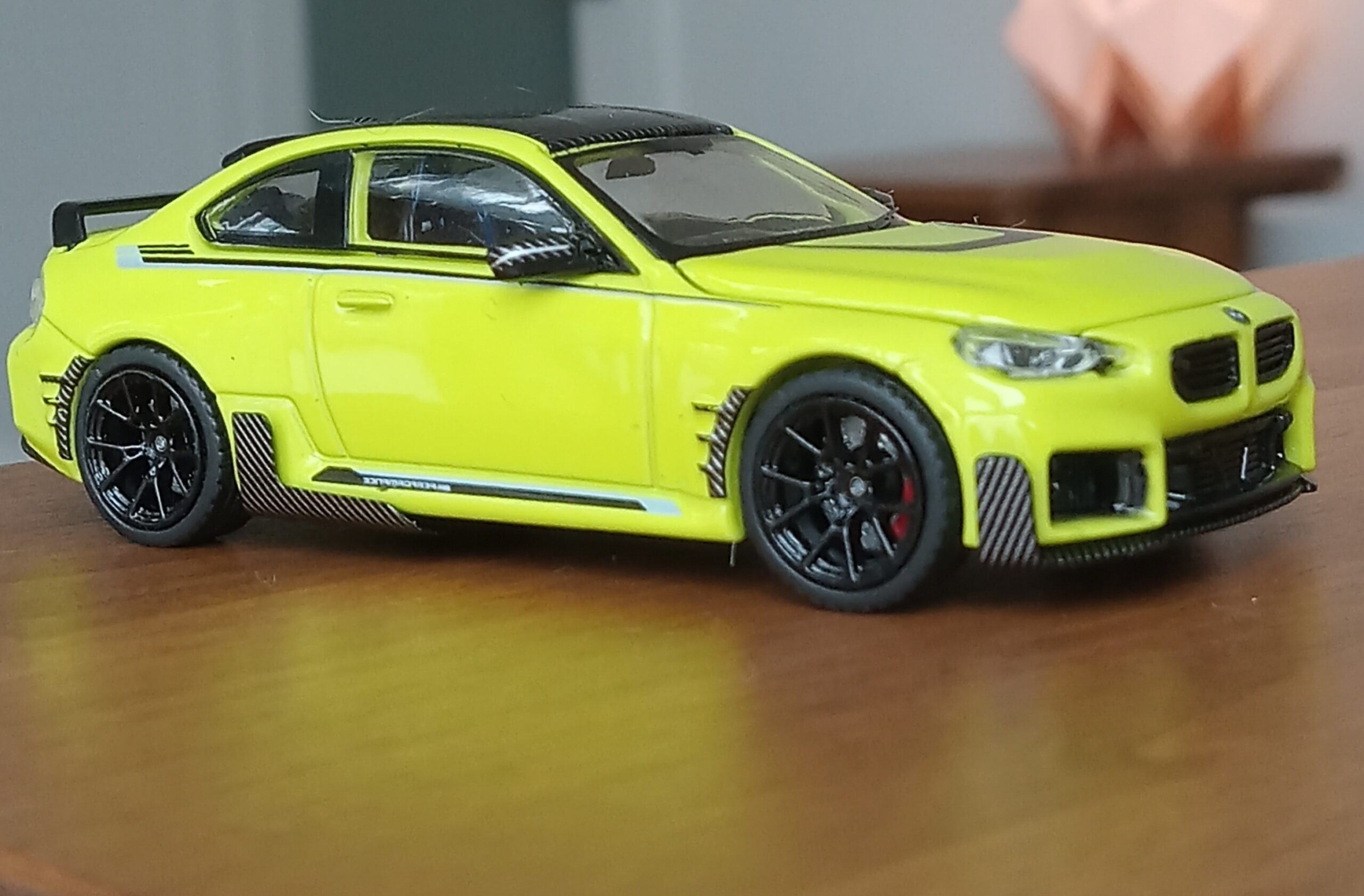
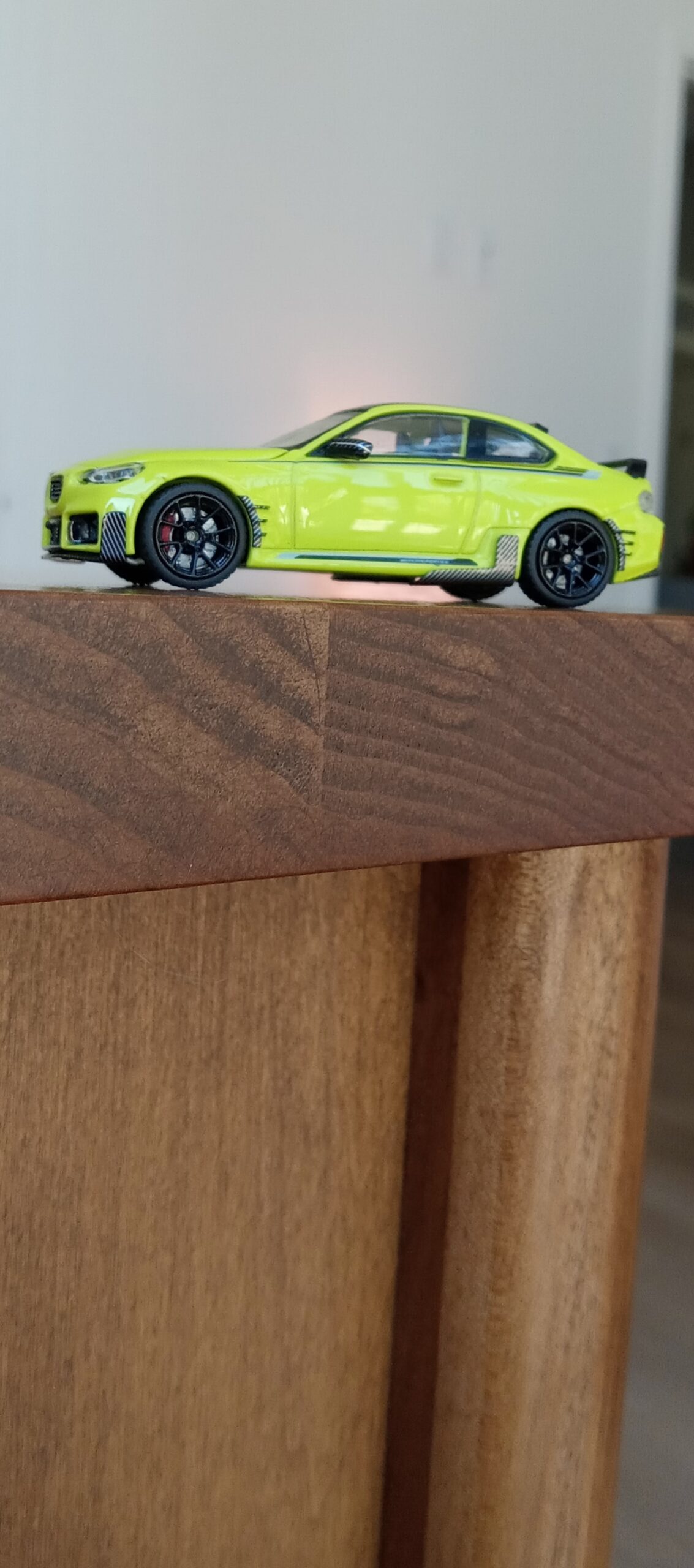
(撮影に使用したミニカー:FX モデル社製、1/64ダイキャスト完成品、BMW M2 パフォーマンス パーツ仕様、(ネオン・ライム)ーーー>ボディーを上下に分割、トラックサイズ最大化とタイヤ+ホイールの軸位置を前傾気味に微調整)
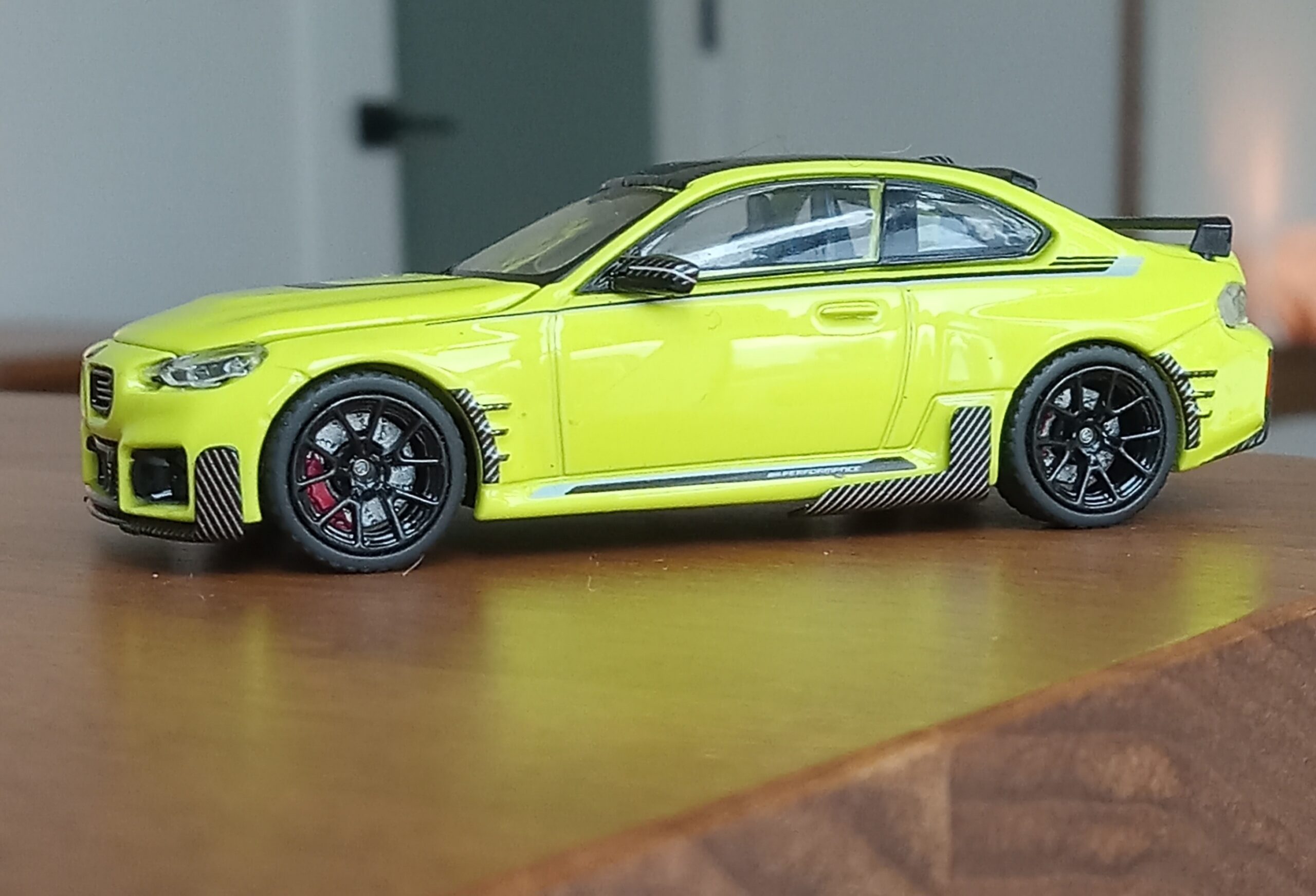
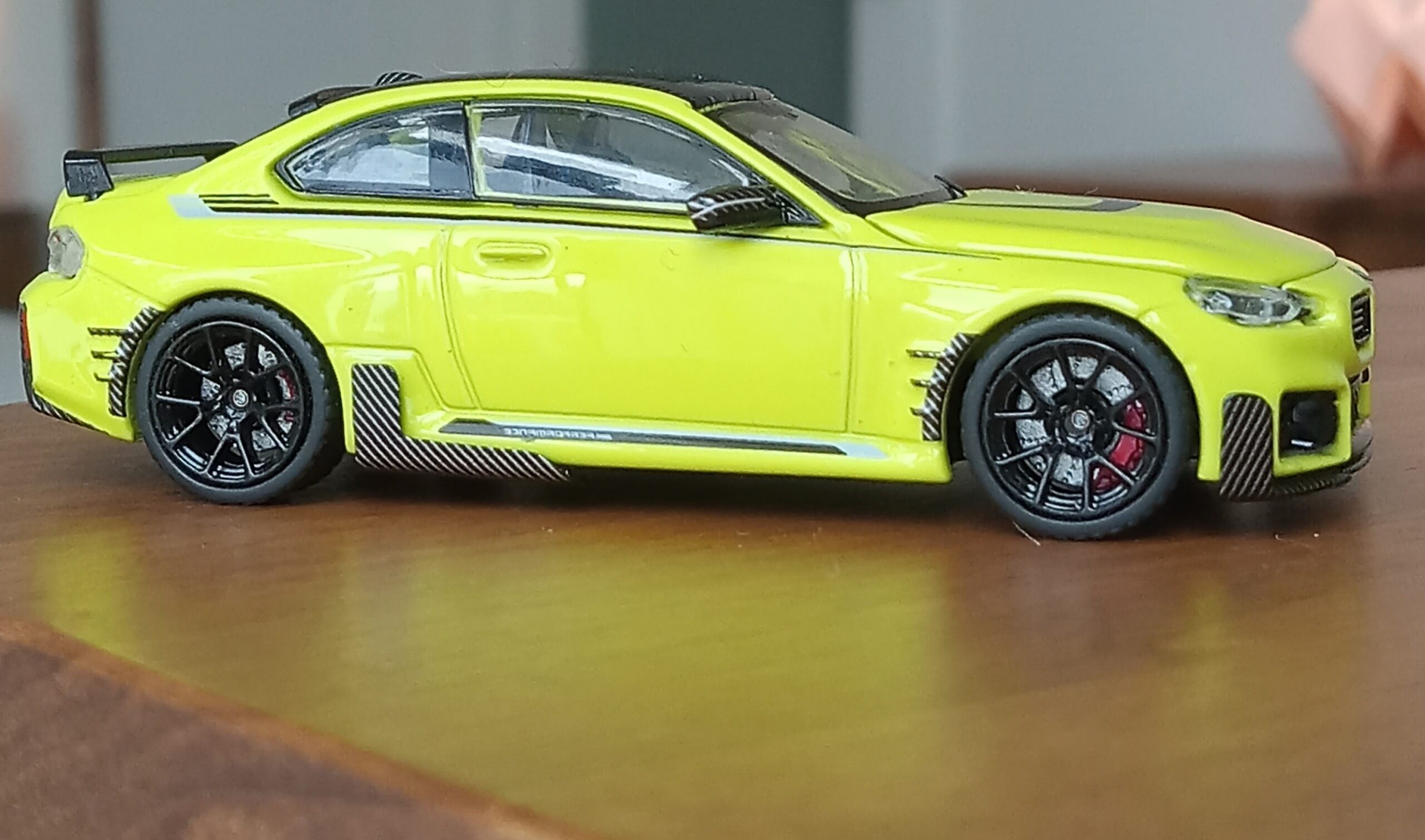
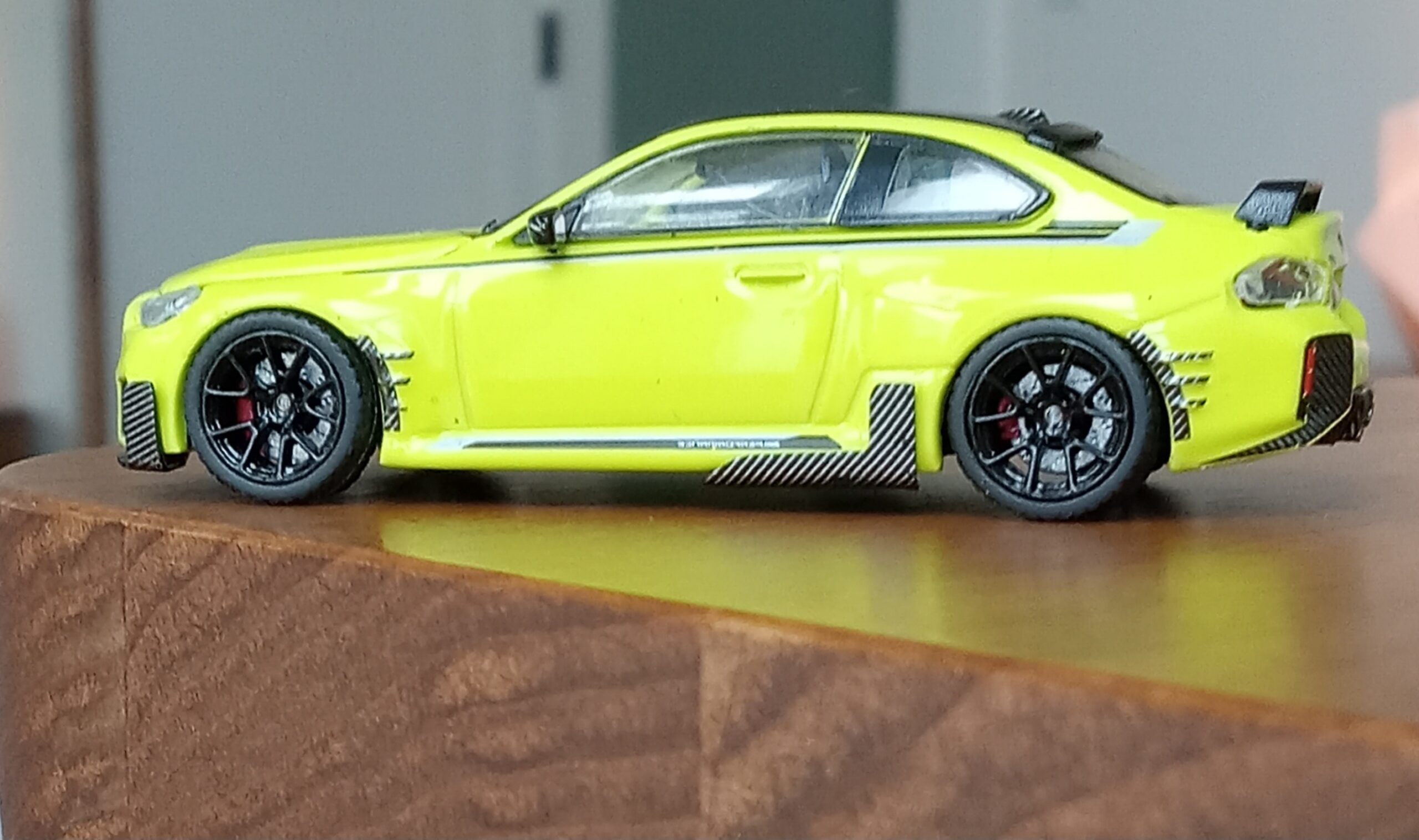
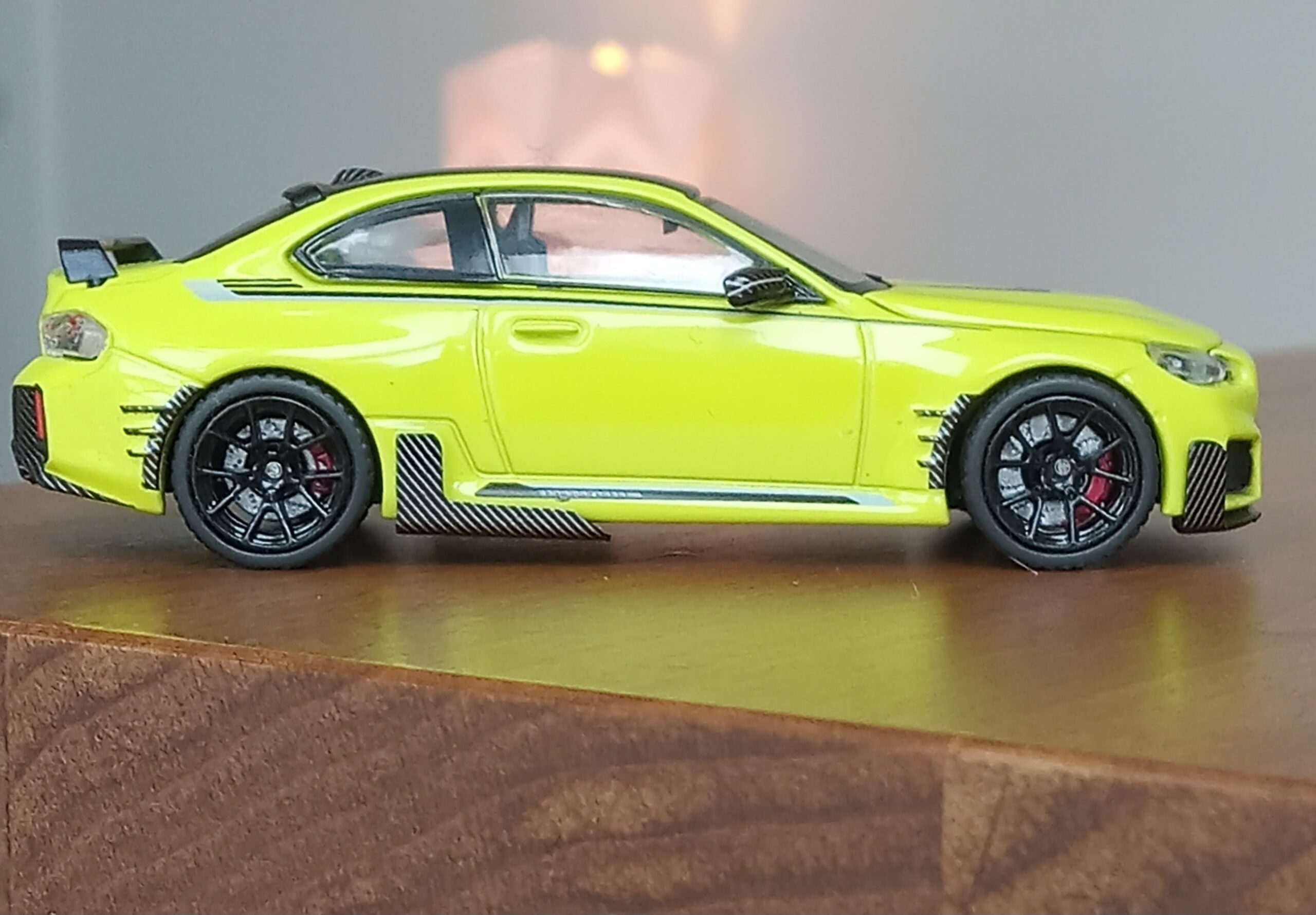
好みの自動車デザイン:第50回ーー2ドア・クーペの系譜: 第30回【ドイツ車編②】 BMW M2 純正パフォーマンス・パーツ仕様、2025(ネオン・ライム)『レトロ・モッドの実体化?』BMW M2 Performance Parts、2025(Neon Lime)『Realized Retro-Mods』

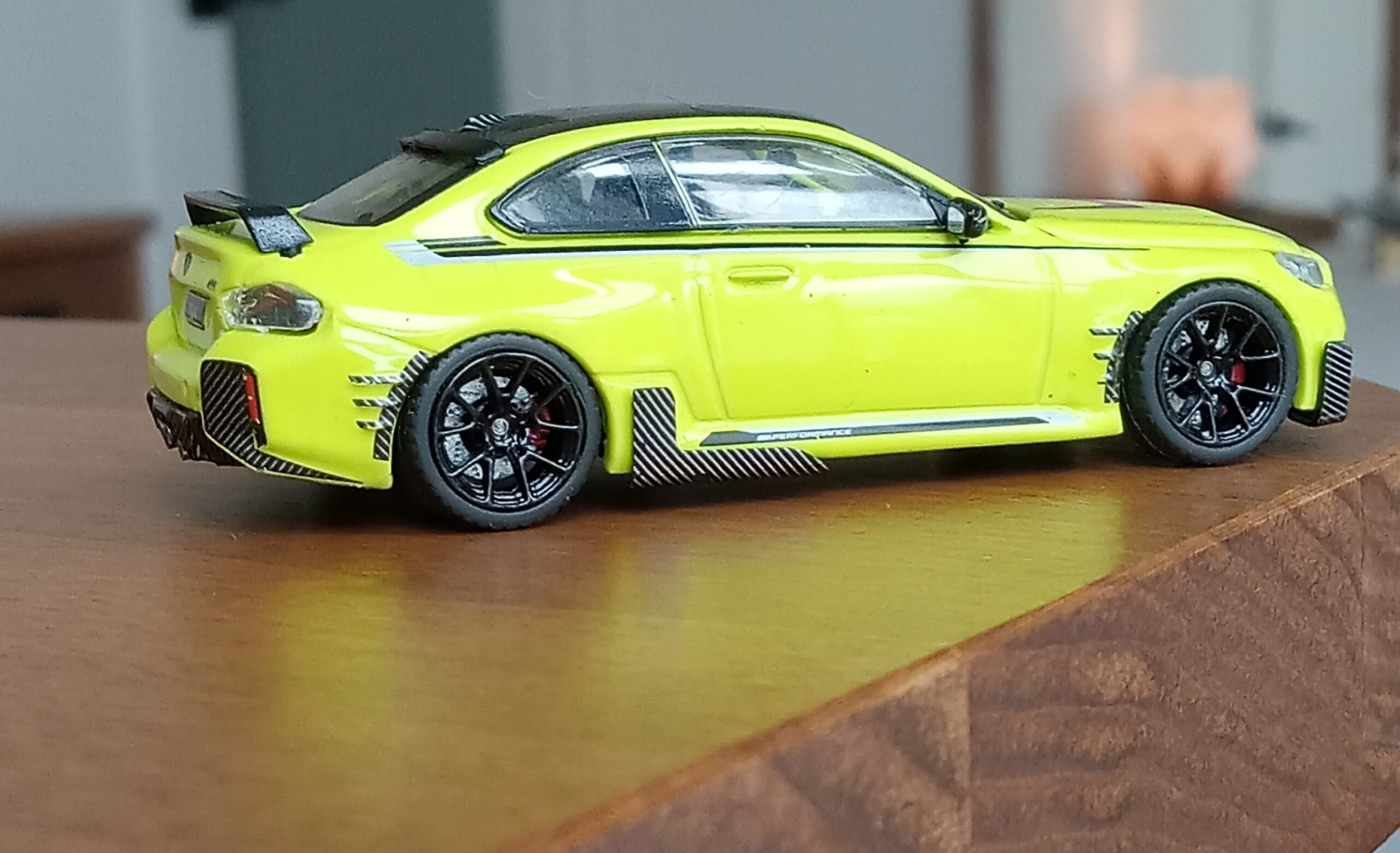
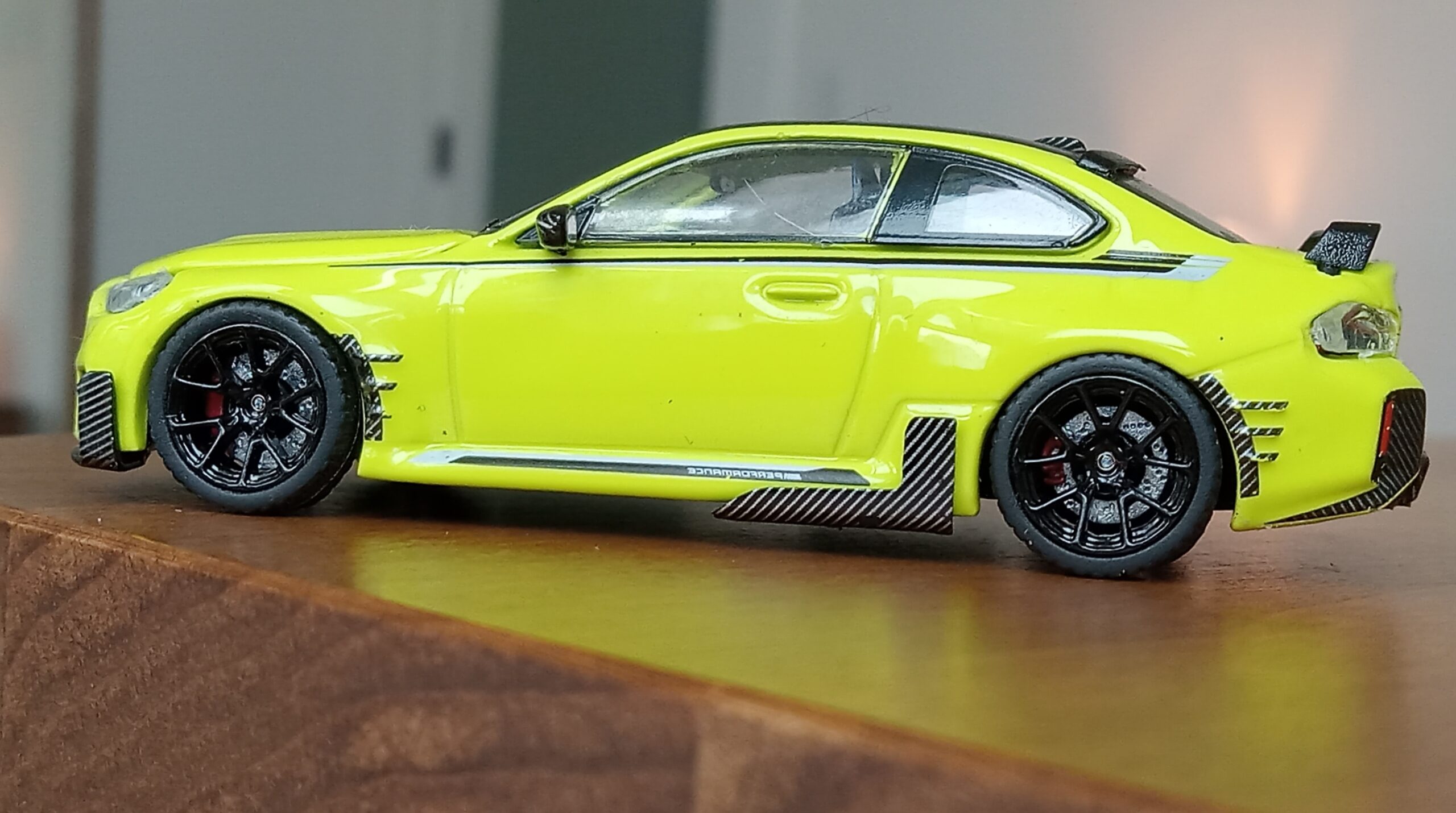
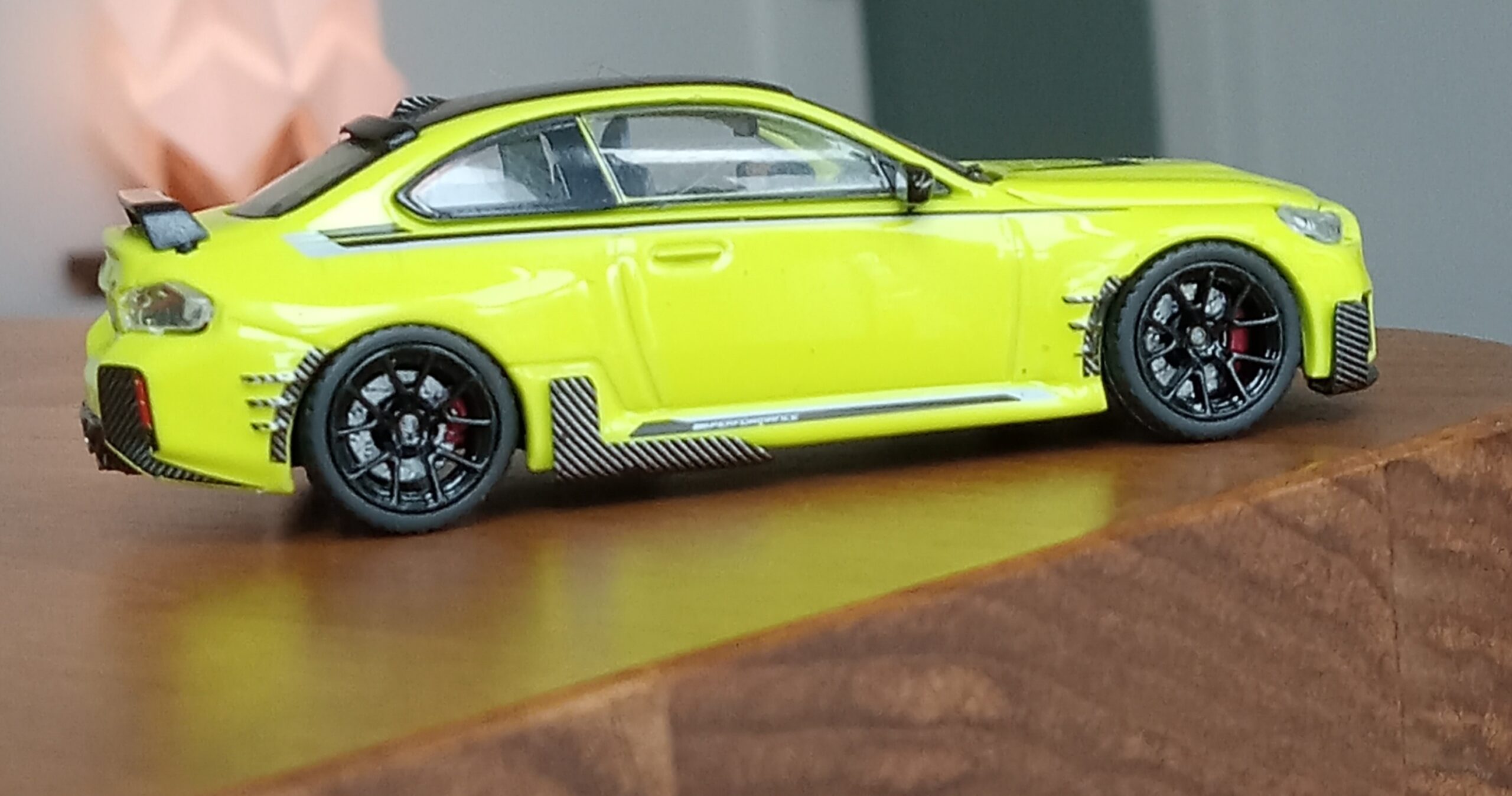
第50回目の今回は、『2ドアクーペの系譜、第30回』と題しまして、各国のお国柄や、外観デザインの個性が強く表れる、高級2ドア(GT)クーペ / ロードスターについてお話ししてみたいです。【注意:オープンカーを含む】
以下の要領で進めていきます。
第30回の今回はいよいよ
【ドイツ車編②】第003回としまして、
2025年発表の
BMW M2 純正パフォーマンス・パーツ仕様、2025(ネオン・ライム)
についてのお話です。
【2ドア・クーペの系譜:目次】
【米国車編】
第1回:キャデラック・エルミラージュ、2013(メタリック・レッド)
第2回:リンカーン・コンチネンタル MK4、1972(ブラック)
第3回:マーキュリー・クーガー, 1967(LTメタリック・グリーン)
【ドイツ車編】
第4回:MB 500K スペシャル・ロードスター、1936(ブラック)
第5回:MB 300SL ロードスター、1957(シルバー)
第6回:MB SLS AMR ガルウイング、2010(ブラック)
【英国車編】
第7回:マクラーレン・F1、1992(メタリック・オレンジ)
第8回:ジャガー・XKSS ロードスター、1957(ロイヤル・ブルー)
第9回:ジャガー XKR クーペ、1996(ダークメタリック・グリーン)
【日本車・ニッサン編】
第10回:ニッサン 初代シルビア、1965(シャンペン・ゴールド)
第11回:ニッサン 5代目シルビア、1988(LTメタリック・グリーン)
【イタリア車編】
第12回:フェラーリ 250TR ポンツーンフェンダー、1958(赤)
第13回:フェラーリ 250GTO、1962(イタリアン・レッド)
第14回:ランボルギーニ・コンセプトS、2005(パール・ホワイト)
【日本車・マツダ編】
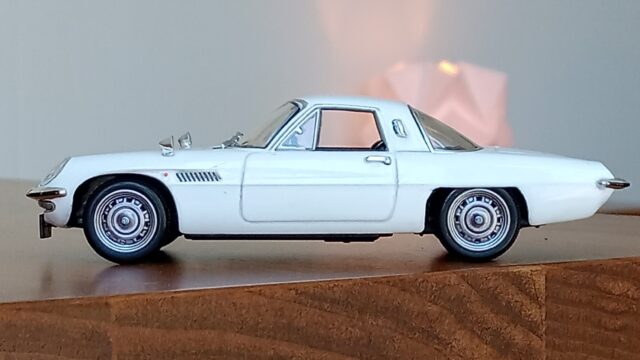
第15回:マツダ コスモ・スポーツ、1968(レーシング・ホワイト)
第16回:マツダ ユーノス・コスモ、タイプ‐S(2トン:黒&グレー)
【フランス車編】
第17回:ブガッティ・タイプ59、1935(フレンチ・ブルー)
第18回:シトロエン・SM、1970(シャンペーン・ゴールド)
第19回:ブガッティ・ラ・ヴォワチュール・ノワール、2019(黒)
【日本車・トヨタ編】
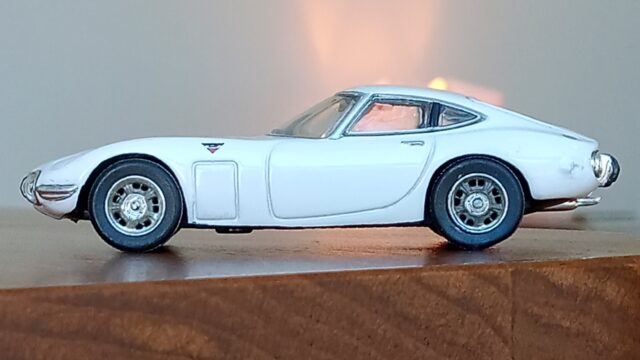
第20回:トヨタ/ヤマハ・2000GT、1967(アイボリー・ホワイト)
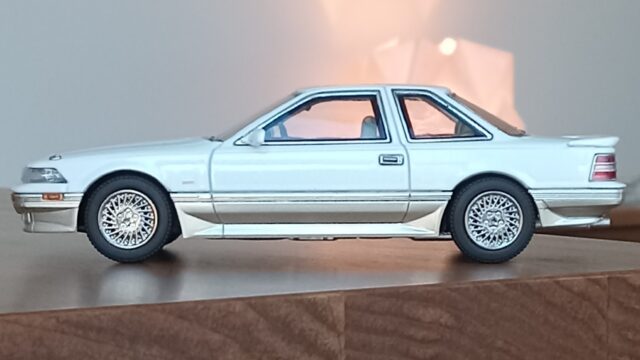
第21回:トヨタ・2代目ソアラ、1986 (クリスタル・ホワイトⅡ)
第22回:レクサス LC500【GWZ100型】、2017(MT・レッド)
【米国車編②】
第23回:ダッジ・チャレンジャー、1970&プリムス・バラクーダ、1971
第24回:ダッジ・ヴァイパー SRT‐10 ACR、 2008(ブラック)
第25回:フォード・シェルビーGR-1 コンセプト、2004(クローム)
【日本車・ミツビシ編】
第26回:ミツビシ・ギャラン λ、1976(ブラウン・メタリック)
第27回:ミツビシ・エクリプス【北米仕様】、2006(オレンジ・メタ)
【ドイツ車編②】
第28回:BMW M635CSi、1984 (ダーク・メタリックブルー)
第29回:MB 560SEC AMG 6.0 ワイドボディー、1989(ブラック)
第30回:BMW M2 純正パフォーマンス・パーツ仕様、2025(ネオン・ライム)
第31回:初代アウディー・TT、1998(レイク・シルバー・メタリック)
【日本車・スバル編】
第32回:スバル・クロストレック XV, 2012(ライムグリーン・メタリック】
【英国車編②】
第33回:ロータス・初代エリート, 1959(ブリティシュ・グリーン)
第34回:ロータス・エラン S4 スプリント(2トン:ブルー、ホワイト&金)
第35回:ジャガー・Eタイプ ロードスター(ライトブルー・メタリック)
【日本車:ホンダ(軽量スポーツ編)】
第36回:ホンダ S800、1966(レッド)
第37回:ホンダ 初代CR-X 1.5i、1983(ブルー&シルバー2トン)
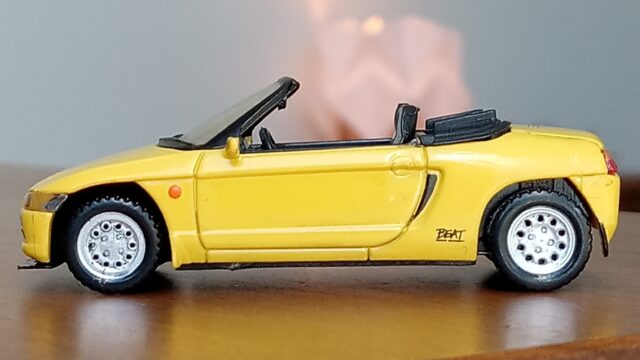
第38回:ホンダ ビート、1991(サンバ・イエロー)
【日本車:トヨタ編②】
第39回:トヨタ コロナ・ハードトップ 1800GT-TR、1982 (レッド)
第40回:トヨタ GRスープラ 【DB型・A90/A91】 (シルバー)
第41回:トヨタ GR GT, 2027【予定】(ガンメタル系)
【米国車③番外編】:コルベットの系譜
第1回:1967年型 スティングレー【C2】コンバーチブル(ハードトップ・メタ青)
第2回:1972年型 コルベット 【C3】コンバーチブル(メタリック・ブルー)
第3回:1984年型 コルベット クーペ【C4】(ブライト・レッド)
第4回:コルベット・インディー【ミッド・シップの先行開発車】(シルバー)
第5回:スティングレー・コンセプト【先行開発車】、2009(プルー・メタリック)
#ドイツ産:チューナーカーの復活⁈

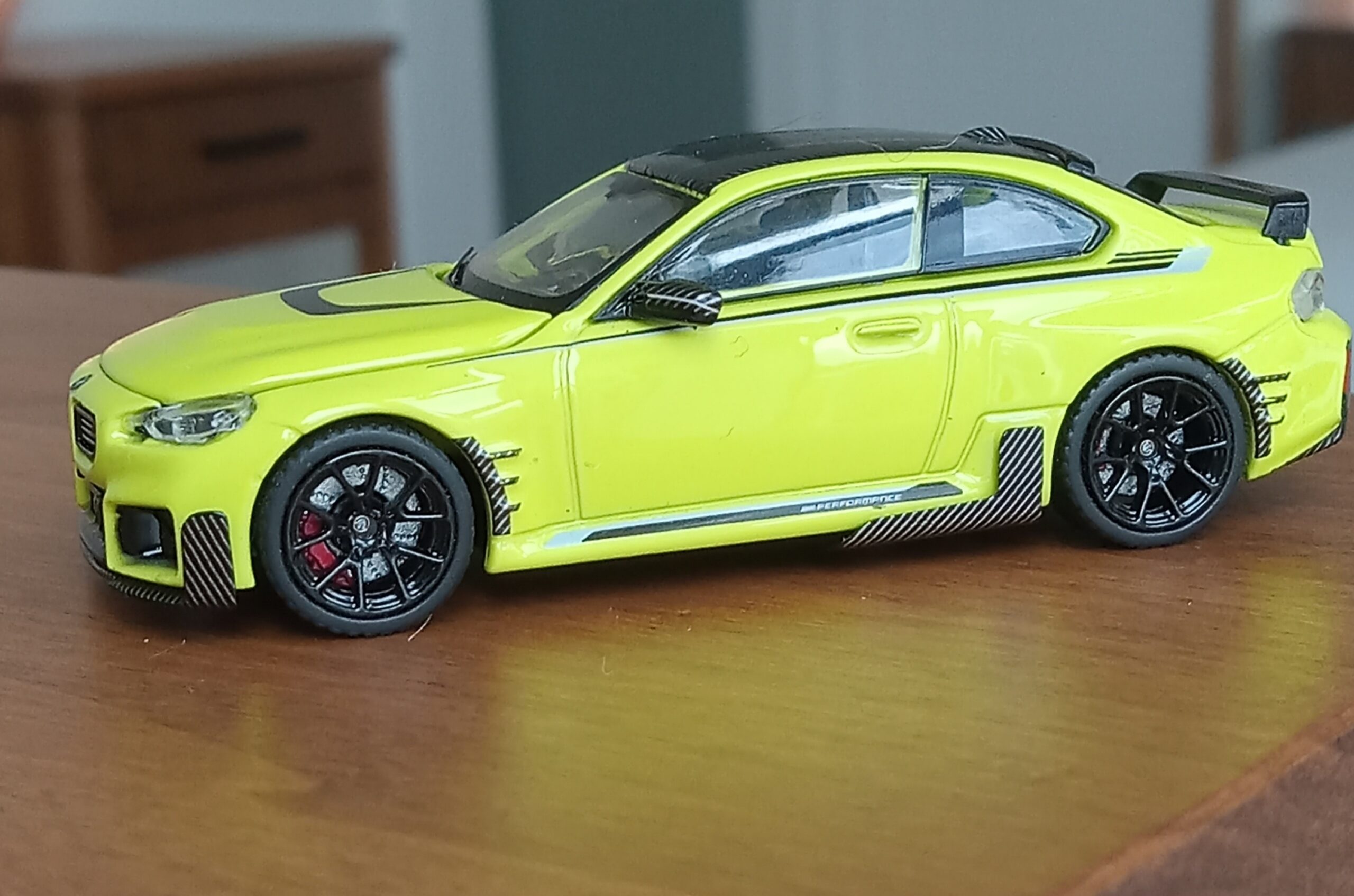
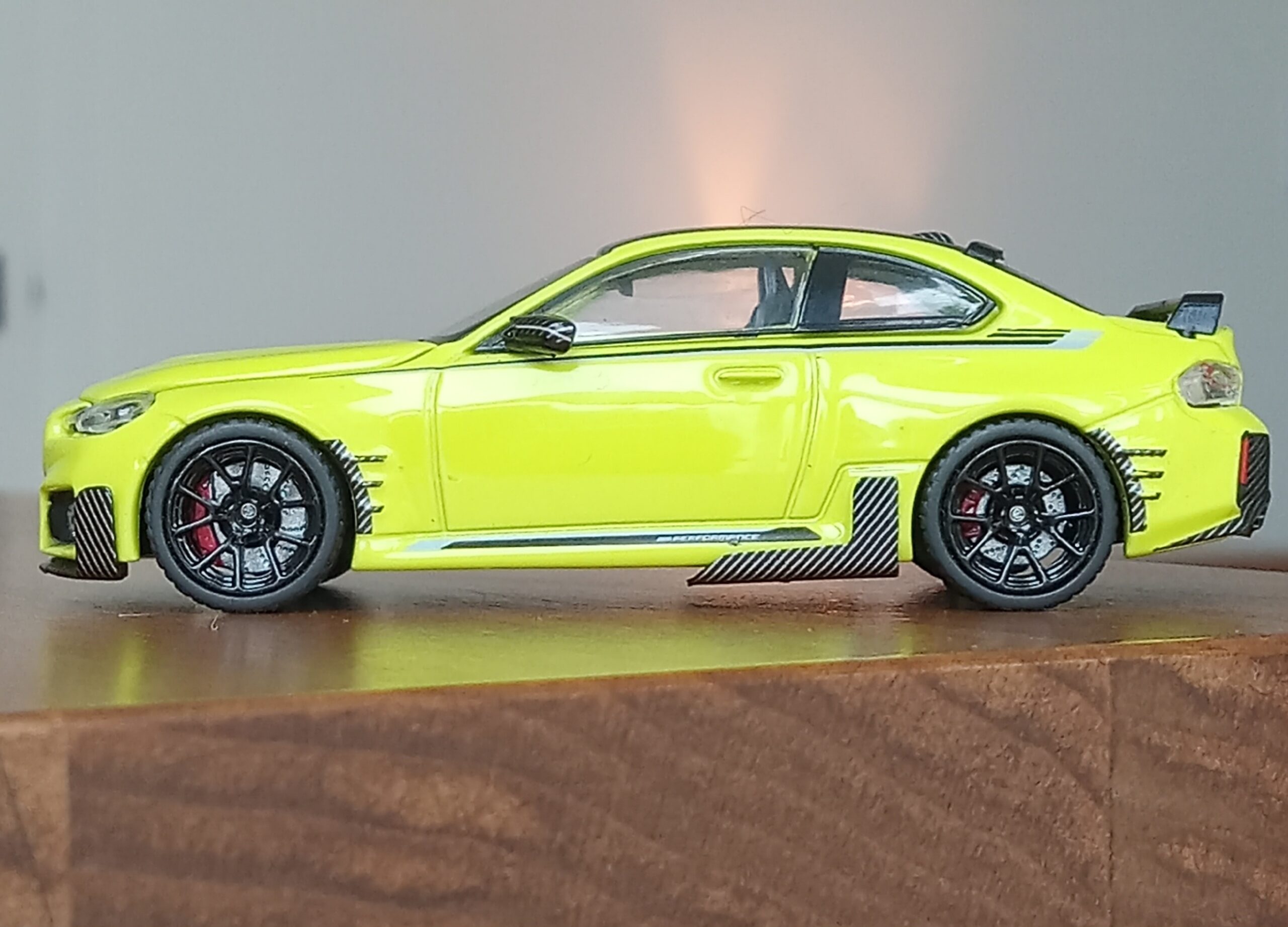
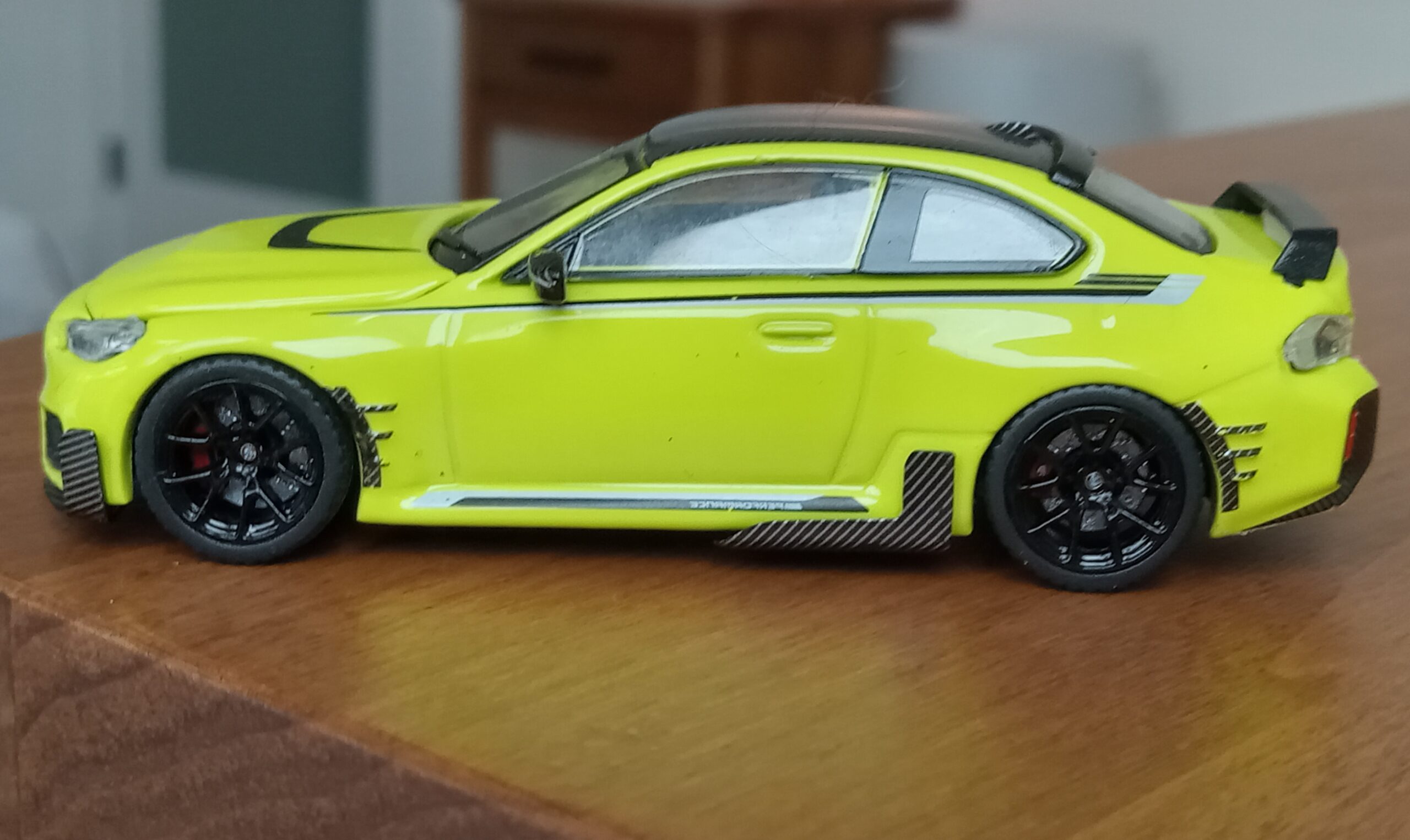
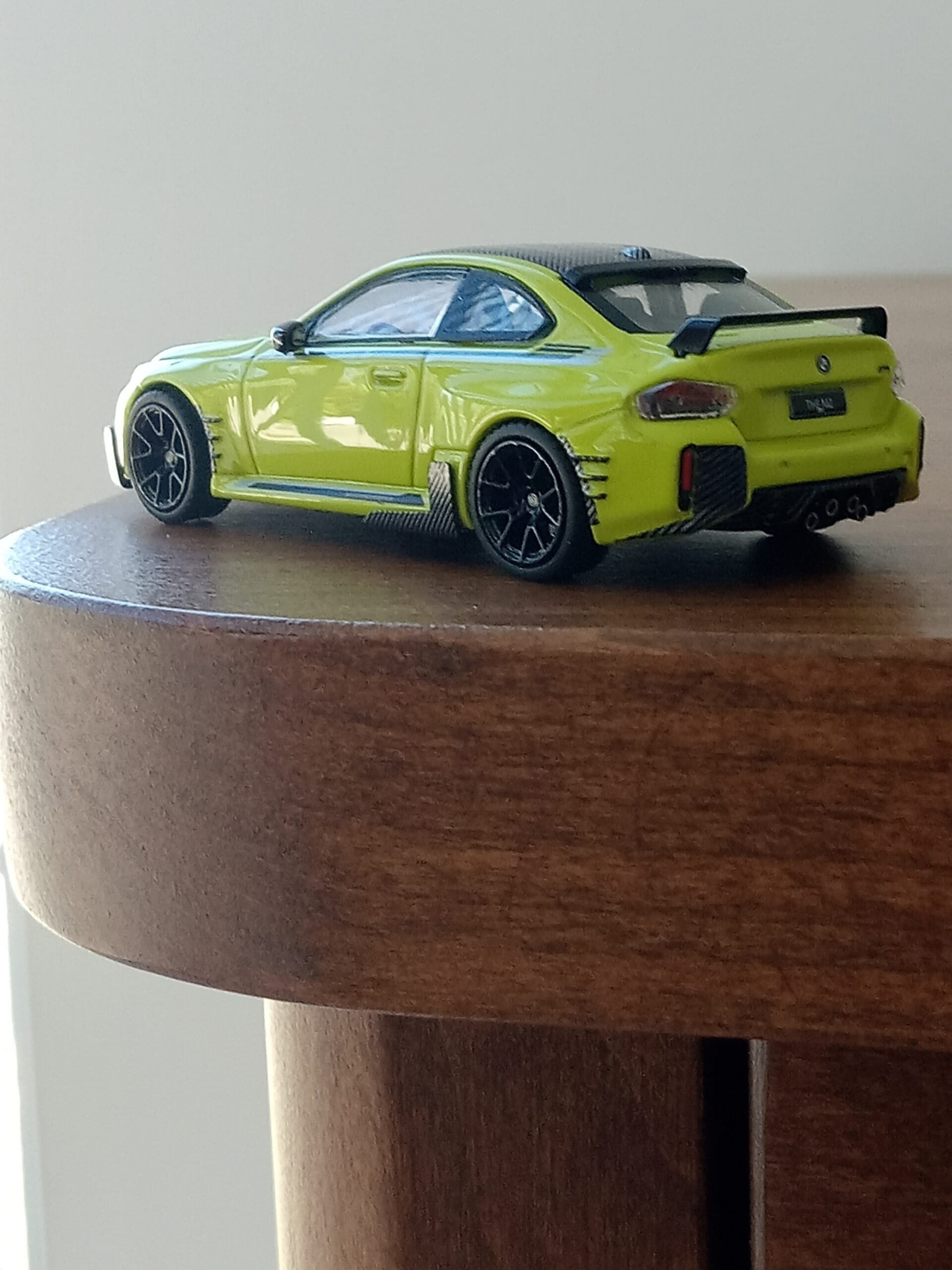
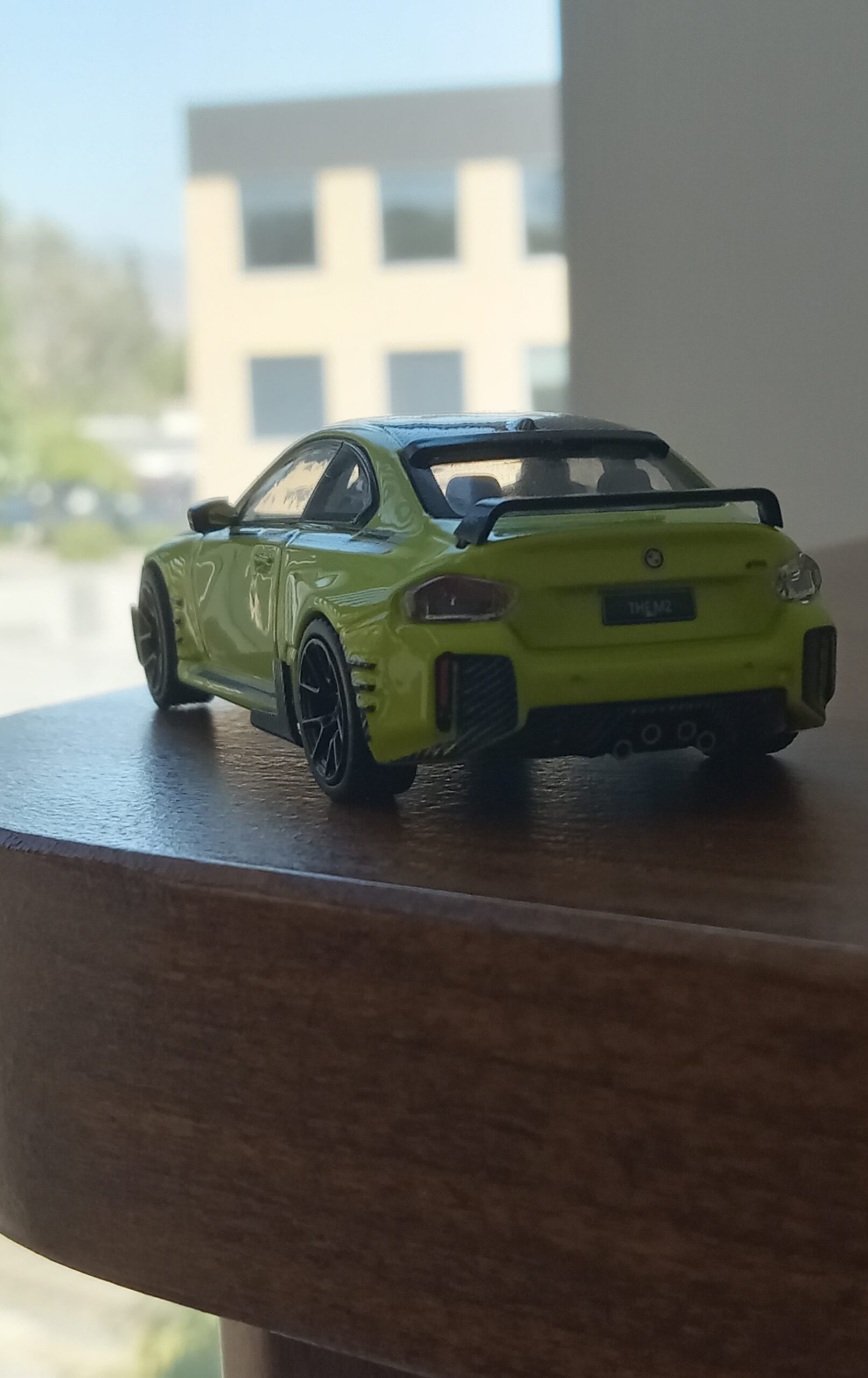
3か月ぐらい前の事でした、
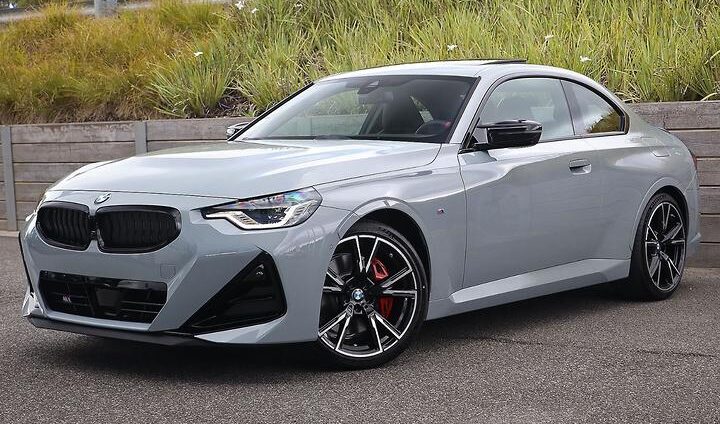
ノーマルの新型3シリーズのクーペを
LAダウンタウンのブロードウエーと7thの交差点付近で初めて目撃して、
『何かごつごつ、カクカクしたBMWダナー』
と呟いたきり、
あまり気にしていませんでした。
そのあと、7月半ばの
Aliexpressでミニカーを検索中、偶然見つけたFX社製1/64
ライムグリーンのM2
純正パフォーマンス・パーツ仕様に
眼がくぎ付けになりました!
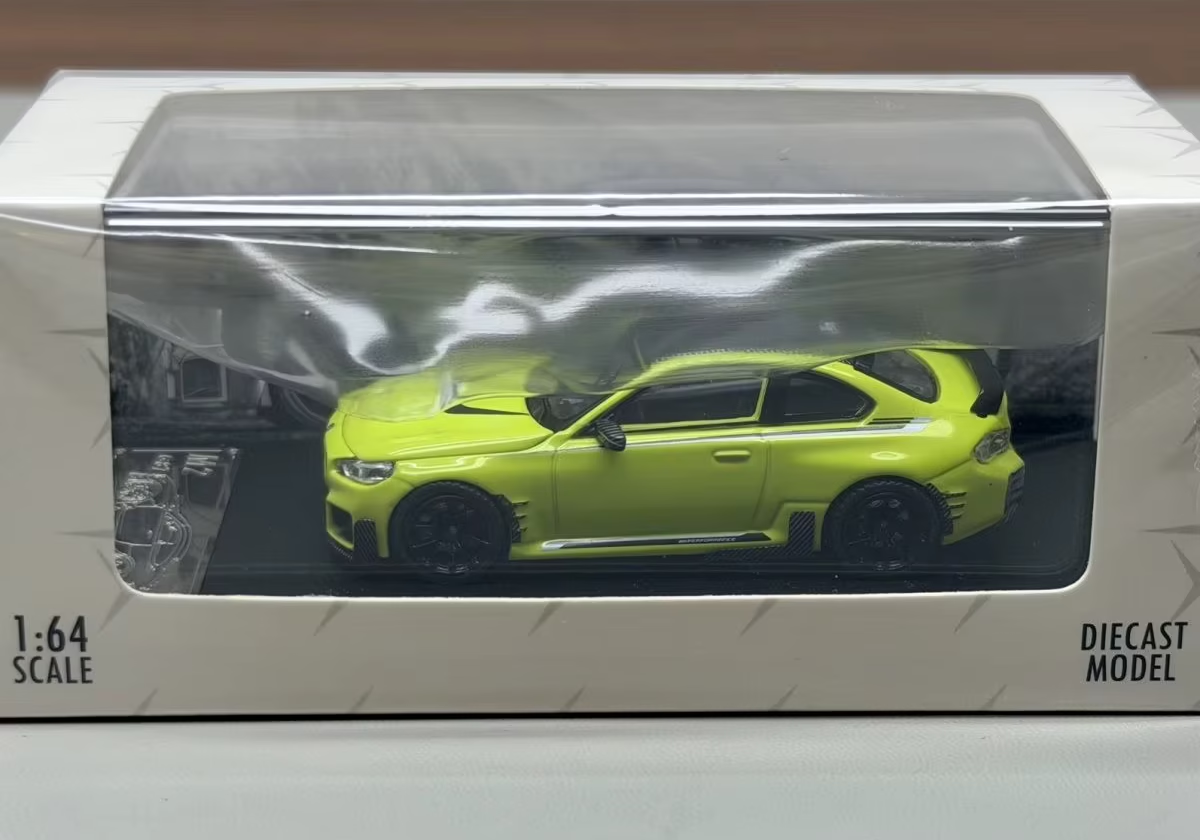
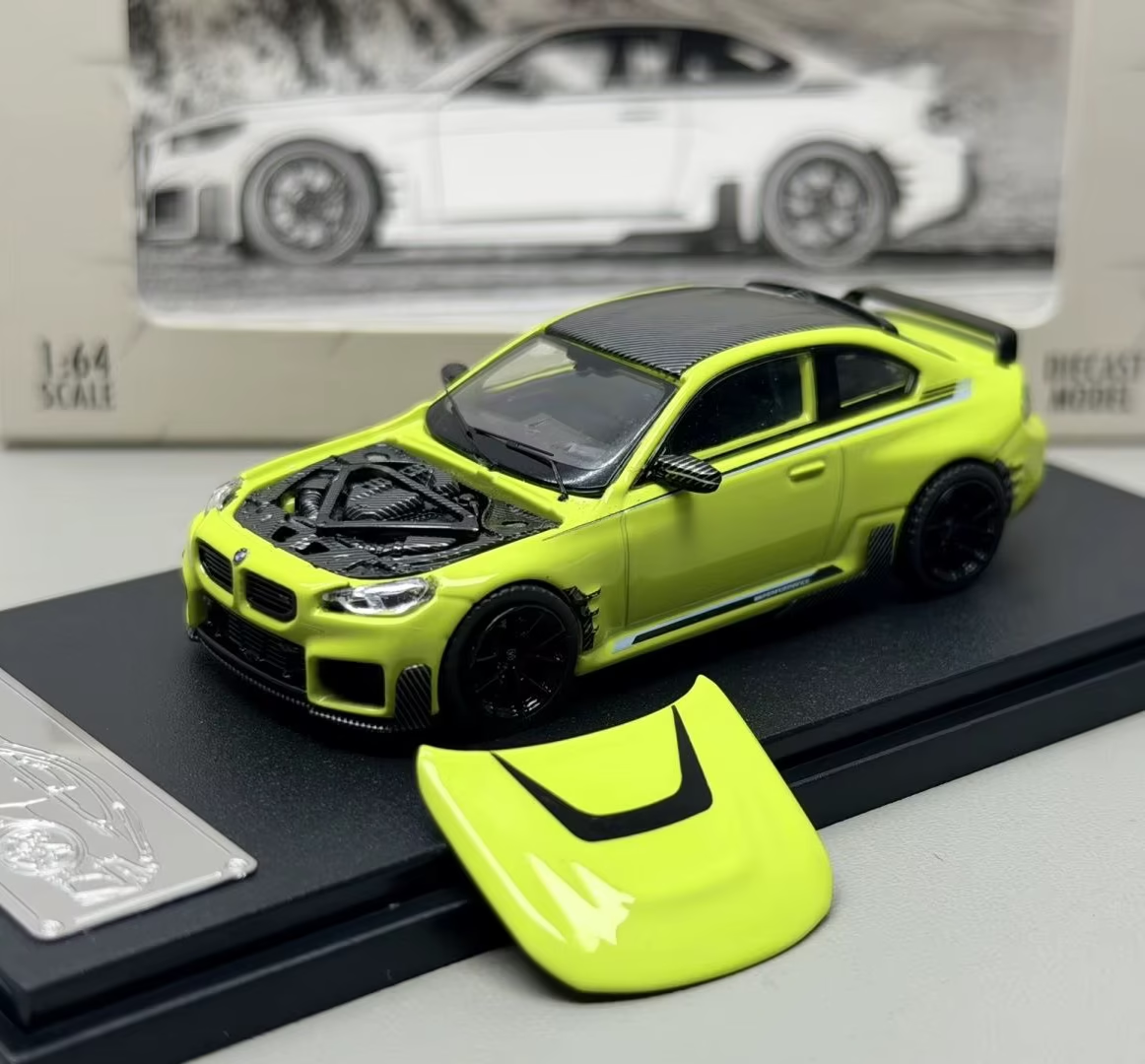
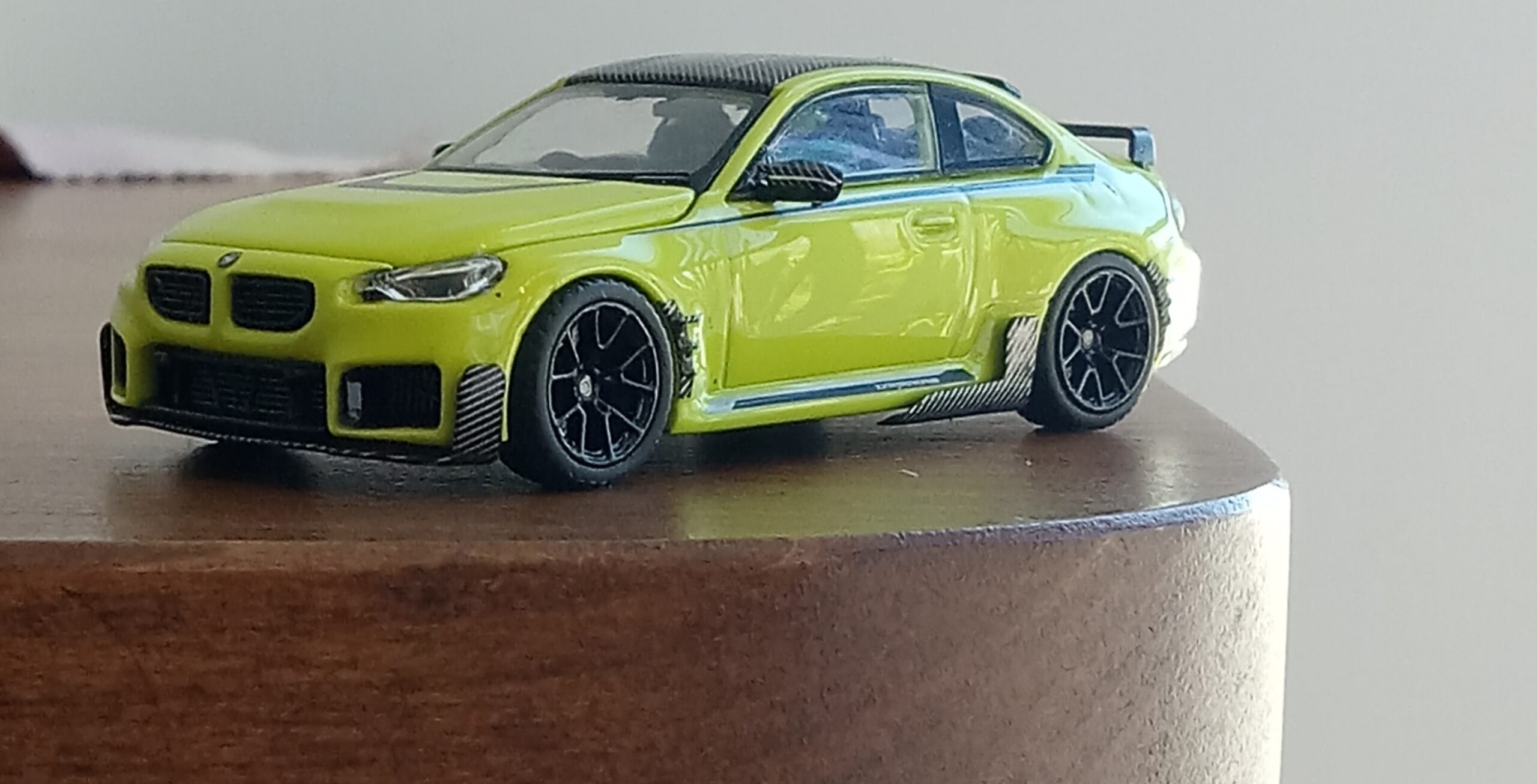
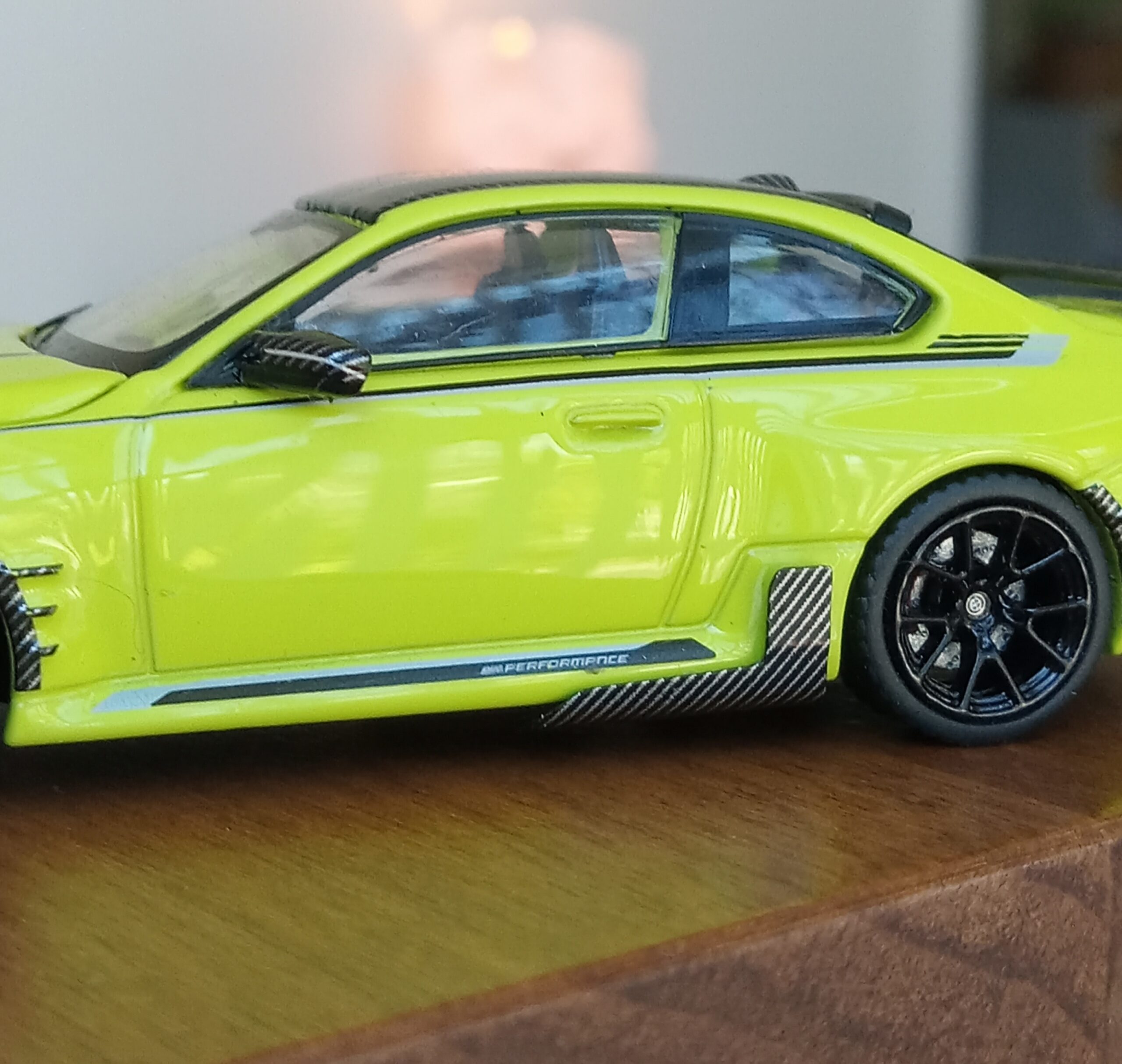
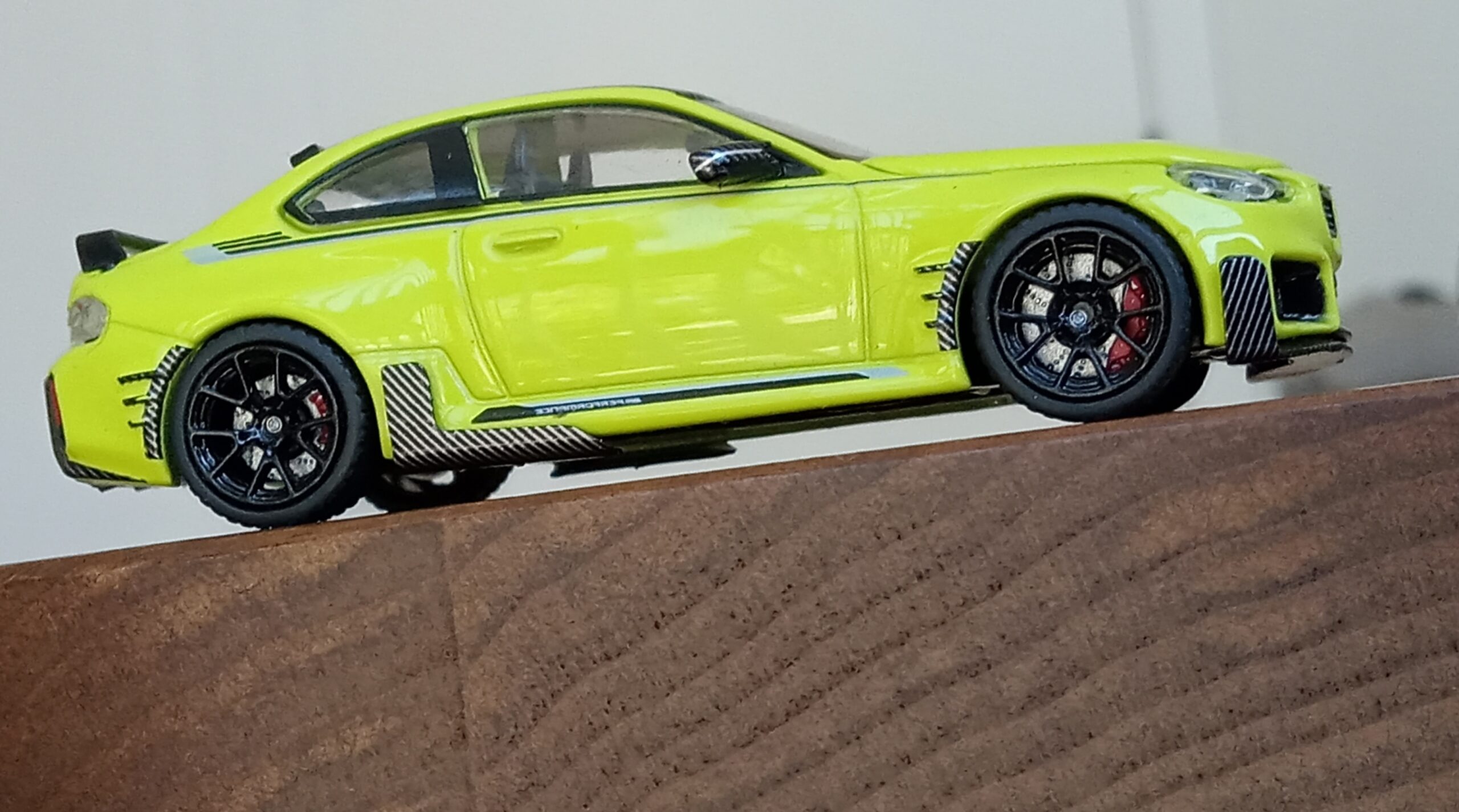
*極端に強調された、ロングノーズ・ショートデッキ
*純正チン・スポイラーが擦りそうなフロントエンドの迫力
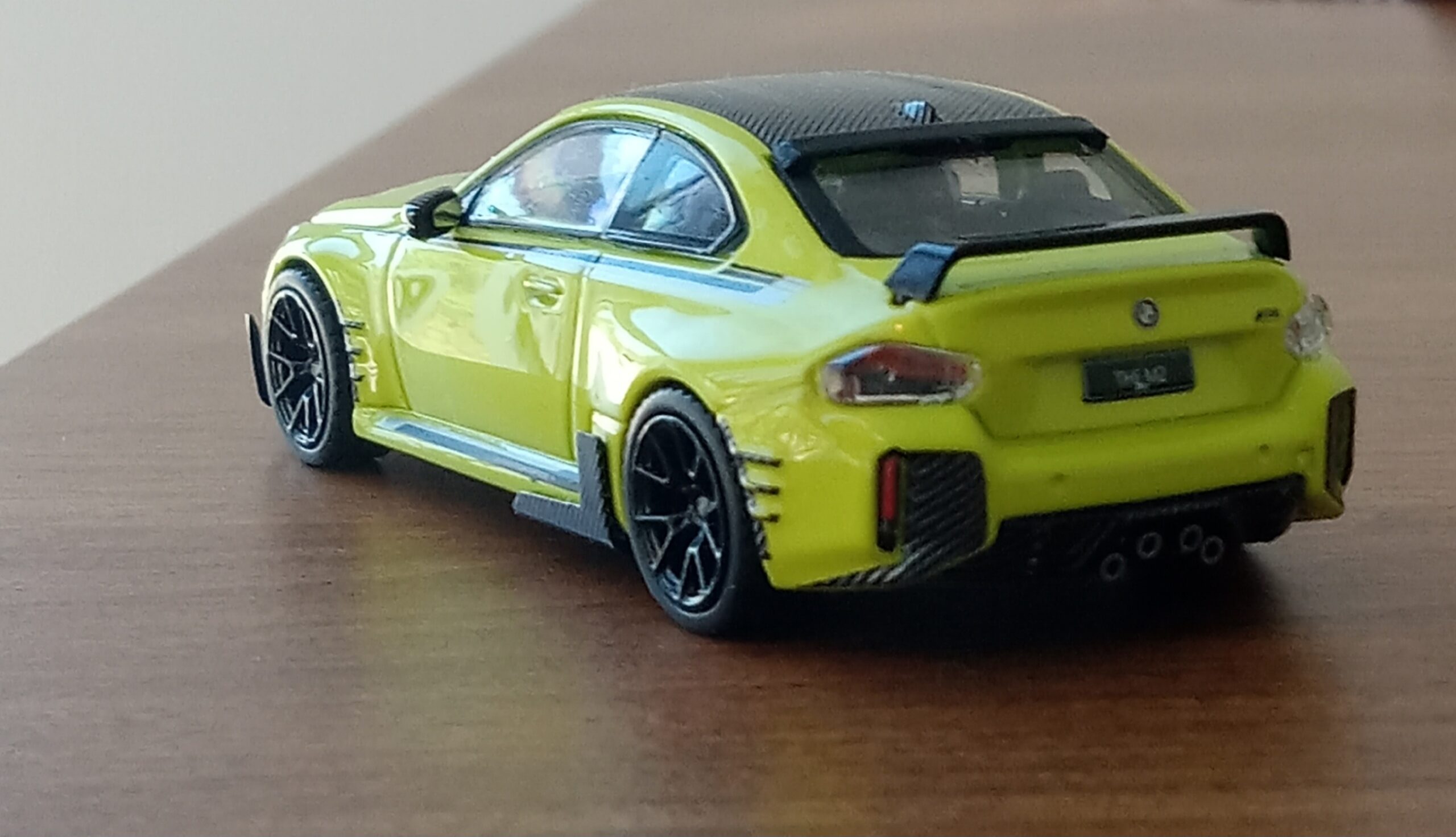
*左右に2個、真四角の空気抜きが目立ちまくる個性的なリアエンド
*いったん盛り上がり、その後扁平になるボンネットの異様なカタチ
などなど、見どころ満載のレーサー・レプリカぶりと、
M3などの従来型のM仕様と完全に断絶したデザイン言語に衝撃を受け、
BMWデザインのヤル気に魅せられました。
新車で買える
レトロモッド・カスタム:
BMW M2 純正パフォーマンス・パーツ仕様
に付き、こんな感じで
攻めてみたいです!
*実車解説:巧妙なマーケティング?
*外観デザインの特徴:胸のすく、やりすぎプロポーション
*『私』とM2パフォーマンス・パーツ仕様
*三題噺:レトロモッド・(時代錯誤・起死回生の一手)
*その他のレトロモッドな新車たち、、、
*実車解説: 巧妙なマーケティング?

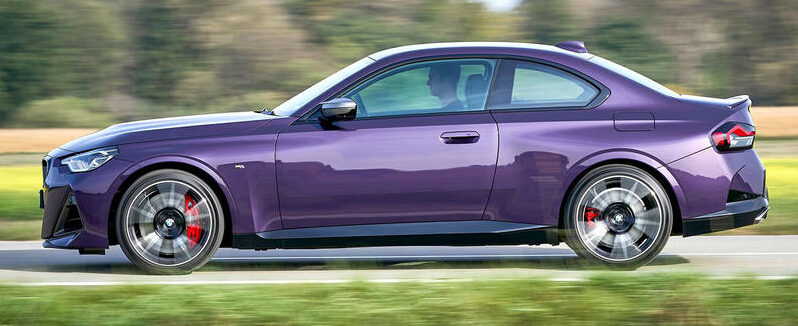
超絶な変化を成し遂げた
新型2シリーズ【クーペ】のデザインに敬意を表しまして、
今回は少し趣向を変え、
外観デザインのみに絞った本格的な解説、
特に前モデル【F-22型】から
本モデル【G42型】への変化を中心に、
お伝えします!
n
n
先代のF22型から現行のG42型への移行は、
n
n
『BMWのコンパクトクーペ史上、最も劇的で大胆な(ドラスティックな)変革』でした。
n
n
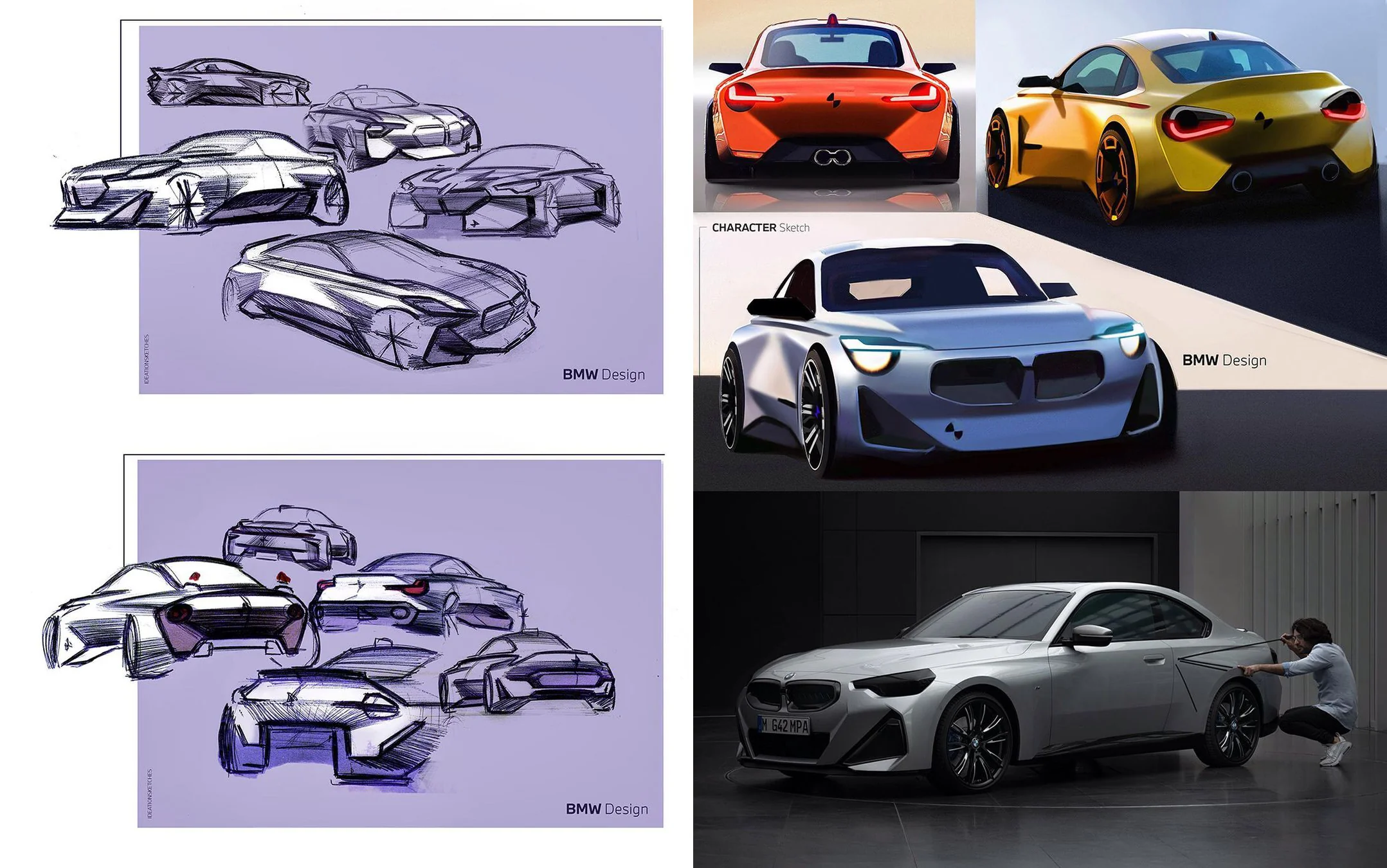
n
N
N
N
N
N
N
N
N
N
N
N
n
n
n
n
n
1. 線のデザイン(F22)から、面(サーフェイス)のデザイン(G42)へ
n
*先代 F22型(キャラクターラインの時代):
F22型は、ボディサイドを貫くクッキリとした「直線(キャラクターライン)」によって形を整えていました。フロントからリアのテールランプへ向かって一直線に伸びるプレスラインが、伝統的なスピード感を表現していました。これは2010年代のオーソドックスで美しい自動車デザインの手法です。
n
*現行 G42型(彫刻的な面の時代):
G42型では、その象徴的な直線の多くが消去されました。代わりに、「三角形や多角形を組み合わせた立体的な多面体」としてボディが構成されています。ラインで形を見せるのではなく、光が当たったときのハイライト(明)とシャドウ(暗)のグラデーションだけで、筋肉のような立体感を表現する現代的なアプローチにシフトしました。
n
n
*先代 F22型(伝統の忠実な再現):
BMWのアイデンティティである「片側2灯(左右で4灯)」のヘッドライトを忠実に守っていました。シャープで少し釣り目のライト形状は、誰が見ても「プレミアムなBMWの一員」と分かる安心感とスポーティさがありました。
*現行 G42型(ヘリテージの超解釈):
G42型は、あえて「片側1灯」に見えるデザインを採用しました。これは一見、伝統の破壊に見えますが、実は1960年代の名車「BMW 2002」のオマージュです。ただクラシックに戻すのではなく、内部のLED発光体を複雑に立体化することで、「レトロなのに未来的な単眼」という、まったく新しいアイコンを作り出しました。
n
n
n
*先代 F22型(馴染みのある機能部品):
ヘッドライトとバランスよく横並びに配置された、控えめで上品なグリルでした。内部には伝統的な縦方向の黒いバー(縦格子)が並び、ラジエーターに風を送る「穴(インテーク)」としての記号性が強いものでした。
n
*現行 G42型(デジタルと融合した彫刻):
4シリーズのような巨大化(縦長化)は避け、横長を維持しましたが、内部構造が激変しました。縦バーを廃止し、幾何学的なフラップ(シャッター)を配置。グリル全体がボディ表面から一歩前に飛び出したような強い立体感(3D感)を持ち、パーツというよりは「フロントマスクの主役となる彫刻」としての存在感を放っています。
n
n
n
*先代 F22型(軽快なコンパクトさ):
5ナンバー枠に比較的近い、キュッと引き締まった「小さなクーペ」の可愛らしさと軽快さが残っていました。キャビン(居住空間)も四角く実用的で、コンパクトカーとしての素直なプロポーションでした。
n
*現行 G42型(上位セグメントの凄み):
全長は大きく伸び、全幅はワイドに、全高は低くなりました。特に、サイドから見たときに「前後フェンダーの膨らみ(フレア)」が圧倒的です。先代が「すっきりとしたアスリート」なら、現行は「筋肉を極限までパンプアップさせたボディビルダー」です。これにより、コンパクトカーというよりも、上位クラスの「8シリーズ クーペ」の弟分のような、格上のオーラを纏うようになりました。
n
n
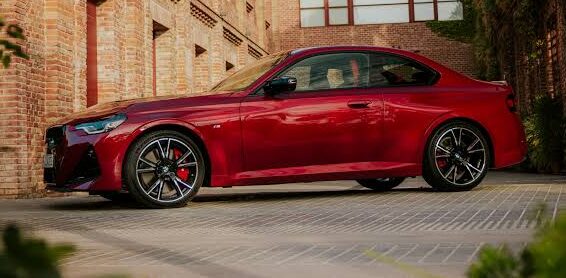 n
n
n
N
N
N
N
N
N
N
N
*F22型は「インテリジェンスと調和」: 誰もが美しいと感じる普遍的なクーペの黄金比を、破綻なく小さなボディに落とし込んだ名作。
*G42型は「エモーションと主張」: 電動化時代にあえてガソリンを燃やして走るFRクーペとしての「狂気」や「熱量」を、過激な面構成とヘリテージの融合で表現した意欲作。
デザイナー目線で見ると、G42型への変化は単なるモデルチェンジではなく、「2シリーズというモデルに、BMWで最も尖った個性を与える」という強い意志が込められた、ドラスティックな方向転換だったと言えます。
n
n
続きまして、【G52型M2】にとって非常に重要な位置を占める、
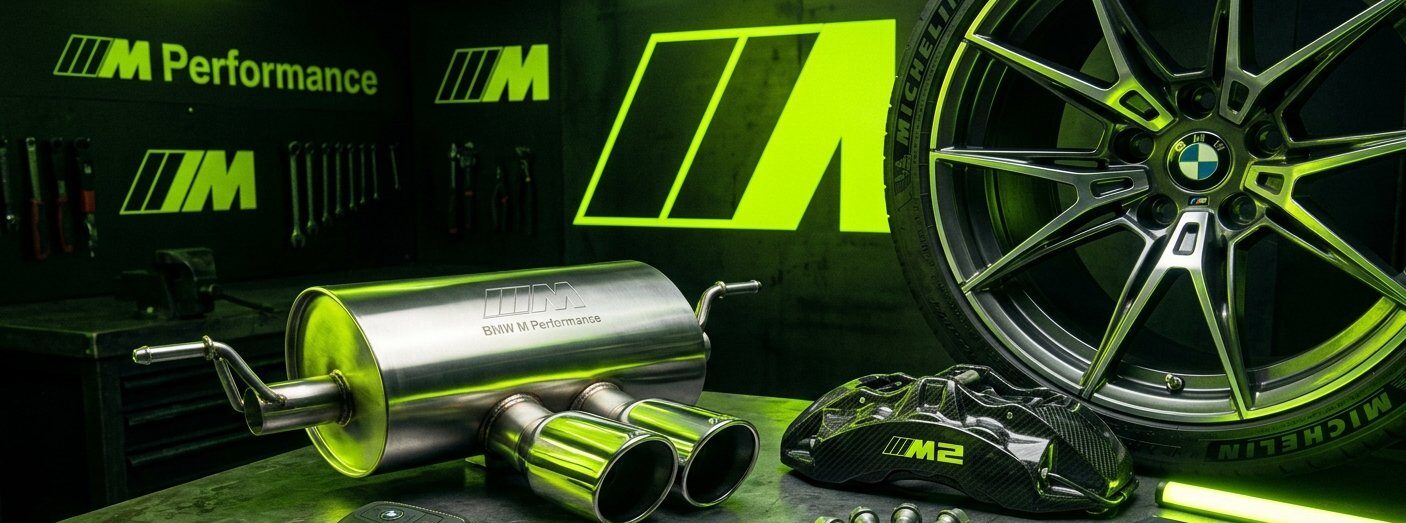
「BMW Mパフォーマンス・パーツ(M Performance Parts)」
に付いての解説です。
BMWの高性能スポーツカー「M2」(特にG87型)向けに用意されている「BMW Mパフォーマンス・パーツ(M Performance Parts)」は、レースで培った高い技術(機構)と、迫力ある見た目(デザイン)を両立させたBMW純正のカスタムパーツです。
n
単なるドレスアップではなく、空力性能の向上や軽量化など、走りの実力を引き上げるための仕組みが詰め込まれています。その主な機構とデザインの特徴を、分かりやすく解説します。
n
1. 空力(エアロダイナミクス)の機構とデザイン
n
パーツの多くは、軽くて頑丈な「CFRP(カーボンファイバー強化プラスチック)」で作られています。職人の手作業で作られており、表面は美しいカーボン繊維の織り目が見えるように透明な塗装(クリアコート)で仕上げられています。
*フロントスプリッター / エアインテークトリム
*【デザイン】 フロントバンパーの底や空気の吸い込み口(インテーク)に装着する立体的なパーツです。顔つきがより低く、ワイドに見えるようになります。
*【機構】 車体の下に流れ込む空気の量を減らし、車体が浮き上がるのを抑えます(ダウンフォースの発生)。これにより、高速道路やサーキットでのフロントタイヤのグリップ力(地面を掴む力)が強くなります。
*サイドスパッツ / カーボンフェンダーカバー
*【デザイン】 タイヤハウス(タイヤが収まる空間)の後ろ側に取り付ける、小さなひれ(フィン)のようなパーツです。
*【機構】 回転するタイヤの周りで発生する激しい空気の乱れ(乱れ気流)をスムーズに後ろへ受け流します。これにより、空気の抵抗を減らし、直進するときの安定性を高めます。
*大型リアウイング / リアディフューザー
*【デザイン】 トランクの上にそびえ立つ固定式の大きなウイング(翼)と、バンパー底に取り付ける網目状のディフューザーです。レーシングカーそのものの迫力を放ちます。
*【機構】 後輪を地面に強く押し付けるダウンフォースを生み出します。特に最新の「スワンネック型」と呼ばれるウイングは、翼の下側の空気の流れを綺麗に保つことで、より効率よく車体を安定させます。
n
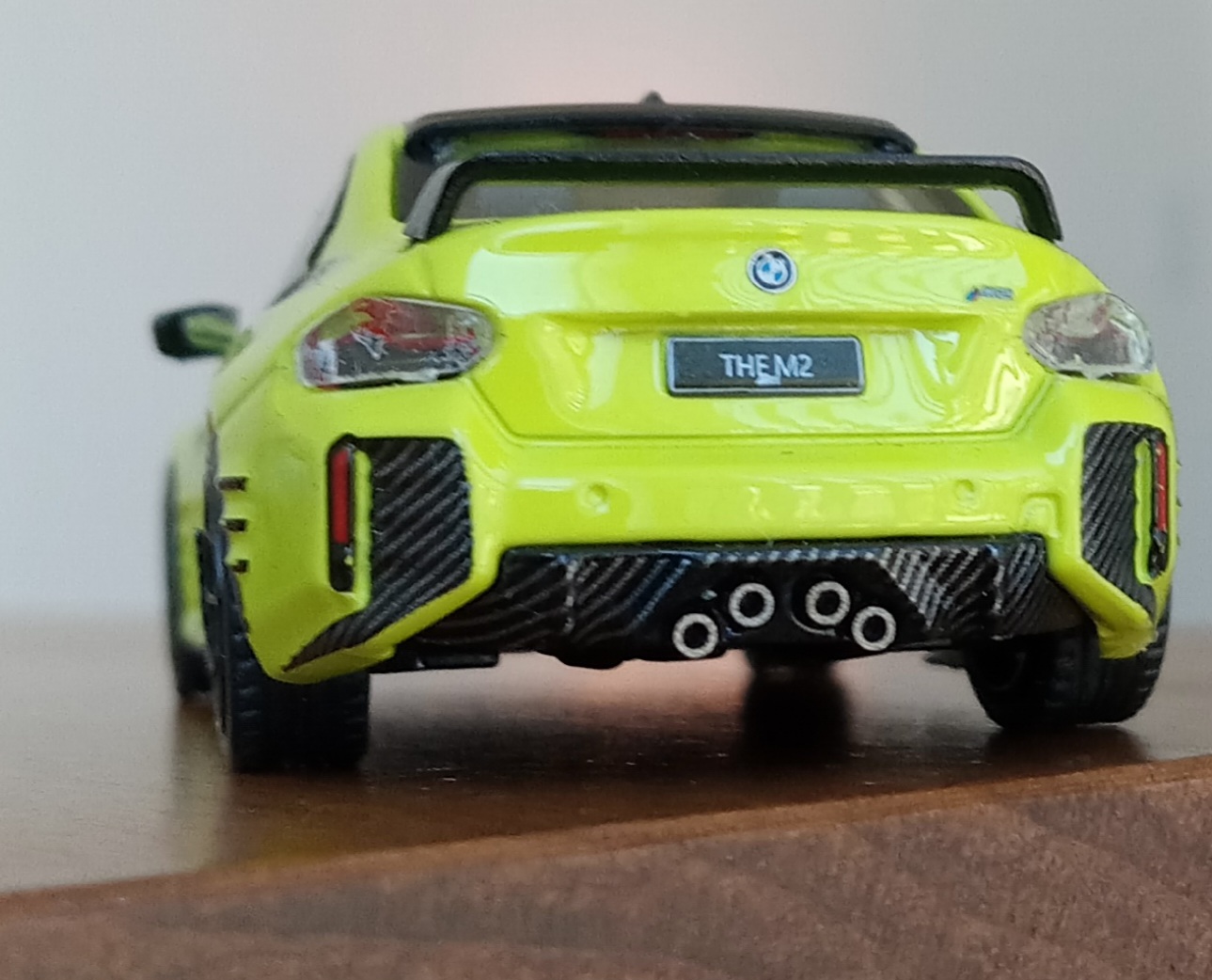
*センター4本出しチタンマフラー
*【デザイン】 通常のM2は左右に2本ずつマフラーがありますが、このパーツはリアの真ん中に4本のマフラーが斜めに積み重なるように配置されます。これに合わせた専用のカーボンディフューザーとセットになっており、一目で特別なモデルだと分かります。
*【機構】 素材に軽いチタンや高級なステンレスを使っているため、普通のシステムより約8kgも軽く作られています。さらに、電気で動くフタ(排気フラップ)が付いており、ドライブモードを変えることで、サーキットではレーシングカーのような迫力あるサウンドを響かせることができます。
n
n
n
*車高調整式サスペンション(コイルスプリング式)
*【デザイン】 車高(地面から車体までの高さ)が低くなり、タイヤと車体の隙間が狭まることで、地を這うようなスポーティな姿勢になります。
*【機構】 ネジを回すことで、車高を最大でミリ単位で調整(約10〜25mmダウン)できます。中のバネやクッションの硬さもM2専用にチューニングされており、カーブを曲がるときの車体の傾きを抑え、ダイレクトな操作感を生み出します。
*大径・軽量 鍛造ホイール
*【デザイン】 フロント20インチ、リア21インチという、前後で異なる大きさの特大ホイールです。きめ細やかなクロススポーク(網目)デザインで、ゴールドブロンズやマットブラックといった特別な色が選べます。
*【機構】 アルミの塊を強い力でプレスして作る「鍛造(たんぞう)」という方法で作られているため、非常に軽くて頑丈です。一部、レース用の車のように真ん中のネジ1本だけで固定する「センターロック」方式の本格的なホイールも選べます。
n
*M Performance ステアリングホイール
*握る部分に滑りにくい高級素材「アルカンターラ」が巻かれ、頂点には赤いセンターマーク(12時位置の目印)が付いています。
*カーボンパーツの多用
*シフトノブの周りやドアの内側、さらにはシートの後ろ側(バックレスト)までカーボンで装飾され、車内全体が引き締まった印象になります。
n
n
n
n
n
#三面写真:
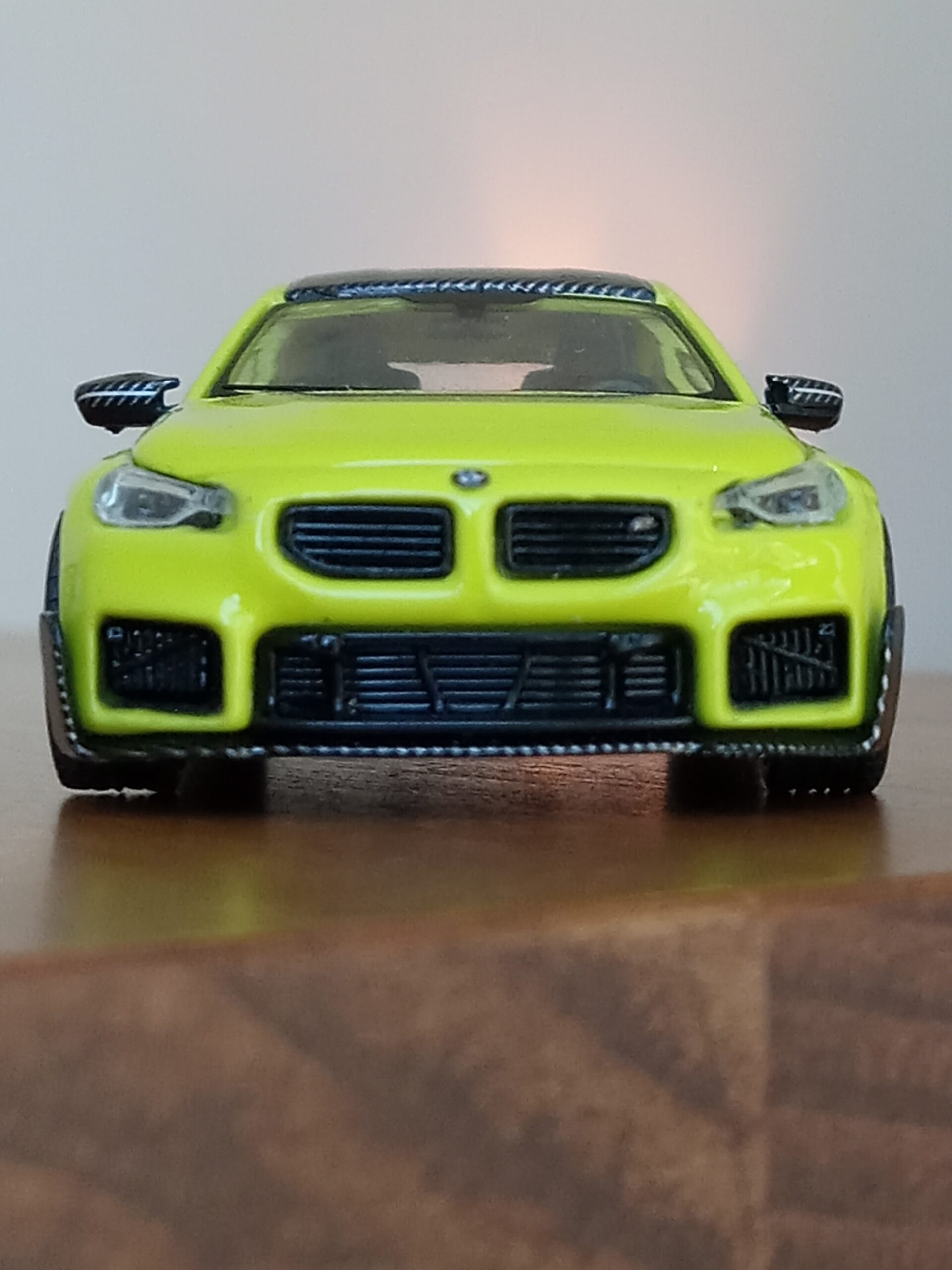
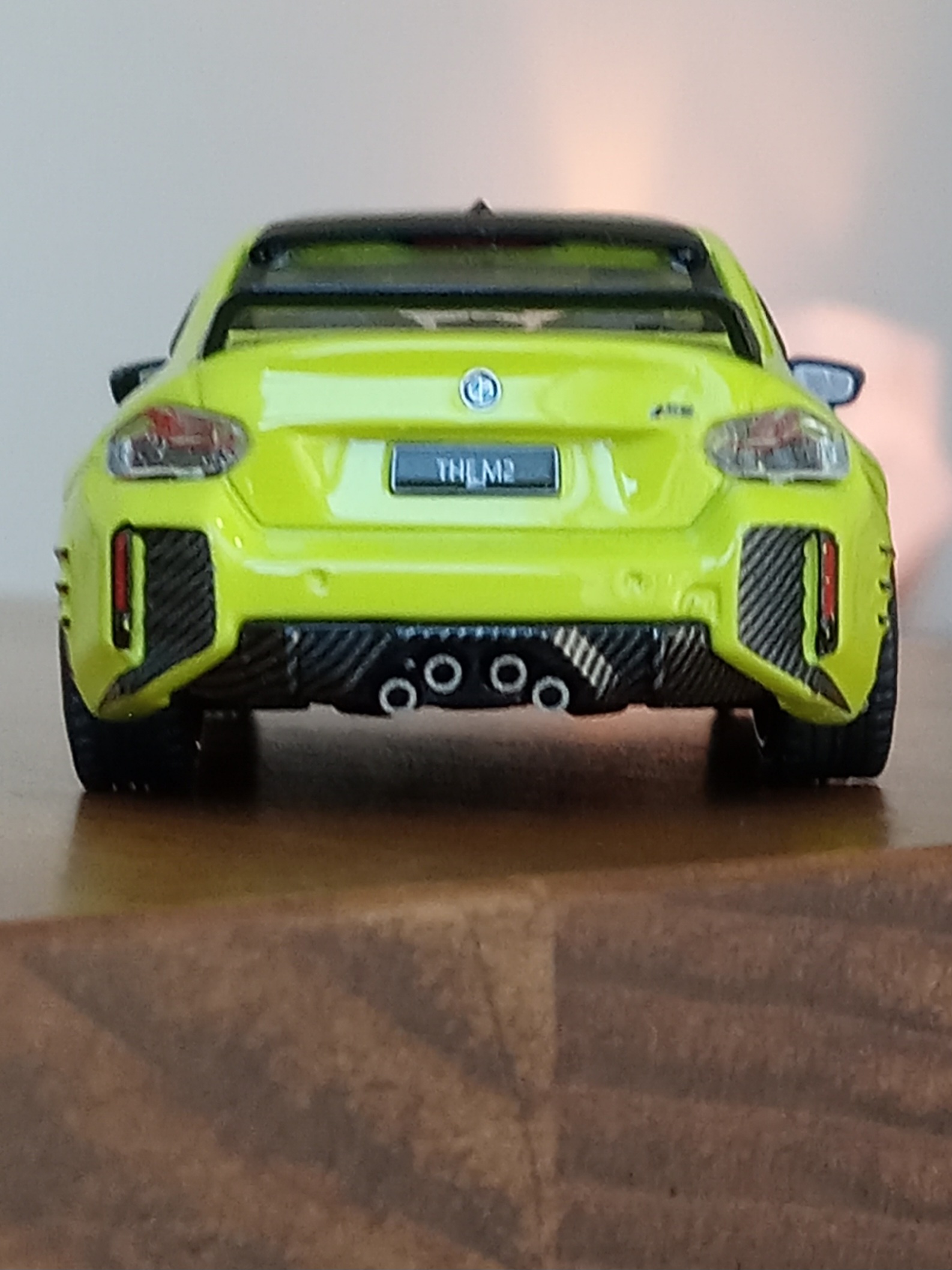
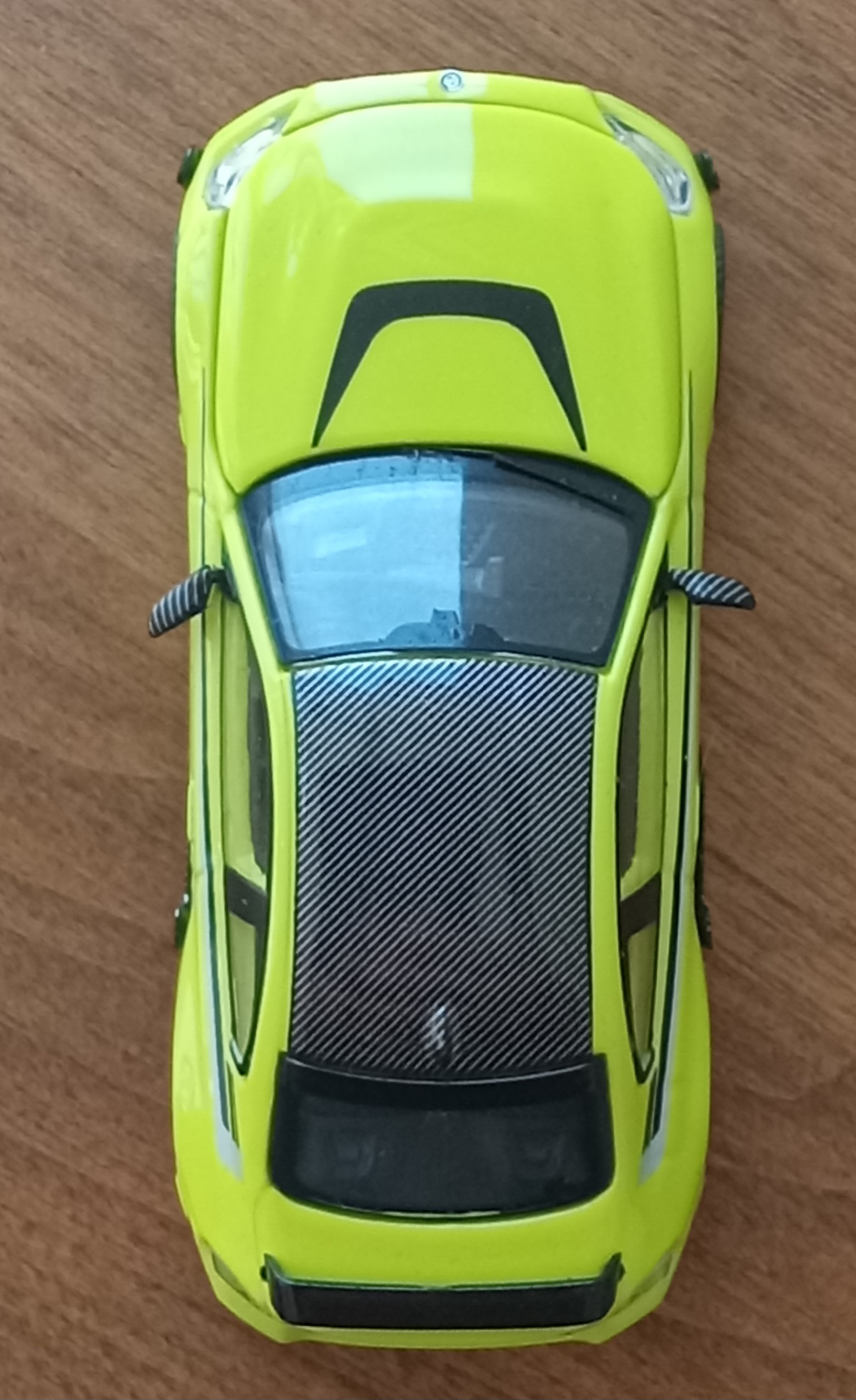
#主要諸元【G-87型】:
- 型式:S58B30A型
- 総排気量: 2,992 cc、直列6気筒DOHC Mツインパワー・ターボ
- 燃料供給 : DME電子燃料噴射装置(直噴ターボシステム)
- 最高出力 : 338kW(460PS)/ 6,250 rpm (一部最新型は 353kW / 480PS)
- 最大トルク:: 550Nm / 2,650〜5,870 rpm (ATモデル等では最高600Nm)
- 駆動方式:FR(フロントエンジン、リアドライブ)
- 定員:4名
- 車体形式:2ドア・クーペ
- ホイールベース:2,740 mm
- 全長:4,580 mm
- 全幅:1,885 mm
- 全高:1,410 mm
- 車両重量:
1,730 kg(8速AT)/ 1,710 kg(6速MT)
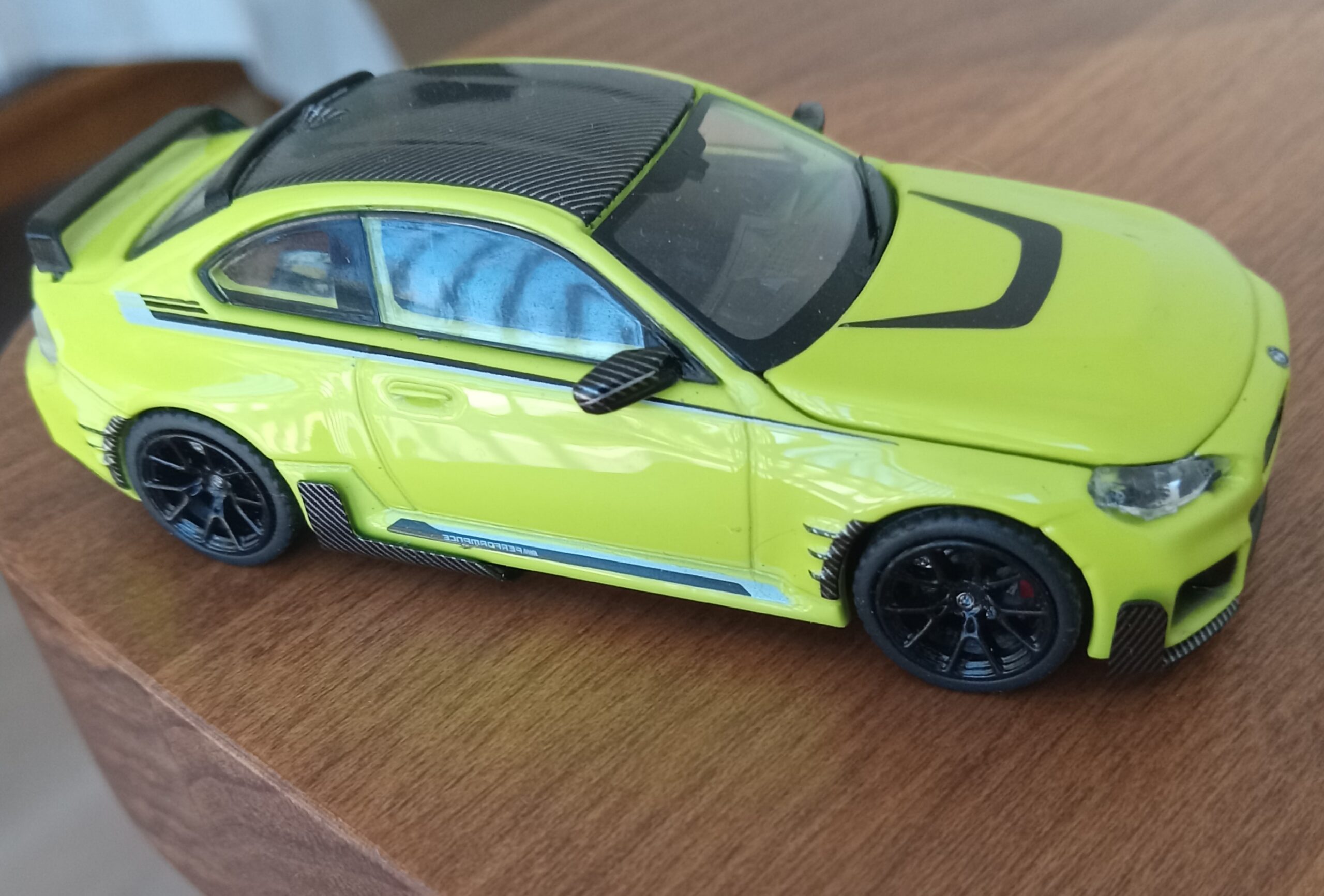
*外観デザインの特徴:胸のすく、やり過ぎプロポーション
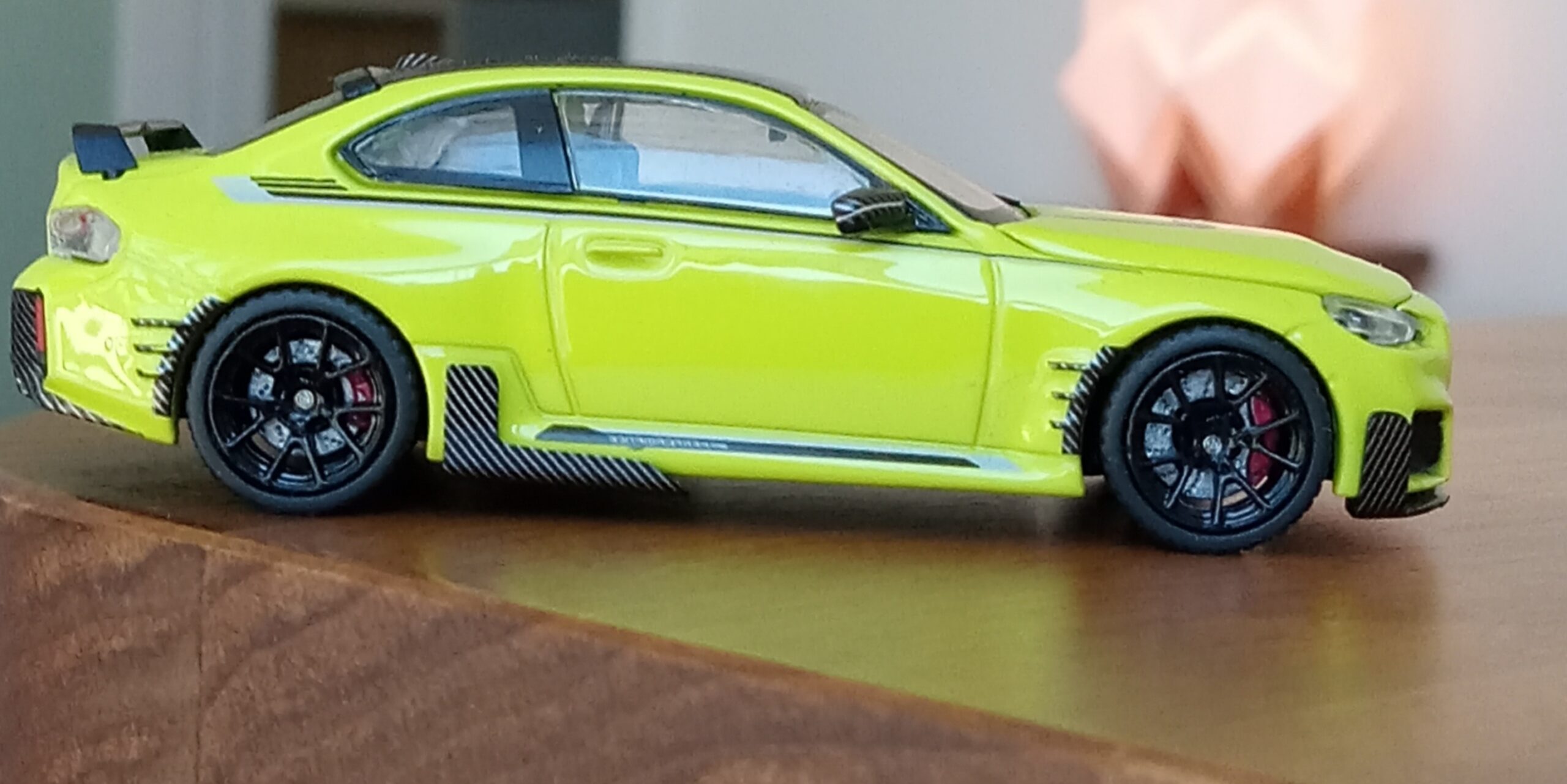
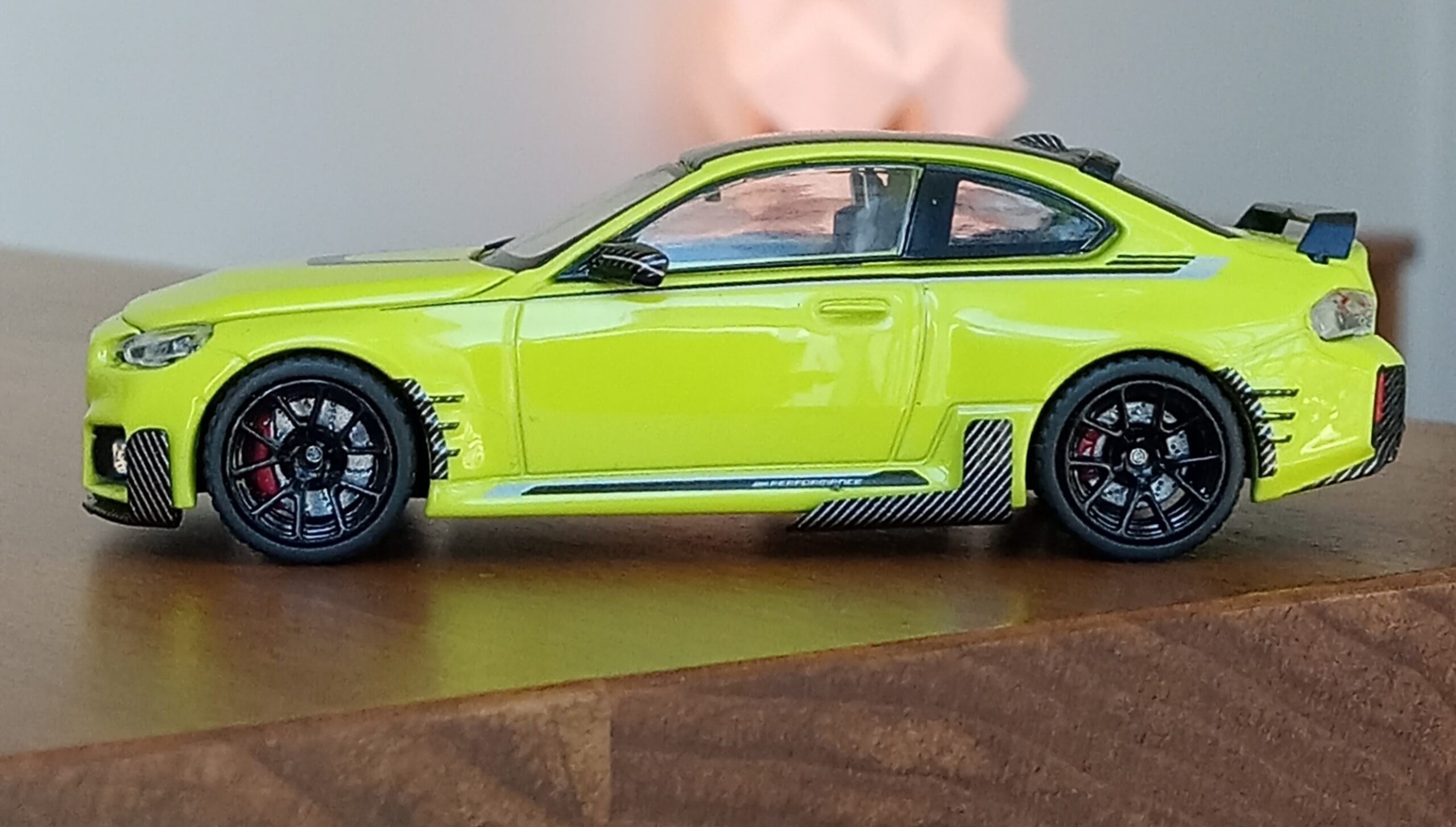
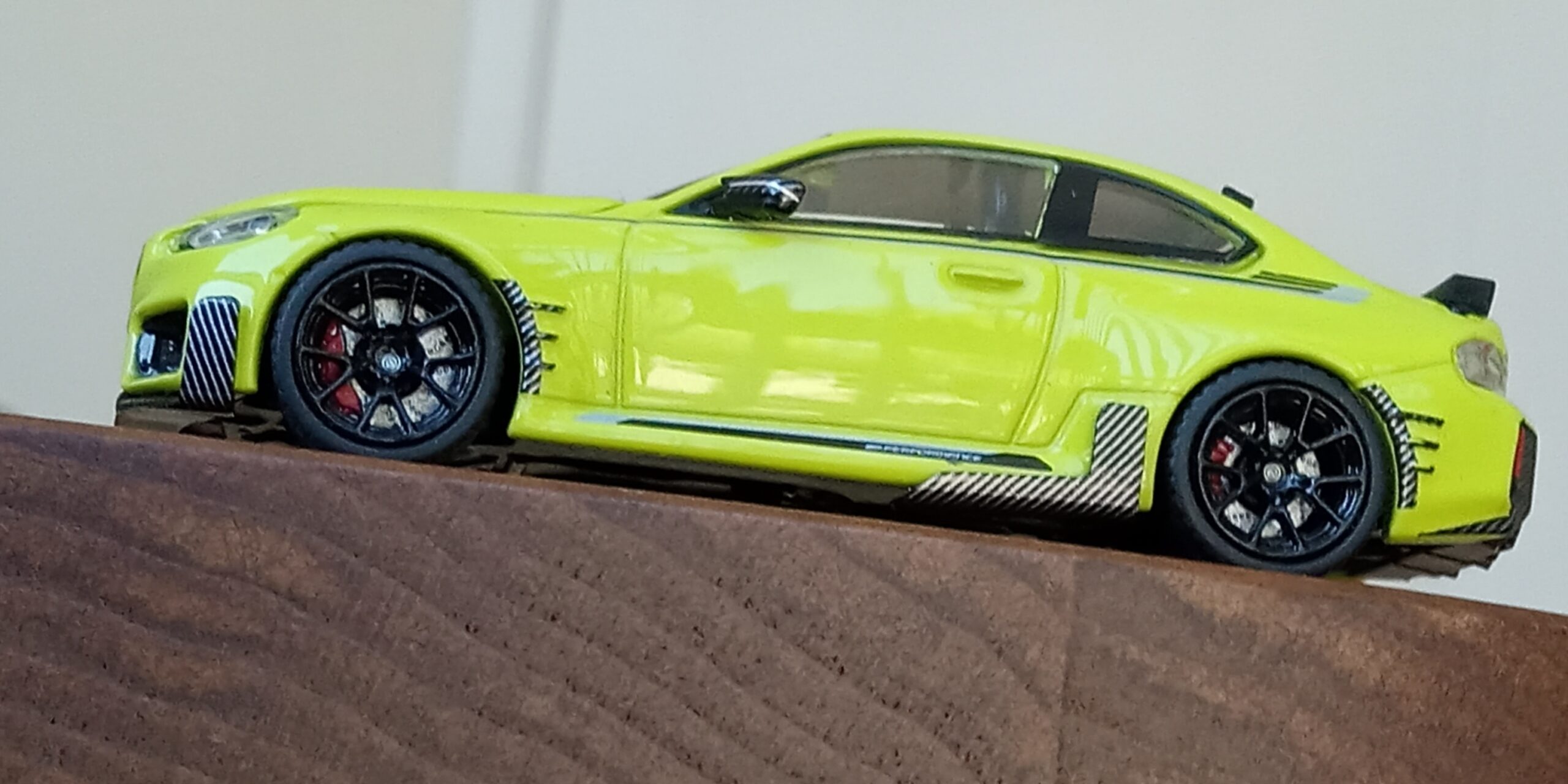
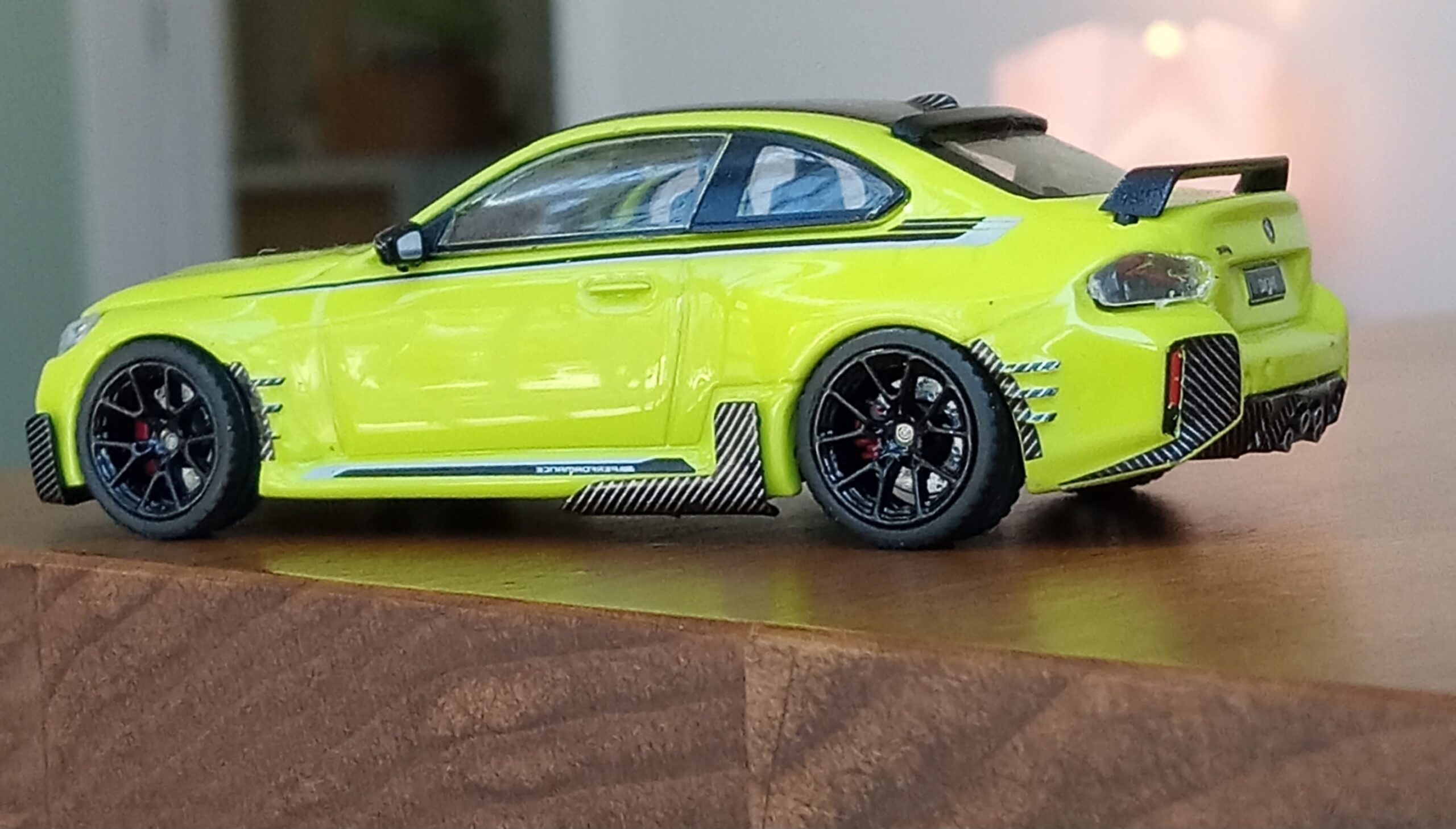
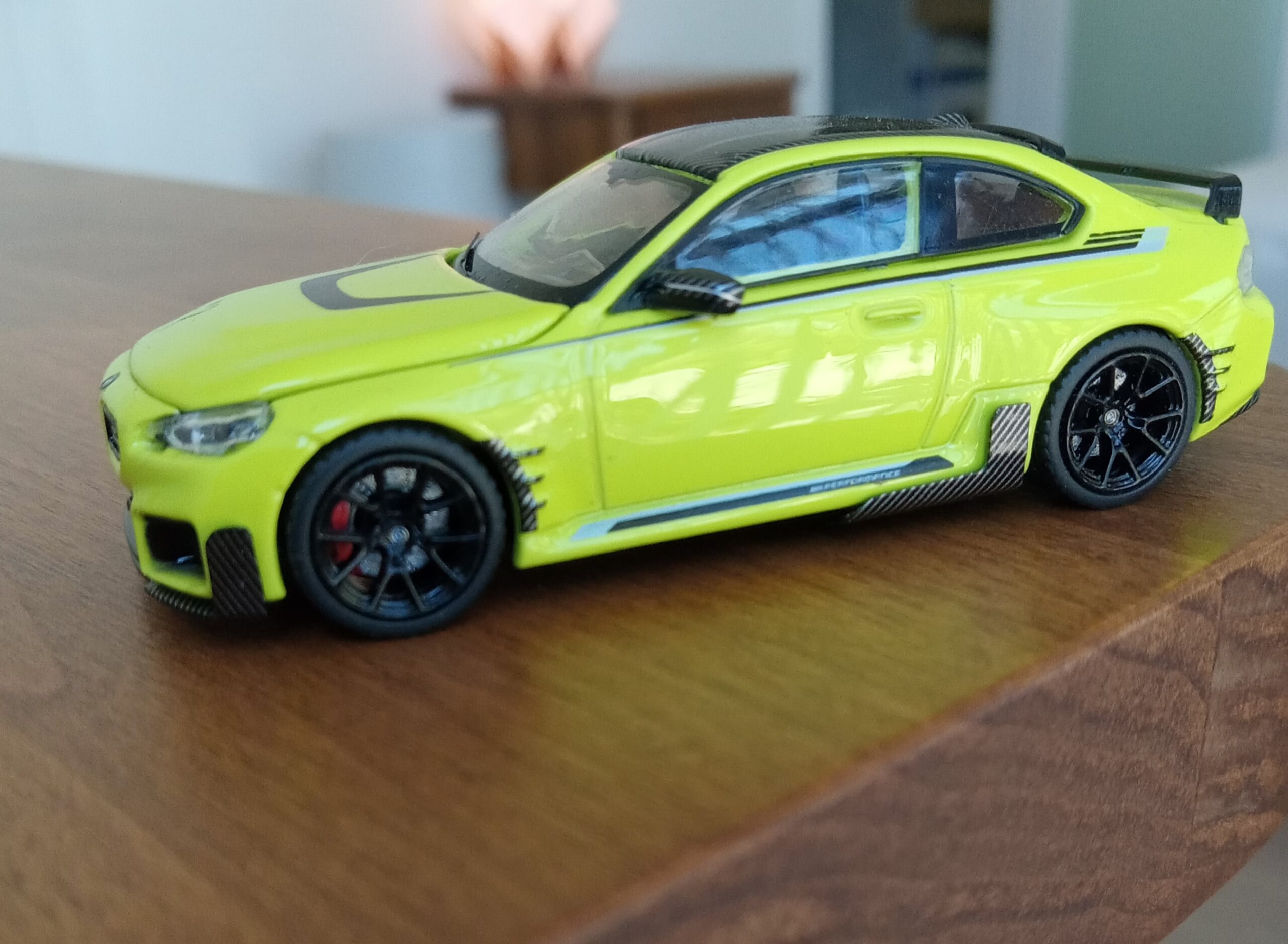
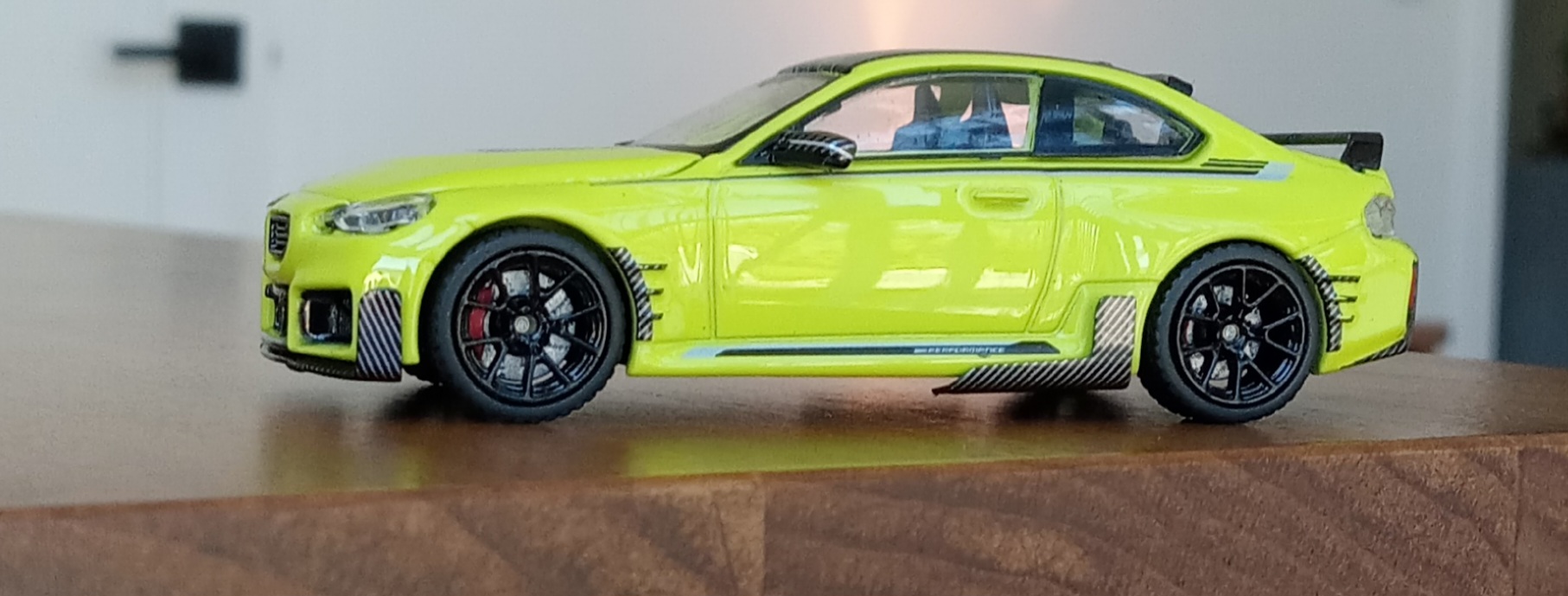
BMWデザインが必死に
次世代EVの形を、
『ノイエ・クラッセ』的なデザイン言語で創出し、
生産型が市場に出始めた、今日この頃、
そのプレッシャーを横目に、
意気揚々として、
ガソリンを燃やして走る内燃機関の栄枯盛衰を祝うような、
時代錯誤的=遅れてきたポストモダン的な狂気溢れる駄々っ子的な
デザイントレンドを作っている車が、
『BMW 2シリーズ』です!
その中でも一番力があるデザイン、
『M2 パフォーマンス・パーツ仕様』に付いて、
以下の5点のデザイン的特徴を上げてみたいです。
1:先代【F-22型】に比べ15cm以上伸ばされたフロント部分【ファイヤーウオールから前の部分】がもたらす、狂気に満ちた『ロングノーズ・ショートデッキ』のFRプロポーションーーー>キャブ・フォアワード的なノイエクラッセをあざ笑うかのような、真逆の構成です。
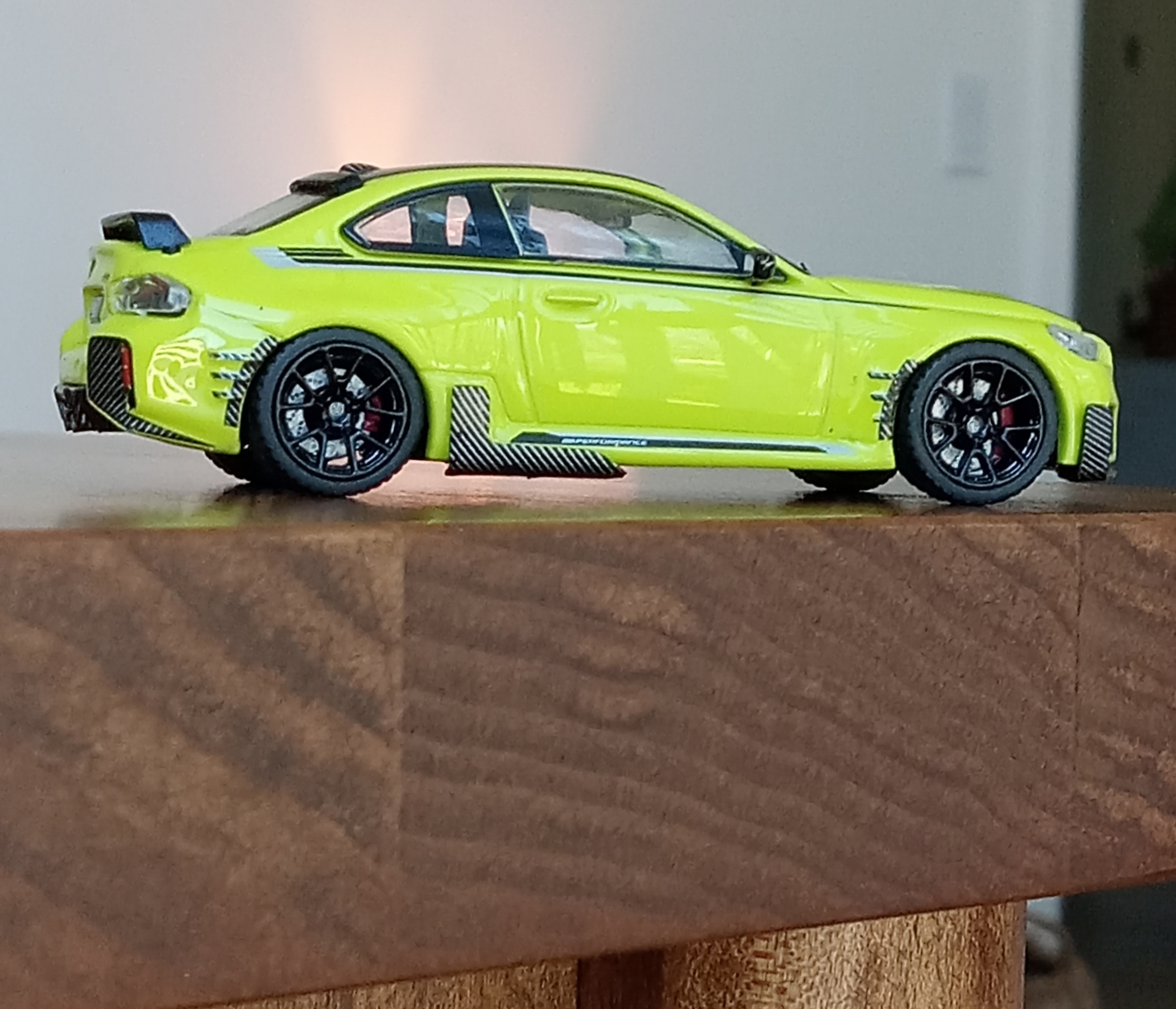
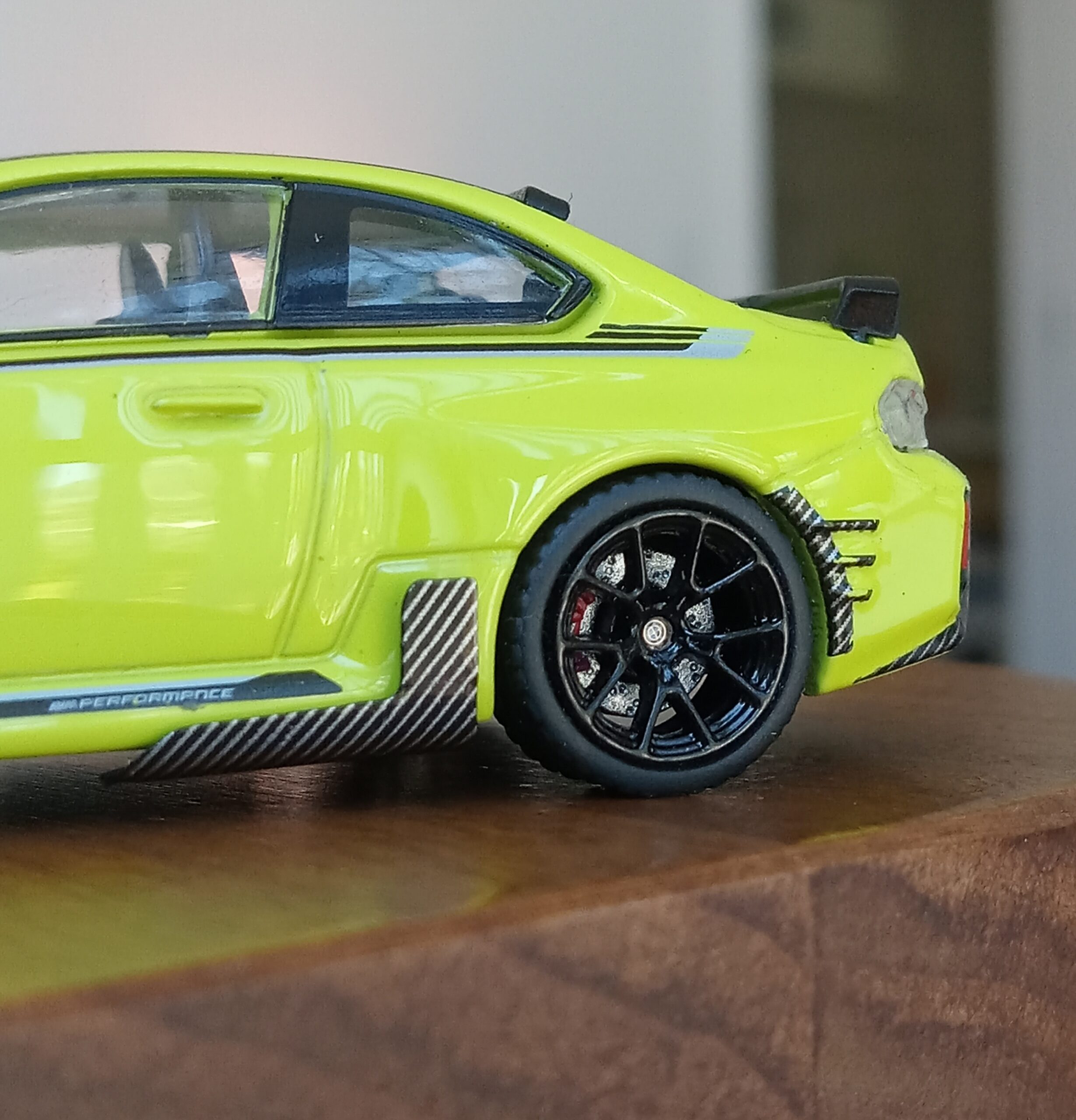
2:とってつけた感が見え見えな、オーバーフェンダー的に取り付けられたカクカクなフェンダーデザインーーーー>先代型に比べ車幅の大幅な増加が、すごみを与えています。
3:チューニング化―文化の構成を、見事にメーカー車のデザインに取り込んだ勇気と勢いーーー>レトロ・モッド文化の生産車への逆襲
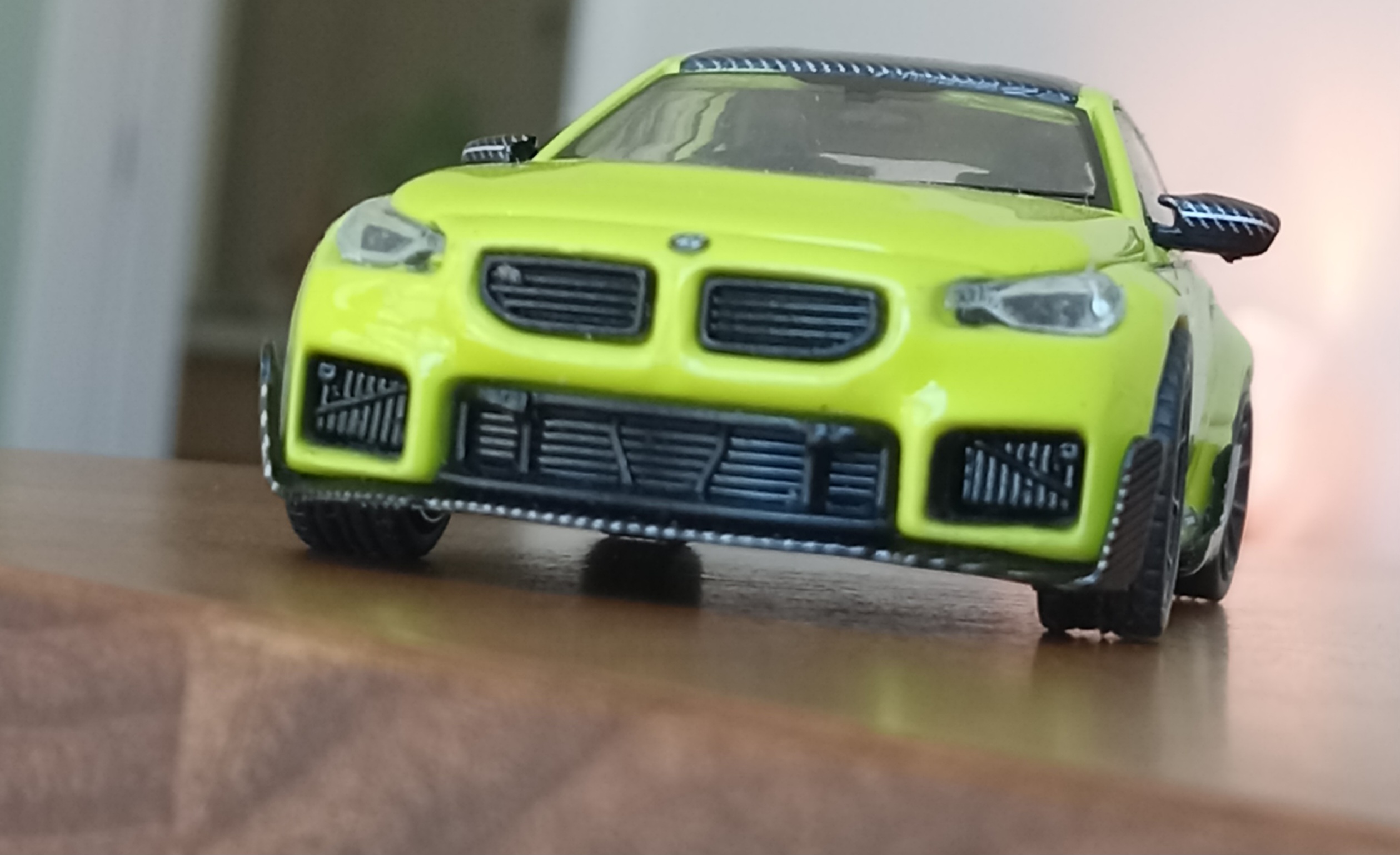
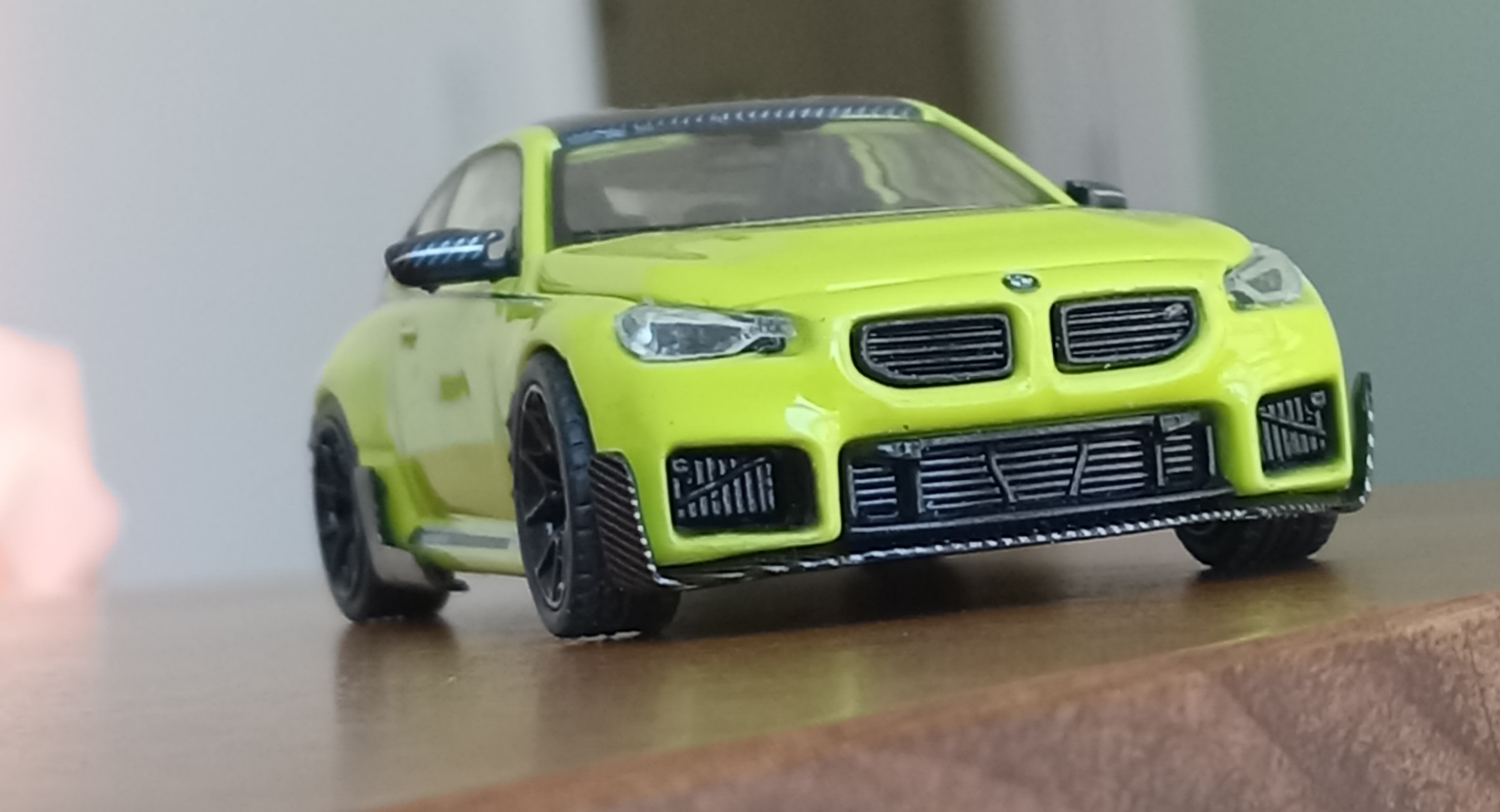
4:勇ましくも、憎めない、四角基調で車幅が強調されたフロントフェイシア・デザイン+後半部分がまっ平らになったボンネットの面構成の悪ガキ感ーーー>まさに狂気的デザイン
5:特別にしつらえられた、カーボン素材、軽量素材をちりばめた、パフォーマンス・パーツのグラフィック的巧妙さーーー>この一台で、新たなハイパフォーマンス+レーサーレプリカの外観アップグレードのパッケージを完成しています。
それでは、
それぞれ写真入りで見て行きましょう!
1:先代【F-22型】に比べ15cm以上伸ばされたフロント部分【ファイヤーウオールから前の部分】がもたらす、狂気に満ちた『ロングノーズ・ショートデッキ』のFRプロポーション
(比較的上品な4シリーズを、食いかねない、BMWラインナップ中随一の破天荒なプロポーションは実車を前にすると目を疑うほどの迫力が、、、)
ーーー>キャブ・フォアワード的なノイエクラッセをあざ笑うかのような、真逆の構成です。
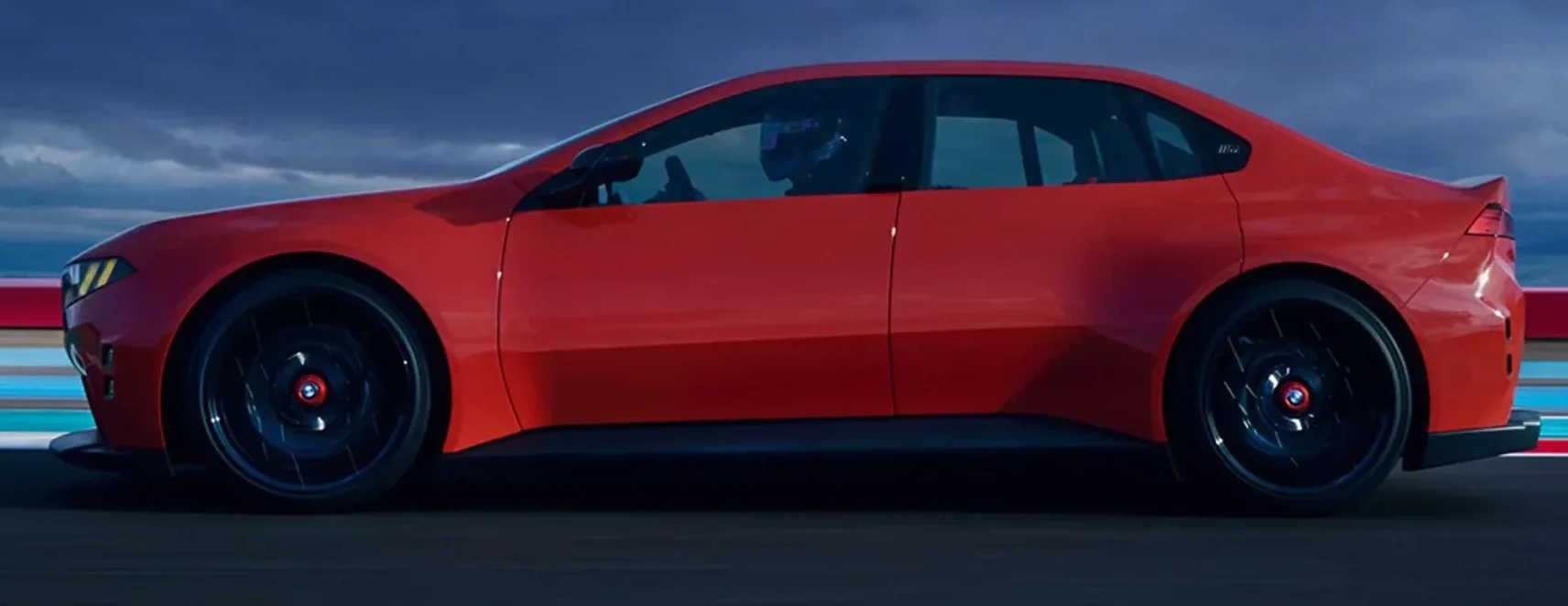
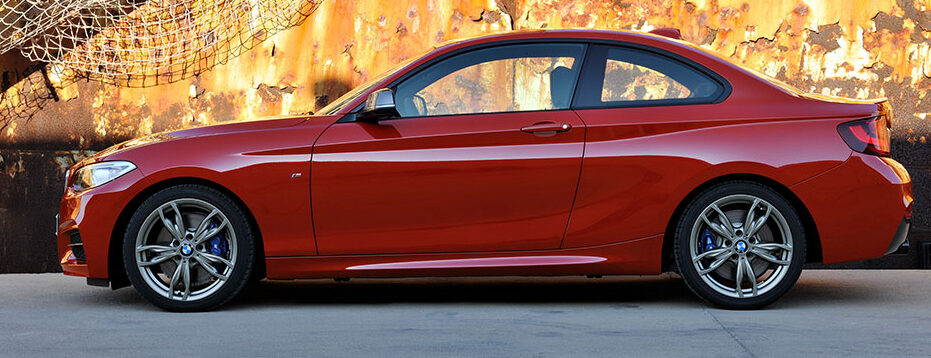
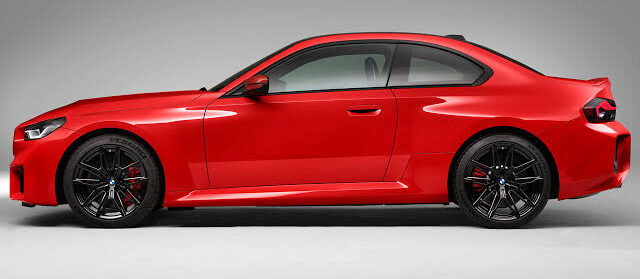
2:とってつけた感が見え見えな、オーバーフェンダー的に取り付けられたカクカクなポストモダンなフェンダーデザイン、、、(笑)
ーーーー>先代型に比べ車幅の大幅な増加が、すごみを与えています。
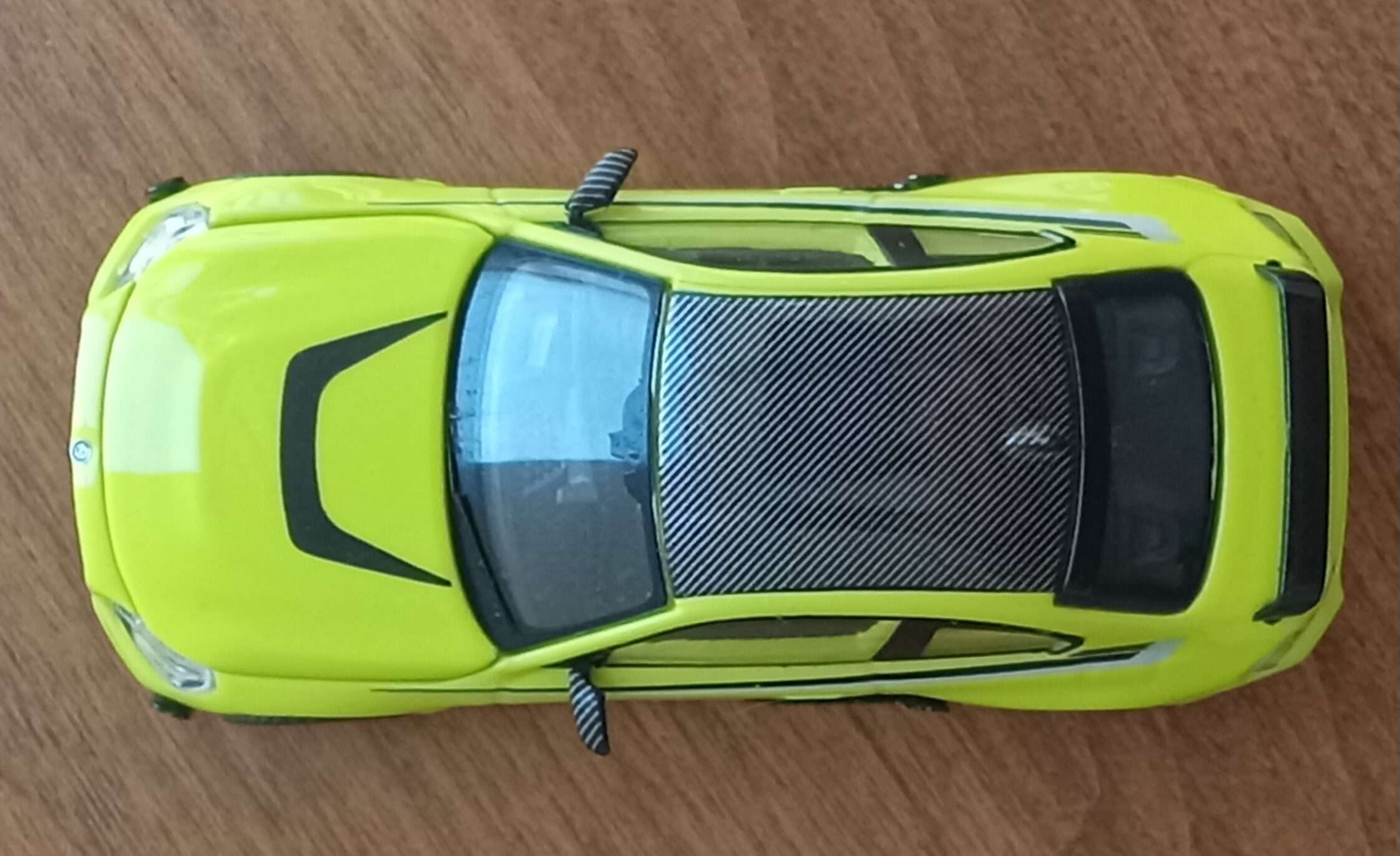
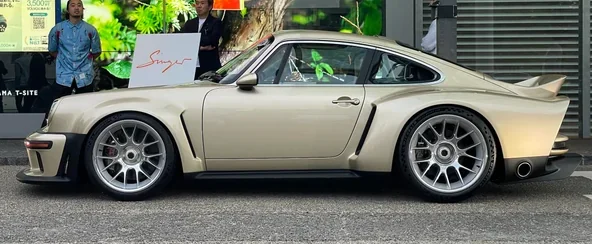
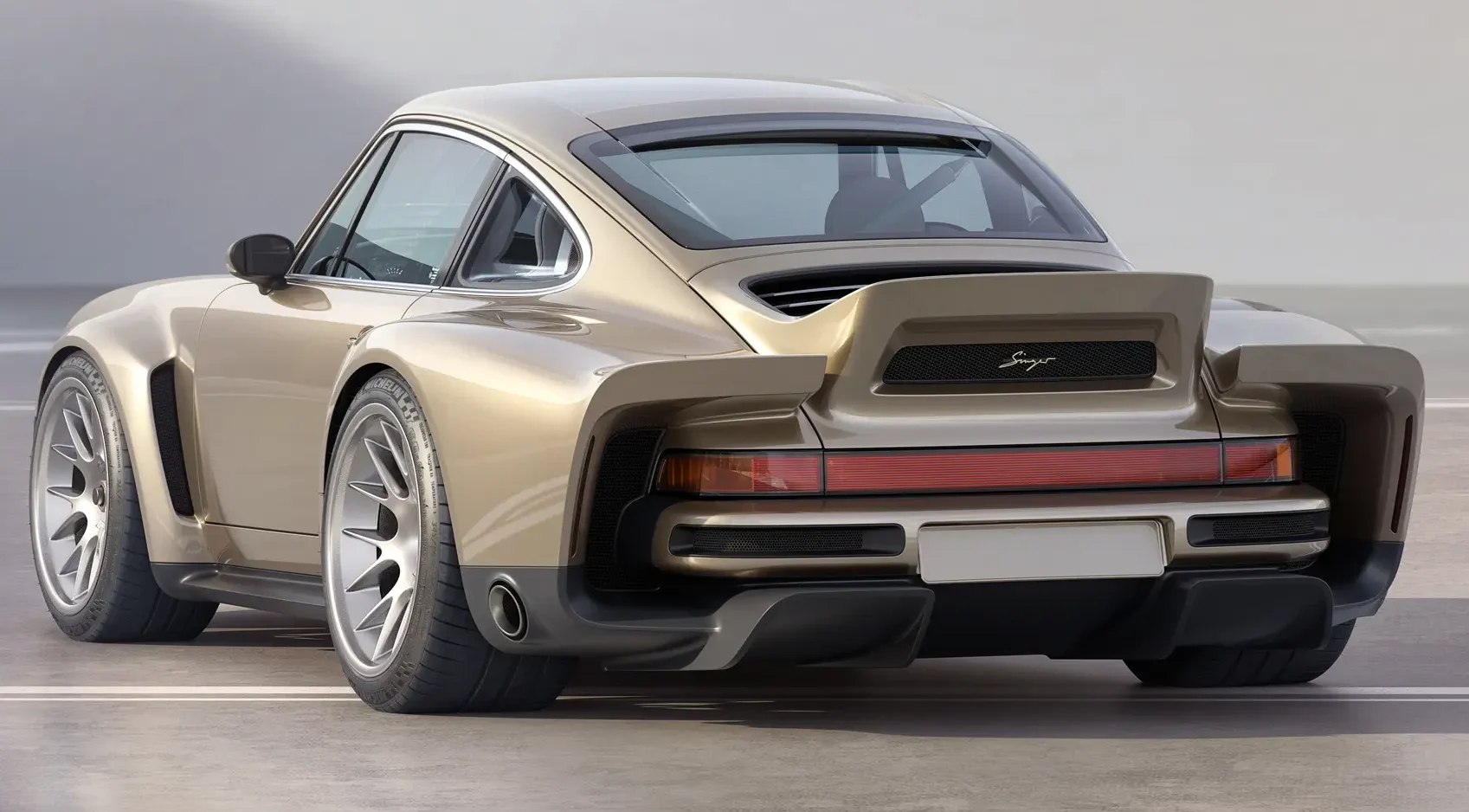
3:チューニング化―文化の構成を、見事にメーカー車のデザインに取り込んだ勇気に喝采を!
ーーー>レトロ・モッド文化の生産車への逆襲
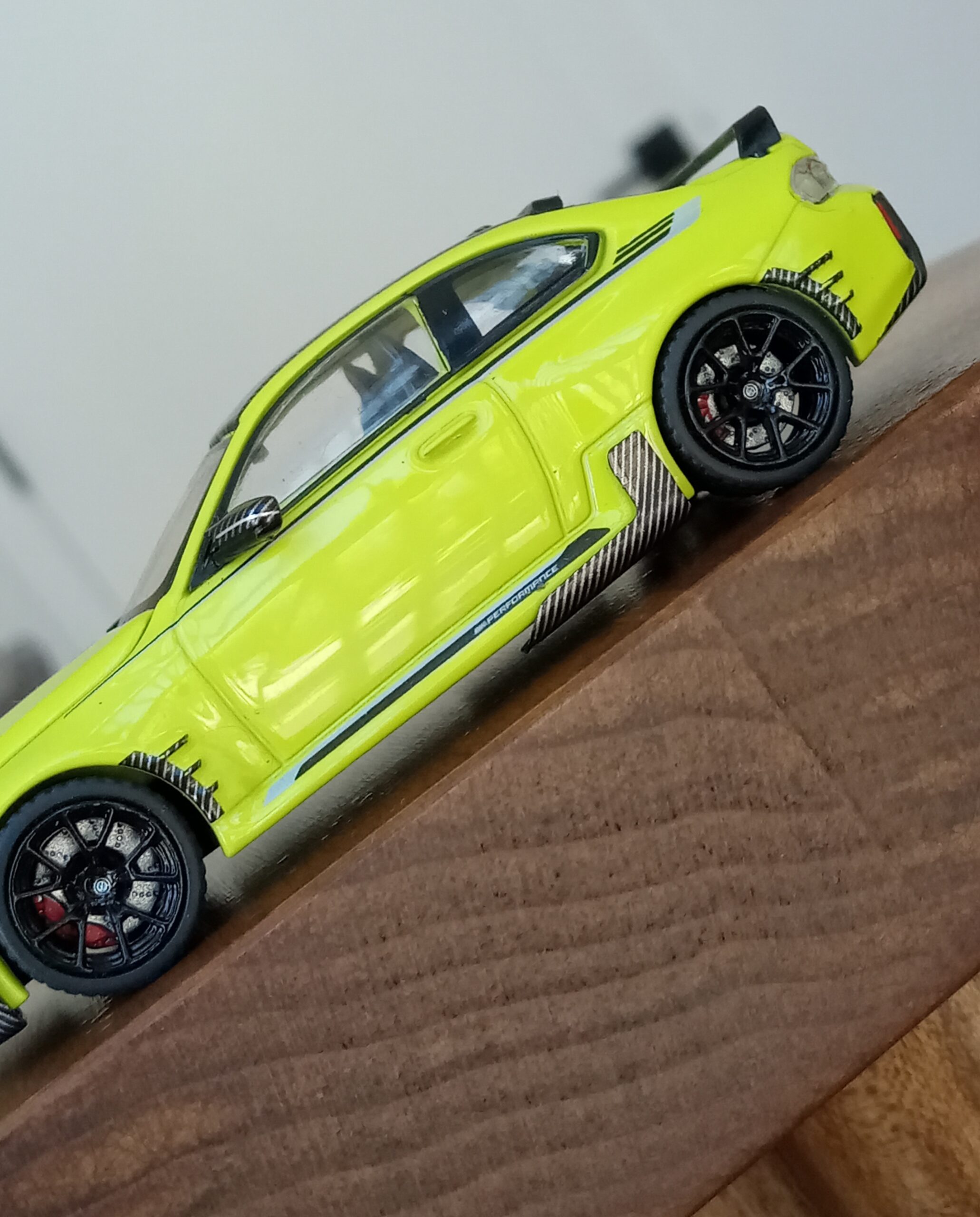
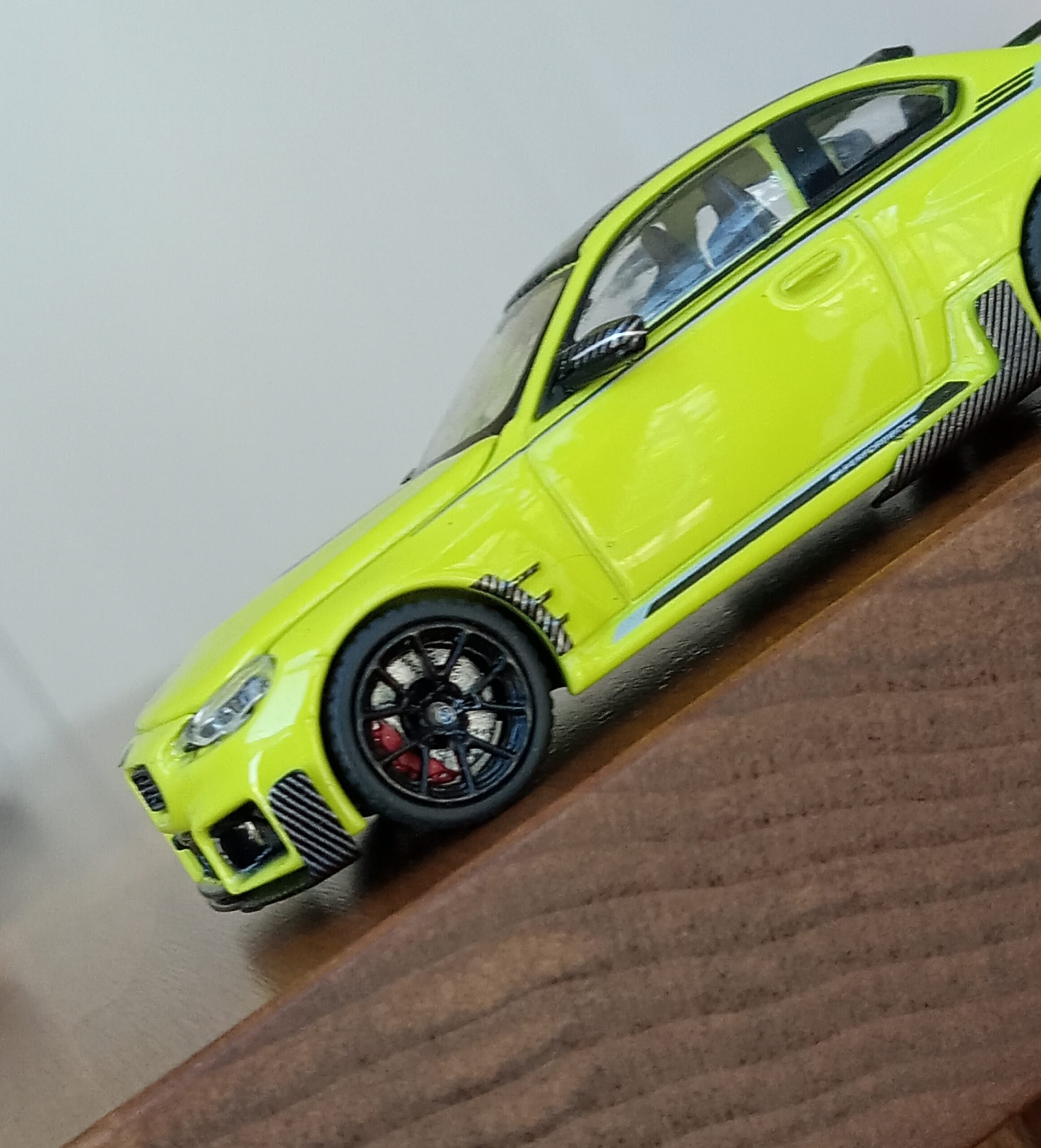
4:勇ましくも、憎めない、四角基調で車幅が強調されたフロントフェイシア・デザイン+後半部分がまっ平らになったボンネットの面構成の悪ガキ感
ーーー>まさに狂気的デザイン
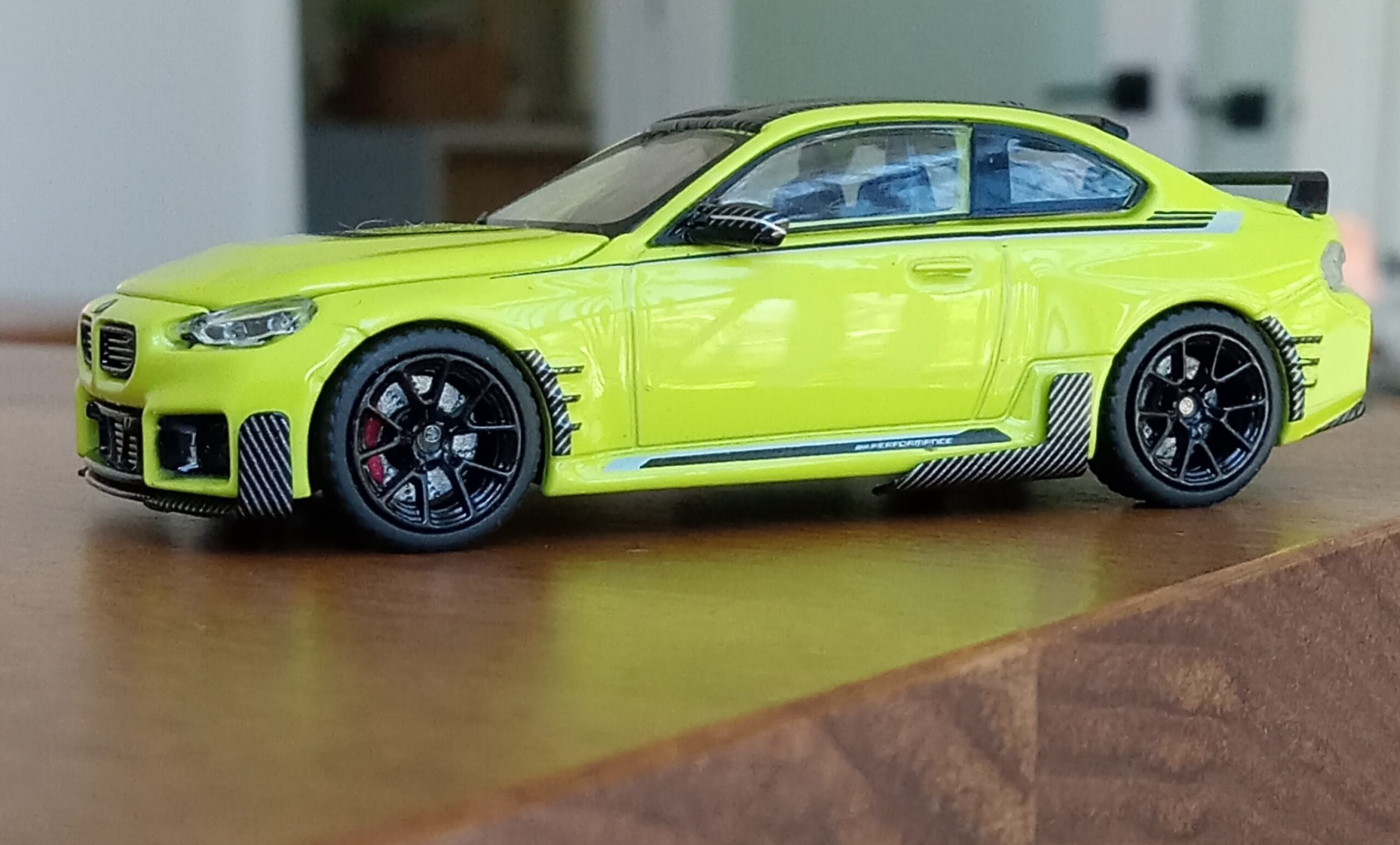
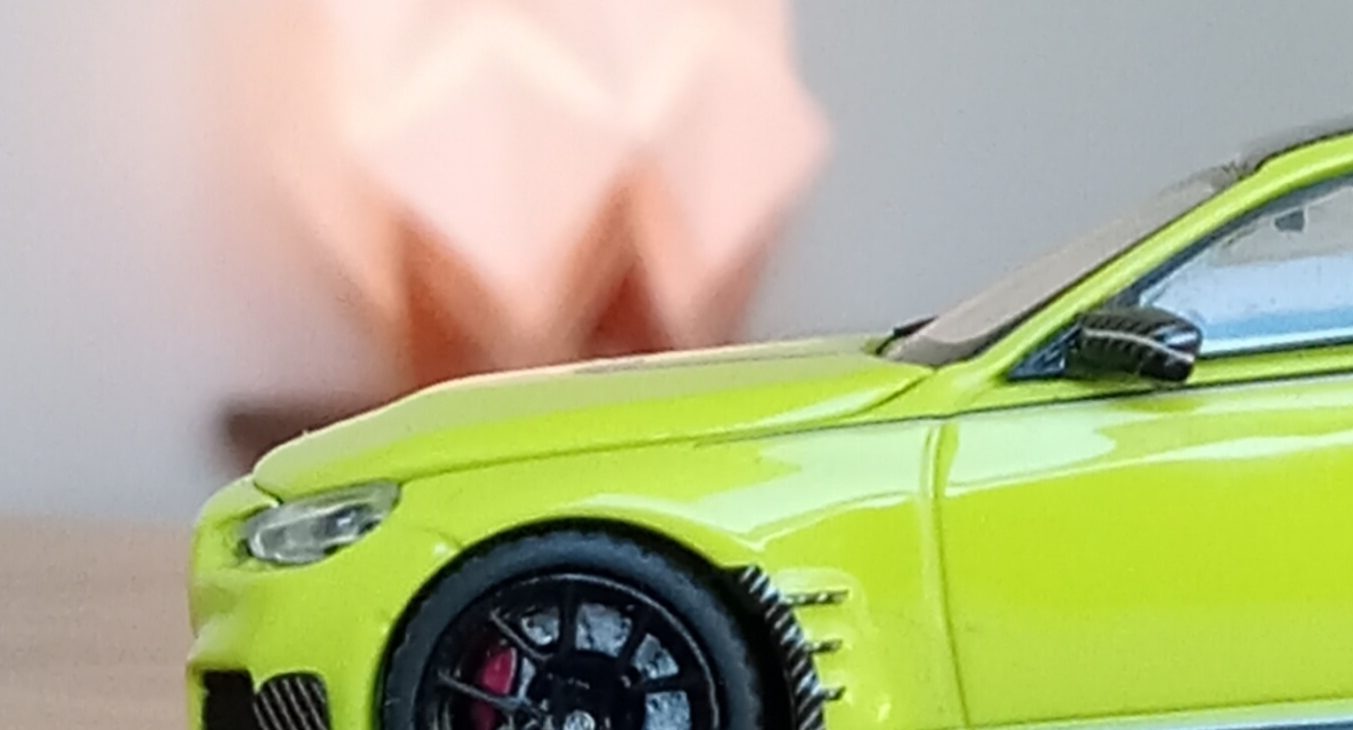
5:特別にしつらえられた、カーボン素材、軽量素材をちりばめた、パフォーマンス・パーツのグラフィック的巧妙さ
ーーー>この一台で、新たなハイパフォーマンス+レーサーレプリカの外観アップグレードのパッケージを完成しています。
*『私』とM2 純正パフォーマンス・パーツ仕様
今回も、
素晴らしい出来のミニカーを発見することで、
一目ぼれ状態となり、
この類まれな、【G-87型】M2=
『BMWの外観デザインに対する
勇敢な挑戦』に触れることとなり、
この記事を書くことになりました、、、
この車のデザインからは、
*EV化という自動車業界の大きな流れの中で、
*取り残されるどころか、
*レトロ・モッドの潮流として大きな雪崩を作るに至る、
内燃機関搭載のFR, RR自動車群の咆哮が、
BMWという、『内燃機関最後の砦』の制作者の厚い情熱を
喚起する様をひしひしと感じます。
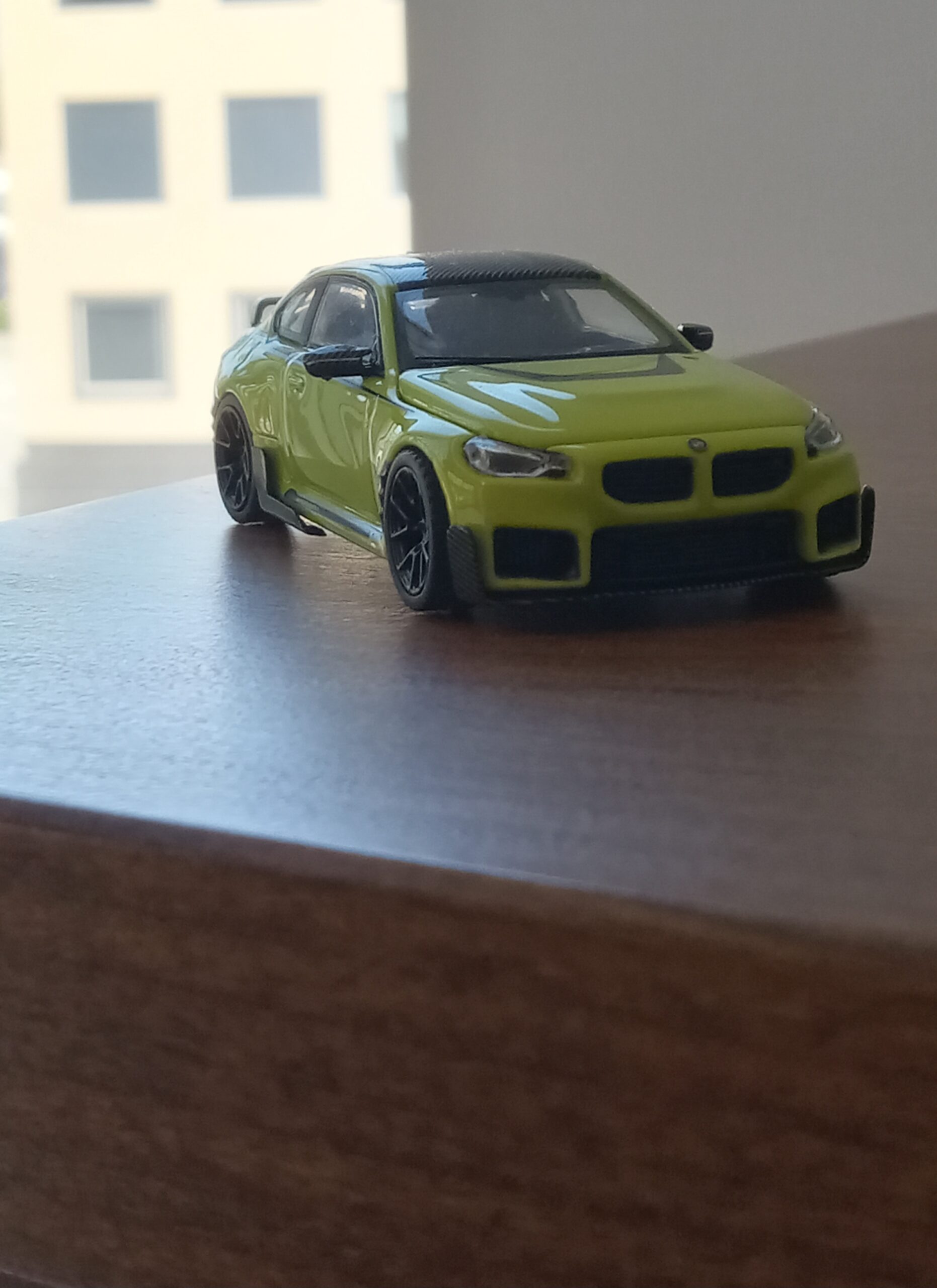
#こちらがそのミニカーです!
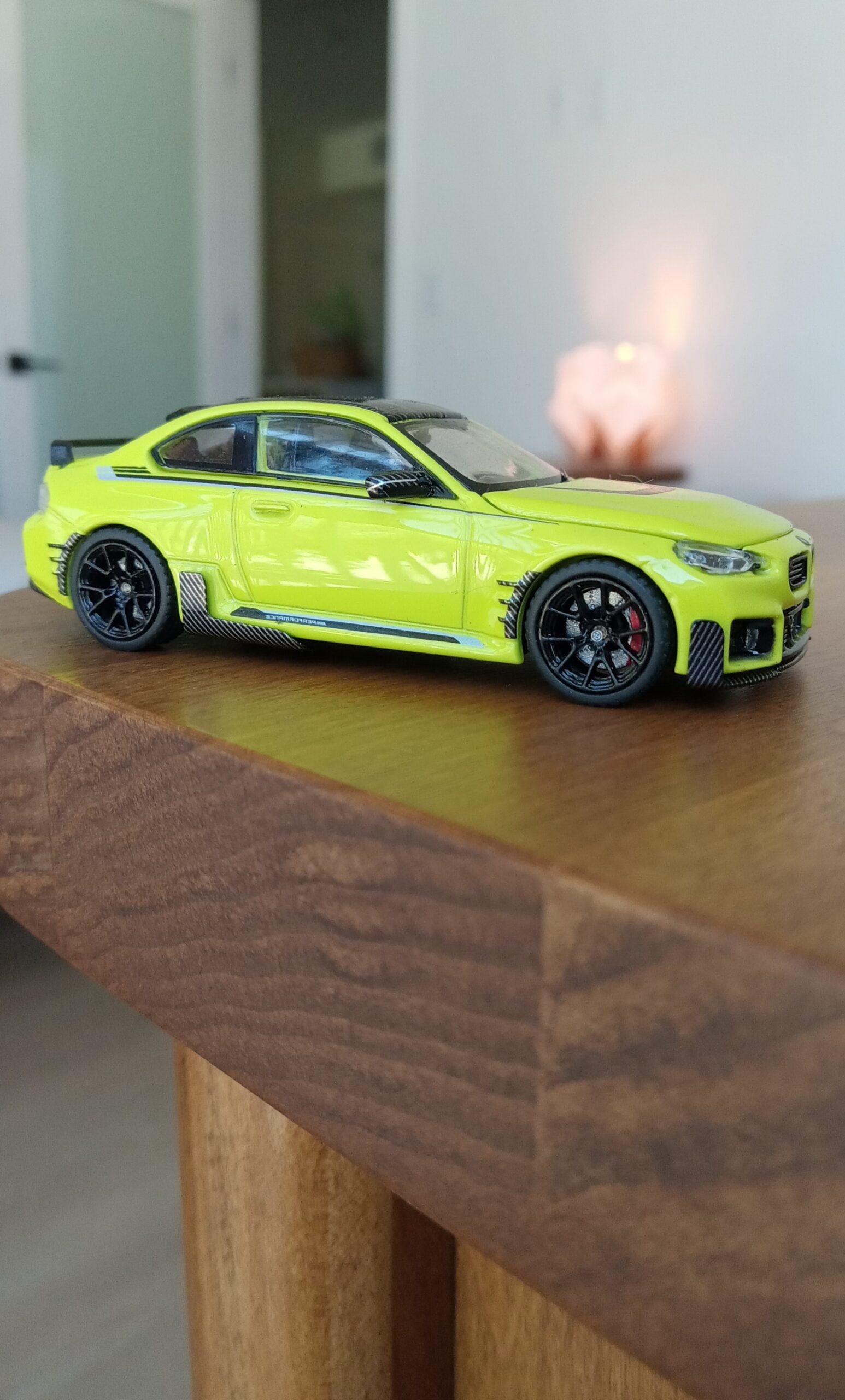
*FX Model社製、1/64ダイキャスト完成品、【G-87型】BMW M2 純正パフォーマンス・パーツ仕様 (ネオン・ライム)
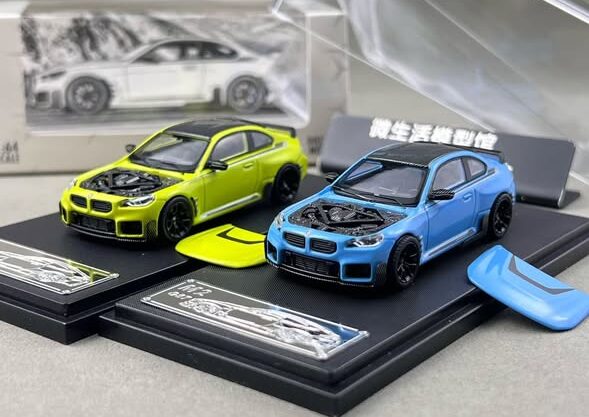
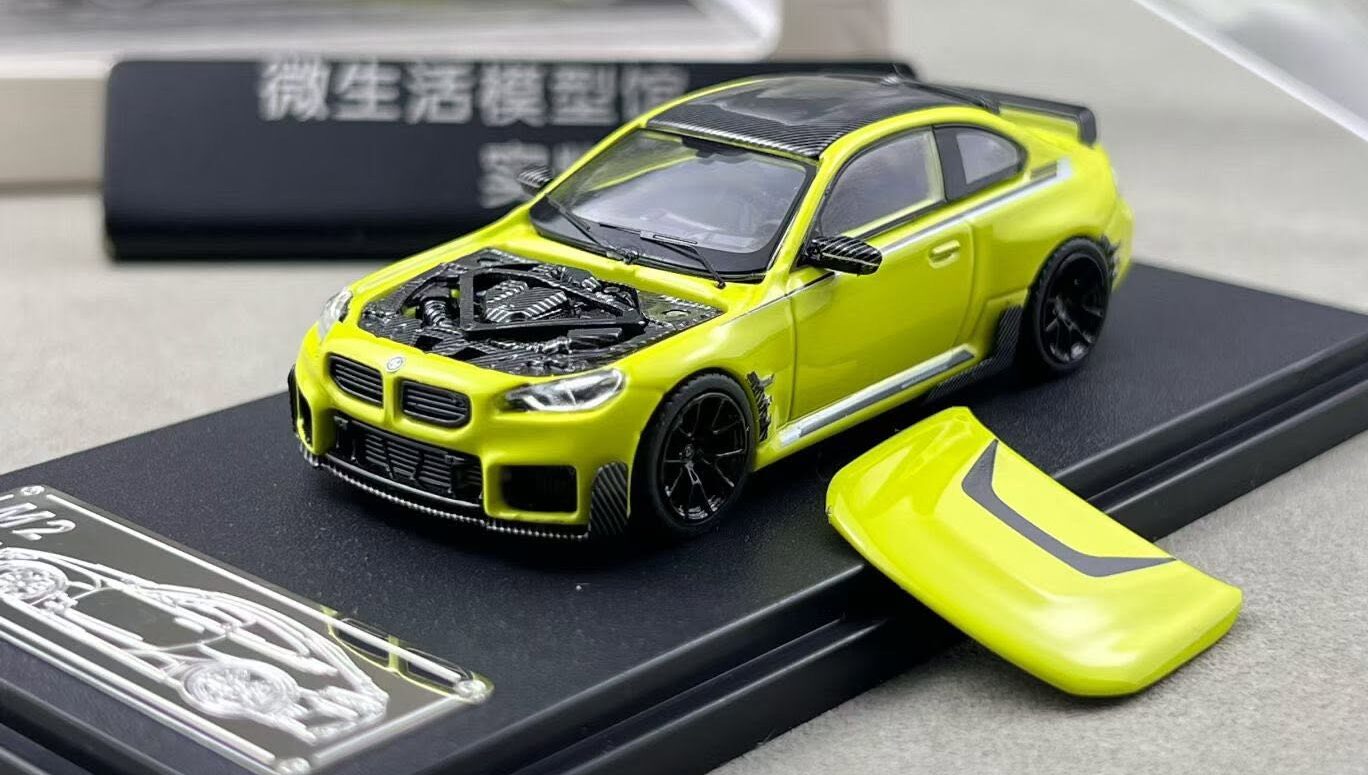
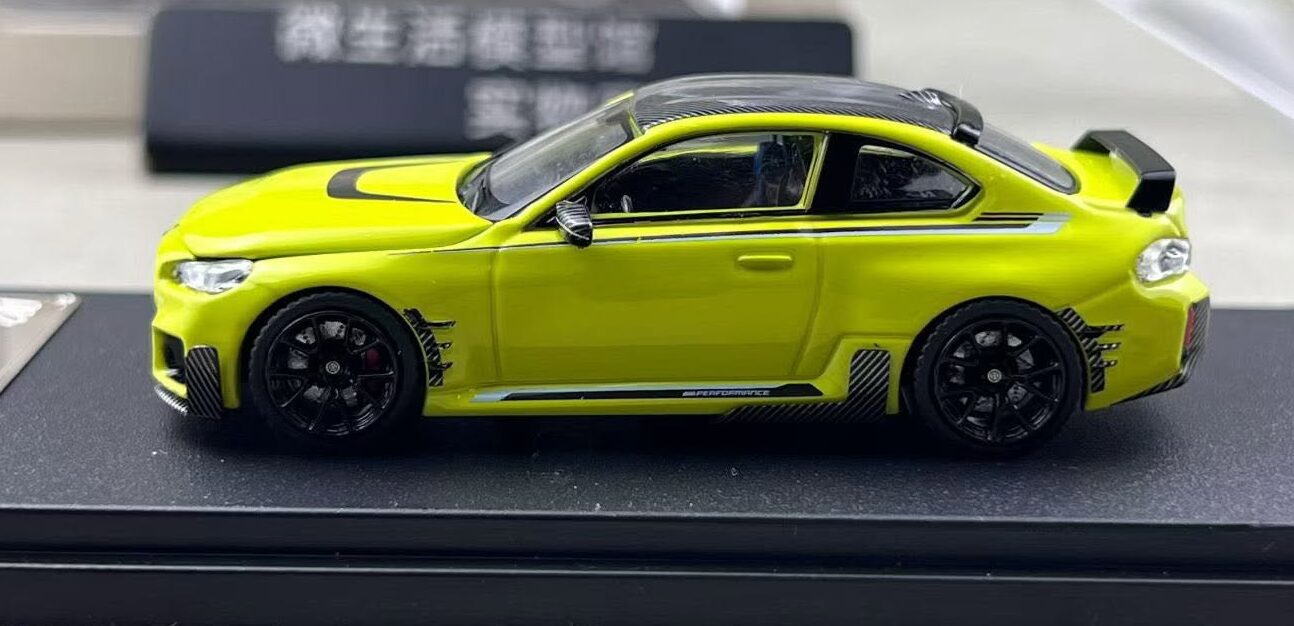 (新生メーカーのようですが、全体のしゃーうぷなボディー造形+パフォーマンス・パーツ部分に金属部品を多用するなど、玄人好みな素晴らしい出来具合にはただただ関心
ーーー>今後もこの調子で頑張ってほしいメーカーです。)
興奮冷めやらぬうちに、
三題噺、
行ってみましょう!
*三題噺:内燃機関の咆哮・レトロモッド・ホセカサス氏
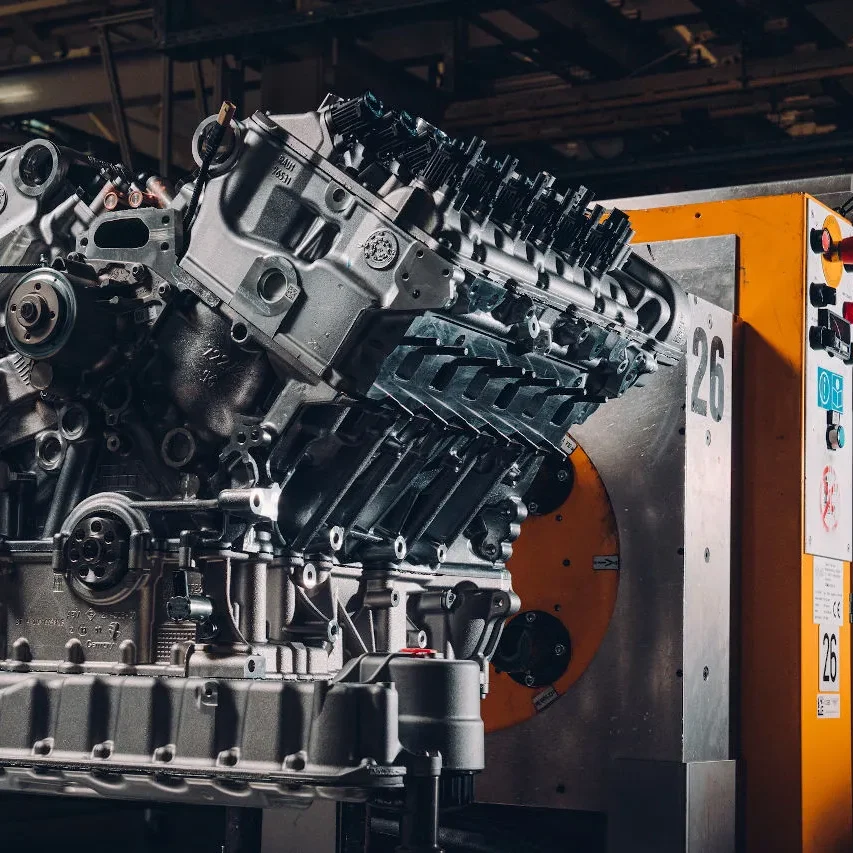
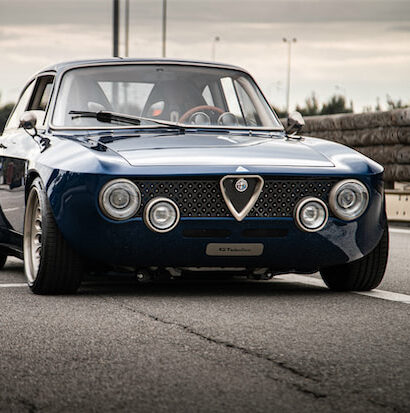

今回もかなり手ごわい
お題をいただいておりますが、、、
*内燃機関の咆哮
*レトロ・モッド
*ホセ・カサス氏
『ジェミニ君』とタッグを組んで、
頑張ります!
n
(出囃子が鳴り、演者が高座に上がる)
n
n
本日は、BMWの誇るモンスターマシン、【G-87型】M2の純正パフォーマンス・パーツ仕様を巡る、とあるデザインスタジオの、おかしな一幕をお聴きいただきましょう。
n
- ホセ:ドイツ在住のメキシコ人若手デザイナー。ノリは軽いが、BMW公式デザイナーのホセ・カサス(Jose Casas)氏を彷彿とさせる、アグレッシブな立体の天才。
- ハンス:引退を数ヶ月後に控えた、頑固一徹なドイツ人のベテラン・クレイモデラー。職人魂の塊。
n
n
(お後がよろしいようで、、、)
 n
nN
n
n
n
n
n
n
n
N
n
n
n
n
n
n
n
n
n
n
サゲの「煙たい(燃費の)悪い話」は、内燃機関(ガソリン車)が上げる「反逆の狼煙(排気ガス・煙)」と、現代のEV推進派から見た「時代遅れで煙たがられる(燃費が悪い)存在」という二重の意味をかけています。デジタルやEVの時代に取り残されようとしている「ガソリン車(M2)」と「頑固なクレイモデラー」という『残されしもの』たちが、文字通り「煙(狼煙)」を上げて反逆しているものの、環境に優しいEV側からは「ただの煙害(煙たい存在)」として一蹴されてしまうという、知的で少しアイロニカルな結末(考え落ち)にしております。
N
*その他の『レトロ/レスト・モッド』な新車たち、、、
次にあげますクルマ達は、
私が気になっている、
『レスト・モッド /
レトロ・モッド』な
クルマたちです。
*(英)ケイトン社製、オースチン・ヒーレー 100/4(BN1)
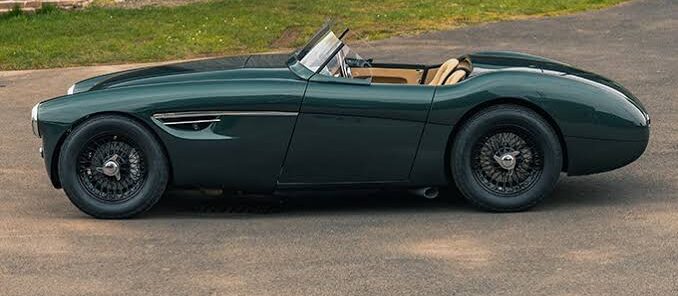
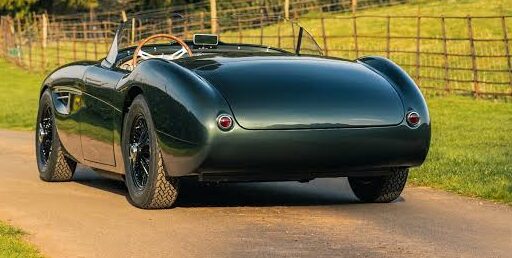
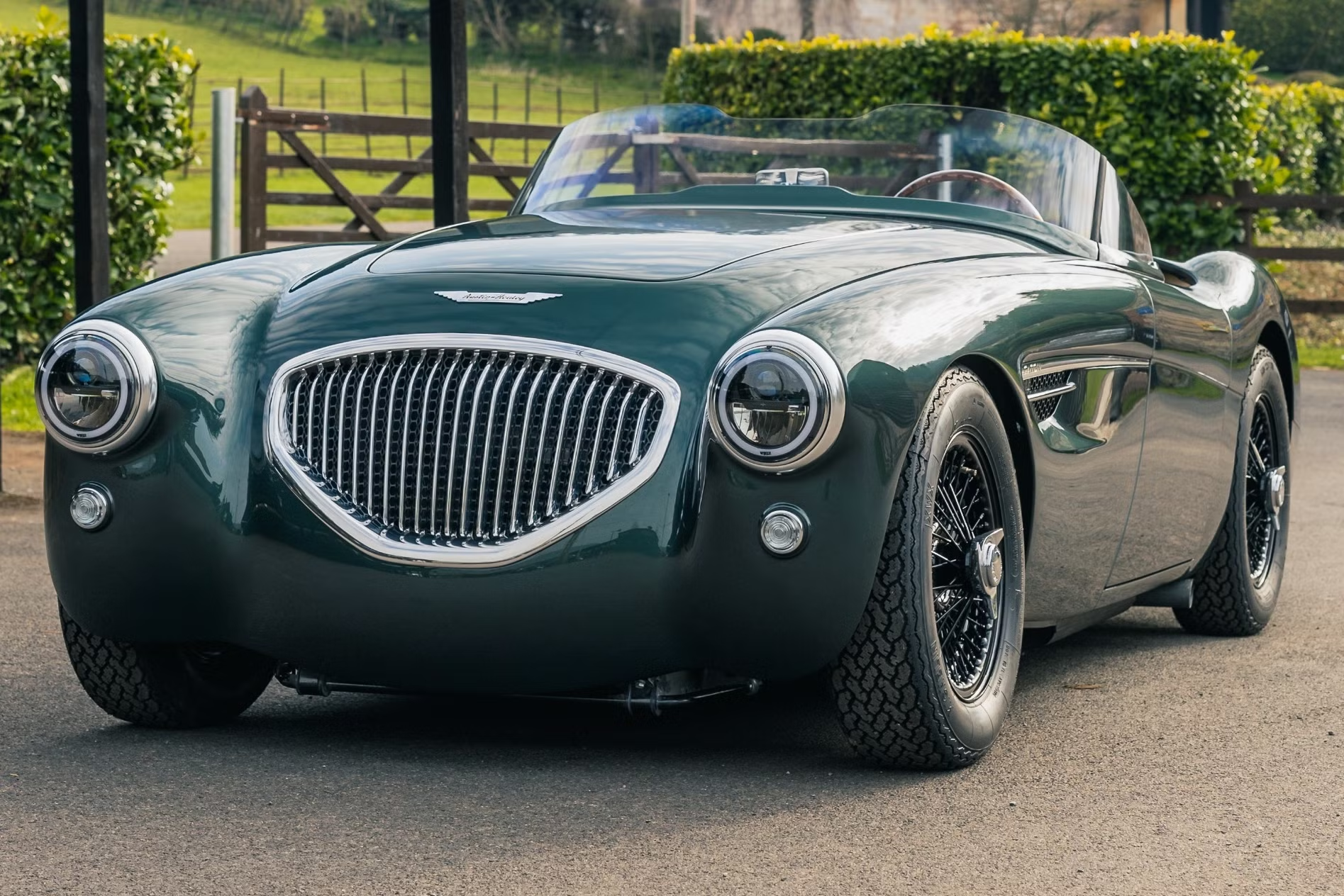 (個人的に一番好きな外観デザインを持つ傑作車を、きっちりレストアしたうえに、3リットルにアップグレードしたエンジンと、細部を新造したボディーを載せてあります。
ーーー>フロントグリルやフロントタイヤ後ろのサイド・エアベントがしっかり現代的になっています。)
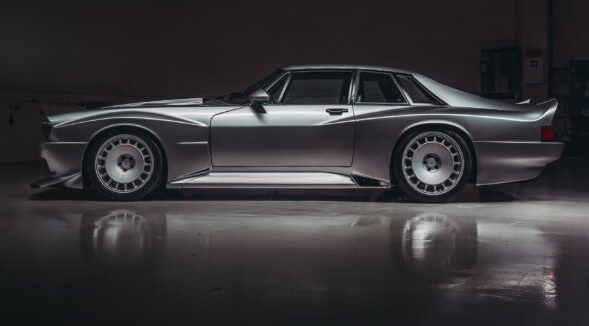
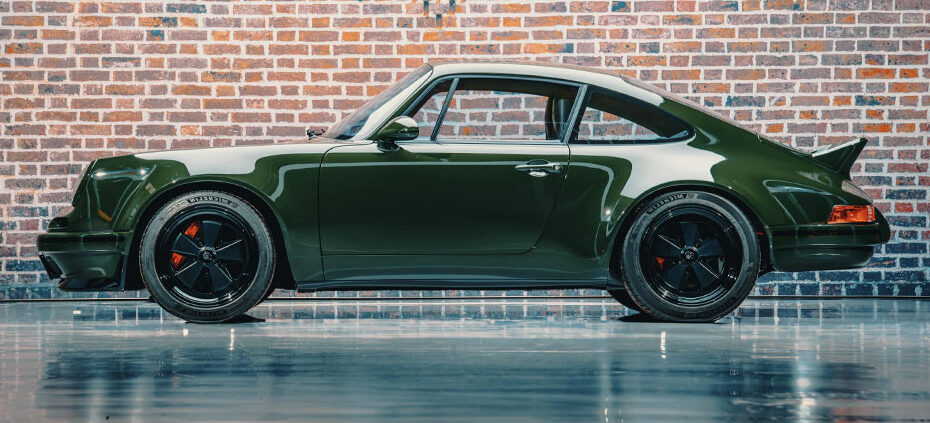
*(米)シンガー・ヴィークル・デザイン社製、ポルシェ 911 DLS ターボ(ゴールド)
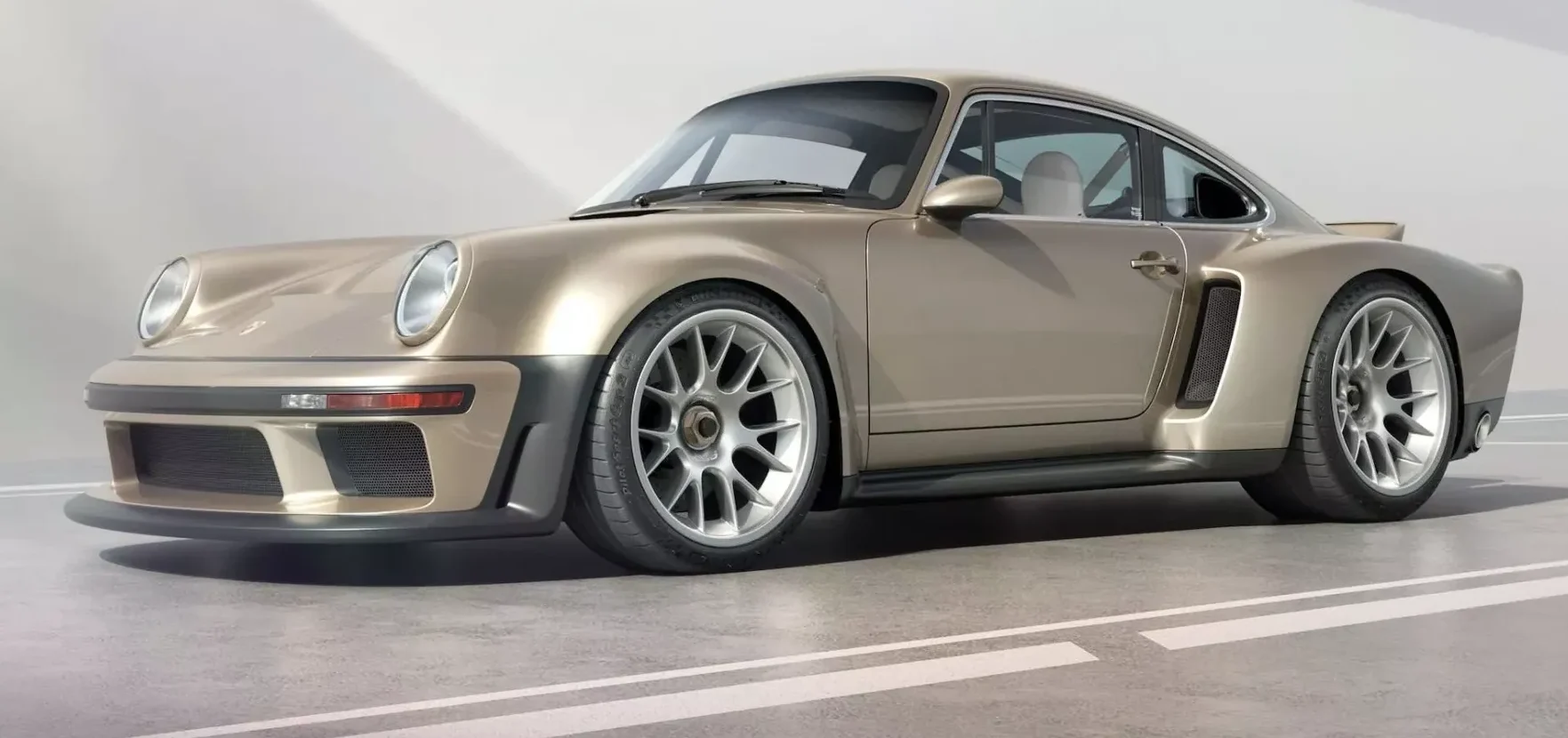
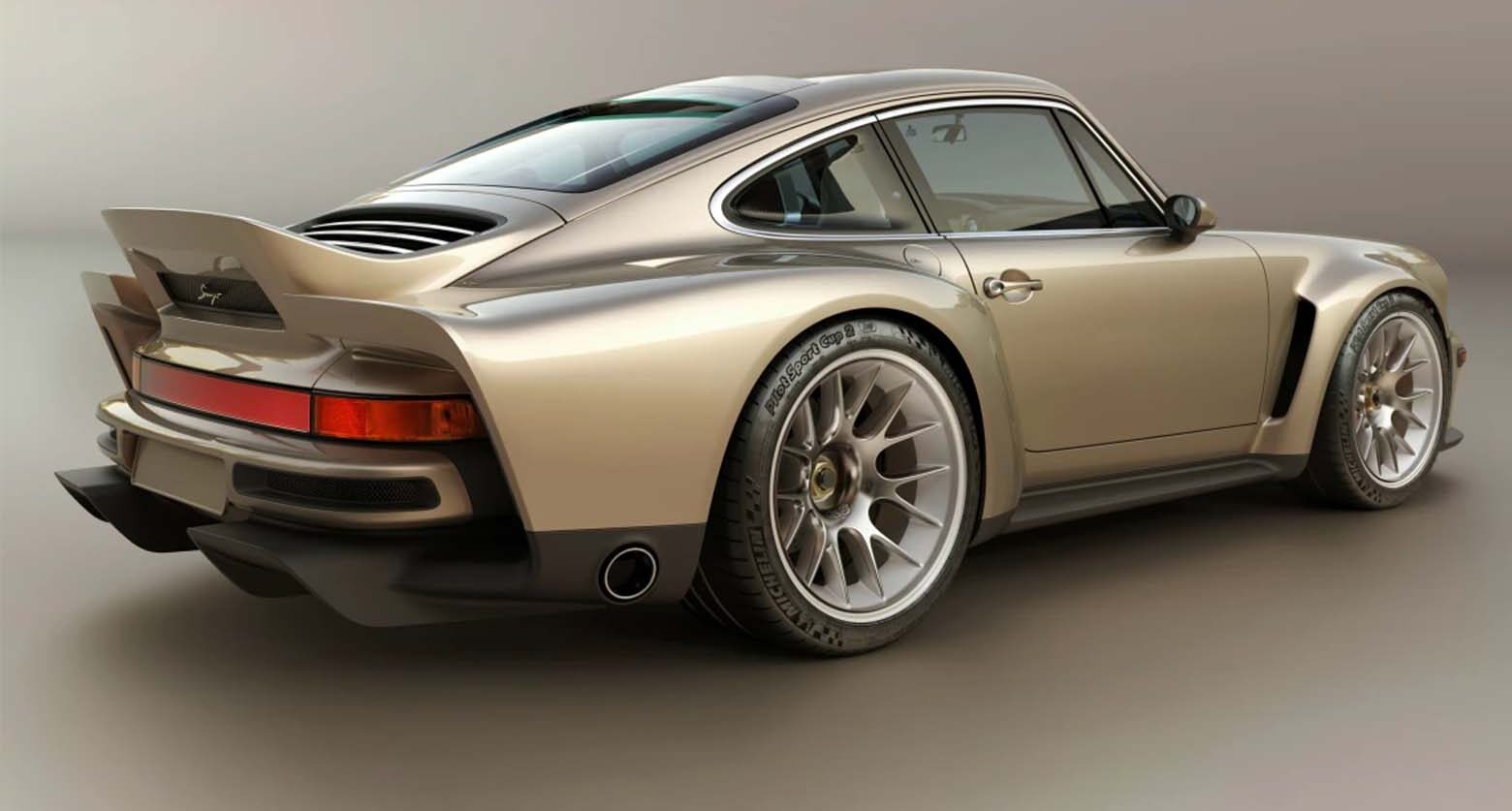 (子供の頃憧れた、ポルシェ935ターボのアップグレード版的な外観が素晴らしいです。
--→リアの大型ウイングなしの、ダックテール版が好みです!!)
*(米)シンガー・ヴィークル・デザイン社製、ポルシェ 911 DLS (ゴールド)
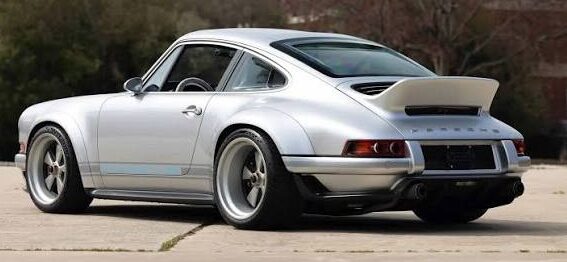 (’73カレラのダックテールを軽量化、ハイ・チューン化したモンスターです、ーーー>リアの程よいwideフェンダーとその下のカーボン処理が得も言えない味わいです!)
今後、EVの占有率が増えれば増えるほど、
過去のお宝発掘事業的な価値が上がり、
レスト・モッド市場と、
その匂いを新型車に生かした、
レトロ・モッド新車の世界は
永続してほしいです。嬉
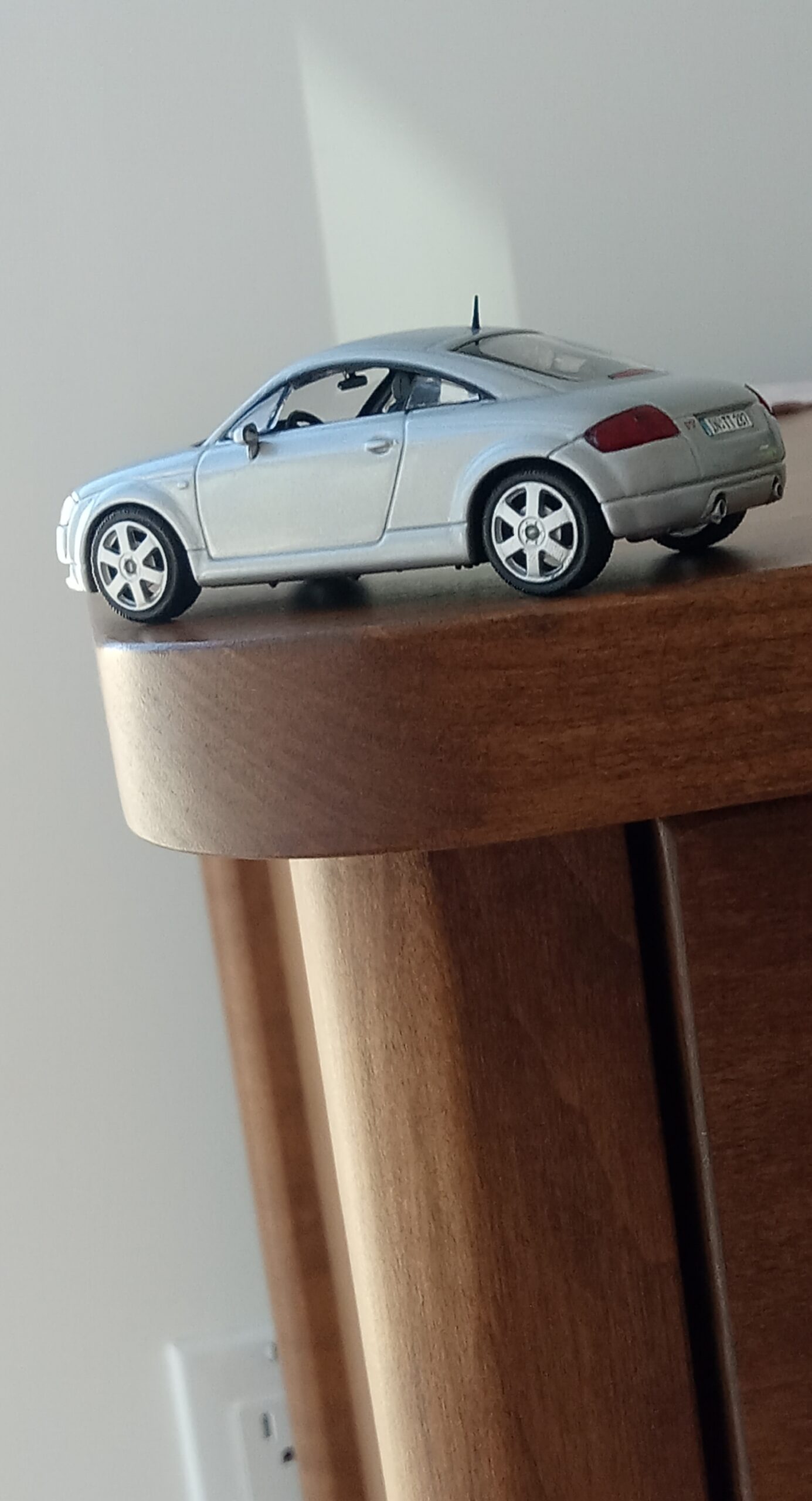 次回は、
次回は、
世紀の名車:『アウディーTT』にいて、
描いてみたいです。
お楽しみにーー
本ブログと記事内容につきまして:
ブログ記事を書くにあたり私の目標は、立体造形(料理も含めて)とのかかわりを通じて、私個人の特徴的(ネジ曲がり方も含めて)な評価軸を解明することで、「美しさ・美味しさ」に対する好奇心や、探求心を、どのように満足・充足させてきたのかを明記しておくことです。
従いまして、記事の中に出てくる、数字や年号、微細なデータなどには細心の注意を払っておりますが、時に大きな間違いや勘違いを犯していることも考えられます。特に自動車記事における主要諸元や、年号などには紛らわしいものも多く、あくまで参考程度に考えていただければ幸いです。
私としては、記事の中で個人的な外観デザインや味覚の評価、そこから広がる後半部分につなげるための、『流れ』を作るための客観的材料として年号やデータを挿入している感じです。あくまで重視したいのは、私個人の頭の中で起こる、記憶の錯そう的混沌から生まれる新たな『見方』や『情報の予想外のつながり』です。その勢いを作り出す、『流れ』の一環として、諸データが副次的に必要となるわけです。
話がそれますが、大好きな落語の世界に「三題噺」という、その場て会場から募った3つのお題を使って1つのお話に仕立てるといったお遊びがございますが、私はそれに近いことを立体造形の特徴や(料理のお味)をお題にして行っている感じがします。その中で頭の中に去来する数々の着想が、全く予想外で楽しく、次回からの記事内容を大幅に変えたり、新展開につながっています。
当ブロブの仕組み:
『好奇心の点と線 x 気まぐれ脳内回路=予想外の新展開』
こんな自分勝手なブログですが、今後ともよろしくお願いいたします。
追記:上記の『流れ』を作る為に必要な写真はできる限り、個人所有のミニカー・自前の料理などを使い撮影しておりますが、その他の必要最小限の図版や写真を他のブログ主様の記事や諸会社ホームページなどからお借りしております。(記事内容に合うよう加工させていただき、使用時は最小の解像度で載せております。)問題がある場合、ご連絡いただければ直ちに降ろさせていただきます。
追記2:当ブログ記事に掲載のミニカー写真等(個人撮影)は許可なしで、どのようにお使いいただいても結構です。私個人の創造性はこの世のもの、と言う認識の上で記事を製作しています。
!!!!!!!!!!!!!!!!!!!!!!!!!!!!!!!!!!!! Translated in English !!!!!!!!!!!!!!!!!!!!!!!!!!!!!!!!!!!!
(Miniature car used in the photoshoot: Manufactured by FX Model, 1/64 die-cast ready-to-display model, BMW M2 Performance Parts specification, (Neon Lime) ——> Split the body into upper and lower sections to maximize track width and slightly adjust the tire and wheel axle position to a slightly forward tilt)
Favorite Car Designs: Episode 50—The Lineage of 2-Door Coupes: Episode 30 [German Cars Part 2] BMW M2 with Genuine Performance Parts, 2025 (Neon Lime) “Retro-Mods Made Real?” BMW M2 Performance Parts, 2025 (Neon Lime) “Realized Retro-Mods”
For this 50th installment, titled “The Lineage of 2-Door Coupes, Part 30,” I’d like to discuss luxury 2-door (GT) coupes and roadsters, which strongly reflect the national characteristics and unique exterior design styles of various countries. [Note: Includes convertibles]
I’ll proceed as follows.
For this 30th installment, we’ll finally move on to
[German Cars Part 2] Episode 003,
featuring the
BMW M2 with factory performance parts, 2025 (Neon Lime),
unveiled in 2025.
[The Lineage of 2-Door Coupes: Table of Contents]
[American Cars]
Part 1: Cadillac El Mirage, 2013 (Metallic Red)
Part 2: Lincoln Continental MK4, 1972 (Black)
Part 3: Mercury Cougar, 1967 (LT Metallic Green)
[German Cars]
Part 4: MB 500K Special Roadster, 1936 (Black)
Part 5: MB 300SL Roadster, 1957 (Silver)
Part 6: MB SLS AMR Gullwing, 2010 (Black)
[British Cars]
Part 7: McLaren F1, 1992 (Metallic Orange)
Episode 8: Jaguar XKSS Roadster, 1957 (Royal Blue)
Episode 9: Jaguar XKR Coupe, 1996 (Dark Metallic Green)
[Japanese Cars / Nissan Edition]
Episode 10: Nissan First-Generation Silvia, 1965 (Champagne Gold)
Episode 11: Nissan 5th-Generation Silvia, 1988 (LT Metallic Green)
[Italian Cars]
Episode 12: Ferrari 250TR Pontoon Fender, 1958 (Red)
Episode 13: Ferrari 250GTO, 1962 (Italian Red)
Episode 14: Lamborghini Concept S, 2005 (Pearl White)
[Japanese Cars: Mazda Edition]
Episode 15: Mazda Cosmo Sport, 1968 (Racing White)
Episode 16: Mazda Eunos Cosmo, Type-S (Two-Tone: Black & Gray)
[French Cars]
Episode 17: Bugatti Type 59, 1935 (French Blue)
Episode 18: Citroën SM, 1970 (Champagne Gold)
Episode 19: Bugatti La Voiture Noire, 2019 (Black)
[Japanese Cars: Toyota Edition]
Episode 20: Toyota/Yamaha 2000GT, 1967 (Ivory White)
Episode 21: Toyota 2nd-Generation Soarer, 1986 (Crystal White II)
Episode 22: Lexus LC500 [GWZ100], 2017 (MT Red)
[American Cars, Part 2]
Episode 23: Dodge Challenger, 1970 & Plymouth Barracuda, 1971
Episode 24: Dodge Viper SRT-10 ACR, 2008 (Black)
Episode 25: Ford Shelby GR-1 Concept, 2004 (Chrome)
[Japanese Cars: Mitsubishi Edition]
Episode 26: Mitsubishi Galant λ, 1976 (Brown Metallic)
Episode 27: Mitsubishi Eclipse [North American Spec], 2006 (Orange Metallic)
[German Cars Part 2]
Episode 28: BMW M635CSi, 1984 (Dark Metallic Blue)
Episode 29: Mercedes-Benz 560SEC AMG 6.0 Widebody, 1989 (Black)
Episode 30: BMW M2 with Genuine Performance Parts, 2025 (Neon Lime)
Episode 31: First-Generation Audi TT, 1998 (Lake Silver Metallic)
[Japanese Cars: Subaru Edition]
Episode 32: Subaru Crosstrek XV, 2012 (Lime Green Metallic)
[British Cars Part 2]
Episode 33: Lotus First-Generation Elite, 1959 (British Green)
Episode 34: Lotus Elan S4 Sprint (2-Tone: Blue, White & Gold)
Episode 35: Jaguar E-Type Roadster (Light Blue Metallic)
[Japanese Cars: Honda (Lightweight Sports Cars)]
Episode 36: Honda S800, 1966 (Red)
Episode 37: Honda First-Generation CR-X 1.5i, 1983 (Blue & Silver Two-Tone)
Episode 38: Honda Beat, 1991 (Samba Yellow)
[Japanese Cars: Toyota Part 2]
Episode 39: Toyota Corona Hardtop 1800GT-TR, 1982 (Red)
Episode 40: Toyota GR Supra [DB Series, A90/A91] (Silver)
Episode 41: Toyota GR GT, 2027 [Planned] (Gunmetal)
[American Cars Part 3: Special Edition]: The Corvette Lineage
Episode 1: 1967 Stingray [C2] Convertible (Hardtop, Metallic Blue)
Episode 2: 1972 Corvette [C3] Convertible (Metallic Blue)
Episode 3: 1984 Corvette Coupe [C4] (Bright Red)
Part 4: Corvette Indy [Mid-Ship Prototype] (Silver)
Part 5: Stingray Concept [Prototype], 2009 (Metallic Blue)
#German Cars: The Revival of Tuner Cars⁈
It was about three months ago,
when I first spotted a stock new 3 Series Coupe
near the intersection of Broadway and 7th Street in downtown LA,
and muttered,
“Some kind of chunky, boxy BMW Danner,”
but other than that,
I didn’t pay it much mind.
Later, in mid-July,
while searching for die-cast cars on AliExpress, I stumbled upon a 1/64-scale model by FX—
a lime-green M2
equipped with factory performance parts—
and my eyes were immediately glued to it!
* The extremely exaggerated long-nose, short-deck profile
* The imposing front end where the stock chin spoiler looks like it might scrape the ground
* The distinctive rear end with two perfectly square air vents on either side that really stand out
* The unusual shape of the hood, which bulges upward before flattening out
And so on—I was blown away by the racer-replica appeal packed with highlights,
as well as the design language that completely breaks from traditional M models like the M3,
and I was captivated by BMW’s design ambition.
A retro-mod custom
you can buy brand-new:
BMW M2 with Genuine Performance Parts
So, I’d like to take a bold approach
like this!
* Real-Car Analysis: Clever Marketing?
* Exterior Design Features: Thrilling, Over-the-Top Proportions
* “Me” and the M2 Performance Parts Spec
* Three-Theme Story: Retro-Mod (Anachronism, a Hail-Mary Move)
* Other Retro-Mod New Cars…
* Real-Car Analysis: Clever Marketing?
In homage to the design of the
all-new 2 Series [Coupe], which has undergone a dramatic transformation,
this time I’m changing things up a bit
with a comprehensive analysis focused solely on the exterior design,
focusing specifically on the changes
from the previous model [F22]
to this model [G42]!
n
n
n
n
The transition from the previous-generation F22 to the current G42
n
n
was “the most dramatic and bold (drastic) transformation in the history of BMW’s compact coupes.”
n
n
While the F22 was a “model student that compactly condensed the fine traditions of the 3 Series,” the G42 has been reborn as an “avant-garde athlete bursting with its own unique character.”
We’ll delve deeply into this shift in design language from a designer’s perspective, focusing on four key aspects.
n
n
n
N
N
N
N
N
N
N
N
N
N
N
n
n
n
n
n
n
n
n
n
n
n
n
1. From Line-Based Design (F22) to Surface-Based Design (G42)
The most significant paradigm shift lies in the very “sculpting technique” used to shape the body.
n
* Previous-generation F22 model (the era of character lines):
The F22 model was shaped by sharp, distinct “straight lines (character lines)” running along the sides of the body. The press line, extending in a straight line from the front to the rear taillights, expressed a traditional sense of speed. This was the orthodox and beautiful automotive design approach of the 2010s.
n
*Current G42 model (the era of sculptural surfaces):
In the G42 model, many of those iconic straight lines have been eliminated. Instead, the body is constructed as a “three-dimensional polyhedron composed of triangles and polygons.” The design has shifted to a modern approach that expresses a muscular, three-dimensional quality not through lines, but solely through the gradations of highlights (light) and shadows (dark) created when light hits the surface.
n
2. From the “Round Four-Headlight” Tradition to the “Single-Eye (One-Headlight)” Icon
The change in the front fascia’s “eyes” was a bold challenge that deliberately broke with BMW tradition to reconstruct it anew.
n
* Previous-generation F22 model (Faithful Reproduction of Tradition):
It faithfully preserved the “two headlights per side (four in total)” configuration, which is central to BMW’s identity. The sharp, slightly upturned headlight shape exuded a sense of reassurance and sportiness that made it instantly recognizable to anyone as “part of the premium BMW family.”
*Current G42 model (a reinterpretation of heritage):
The G42 model deliberately adopted a design that appears to feature “one headlight per side.” While this may seem at first glance like a break from tradition, it is actually an homage to the legendary 1960s “BMW 2002.” Rather than simply reverting to a classic style, the designers created an entirely new icon—a “retro yet futuristic single-eye” headlight—by giving the internal LED light sources a complex, three-dimensional form.
n
n
3. A New Star of the Show: The Kidney Grill as a 3D Sculpture
The design language of the kidney grill—which has been the subject of much discussion in recent BMW models—also differs by 180 degrees between the two cars.
n
* Previous-generation F22 model (familiar functional component):
It featured a understated and elegant grille positioned horizontally in balanced alignment with the headlights. Inside, traditional vertical black bars (vertical slats) were arranged, giving it a strong symbolic presence as “intakes” for directing air to the radiator.
n
*Current G42 model (sculpture fused with digital design):
While it avoided the oversized (tall) design seen in the 4 Series and maintained a wide profile, the internal structure underwent a drastic change. The vertical bars were eliminated and replaced with geometric flaps (shutters). The entire grille possesses a strong three-dimensional (3D) presence, as if it protrudes slightly forward from the body surface, exuding a presence not merely as a part but as a “sculpture that takes center stage on the front fascia.”
n
n
4. The Drama of Proportions: From a Small Car to a Wide & Low “Monster”
The changes to the car’s skeletal structure (proportions) have even altered its perceived class.
n
* Previous-generation F22 (Agile Compactness):
It was relatively close to the “5-number” classification, retaining the tight, compact “small coupe” that was relatively close to the 5-number classification, retaining its cuteness and nimbleness. The cabin was also boxy and practical, with proportions true to a compact car.
n
*Current G42 Model (The Impressive Presence of the Premium Segment):
The overall length has increased significantly, the width has broadened, and the height has been lowered. In particular, when viewed from the side, the “flared front and rear fenders” are truly striking. If the previous generation was a “sleek athlete,” the current model is a “bodybuilder who has pumped up his muscles to the absolute limit.” As a result, rather than feeling like a compact car, it now exudes a more upscale aura—almost like the younger sibling of the higher-class “8 Series Coupe.”
n
n
n
n
N
N
N
N
N
N
N
N
Summary: The Differences in What the Two Models Aimed For
* F22: “Intelligence and Harmony”: A masterpiece that flawlessly incorporated the universal golden ratio of a coupe—which everyone finds beautiful—into a compact body.
* G42: “Emotion and Assertiveness”: An ambitious creation that expresses the “madness” and “passion” of a rear-wheel-drive coupe that dares to burn gasoline in the age of electrification, through a fusion of radical design elements and heritage.
From a designer’s perspective, the shift to the G42 model was not merely a facelift; it was a drastic change in direction driven by a strong determination to “endow the 2 Series with BMW’s most edgy personality.”
n
n
Next, we’ll explain
“BMW M Performance Parts,”
which play a crucial role for the [G52 M2].
“BMW M Performance Parts,” designed for BMW’s high-performance sports car, the “M2” (particularly the G87 model), are genuine BMW custom parts that combine advanced technology (mechanical systems) honed on the racetrack with a striking visual presence (design).
n
These are not merely cosmetic upgrades; they are packed with mechanisms designed to enhance driving performance, such as improved aerodynamics and weight reduction. We’ll explain their main mechanical and design features in an easy-to-understand manner.
n
n
1. Aerodynamic Mechanisms and Design
n
Many of the parts are made of lightweight yet sturdy “CFRP (carbon fiber-reinforced plastic).” They are handcrafted by artisans and finished with a transparent clear coat that reveals the beautiful weave of the carbon fiber.
* Front Splitter / Air Intake Trim
* [Design] These are three-dimensional parts mounted on the bottom of the front bumper and the air intakes. They make the front end appear lower and wider.
* [Function] Reduces the amount of air flowing under the vehicle, suppressing lift (generating downforce). This enhances the front tires’ grip (their ability to hold onto the road) on highways and racetracks.
* Side Spats / Carbon Fender Covers
* [Function] These are small, fin-like parts mounted at the rear of the wheel wells (the space where the tires are housed).
* [Function] They smoothly channel the intense air turbulence generated around the rotating tires toward the rear. This reduces air resistance and improves stability when driving in a straight line.
* Large Rear Wing / Rear Diffuser
* [Design] A large, fixed wing towering above the trunk and a mesh-like diffuser mounted at the bottom of the bumper. These components exude the sheer power of a race car.
* [Function] They generate downforce that firmly presses the rear wheels against the ground. In particular, the latest “swan-neck” style wing stabilizes the vehicle more efficiently by maintaining a clean airflow beneath the wing.
2. Exhaust System Mechanism and Design
n
* Center-mounted quad-exit titanium muffler
* [Design] While the standard M2 has two exhaust pipes on each side, this part features four exhaust pipes stacked diagonally in the center of the rear. It comes as a set with a dedicated carbon fiber diffuser designed to match, making it immediately clear that this is a special model.
* [Mechanics] Because it uses lightweight titanium and high-grade stainless steel, it is approximately 8 kg lighter than a standard system. Furthermore, it features an electrically operated exhaust flap; by changing the drive mode, you can produce a powerful, race-car-like sound on the track.
n
n
3. Suspension and Wheel Mechanics and Design
n
* Height-Adjustable Suspension (Coil Spring Type)
* [Design] The ride height (distance from the ground to the body) is lowered, and the gap between the tires and the body is reduced, creating a sporty, low-slung stance that seems to hug the road.
* [Mechanism] By turning a screw, you can adjust the ride height in millimeter increments (lowering it by approximately 10–25 mm). The stiffness of the internal springs and dampers has been specifically tuned for the M2, reducing body roll when cornering and delivering a direct, responsive handling feel.
* Large-Diameter, Lightweight Forged Wheels
* [Design] These are oversized wheels with different sizes front and rear: 20 inches in the front and 21 inches in the rear. They feature a finely detailed cross-spoke (mesh) design and are available in special colors such as gold bronze and matte black.
* [Construction] These wheels are manufactured using a process called “forging,” in which a solid block of aluminum is pressed under high pressure, making them extremely lightweight yet sturdy. You can also choose authentic “center-lock” wheels—similar to those used on race cars—which are secured with a single bolt in the center.
n
4. Interior Design
n
Precisely because these are areas you touch constantly while driving, they’ve been designed to give you that racer’s thrill.
n
* M Performance Steering Wheel
* The grip is wrapped in “Alcantara,” a premium, non-slip material, and features a red center mark (at the 12 o’clock position).
* Extensive Use of Carbon Fiber Parts
* Carbon fiber accents are used around the shift knob, on the inside of the doors, and even on the back of the seats (backrests), giving the entire interior a sleek and refined look.
n
n
Summary: The Greatest Strength of Genuine Parts
n
Unlike aftermarket custom parts (parts from custom shops), these are designed and developed by BMW in conjunction with the vehicle itself. As a result, their greatest appeal lies in the peace of mind and overwhelming level of perfection unique to genuine parts—such as “fully meeting legal safety standards (including vehicle inspections)” and “a 100% precise balance of aerodynamic drag and cooling performance.”
n
n
n
#Three-view photos:
#Key Specifications [G-87 Model]:
Model: S58B30A
Total Displacement: 2,992 cc, Inline-6 DOHC M TwinPower Turbo
Fuel Supply: DME Electronic Fuel Injection System (Direct-Injection Turbo System)
Maximum Power: 338 kW (460 PS) / 6,250 rpm (353 kW / 480 PS on some later models)
Maximum Torque: 550 Nm / 2,650–5,870 rpm (up to 600 Nm on AT models, etc.)
Drivetrain: FR (front-engine, rear-wheel drive)
Seating Capacity: 4 passengers
Body Style: 2-door coupe
Wheelbase: 2,740 mm
Overall Length: 4,580 mm
Overall Width: 1,885 mm
Overall Height: 1,410 mm
Curb Weight:
1,730 kg (8-speed automatic transmission) / 1,710 kg (6-speed manual transmission)
*Exterior Design Features: Exhilarating, bold proportions
As BMW Design has been desperately
shaping the form of next-generation EVs
using a “Neue Klasse”-inspired design language,
and production models have begun hitting the market,
glancing aside at that pressure,
in high spirits,
as if celebrating the rise and fall of internal combustion engines that run on gasoline—
an anachronistic, belated postmodern madness, brimming with childish tantrums—
design trend—
is the “BMW 2 Series”!
Among them, I’d like to highlight the five design features
of the most powerful variant,
the “M2 Performance Parts Edition,” as follows:
1: The front section [the area from the firewall forward], extended by more than 15 cm compared to the previous generation [F-22 model], creates a wildly “long-nose, short-deck” FR proportion—> It’s a composition that’s the exact opposite of the cab-forward design of the Neue Klasse, as if mocking it.
2: The angular fender design, mounted in an “overfender” style that looks blatantly tacked on—> The significant increase in width compared to the previous model lends it an intimidating presence.
3: The courage and momentum to masterfully incorporate the essence of tuning culture into the design of a factory-built car—> A counterattack by retro-mod culture on production vehicles
4: A bold yet endearing front fascia design with a boxy silhouette that emphasizes the car’s width, combined with the “bad-boy” vibe of the hood’s flat rear surface—> A truly insane design
5: The graphic ingenuity of the specially crafted performance parts, studded with carbon fiber and lightweight materials—> This single car completes a new package for high-performance and racer-replica exterior upgrades.
Now then,
let’s take a look at each one with photos!
1: The front section [from the firewall forward], extended by over 15 cm compared to the previous-generation [F-22 model], creates the insanely dramatic “long-nose, short-deck” FR proportions.
(These are the most outrageous proportions in the entire BMW lineup—enough to overshadow even the relatively refined 4 Series. Standing in front of the actual car, its sheer presence is so overwhelming you’ll have to rub your eyes to believe it…)
――> It’s a configuration that’s the exact opposite of the “cab-forward” design of the Neue Klasse, almost as if it’s mocking it.
2: The angular, postmodern fender design, mounted like overfenders, looks like it was tacked on… (lol)
―――> The significant increase in width compared to the previous model gives it a menacing presence.
3: A round of applause for the courage to masterfully incorporate elements of the tuning subculture into the design of a stock production car!
―――> The retro-mod culture’s counterattack on production cars
4: A bold yet endearing front fascia design with a boxy silhouette that emphasizes the car’s width, combined with a hood that’s completely flat toward the rear—giving it a “bad boy” vibe
――> Truly a mad design
5: The graphic ingenuity of the specially crafted performance parts, studded with carbon fiber and lightweight materials
――> This single model completes a new package for high-performance and racer-replica exterior upgrades.
*“Me” and the M2 with Genuine Performance Parts
Once again,
upon discovering a superbly crafted die-cast model,
I fell in love at first sight,
and this extraordinary [G
*“Me” and the M2 with Genuine Performance Parts
Once again,
after discovering a superbly crafted die-cast model,
I fell in love at first sight,
and found myself encountering this extraordinary [G-87] M2—
a “bold challenge to
BMW’s exterior design”—
which led me to write this article…
From this car’s design,
*Amid the automotive industry’s major shift toward electrification,
*Far from being left behind,
*It’s creating a massive avalanche as part of the retro-mod trend—
I can keenly feel how the roar of these rear-engine, rear-wheel-drive (FR) and rear-engine, rear-wheel-drive (RR) vehicles equipped with internal combustion engines
stirs the deep passion of BMW, the creator of “the last bastion of the internal combustion engine.”
#Here’s the die-cast model!
* Manufactured by FX Model, 1/64 scale die-cast ready-to-display model, [G-87] BMW M2 with Genuine Performance Parts (Neon Lime)
(It seems to be a new manufacturer, but the sleek overall body design and the extensive use of metal parts in the performance components result in a superb finish that will appeal to connoisseurs—I’m simply impressed.
——> I hope this manufacturer keeps up the good work.)
While the excitement is still fresh,
let’s dive into
the “Three-Theme Story”!
*Three-Theme Story: The Roar of the Internal Combustion Engine, Retro Mod, Mr. José Casas
Once again, I’ve been given some
pretty tough topics to tackle…
* The Roar of the Internal Combustion Engine
* Retro Mod
* Mr. José Casas
I’ll team up with “Gemini-kun”
and give it my all!
Please create a rakugo story in the form of a comedic three-topic exchange—featuring a Mexican designer living in Germany and a stubborn, middle-aged German clay modeler with the spirit of a craftsman on the verge of retirement—explaining the exterior design of the [G-87] BMW M2 equipped with genuine performance parts. The overarching theme is “The Signal of Rebellion from Those Left Behind,” and the closing should intelligently tie the theme back together with a thought-provoking conclusion. The three prompts are: The Roar of the Internal Combustion Engine / Retro-Mod / Mr. José Casas. Keep it tight and compact—within 2,000 characters.
n
n
(The opening music plays, and the performer takes the stage.)
n
n
“Well now, there’s a saying in this world: ‘Learn from the past to understand the present.’ Yet the automotive world is on the verge of being completely enveloped in the silence of electricity. However, even in such an era, there are those who dare to create cars that breathe fire and bare their fangs—cars that defy the times.
n
Today, let’s hear about a bizarre scene at a certain design studio revolving around the factory performance parts specification for BMW’s pride and joy, the [G-87] M2.
n
The overarching theme is… ‘The Signal Fire of Rebellion by Those Left Behind.’
n
◇
[Characters]
Jose: A young Mexican designer living in Germany. He has a lighthearted demeanor but is an aggressive genius of three-dimensional design, reminiscent of official BMW designer Jose Casas.
Hans: A stubborn, uncompromising veteran German clay modeler, just a few months away from retirement. He is the very embodiment of the artisan’s spirit.
◇
(The scene takes place at the BMW Design Studio in Munich. Two men stand in front of a life-size clay model.)
n
n
Jose: “Amigo! Hans, please don’t glare at me like that. This ‘Performance Parts Spec’ version of the G-87 M2 I designed—it’s totally crazy, right? Look at this fighter-jet-like carbon-fiber front attachment and the side skirts! Isn’t this design exactly the kind that makes you see the roar of the internal combustion engine taking shape right before your eyes?”
n
Hans: “(Snorts derisively) …Hey, Jose. You young designers are always throwing around catchy terms like ‘roar’ and ‘emotion.’ But you can’t fool my eyes or these hands. Those extremely square-shaped front intakes, and the straight edges of those blister fenders… This is practically an homage to the ’80s E30 M3 or the 2002 Turbo—in other words, just a rehash of retro-mod. Where’s the elegance of those ‘flowing lines’ that we German craftsmen built up?”
n
Jose: “No, no, no, Hans! You just don’t get it. This isn’t just nostalgia (retro). These days, everyone’s all about ‘EVs, autonomous driving, clean, and quiet.’ It’s as if cars have turned into moving household appliances. That’s exactly why we have to let this inline-six twin-turbo—this ‘surviving remnant of the pure gasoline engine’—bare its fangs. These extreme performance parts are a ‘signal of rebellion’ against this era!”
n
Hans: “A ‘signal of rebellion,’ you say…?”
n
Jose: “That’s right! Just look at this center-mounted quad-exit angled exhaust system against the solid, block-like base design crafted by Jose Casas. Surrounded by a triangular diffuser, it’s like a rocket spewing fire from its rear end. This is the ultimate analog rebellion against the digital age!”
n
Hans: “(Fiddling with his clay spatula, his gaze drifting off into the distance) …Hmph. Analog rebellion, huh. You digital kids fiddle with CAD on screens, but for the past 40 years, I’ve been sculpting the ‘form of a car’s soul’ by hand with clay. I’m retiring in a few months. 3D printers and AI will take center stage in the studio. …So it seems we clay modelers are just ‘left behind’ by the times, aren’t we?”
n
Jose: “Hans…”
n
Hans: “But you know what, Jose? Looking at those passionate, quirky sketches of yours really got my artisan’s blood pumping. …All right, this carbon edge on the rear wing—a simple straight line just isn’t interesting enough. With my own hands, I’ll add a ‘ripple’ of a few tenths of a millimeter. It’ll be an edge that makes the wind cry the moment the airflow separates. With this, that ‘roar of the internal combustion engine’ you keep talking about should harmonize beautifully with the whoosh of the wind!”
n
Jose: “Gracias, Hans! That’s it! With your touch, this design will become true art!”
n
Hans: “Whoa, don’t get the wrong idea. I’m not sculpting this for the future of BMW. As the last act of defiance from a clay modeler, I’m simply carving my soul into the final swan song of gasoline-powered cars—cars that are already being called obsolete. …This is my ‘signal of rebellion’!”
n
Jose: “That’s awesome! It’s a fusion of Mexican passion and German stubborn craftsmanship. All right, Hans, let’s get to work—start carving that clay on the wing right away!”
n
Hans: “Yeah, watch this. … (Sound of clay being carved: *swoosh, swoosh*) … How’s this edge?”
n
Jose: “Wow… it’s perfect. So perfect, in fact, that this car looks like it’s already furious, belching thick smoke even before it’s hit the road.”
n
Hans: “Hahaha! That’s exactly the point. After all, this design itself is a ‘signal fire.’ …But Jose, even though we’re sending this signal of rebellion by spewing all this smoke, do you think this message will actually get through to those guys of the future (EVs)?”
n
Jose: “Hmm, I’m not sure. They run on electricity (eco-friendly power), after all. Even if they see our passionate message, don’t you think they’d say something like this?”
n
Hans: “What would they say?”
n
Jose: “‘Oh look, over there they’re talking about that smoky (poor fuel economy) stuff again.’”
n
n
n
(And that’s all for now…)
n
n
N
n
n
n
n
n
n
n
n
N
n
n
n
n
n
n
n
n
n
n
n
n
[Explanation (Regarding the Unresolved Ending)]
The closing line, “a smelly (poor fuel-efficiency) story,” plays on a double meaning: the “smoke signals of rebellion” (exhaust fumes and smoke) emitted by internal combustion engines (gasoline cars), and their status as “outdated and resented (for poor fuel efficiency)” from the perspective of modern EV advocates. The “gasoline cars (M2)” and “stubborn clay modelers”—who are being left behind in the age of digital technology and EVs— —the “left-behind ones”—are literally raising “smoke (signal fires)” in rebellion, yet they are dismissed by the environmentally friendly EV camp as “nothing more than a nuisance (a smoky presence).” This creates an intellectual and slightly ironic conclusion (a twist).
Based on this rakugo script, I could also create a detailed explanation—in the form of regular narrative text—that incorporates more specific features of the exterior parts (such as details of the front, sides, and rear). What do you think?
N
* Other “Retro/Rest-Mod” new cars…
The cars listed below are
ones that have caught my attention:
“Rest-Mod /
Retro-Mod’
styles.
* (UK) Kayton-built Austin-Healey 100/4 (BN1)
(This is a meticulously restored masterpiece—my personal favorite in terms of exterior design—featuring a 3-liter upgraded engine and a body with newly fabricated details.
――> The front grille and the side air vents behind the front tires have been thoroughly modernized.)
* (U.S.) Singer Vehicle Design, Porsche 911 DLS Turbo (Gold)
(The exterior, which looks like an upgraded version of the Porsche 935 Turbo I admired as a child, is fantastic.
--→ I prefer the ducktail version without the large rear wing!!)
* (U.S.) Singer Vehicle Design Porsche 911 DLS (Gold)
(It’s a monster created by lightening and heavily tuning the ducktail of a ’73 Carrera—> The moderately wide rear fenders and the carbon fiber finish underneath give it an indescribable charm!)
As the market share of EVs continues to grow,
the value of “unearthing treasures from the past” will rise,
and I hope the rest-mod market,
along with the world of retro-mod new cars—
which incorporate that retro vibe into new models—
will endure forever. Yay!
Next time,
I’d like to write about
the iconic car of the century: the “Audi TT.”
Stay tuned—
Regarding this blog and its content:
My goal in writing these blog posts is to clarify my personal, distinctive criteria for evaluation—including my somewhat unconventional perspectives—through my engagement with three-dimensional forms (including cooking), and to document how I have satisfied and fulfilled my curiosity and desire to explore “beauty and deliciousness.”
Therefore, while I pay the utmost attention to the numbers, years, and detailed data that appear in my articles, it is possible that I may occasionally make significant errors or misunderstandings. In particular, key specifications and model years in automotive articles can often be confusing, so I would appreciate it if you treated them as general references only.
For my part, I feel as though I’m inserting dates and data into the articles as objective material to create a “flow” that connects my personal assessments of exterior design and taste to the broader themes explored in the latter half of the piece. What I ultimately prioritize are the new “perspectives” and “unexpected connections between pieces of information” that emerge from the chaotic jumble of memories in my own mind. The various data points are needed secondarily as part of that “flow” to generate that momentum.
As a slight digression, in the world of rakugo—which I love—there’s a playful format called “san-dai-banashi,” where a performer weaves a single story using three topics solicited on the spot from the audience. I feel like I’m doing something similar here, using the characteristics of three-dimensional sculptures and (the taste of food) as my prompts. The countless ideas that flit through my mind during this process are completely unexpected and delightful; they often drastically change the content of future articles or lead to new developments.
How This Blog Works:
“Spots and Lines of Curiosity x Whimsical Mental Circuits = Unexpected New Developments”
This blog may be a bit self-indulgent, but I hope you’ll continue to follow along.
P.S.: To create the “flow” described above, I take as many photos as possible using my own die-cast cars and home-cooked meals. However, I do borrow the bare minimum of other illustrations and photos from other bloggers’ posts and company websites. (I edit them to fit the article’s content and post them at the lowest possible resolution.) If there are any issues, please contact me, and I will remove them immediately.
Addendum 2: You are free to use the photos of die-cast cars and other images (taken by me) featured in this blog’s posts in any way you like without permission. I create these posts with the understanding that my personal creativity belongs to me alone.
Translated by DeepL.com

これはCTAサンプルです。
内容を編集するか削除してください。